Best WooCommerce Development Agency in the USA: What to Look For
Key Highlights
- Many WooCommerce stores struggle with performance issues, plugin conflicts, and scalability limitations because they are built using short-term, template-driven development approaches.
- Choosing a technically qualified WooCommerce development agency helps businesses reduce technical debt, strengthen security, and build scalable eCommerce infrastructure designed for long-term growth.
- Sigma Infosolutions’ WooCommerce Development Services deliver custom WooCommerce solutions with performance-focused architecture, secure integrations, and structured post-launch support.
Introduction
Choosing a WooCommerce development agency is not simply a vendor selection exercise; it is a long-term operational decision that directly affects store performance, scalability, security, and revenue continuity. Many businesses launch WooCommerce stores quickly using pre-built themes and excessive third-party plugins, only to encounter slow performance, unstable integrations, security vulnerabilities, and expensive rebuilds within a short period of growth.
The challenge is not WooCommerce itself. The real risk lies in working with agencies that prioritize rapid deployment over sustainable architecture and custom engineering discipline. As stores scale, poorly structured builds become difficult to maintain, costly to optimize, and increasingly vulnerable during platform or plugin updates.
This is where experienced development partners make a measurable difference. A technically qualified WooCommerce development agency builds beyond surface-level storefront design, focusing instead on scalable architecture, secure integrations, optimized performance, and long-term maintainability from the beginning.
Sigma Infosolutions helps US businesses build scalable WooCommerce ecosystems through custom development, structured engineering workflows, ERP and third-party integrations, and performance-focused architecture designed for long-term eCommerce growth.
Why the Agency Selection Decision Carries Long-Term Risk
Most eCommerce businesses evaluate development agencies on portfolio aesthetics, pricing, and delivery timelines. Those criteria matter, but they do not surface the technical and operational gaps that determine whether a store performs reliably over a two to three-year horizon.
WooCommerce’s open-source architecture permits deep customization. Development teams that lack command of their core behavior respond to custom requirements by stacking third-party plugins rather than building purpose-built solutions. Each plugin introduces a version dependency. When those dependencies accumulate, a single WooCommerce core update can break multiple integrations simultaneously. The cost of emergency remediation on a live store, including lost revenue during downtime and the engineering hours required to untangle conflicting plugin logic, consistently exceeds what a properly scoped build would have cost at the outset.
The businesses most exposed to this outcome are those that prioritized low initial cost over documented technical capability. Identifying the right partner before signing a contract is the most effective form of cost control available in a WooCommerce engagement.
Core Technical Criteria for Evaluating a WooCommerce Development Agency
Custom Development Capability Beyond Theme Configuration
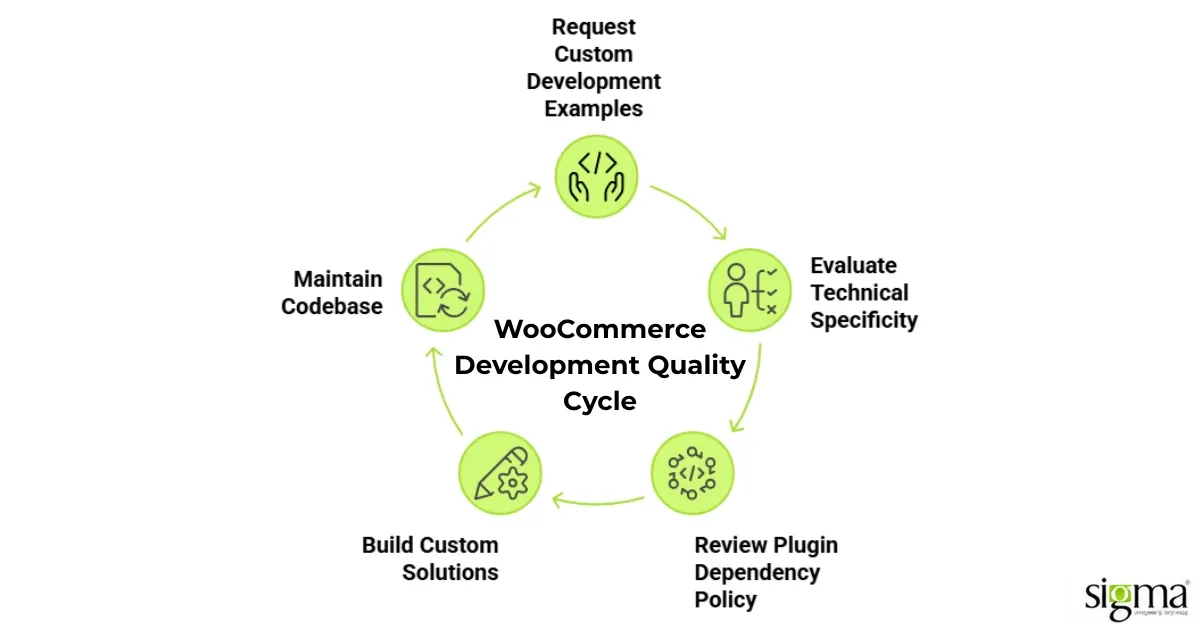
Configuring a pre-built WooCommerce theme is not a qualification. The baseline standard for a capable WooCommerce development agency is documented experience building custom plugins, authoring REST API integrations, and modifying WooCommerce core behavior in ways that remain stable through major version releases.
Before committing to a contract, request specific examples of custom development work. A live store URL confirms a site exists; it does not confirm the technical quality of the codebase, the complexity of the problems solved, or whether the build will hold up under two years of plugin updates and traffic growth. Ask the agency to describe how it handled a specific technical constraint in a recent project. Agencies that cannot provide technical specifics are agencies that either outsource the work or rely on templated approaches that will not serve non-standard requirements.
Plugin dependency management is a reliable indicator of development maturity. Experienced teams maintain a defined policy on when to build custom functionality and when a marketplace plugin is appropriate. Request that policy in writing as part of the evaluation process.
Performance Architecture as a Standard Build Component
Store performance is a structural outcome of how a site is built, not a post-launch optimization layer. The relationship between page load time and checkout completion is direct and well-documented. A one-second increase in load time at checkout carries a measurable revenue impact at any meaningful transaction volume.
Caching configuration, database query optimization, CDN integration, and image compression are standard components of a professional WooCommerce build. Any agency that presents these as premium service additions is signaling that they are not equipped for commercial eCommerce development. During evaluation, ask the agency to describe its performance baseline methodology and how it validates that baseline before project handoff.
Security Practices and Compliance Standards
WooCommerce stores process payment data and retain customer records, which creates ongoing security obligations for every development partner involved. A qualified agency follows OWASP secure coding guidelines, maintains a documented vulnerability patching process, and applies defined access controls at both the code and infrastructure levels. ISO 27001:2022 certification provides external, audited confirmation that information security management is embedded into operations rather than referenced in marketing materials.
US businesses in regulated industries or those processing high transaction volumes should ask directly about PCI-DSS compliance awareness. The development agency does not need to function as a compliance firm, but its built-in practices must not introduce gaps that create liability for the business.
Also, read the blog: Build a compliant, scalable clinical supply eCommerce platform with Sigma’s WooCommerce solutions to secure PHI, streamline procurement, and accelerate growth.
Comparing Qualified and Unqualified WooCommerce Development Agencies
Evaluation Criteria | Qualified Agency | Unqualified Agency |
| Platform expertise | Documented portfolio of custom WooCommerce builds and plugin development | Generalist developer with limited platform-specific experience |
| Custom development | Builds plugins, REST API integrations, and theme modifications from scratch | Relies on off-the-shelf marketplace plugins for all custom requirements |
| Performance standards | Caching, CDN, and query optimization are treated as standard build deliverables | Performance is treated as an optional enhancement added after launch |
| Security framework | ISO 27001-certified; OWASP-compliant development workflows | No documented security standard or vulnerability patching process |
| Post-launch support | Structured SLA with defined response times, contacts, and coverage scope | Ad hoc availability with no formal support commitment |
| Delivery scope | End-to-end: discovery, architecture, build, QA, integrations, and handoff | Build-only with no strategic input or post-launch accountability |
Additional Criteria That Determine Long-Term Store Outcomes
Integration Depth With Business Systems
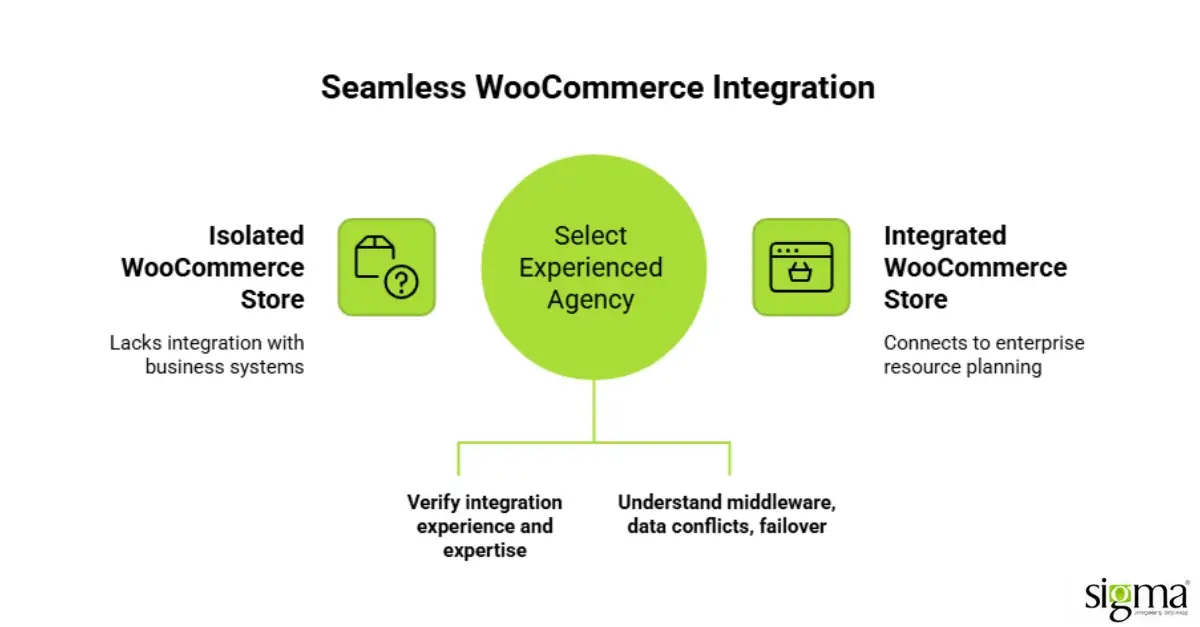
Most WooCommerce stores connect to ERP systems, warehouse management platforms, CRM tools, and accounting software. The agency that builds the initial store sets the architectural pattern for how those integrations behave under load, across version updates, and as the business scales. An agency without direct WooCommerce-to-ERP experience will encounter that complexity during your project rather than before it.
Request specific integration references. If the agency has connected WooCommerce to an ERP, ask what middleware layer they used, how they handled data conflicts, and what the failover behavior looks like when the external system is unavailable. The precision of the answers at this stage is a reliable predictor of the quality of solutions delivered during development.
Post-Launch Support Structure
The go-live date is the beginning of the operational phase, not the end of the engagement. WooCommerce releases major versions on a regular cycle. Plugins update independently. Hosting environments change. A qualified agency provides post-launch support under a defined service level agreement that specifies response times, contact channels, and the scope of what is covered under the agreement.
Agencies that offer support on an informal basis create a predictable risk: when a critical issue occurs in a live store, there is no contractual basis for a timely response. Unplanned downtime on an active e-commerce store carries direct and immediate revenue costs. Verify the support model before signing, not after an incident makes it necessary.
Documentation and Knowledge Transfer
Undocumented WooCommerce builds create long-term dependency on the agency that built them. When only the original development team understands how the store functions, the business loses the ability to switch vendors, onboard internal developers, or conduct independent technical audits without starting from scratch. Professional agencies deliver build documentation, inline code comments, and deployment records as standard project deliverables. Request a sample documentation package from a completed project before entering a contract.
How Sigma Infosolutions Delivers WooCommerce Development for US Businesses
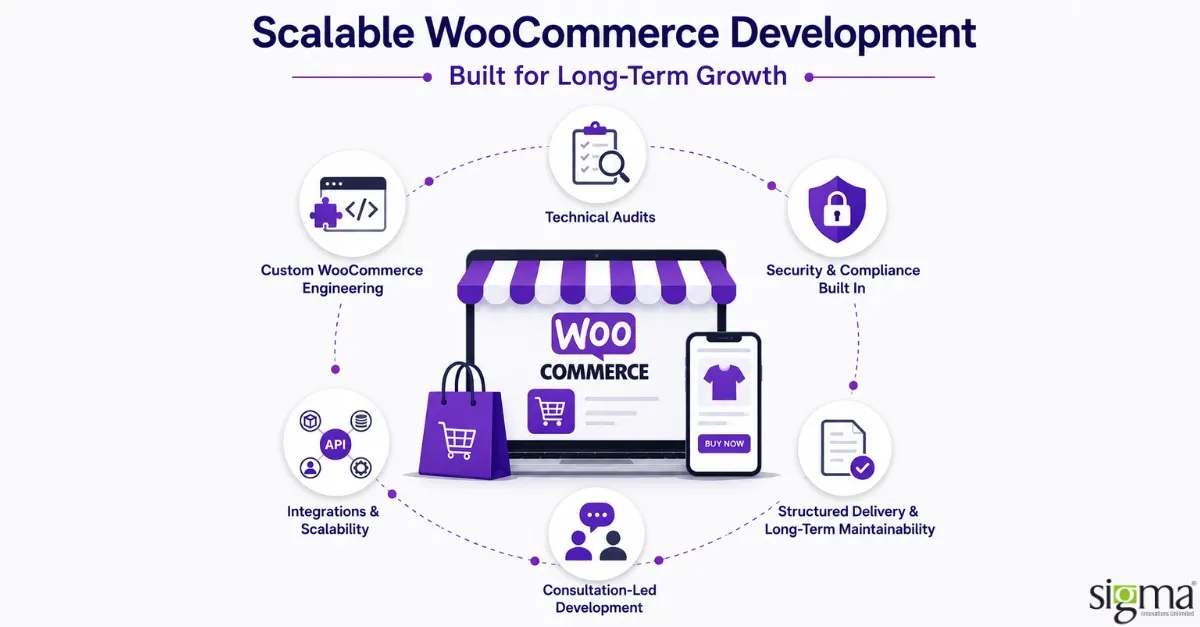
Building a scalable WooCommerce store requires more than storefront customization. As businesses grow, stores must support complex integrations, increasing transaction volumes, evolving customer expectations, and continuous platform updates without compromising performance or stability. Sigma Infosolutions helps US businesses build WooCommerce ecosystems engineered for long-term scalability, operational flexibility, and secure eCommerce growth.
Technical Audits Before Development Begins
Every engagement starts with a detailed technical assessment of the existing WooCommerce environment, infrastructure, integrations, and code quality. This process helps identify performance bottlenecks, plugin conflicts, scalability limitations, and architectural risks before development work begins.
By defining technical gaps early, Sigma helps businesses avoid mid-project scope expansion, unexpected redevelopment costs, and operational disruptions during scaling.
Custom WooCommerce Engineering for Complex Requirements
Many growing eCommerce businesses eventually outgrow the limitations of off-the-shelf plugins and standard theme-based configurations. Sigma’s WooCommerce development practice focuses on building custom functionality tailored to operational and customer experience requirements.
This includes:
- Custom plugin development
- WooCommerce-to-ERP integrations
- CRM and third-party platform integrations
- Multi-currency and international commerce support
- Headless WooCommerce development using React and Next.js
The goal is to create scalable commerce architectures that remain stable as transaction volumes, integrations, and business complexity increase.
Security and Compliance Built Into Delivery
WooCommerce stores process sensitive customer and payment-related data, making security a foundational requirement rather than an optional enhancement. Sigma follows structured security practices aligned with ISO 27001:2022 standards across development workflows, infrastructure management, and access controls.
This provides businesses with a verifiable security framework designed to support high-transaction environments and regulated industries where operational reliability and data protection are critical.
Structured Delivery and Long-Term Maintainability
Undocumented or poorly structured WooCommerce builds often create long-term dependency on the original development vendor. Sigma addresses this through structured code reviews, documented development workflows, and fully documented codebases that support future scalability and maintainability.
Businesses retain the flexibility to onboard internal teams, extend platform capabilities, or work with additional vendors without rebuilding the entire commerce environment from scratch.
Consultation-Led WooCommerce Development
For businesses facing scalability challenges, integration complexity, or platform limitations, Sigma begins with a consultation-led approach to define the right technical direction before development starts. This helps organizations align platform architecture, business operations, and long-term eCommerce goals from the outset.
Conclusion
Selecting the right WooCommerce development agency is a decision with consequences that extend well beyond the initial launch date. Technical depth, security practices, integration experience, post-launch support, and documentation standards collectively determine whether a store remains stable and scalable over a multi-year horizon. Businesses that evaluate agencies on price or visual portfolio without assessing these criteria consistently face costly rebuilds and operational disruptions within two years. The framework outlined here gives US eCommerce businesses a structured basis for identifying a WooCommerce development partner whose capabilities are aligned with the demands of commercial store operations.
Frequently Asked Questions
Q1. What technical qualifications should a WooCommerce development agency hold in 2026?
Look for agencies with documented experience in custom plugin development, REST API integrations, and WooCommerce version-upgrade management. ISO 27001:2022 certification confirms that a formal, audited security standard is in place. Request case studies that describe specific technical problems and the solutions delivered, rather than finished store links that reveal nothing about the quality of the underlying codebase.
Q2. How much does professional WooCommerce development typically cost for a US business?
Project cost depends on custom functionality requirements, third-party integration complexity, and performance specifications. Standard builds with defined integrations typically begin in the low five figures. Enterprise builds involving ERP connections, headless architecture, or multi-market configuration carry significantly higher investment. A professionally run agency provides a detailed, scoped estimate before any development work begins.
Q3. How long does a WooCommerce development project take from scoping to launch?
A well-scoped WooCommerce project typically runs six to twelve weeks from kickoff to launch. Custom plugin development, ERP integrations, and complex catalog configurations extend that timeline. Agencies that commit to compressed delivery schedules without completing a formal scoping process are transferring timeline risk directly to the client rather than managing it themselves.
Q4. Can a WooCommerce development agency recover a store that already has performance or stability problems?
Yes. A technical audit identifies performance bottlenecks, plugin conflicts, security vulnerabilities, and code quality issues in the existing build. The audit output determines whether the store requires targeted optimization or a structured rebuild. Attempting to address performance or stability problems without a diagnostic audit produces incomplete corrections and recurring issues in the same areas.
Q5. What contractual commitments should US businesses secure before signing with a WooCommerce agency?
Confirm the post-launch support model, documentation standards, and security certifications in writing before signing. Request a sample SLA and a documentation deliverable from a completed project. Verify that the agency has direct, referenced experience with the specific integrations your store requires. Commitments made in writing carry operational weight; verbal assurances made during the sales process do not.