Hyva vs PWA: Which Investment Delivers ROI First and How to Decide

Key Highlights:
- Investing in PWA too early can increase development costs and complexity without delivering proportional returns.
- Delaying a frontend upgrade can leave Magento retailers with performance issues and missed mobile conversion opportunities.
- Evaluating catalog complexity, traffic patterns, customer needs, and team capacity helps prioritize the right frontend investment.
- Sigma Infosolutions provides Magento development services to help retailers assess Hyva and PWA options and align frontend investments with business goals.
Introduction
Retailers researching Magento frontend options frequently encounter Hyva and Progressive Web App architecture presented as competing choices, when the more useful framing is sequencing: which investment delivers the larger return given the store’s current catalog complexity, traffic profile, and team capacity, and which comes next as the business grows into needing it. The Hyva vs PWA decision is not a permanent, mutually exclusive fork; many retailers eventually adopt elements of both, but starting with the wrong one for their current stage wastes budget and can delay the performance and flexibility gains either investment is meant to deliver to the store and its customers over time and across every future selling season the store operates through. For a Head of eCommerce or VP Engineering at a growth-stage retailer, the decision is rarely about which architecture is more technically impressive and almost always about which one the business is actually positioned to use well right now. Getting this sequencing right protects the development budget and avoids funding infrastructure the team cannot yet maintain or leverage effectively.
Choose the Right Magento Frontend Strategy
What Each Option Actually Solves
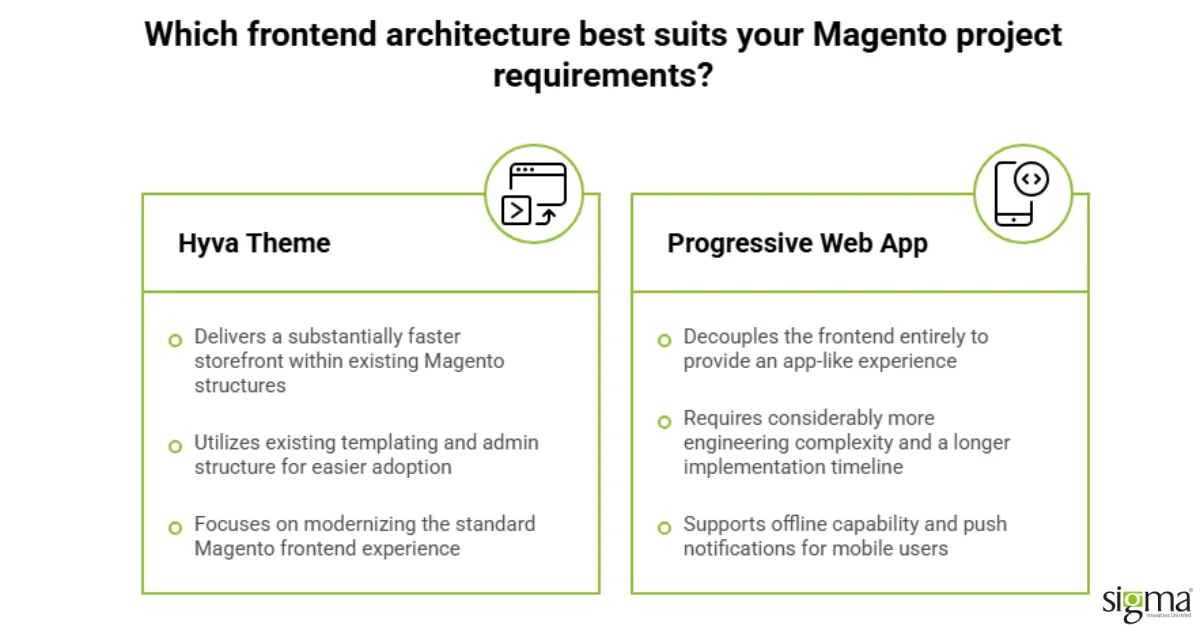
Hyva is a Magento frontend theme, replacing the older Luma theme with an architecture built on Tailwind CSS and Alpine.js, delivering a substantially faster storefront within Magento’s existing templating and admin structure. A Progressive Web App goes further, decoupling the frontend entirely from Magento and rebuilding it as an app-like experience that works across web and mobile with offline capability and push notification support, at the cost of considerably more engineering complexity and a longer implementation timeline than a theme migration requires.
Why Catalog Complexity Should Drive the Hyva vs PWA Decision
A retailer with a straightforward catalog and a single primary sales channel, a typical web storefront, generally gets the larger near-term return from a Hyva migration, since the performance gain is substantial and the implementation risk and cost are considerably lower than a full PWA rebuild. A retailer that genuinely needs an app-like, installable experience, serves significant traffic through mobile web specifically, or needs offline functionality for a real use case, such as a field sales scenario or an unreliable-connectivity market, has a stronger case for PWA investment, provided the team can support the added complexity that comes with it.
Comparing Hyva and PWA on the Factors That Determine Fit
| Factor | Hyva | Progressive Web App |
|---|---|---|
| Implementation Complexity | Lower, theme-level change | Higher, architectural rebuild |
| Typical Timeline | Weeks to a few months | Several months to longer |
| Performance Gain | Substantial over Luma | Potentially higher, app-like experience |
| Best Fit | Straightforward catalog, single channel | Multi-surface reach, offline or app-like needs |
Why Sequencing Matters More Than Choosing a Winner
Retailers who frame this as a permanent, exclusive choice tend to either over-invest in PWA capability the business is not yet positioned to use, since a PWA without a genuine multi-surface or offline use case does not deliver a return proportional to its cost, or they stay on Hyva indefinitely past the point where a genuine multi-surface strategy would justify the added PWA investment. The more productive approach treats this as a sequencing question tied to growth stage: start with Hyva to capture the near-term performance gain most retailers need immediately, then evaluate PWA once traffic patterns, mobile engagement data, and business strategy provide real evidence for the larger investment.
That same foundation-first approach, capturing the more accessible performance gain before committing to a larger architectural investment, applies directly to sequencing the Hyva versus PWA decision correctly.
Reading the Signals That Indicate Readiness for the Larger Investment
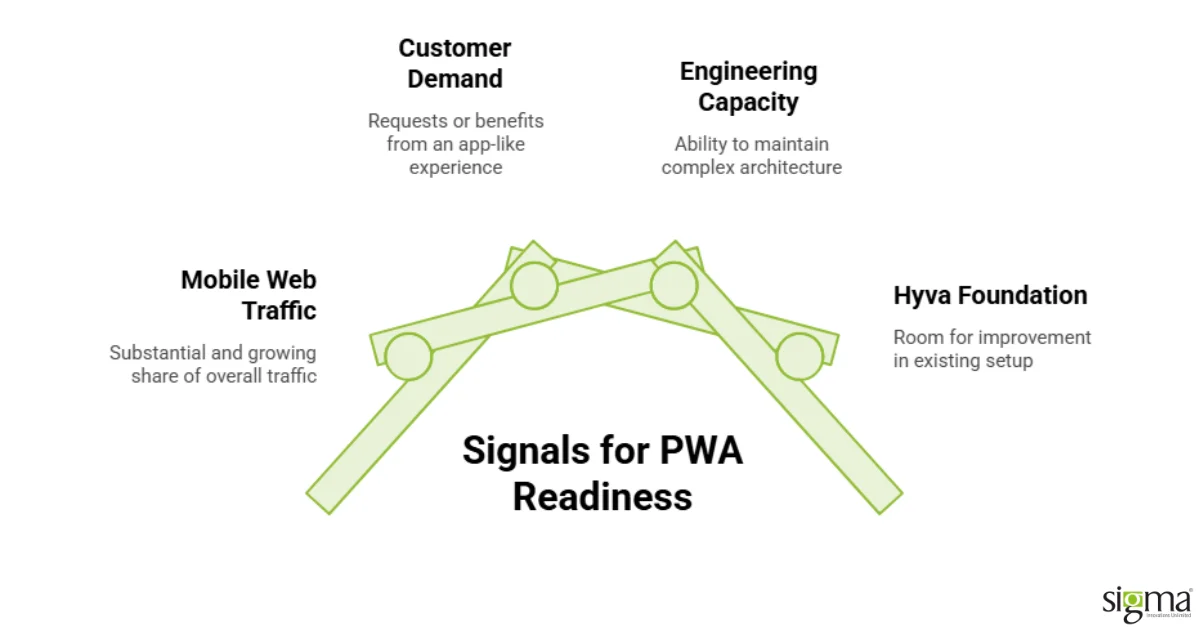
A retailer is generally ready to evaluate PWA once several signals appear together: mobile web traffic represents a substantial and growing share of overall traffic, customers are requesting or would clearly benefit from an installable, app-like experience, and the engineering team has the capacity to maintain a more complex architecture without it becoming a bottleneck for other priorities. Absent these signals, PWA investment is premature regardless of how compelling the underlying technology sounds in a vendor pitch, and the near-term budget is better spent on the Hyva foundation; most retailers still have room to capture. Tracking these signals on a recurring basis, rather than checking for them once and moving on, gives a retailer an evidence-based trigger point for revisiting the decision instead of relying on a gut sense that the timing has arrived.
The Front-End Evaluation Sigma Runs Before Recommending a Migration Path
Sigma Infosolutions evaluates the Hyva versus PWA decision for growth-stage eCommerce retailers based on actual catalog complexity, traffic patterns, and team capacity rather than presenting one option as categorically superior. That evaluation has guided retailers toward starting with Hyva when the near-term case was clearly stronger, and toward a PWA investment when multi-surface traffic and business strategy genuinely supported the larger commitment.
Getting the sequence right protects the budget for the investment that delivers the larger near-term return, while keeping the larger architectural option available once the business has real evidence it is ready to use it well.
Retailers who have already decided Hyva is the right foundation, and want to extend it further with additional modules and personalization after the initial migration, should evaluate each addition against its own performance cost.
Also, read the blog: Hyva Theme Customization: What Merchants Need to Know Before Extending Beyond the Default Build
Avoiding the Sunk Cost Trap on Either Path
Once a retailer commits budget to either Hyva or a PWA build, there is a natural pull toward justifying further investment in that same direction, even when the evidence starts pointing toward a different next step. This shows up most often as a retailer that invested heavily in Hyva continuing to add frontend customization layer after layer in pursuit of PWA-like capability, rather than acknowledging that a genuine multi-surface need has emerged and warrants evaluating PWA directly. The reverse also happens: a retailer with an underused PWA continues funding its maintenance and expansion rather than acknowledging that the multi-surface traffic never materialized as expected. Revisiting the original sequencing decision periodically, against updated traffic and engagement data rather than the assumptions made at the time of the original investment, keeps the retailer from anchoring to a choice that no longer reflects the business’s actual trajectory.
Hyvä delivers ROI faster for stores whose primary pain point is page speed, while a PWA delivers ROI faster for stores whose primary pain point is mobile conversion, they are not interchangeable investments, and choosing based on budget alone without diagnosing which problem you actually have risks spending on the wrong fix. If you want a clear read on which investment Sigma’s team would recommend for your specific metrics, reach out to scope a short diagnostic before committing budget to either path.
However, that diagnostic step is itself a consideration worth planning for: skipping it to save time is the most common reason teams end up revisiting the same decision a year later.
Conclusion
The Hyva vs PWA decision is better framed as a sequencing question tied to growth stage than as a permanent, mutually exclusive choice between two competing architectures. Hyva delivers a substantial performance gain within Magento’s existing structure at considerably lower implementation cost and complexity than a full Progressive Web App rebuild requires. PWA delivers genuine multi-surface reach and app-like capability, but only for retailers with the traffic patterns, business need, and team capacity to use that capability well once it is built. Catalog complexity, current traffic profile, and engineering team capacity should drive the decision more than which architecture is currently generating the most industry attention. Retailers who treat this as a permanent either-or choice tend to either over-invest in PWA capability they are not positioned to use, or stay on an outdated theme past the point where PWA would genuinely be justified by their situation. The more productive approach starts with Hyva to capture the near-term, lower-risk performance gain most retailers still have available to them, then evaluates PWA once real evidence, mobile traffic share, customer demand, and team readiness, supports the larger investment. Retailers who are ready to evaluate PWA should look for these signals appearing together rather than committing based on a single compelling factor alone. Getting the sequencing right protects the budget for the investment that delivers the larger near-term return while keeping the larger architectural option available for when the business is genuinely ready to use it. This sequencing discipline, matching investment to actual readiness rather than industry trend, is what separates a Magento frontend strategy that compounds value over time from one that spends budget ahead of the business’s real need. Revisiting the sequencing decision periodically against updated traffic and engagement data helps a retailer avoid anchoring to a choice that no longer reflects where the business has actually moved. Framed this way, the Hyva vs PWA question stops being a one-time platform debate and becomes an ongoing part of how the storefront’s roadmap gets prioritized each year.
Improve Magento Storefront Performance with Hyvä
Frequently Asked Questions
1. Can a retailer eventually use both Hyva and a PWA together?
Yes, and many growth-stage retailers do, typically starting with Hyva for the near-term performance gain and later layering PWA capability once multi-surface traffic and business strategy justify the additional investment and complexity involved in that larger, more demanding architectural change to the storefront and its supporting infrastructure.
2. How long does a typical Hyva migration take compared to a PWA build?
A Hyva migration typically takes weeks to a few months depending on catalog and customization complexity, while a PWA build is a considerably larger architectural project that commonly takes several months or longer to complete, given the added engineering scope and testing involved throughout the process.
3. What traffic signal indicates a retailer is ready for PWA investment?
A substantial and growing share of mobile web traffic, combined with clear customer demand for an installable, app-like experience, are the strongest signals to watch for. Without these signals present together, the near-term return on a PWA investment is considerably harder to justify against its cost.
4. Does choosing Hyva first delay a future PWA investment?
Not meaningfully, since Hyva operates at the theme level within Magento’s existing structure and does not create significant technical debt that would complicate a later PWA build down the road. If anything, capturing the Hyva performance gain first strengthens the baseline a future PWA build starts from.
5. Is PWA always the better long-term choice regardless of catalog size?
No. A PWA without a genuine multi-surface or offline use case does not deliver a return proportional to its added complexity and cost. The right long-term choice depends on the retailer’s actual traffic patterns and business strategy, not a general assumption that more architecture is always better.
