Magento 2.4 Latest Security Enhancements That you Need to Know

Key Highlights:
- Most Magento stores run for years without anyone re-checking whether the platform’s built-in Magento security capabilities are actually switched on, which leaves real protection sitting unused while risk quietly accumulates.
- Magento 2.4 bundles edge-level protection, automated vulnerability scanning, and centralized patch management directly into the platform, so closing that gap is largely a configuration and monitoring exercise rather than a rebuild.
- Turning these capabilities on and keeping them tuned converts Magento security from a recurring fire drill into a predictable, monitored part of running the store.
- Sigma treats enabling and maintaining Magento platform security features as a standing engineering responsibility, not a one-time setup task, so protection holds as the platform, traffic, and extension footprint change.
Introduction:
Every major Magento release adds security capability to the platform itself: edge-level traffic filtering, automated vulnerability scanning, structured patch delivery, but capability sitting in the platform is not the same as protection actually in place. Most stores accumulate these releases the way they accumulate extensions: incrementally, without anyone stepping back to confirm the new capability is configured, monitored, and owned by someone. For a retailer handling customer payment data, that gap between “the platform can do this” and “our store is doing this” is where real exposure lives. This post explains what changed in Magento’s security layer, what each capability actually protects against, and why closing the configuration gap is a leadership decision, not a task left to whoever has time between sprints.
Keep Your Magento Store Secure and Ready to Scale
Why Magento Security Has Become a Leadership Conversation
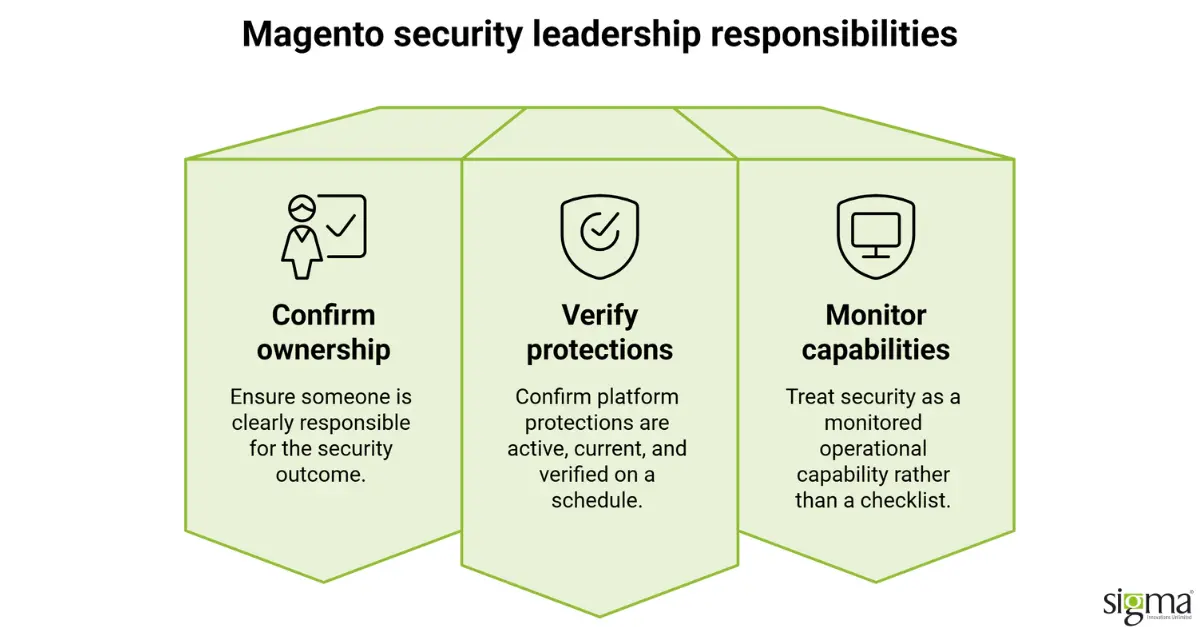
Security used to be something a Magento store’s development team handled reactively: patch when notified, investigate when something looks wrong. That model breaks down as the platform itself takes on more of the security workload, because reactive patching only works if someone is actively watching for the platform’s newer, largely automated protections and confirming they are switched on. A retailer that treats Magento security as a developer-level checklist item, rather than a monitored operational capability with clear ownership, is running with tools available that nobody is actively using. The cost of that gap is not hypothetical: a compromised checkout page or an unpatched admin panel exposes customer payment data, triggers mandatory breach disclosure, and does measurable damage to customer trust that outlasts the technical fix. Leadership’s job is not to configure Varnish or write VCL snippets. It is to confirm someone owns the outcome, that the platform’s protections are active, current, and verified on a schedule, rather than assumed.
Edge and Network Protection Built Into the Platform
Magento Commerce integrates Fastly as its content delivery network, and that integration carries real security value beyond faster page loads. Fastly pairs CDN delivery with distributed denial-of-service protection and a web application firewall, filtering malicious traffic before it ever reaches the origin server. Custom VCL snippets let an engineering team fine-tune that filtering, for example restricting admin panel access to known IP ranges or blocking traffic patterns associated with referral spam and credential-stuffing attempts, without touching application code or risking downtime during deployment. TLS handling has moved to Fastly’s platform-level certificate management as well, replacing shared certificates with individually validated ones per merchant, which closes a class of certificate-management error that used to be a manual, easy-to-miss step. None of this requires custom development. It requires someone confirming the store’s Fastly configuration actually uses these controls rather than running on defaults left over from initial setup.
Close the Gaps in Your Magento Security Setup
Automated Detection Closes the Gap Manual Review Cannot
Manually auditing a Magento store for misconfigurations, vulnerable extensions, and outdated patches does not scale, which is why Adobe built automated detection directly into the platform.
| Tool | What It Monitors | Output |
| Security Scan | Known misconfigurations, digital skimming injection attempts, vulnerable extensions, missing patches | Automatic alert to the admin team, no scheduled manual review needed |
| Site-Wide Analysis Tool | Exception logs, third-party extension behavior, general platform health | Structured report naming the issue, likely cause, and recommended fix |
| Managed Alerts | Memory, CPU, disk, and application response metrics | Early warning before resource exhaustion becomes an outage or incident |
Together these tools shift Magento security from something a team checks when they remember to something the platform checks continuously, provided someone is reviewing what the tools report.
Patch Management Without the Operational Drag
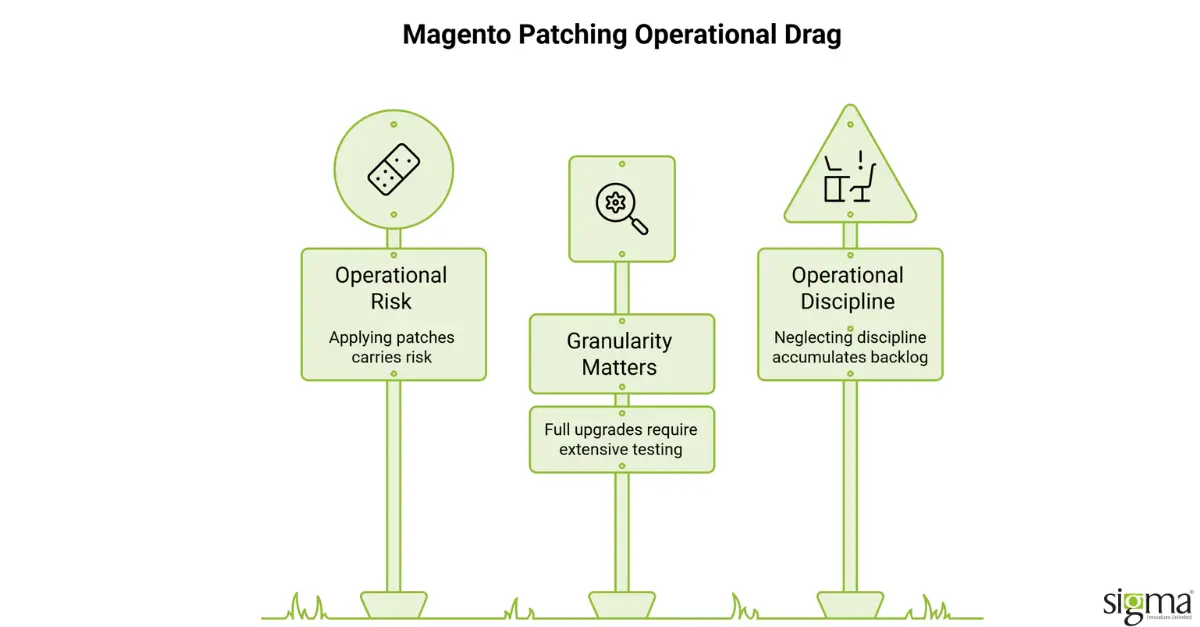
Patching has historically been where Magento security enhancements stall inside real organizations, not because teams do not care, but because applying, testing, and reverting patches against a customized store carries real operational risk. Magento Quality Patches addresses this directly by packaging individual fixes that can be applied, viewed, and reverted independently, rather than forcing a team to wait for a full version upgrade to receive a single critical fix. That granularity matters for a store running custom extensions and integrations, where a full-version upgrade can require weeks of compatibility testing while a single quality patch closing a known issue can often be applied and verified in a day. The operational discipline this requires is straightforward to describe and easy to neglect in practice: someone needs to track which patches apply to the store’s specific version and extension set, apply them in a staging environment first, and confirm the fix before it reaches production. Stores that skip this discipline accumulate a patch backlog that grows quietly until an audit or an incident forces the question.
Sigma Infosolutions Treats Platform Security as a Monitored Discipline
The problem with most Magento security work is not that the platform lacks capability; it is that capability goes unused once the initial setup is finished and nobody owns keeping it current. Sigma’s engineering principle is that platform security features only produce value when someone verifies configuration, tracks patch status, and reviews scan and alert output on a defined cadence, the same discipline applied to performance monitoring rather than a one-time hardening pass. The practical approach starts with an audit of what the store’s Fastly, Security Scan, and patch configuration currently allow versus what is actually active, followed by closing the gap and establishing the review cadence that keeps it closed as the store evolves. Sigma migrated Hansen Wholesale, a US home decor retailer, from Magento 1 to Magento 2 ahead of Magento 1’s end-of-life deadline specifically because Magento 2 closed security gaps the legacy platform could no longer address, delivering PCI-aligned full-page caching and a modernized security baseline alongside the platform’s functional improvements. On a separate engagement, Sigma upgraded a leading Asian grocery retailer’s store across ten Magento version releases and thirty-five patches to reach 2.4.7, improving platform stability and security posture while also lifting order volume 15 percent and revenue 10 percent, evidence that closing a patch and version gap pays back in more than risk reduction alone. That combination, real security gain paired with a measurable business result, is the outcome Sigma aims for on every Magento security engagement.
That engagement closed a version-related gap through migration; the same discipline holds a platform current without a full version change too.
Both results came from the same discipline a security audit depends on: mapping what a platform is actually configured to do, not what its documentation claims it can do. Hansen Wholesale’s module rebuild during migration and the grocery retailer’s theme upgrade both started with that same gap analysis before any change was made, the same starting point that separates real Magento security exposure from unused capability.
How Sigma Infosolutions Manages Magento Security
Sigma Infosolutions manages Magento security as part of its ongoing Magento support and maintenance service. Sigma’s team monitors Magento security advisories, assesses patch applicability to the client’s specific configuration, and deploys security updates through a tested release process that prevents patch deployment from introducing regression issues in production.
If your Magento store’s security patch cadence has fallen behind or you are uncertain whether your current configuration is exposed to the vulnerabilities in recent Magento security releases, speak with Sigma Infosolutions. Sigma’s Magento security team can assess your current patch status and establish a managed update process.
Not every security enhancement needs to be applied on day one: the trade-off is patching velocity against regression risk, and applying every available patch immediately without a staging test may not be suitable for a store with significant custom code. The right approach weighs the severity of each vulnerability against the cost of the testing window it requires, a lower-severity patch can reasonably wait for a scheduled release cycle.
Conclusion:
Magento security today is less a question of what the platform can do and more a question of what a given store actually has configured and monitored. Magento 2.4 provides real capability across three layers: edge-level traffic protection through Fastly, automated detection through the Security Scan and Site-Wide Analysis tools, and structured patch delivery through Magento Quality Patches. Each layer closes a specific class of risk that used to require manual, inconsistent effort to manage. None of it protects a store automatically; each capability needs deliberate configuration and an owner who reviews its output on a defined cadence. Leadership’s role is to confirm that ownership exists and that it survives staff turnover and platform changes, not to configure the tools directly. Stores that treat these capabilities as a one-time setup task drift out of alignment with current best practice within a few release cycles, exactly the pattern that leaves known gaps unaddressed. Stores that treat platform security as an ongoing, monitored discipline convert Magento’s built-in capability into actual protection and carry that protection forward as the platform evolves. The security question worth asking is not whether Magento is secure in the abstract, but whether this specific store’s configuration reflects what the platform currently makes available. That question has a concrete, verifiable answer once someone actually checks. Closing the gap between platform capability and store configuration is engineering work with a clear scope and a measurable outcome. Treating it that way, rather than as a vague ongoing worry, is what separates a store with real protection from one that only appears protected.
Turn Magento Security Into a Business Advantage
Frequently Asked Questions
What is the biggest misconception about Magento security?
That the platform provides protection automatically once installed. Magento 2.4 ships real security capability, edge filtering, automated scanning, and patch management, but each requires configuration, monitoring, and an owner. A store running on default settings is not using most of what the platform actually offers against real threats.
Does using Magento’s built-in security tools replace the need for a security audit?
No, they complement one another and serve different purposes. The built-in tools detect known issues and enforce baseline protections continuously in the background, while an audit verifies configuration is correct, checks for gaps the automated tools do not cover, and confirms the store meets standards like PCI relevant to the business.
How often should a Magento store’s security configuration be reviewed?
At minimum quarterly, and immediately after any major extension change, version upgrade, or reported vulnerability affecting a component the store uses. Stores handling payment data directly, rather than through a hosted checkout, warrant more frequent review given the higher stakes of a configuration gap going unnoticed.
What is the practical difference between a full version upgrade and applying quality patches?
A version upgrade brings new features and requires broad compatibility testing across the store’s extensions and customizations. Quality patches deliver individual fixes, security or otherwise, without the full upgrade cycle, letting a team close a specific known issue quickly while planning larger upgrades on a longer, better-tested timeline.
Who should own Magento security configuration inside an engineering organization?
It needs a named owner, whether an internal engineer or an outside partner, rather than being treated as ambient responsibility. The owner tracks patch status, reviews automated scan output, confirms edge configuration, and reports status to leadership on a defined schedule so gaps surface before they become incidents.