Predictive Analytics: Why Accurate Forecasts Fail to Drive Decisions

Most stalled predictive analytics programs have a working, validated model that the business still ignores in favor of the old spreadsheet. Data teams read this as a data quality problem, which is the wrong diagnosis.
Predictive analytics is the broader discipline of estimating a future outcome from data. Forecasting turns that estimate into a number for a period. Operational decision-making is where that number either changes what a team does or gets filed away unused.
AI adoption is accelerating, but adoption alone does not create operational intelligence. U.S. Census Bureau data shows that 19.8% of U.S. businesses use AI, with adoption reaching 37% among firms with at least 250 employees. As AI becomes part of larger enterprises, the competitive gap shifts from access to AI toward the ability to connect data, analytics, and AI outputs to decisions. Sigma’s BI and Analytics Development Services bring those layers together, engineering data foundations, predictive analytics, and decision-ready experiences around the workflows that matter to the business.
Key Highlights
- Forecasting models get built, validated, and ignored because nothing in the operating rhythm changed to consume them.
- Define the decision the forecast will alter before picking a horizon, a model, or a data source, then wire the output into that decision’s workflow.
- Forecasts move inventory, staffing, and cash rather than accumulating in a dashboard nobody opens after launch.
- Sigma treats the operational handover as part of the build, since a forecast that never reaches a decision owner has produced no return.
What Is Predictive Analytics, and How Is It Different From Forecasting and Reporting?
Predictive analytics uses historical and current data to estimate the probability of a future outcome, specific enough to act on. Forecasting is the output: a number tied to a period and a grain. Reporting describes what already happened. Only a forecast wired into an existing decision becomes a decision system rather than another dashboard.
A company-level forecast is a board slide. A forecast by SKU and location, delivered before the purchase order deadline, is an input to a decision somebody already has to make. A forecast that’s genuinely used replaces somebody’s judgment, which is why adoption is a design problem, not a footnote.
The Forecasting Model Is One Layer, Not the Whole System
A forecasting model produces the number. Predictive analytics decides which number matters and how it reaches the person who has to act. Treating the model as the deliverable, not the decision it changes, is why accurate work often never becomes an operational habit.
When the forecasting model itself becomes the constraint, AI/ML engineering becomes part of the solution. Businesses with complex demand patterns, fragmented behavioral data, large operational datasets, or changing external variables may need more than a standard forecasting approach. Model selection, feature engineering, training, validation, monitoring, and retraining all have to work against the business’s actual data and decision requirements. Sigma’s AI and ML Development Services bring those capabilities into the broader analytics architecture, from predictive model development and data preparation to model deployment and performance monitoring. The objective is not to build a more sophisticated model for its own sake, but to engineer a prediction that remains useful as the business, data and operating conditions change.
Build predictive models that hold up in real operating conditions.
Why Do Predictive Analytics Models Get Ignored?
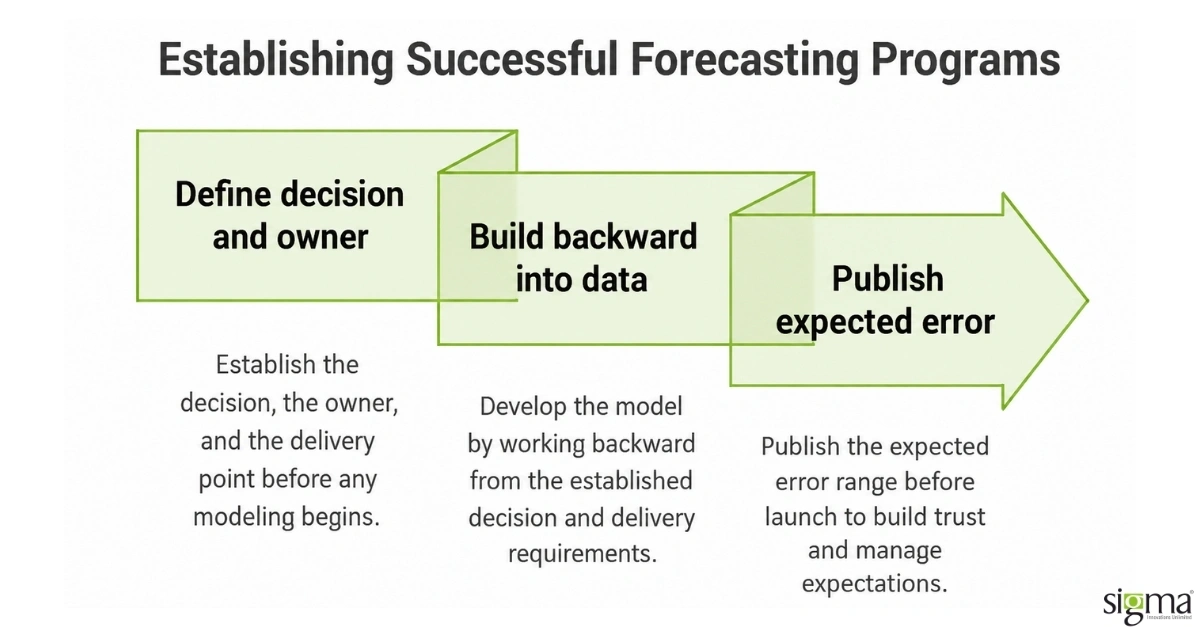
Four failure modes explain most abandoned programs, none of them model performance. Timing failure: the forecast arrives after the decision deadline. Granularity failure: it predicts at a level nobody can act on. Ownership failure, the most common: nobody is accountable for it, so it stays advisory. Trust failure: a model visibly wrong once gets discounted permanently because no error range was set in advance.
Programs that survive fix the decision, owner, and delivery point before modeling begins. Programs that stall build the model first and discover no workflow exists to receive it.
Turn forecasts into decisions your operations team actually makes.
How Should Businesses Choose a Forecast Horizon?
Horizon selection is the first irreversible mistake most programs make: choosing the longest horizon the data supports rather than the one the decision needs. Work backward from the decision’s lock date.
| Decision | Useful horizon | Refresh cadence | Typical Predictability |
| Daily staffing and shift cover | 1 to 2 weeks | Daily | High, patterns are stable |
| Replenishment and purchase orders | 4 to 12 weeks | Weekly | Moderate, supplier lead time dominates |
| Cash and working capital planning | 1 to 2 quarters | Monthly | Moderate, sensitive to collections behavior |
| Capacity and headcount planning | 2 to 4 quarters | Quarterly | Low, wide intervals are expected |
| Strategic capital allocation | Multi-year | Annual | Scenario ranges only, not point estimates |
Predictability varies by volatility, forecast grain, data quality and industry. Treat the patterns above as directional, not as universal benchmarks for any specific forecasting model.
Leadership tends to want the long-horizon numbers, which are the least predictable, while the near-horizon forecasts that would save real money get treated as operational detail. A forecast refreshed less often than the decision recurs will be stale at the moment of use, so cadence matters as much as the model itself.
Read the blog: See how Sigma approaches machine learning-powered business forecasting
What Data Is Needed for Predictive Analytics?
Data readiness functions as a gate, not a maturity curve. A forecast needs sufficient history of the target variable at the decision grain, a stable definition of it across the period, and a record of the exceptions that distorted it. Missing any one can make the forecast unsuitable for operational deployment, even if a technically valid model can still be trained.
Definitional stability is the most commonly missed requirement: a revenue recognition change mid-history teaches a model to read a bookkeeping shift as demand. An unflagged stockout gets read as low demand and forecast forward indefinitely. External signals like weather should wait until the internal baseline is stable.
This gate matters most heading into Q3 and Q4 planning, when annual operating plans lock in inventory, workforce, cash, and capacity assumptions. A model that fails the readiness gate in September produces unreliable numbers exactly when budget conversations need them most.
How to Operationalize a Forecasting Model
A stalled program rarely announces itself as a failed model. Planners export outputs into private spreadsheets, dashboards get consulted after decisions are made, and nobody owns what happens when the forecast conflicts with judgment.
In one Sigma engagement, a fast-growing U.S. manufacturer was working across 5 to 10 disconnected tools daily, with no real-time visibility into production or inventory. Sigma connected finance, inventory, sales, supply chain, and HR into one AI-native platform with predictive analytics feeding forecasts to leadership across 150+ integrations, so outputs no longer had to be exported and reconciled before anyone could act.
See how Sigma connected fragmented enterprise systems, real-time intelligence and operational workflows in a U.S. manufacturing environment. Read the AI-native BRP manufacturing case study
In another engagement, fragmented institutional data kept decisions reactive. Sigma connected the sources, standardized risk definitions, and built real-time dashboards, moving the organization to continuous, decision-ready monitoring.
See how Sigma turned fragmented data into real-time signals and decision-ready operational intelligence. Read the AI-powered operations intelligence case study
The question that drives this architecture isn’t which model to use. It’s which decision needs to change, who owns it, and where the prediction needs to appear:
- Data consolidated at the grain the decision requires
- Forecasts placed inside existing workflows, not a new dashboard
- Decision owners and override rules set upfront
- Expected error ranges visible alongside predictions
- Monitoring on both inputs and outputs
- Retraining with an accountable owner and cadence
How to Measure Whether a Forecast Is Actually Being Used
Accuracy tells you whether the model is good, not whether anyone uses it. Track how often the forecast is opened before the deadline rather than after, and whether the override rate falls as trust grows. Rising overrides alongside high accuracy means adoption is failing even as prediction succeeds.
Conclusion
Predictive analytics programs rarely stall because the model is inaccurate. Forecasts get ignored when they arrive late, predict at the wrong grain, have no owner, or lose trust after one bad month. The programs that endure are the ones where someone in operations owns the outcome and consumes the forecast inside the system where the decision was already being made.
Is your forecast accurate but still ignored? Turn it into an operational decision system.
FAQs
Q1. What is predictive analytics in a business context?
Predictive analytics estimates a future outcome from data, specific enough to act on. Forecasting is one application; what matters is whether the output feeds a decision or just sits on a dashboard.
Q2. Why do accurate forecasting models still get ignored?
Four causes dominate, none involving model performance: the forecast arrives late, predicts at a grain nobody can act on, has no owner, or lost credibility during an unusual period with no published error range.
Q3. How do you choose a forecast horizon?
Work backward from the decision’s lock date. Staffing needs one to two weeks, replenishment needs four to twelve, capacity planning needs two to four quarters. Choosing the longest horizon the data supports, rather than what the decision needs, is the common error.
Q4. What data do you need before starting a predictive analytics project?
Three things act as a gate: history of the target variable at the decision grain, a stable definition of it, and records of exceptions like stockouts. Missing any one can make the forecast unsuitable for deployment, even if a valid model can still be trained.
Q5. How long before a forecasting program shows measurable return?
Short-horizon operational forecasts can often show value within a single quarter, depending on decision frequency, adoption, and implementation scope. Longer-horizon strategic forecasts are harder to validate quickly, making them a weaker choice for building credibility first.