Preparing Your Ecommerce Site for the Boxing Day Traffic Surge: A Retailer’s Infrastructure Checklist
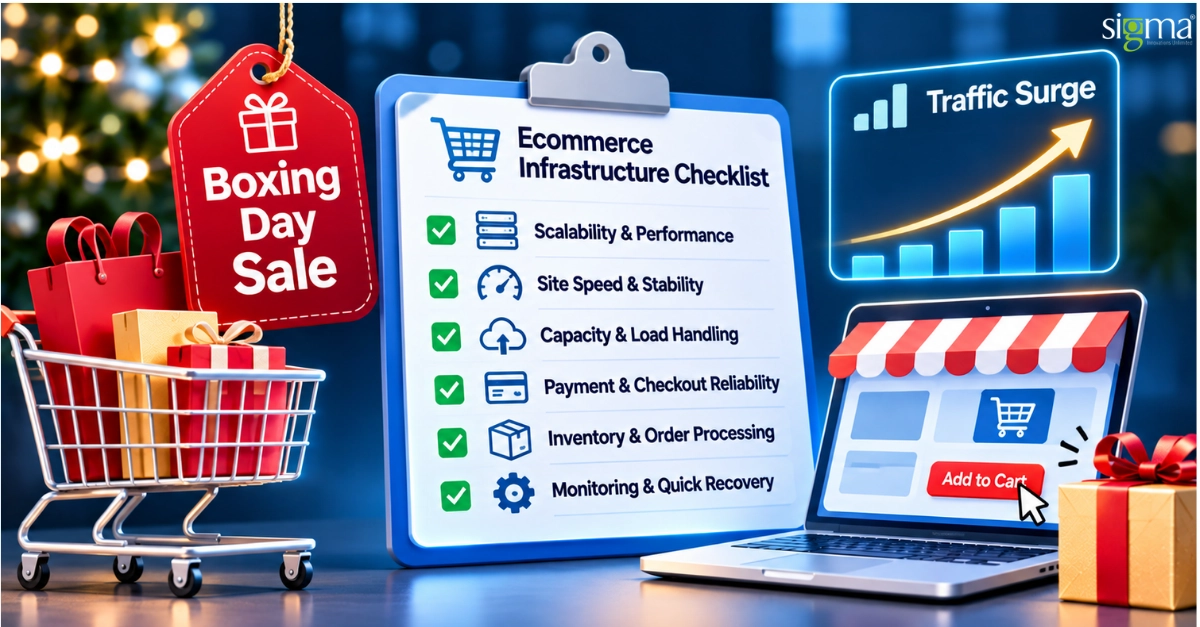
Key Highlights:
- Boxing Day traffic overwhelms sites sized for normal weeks, causing slow pages, stock errors, payment failures, and lost sales on one of the most competitive shopping days of the year.
- Every slow page, failed checkout, or incorrect stock count on Boxing Day is lost revenue on the single highest-stakes day of the season, plus the longer-term cost of a shopper who does not come back.
- Validated CDN and caching, confirmed cloud autoscaling thresholds, tested inventory and OMS sync, checkout and payment capacity, real-time observability, and a defined peak-day runbook, all confirmed before traffic arrives, not during it.
- Sigma audits readiness, scales cloud infrastructure, tunes the commerce platform, and provides a dedicated team for peak season and year-round support.
Searches for boxing day sale uk reflect shoppers hunting discounts, but for the retail executive who owns the technology budget, the real question is whether the site behind those discounts can take the traffic.
Checkout.com’s transaction data for the UK holiday season shows spending on Boxing Day jumped 43% compared with Christmas Day and ran 29% above the adjusted period average, concentrating a disproportionate share of the season’s revenue into a single day. Every one of those visits and transactions has to pass through the same infrastructure, content delivery, autoscaling, inventory sync, checkout, and payment processing, that handled a fraction of the load the day before. A site sized for a normal December day finds out the hard way whether it was ready. This article lays out the infrastructure checklist that protects revenue on the one day retailers can least afford to get it wrong.
Build an eCommerce Website Ready for Peak Traffic and Sales.
How Do You Prepare a Website for Boxing Day Traffic?
Preparing a website for Boxing Day traffic means validating every layer that handles load, CDN and caching, cloud autoscaling, inventory and order-management sync, checkout and payment capacity, and observability, before the traffic arrives, not during it. A readiness review that tests these layers together, rather than one at a time, is what catches the failure that only shows up when every system is under load at once.
What Infrastructure Does an Ecommerce Site Need for Peak Sales?
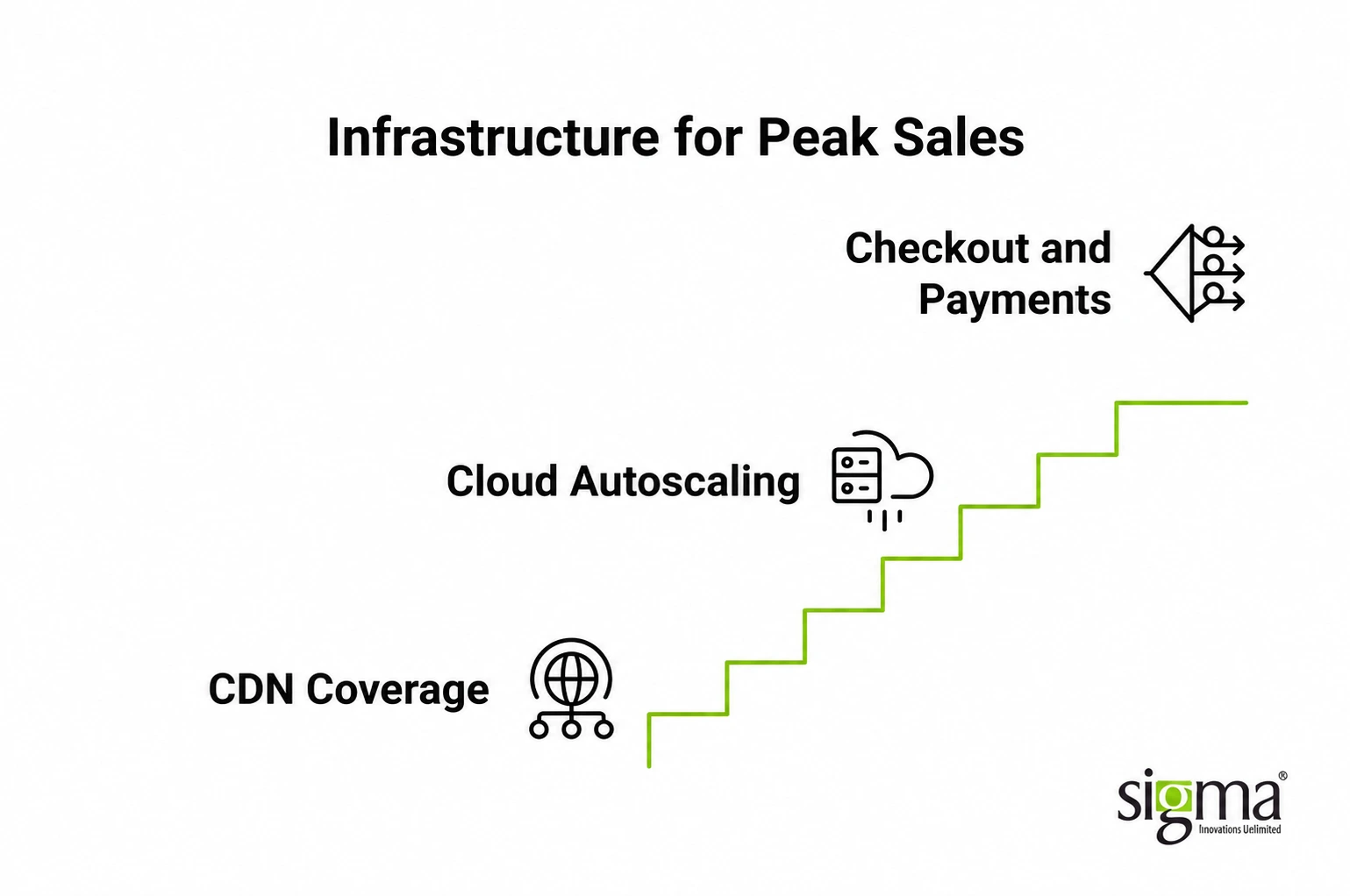
An ecommerce site needs infrastructure that scales automatically under sudden load rather than infrastructure sized for its busiest ordinary day. That means CDN coverage and cache rules validated for mobile and product-page traffic specifically, cloud autoscaling thresholds confirmed with real failover testing, and checkout and payment routing capacity tested against the volume a peak day actually produces, not the volume a normal day produces.
| Area | Peak risk | Executive action |
|---|---|---|
| CDN and caching | Slow product and category pages | Validate cache rules, edge coverage, and mobile performance |
| Cloud autoscaling | Site slowdown or outage during spikes | Confirm scaling thresholds, failover, and cost controls |
| Inventory and OMS sync | Overselling, stock errors, canceled orders | Test inventory updates, order routing, and marketplace sync |
| Checkout and payments | Abandoned carts and failed orders | Validate checkout capacity, payment routing, and error handling |
| Observability | Late detection of revenue-impacting failures | Define business KPIs, alerts, and escalation ownership |
| Peak-day runbook | Slow incident response | Assign owners, decision rights, and rollback procedures |
Protect Boxing Day revenue with eCommerce performance optimization services from Sigma.
How Do You Stop a Site Crashing During Sales?
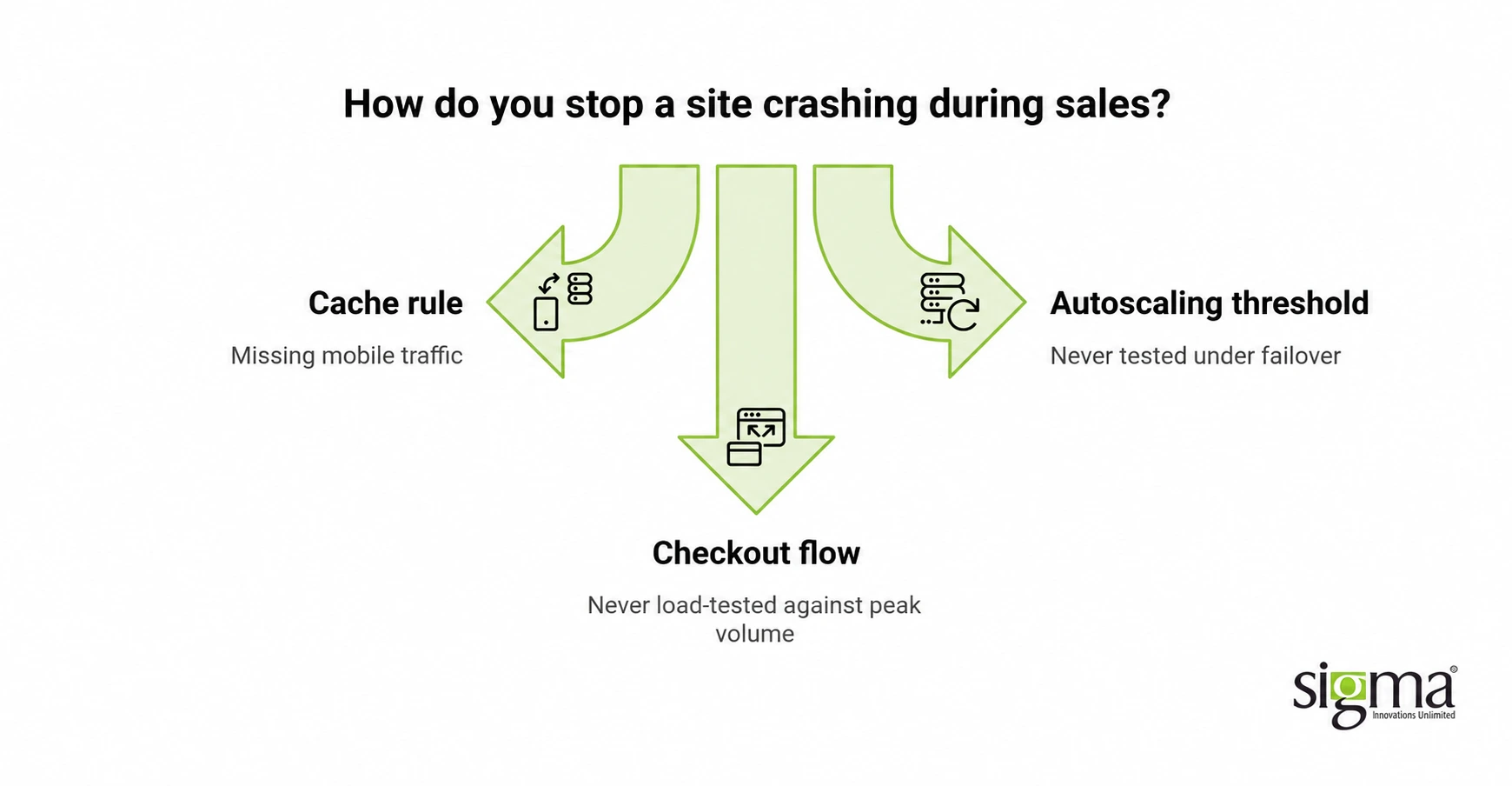
Stopping a site from crashing during a sales event means removing the single points of failure that a normal-day architecture tolerates but a peak day does not: a cache rule that misses mobile traffic, an autoscaling threshold that was never tested under real failover conditions, or a checkout flow that was never load-tested against anything close to Boxing Day volume. Fixing these before the day arrives is a readiness exercise; fixing them during the day is an incident, with a visible outage and a support queue instead of a quiet non-event.
The distinction matters because a readiness review and an incident response draw on the same technical knowledge but operate on completely different timelines. A readiness review can test a failover scenario deliberately, observe the result, and adjust a threshold with no customer impact at all. An incident on Boxing Day itself has none of that room: every minute spent diagnosing the cause is a minute of lost checkout traffic on the one day retailers can least afford to lose it.
How Sigma Gets Retailers Ready for the One Day They Cannot Afford to Get Wrong
A storefront modernization is often judged by how it looks, but the harder test is how it performs under load it was never built for. Sigma modernized a long-established Magento storefront for a California-based retailer using Hyvä, improving frontend performance while preserving a shared multi-website environment that had to keep a second storefront running on its existing setup throughout the change. Orders rose 25% after launch, a result that reflects a faster, more reliable storefront converting the traffic it was already getting, not just a redesign.
The project also had to preserve a shared multi-website environment, since a second storefront on the same platform needed to keep running on its existing setup throughout the change, a constraint that matters to any retailer running more than one storefront on a shared platform heading into a peak event.
Inventory and order-management sync is the readiness item that is easiest to underestimate until a peak day exposes it. Sigma helped a Romania-based beauty brand operating more than 50 physical locations and multiple Shopify Plus stores across several European markets unify its multi-store operations and keep inventory synchronized accurately across every location, supporting continued growth without the stock errors that fragmented systems tend to produce under load.
For a retailer heading into Boxing Day, the question is not whether traffic will spike, it reliably does on this single day more than almost any other, but whether CDN, autoscaling, inventory sync, checkout, and monitoring were all tested together before it arrives. Sigma can run a peak-readiness review as a defined engagement or stay engaged as the team behind the platform through peak season and beyond.
Conclusion
A boxing day sale uk search reflects shopper demand, but the retailer’s real test is whether the site behind the sale holds up on the one day that concentrates this much of the season’s revenue into a single 24-hour window. Boxing Day traffic overwhelms sites sized for normal weeks, and the failures that follow, slow pages, stock errors, payment failures, lost sales, are not random; they trace back to specific, testable layers of infrastructure.
CDN and caching rules that were never validated for mobile and product-page traffic show up as slow pages exactly when shoppers are least patient. Cloud autoscaling thresholds that were never tested under real failover conditions show up as a slowdown or outage at the worst possible moment. Inventory and order-management sync that cannot keep pace with order volume shows up as overselling and canceled orders. Checkout and payment capacity that was never load-tested against peak volume shows up as abandoned carts and failed orders. Observability that only defines technical metrics, not business-impact alerts, means a revenue-affecting failure gets caught too late to matter.
A defined peak-day runbook, with owners and decision rights assigned in advance, is what turns a crisis into a fast, contained fix rather than an improvised one. None of these six areas is optional on its own, since a site can pass every check but one and still fail on the day, at the exact check it skipped.
Retailers that treat Boxing Day readiness as a single coordinated review, rather than six separate vendor conversations, protect the revenue this one day represents instead of discovering the gap while it is happening. The cost of that review is small next to the cost of finding out, on the busiest day of the season, which layer was not actually ready.
Frequently Asked Questions
How do you prepare a website for Boxing Day traffic?
Preparing a website for Boxing Day traffic means validating CDN and caching, cloud autoscaling, inventory and order-management sync, checkout and payment capacity, and observability together, before the day arrives. Testing these layers individually misses the failure that only appears when every system is under load at the same time.
What infrastructure does an ecommerce site need for peak sales?
An ecommerce site needs infrastructure that scales automatically under sudden load, with CDN coverage and cache rules validated for mobile and product-page traffic, autoscaling thresholds confirmed through real failover testing, and checkout and payment routing tested against actual peak-day volume rather than an average day’s traffic.
How do you stop a site crashing during sales?
Stopping a crash during a sales event means removing single points of failure before the event starts: cache rules that miss mobile traffic, autoscaling thresholds that were never tested under failover conditions, or a checkout flow never load-tested against real peak volume. Fixing these in advance is readiness; fixing them live is an incident.
Why does Boxing Day create more infrastructure risk than an ordinary peak day?
Boxing Day concentrates an unusually large share of holiday-season spending into a single 24-hour window immediately after Christmas, when checkout data shows UK spending running well above the surrounding period’s average. That concentration leaves infrastructure almost no time to absorb a slow ramp-up the way a multi-week sale event might.
What should a retailer’s peak-day runbook include?
A peak-day runbook should assign clear ownership for each infrastructure area, define the business-impact alerts that trigger a response (not just technical metrics), and set rollback procedures decided in advance rather than improvised during an incident. Without this, even a well-prepared infrastructure can respond slowly to the one failure nobody anticipated.