Salesforce CPQ ROI: How to Build the Business Case That Gets Implementation Approved

Key Highlights:
- A leadership team that already suspects quoting friction is costing revenue still needs a defensible ROI case before finance signs off on a Salesforce CPQ implementation.
- Building that case means quantifying cycle time, discount leakage, and rep hours lost to manual quoting, then mapping each figure to a specific CPQ capability that addresses it.
- A rollout sequenced around real deal scenarios, tested in stages rather than launched all at once, is what determines whether the ROI case actually materializes after go-live.
- Sigma scopes and sequences Salesforce CPQ implementation projects around the team’s real workflow first, which is the single biggest factor separating rollouts that stick from ones that stall.
Introduction
Deciding that quoting friction is a real problem is the easy part. The harder work starts once a VP of Sales or RevOps leader has to walk into a budget conversation and defend a Salesforce CPQ implementation as a funded project rather than a nice-to-have. Finance wants a number, not a feeling that reps are slow. Sales leadership wants confidence that the rollout will not disrupt a quarter’s pipeline while reps learn a new system. And the team running the project needs a sequence that gets to measurable value without a six-month stall. This is the planning stage most CPQ content skips past, jumping straight from “quoting is broken” to “here is what the tool does.” What actually determines whether the investment pays off is how the ROI case gets built and how the rollout gets sequenced, not just the decision to buy.
Build a Salesforce CPQ Case That Holds Up
Building a Defensible ROI Case
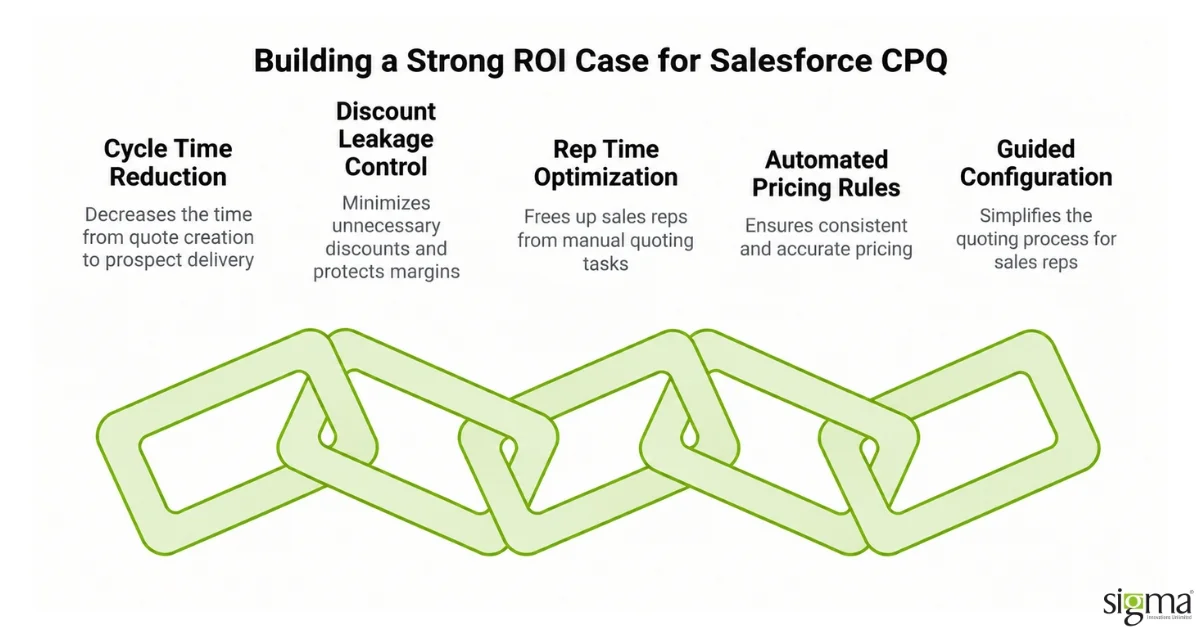
The strongest ROI case for a Salesforce CPQ implementation is built from numbers the business already has, not projections borrowed from a vendor deck. Start with cycle time: pull the average number of days between a deal reaching quote stage and the quote actually reaching the prospect, then estimate what percentage of that time is manual assembly and approval routing rather than genuine customer back-and-forth. Add discount leakage: compare the discount rates different reps apply to comparable deals, since the spread between them is usually a conservative proxy for margin being given away without oversight. Then account for rep time: a rough hours-per-week estimate of quote-building time across the sales team, multiplied by fully loaded cost, turns quoting friction into a number finance recognizes immediately. None of these figures need to be perfectly precise to be useful. What matters is that each one maps directly to a CPQ capability: automated pricing rules close the discount leakage gap, guided configuration closes the cycle-time gap, so the business case reads as a specific fix for a specific cost rather than a general efficiency promise.
Readiness Signals Worth Checking Before You Scope the Project
An ROI case that looks strong on paper can still stall in execution if the team is not actually ready for the project. A few checks are worth running before scoping begins.
| Readiness Check | Ready | Not Yet Ready |
| Pricing and Approval Logic | Documented accurately by a clear owner | Lives informally across a few tenured reps’ memory |
| Catalog Stability | Stable enough to model as-is | Undergoing restructuring that would force a rebuild post-launch |
| Team Bandwidth | Can test against real deal scenarios during implementation | Validation only happens after go-live, in front of live customers |
| Executive Sponsorship | Strong enough to hold the timeline through mid-project friction | Likely to waver, risking a compromised scope |
None of these are disqualifying on their own, but a project missing two or more of them should plan for a longer runway or a more phased rollout than the standard timeline assumes.
Sequencing the Rollout So the ROI Actually Materializes
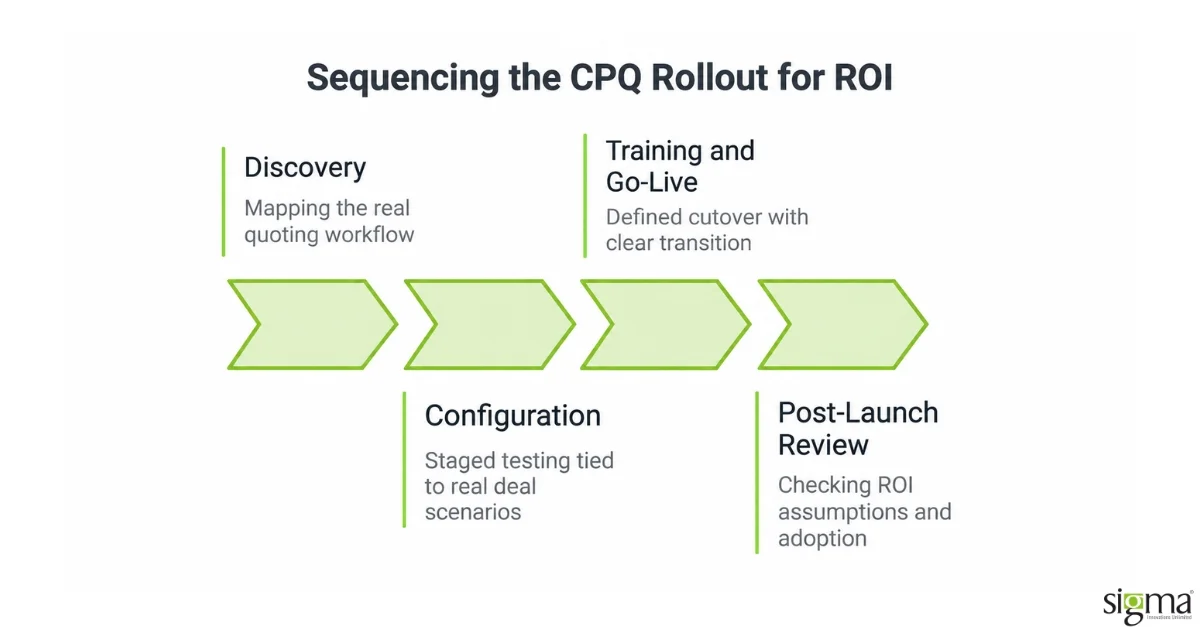
The gap between a CPQ project that delivers its projected ROI and one that quietly underperforms is almost always in the rollout sequence, not the software itself. Discovery has to come before configuration: mapping the real quoting workflow, catalog structure, and approval chain, rather than assuming a standard template, is what prevents a system that technically works but that reps route around because it does not match how they actually sell. Configuration should proceed in stages tied to real deal scenarios, tested by sales and operations at each step, rather than delivered as one large release at the end of the project, since staged testing surfaces edge cases while they are still cheap to fix. Training and go-live need a defined cutover, not a soft transition where reps can quietly default back to the old spreadsheet process, which is one of the most common reasons a technically successful implementation never converts into the projected ROI. Finally, the project needs an explicit post-launch review, typically thirty to sixty days after go-live, that checks the original ROI assumptions, cycle time, discount consistency, and rep adoption against what actually happened, so any gap gets addressed while it is still small.
For companies running subscription or recurring-revenue models, this sequencing has one more dependency worth planning for early: aligning CPQ contract terms with the billing and revenue recognition system before go-live, rather than treating that integration as an afterthought once quoting is already live. Retrofitting that connection after the fact is a common source of scope creep in Salesforce CPQ projects.
Sigma Infosolutions Scopes and Sequences a CPQ Implementation
Most Salesforce CPQ implementation projects that stall do not fail on the technology. They fail because configuration started before the team’s real workflow was properly mapped, which produces a system that is technically correct but practically unusable. Sigma’s approach starts with discovery: documenting the actual quoting workflow, product catalog structure, and approval logic in use today, so the ROI case built during scoping and the configuration built during implementation are grounded in the same reality. From there, Sigma’s architects design the data model and pricing rule sets to hold up under the catalog’s real complexity, and configuration proceeds in iterative sprints so sales and operations can test against genuine deal scenarios at each stage rather than discovering gaps at go-live. Sigma completed a Salesforce Account Engagement implementation for a US-based membership organization that connects businesses with supplier networks, unifying prospect tracking and lead scoring inside Salesforce. That engagement delivered a 30 percent increase in lead-to-opportunity conversion and a 43 percent reduction in manual campaign execution effort, the kind of measurable, staged outcome that comes from scoping a project around the team’s actual workflow first, which is the same discipline a CPQ rollout depends on to convert its ROI case into a real result.
That engagement addressed workflow discipline on the lead-generation side; the same discipline applies to voice and service operations built on the platform.
Both results came from sequencing discovery before configuration, the same order a Salesforce CPQ implementation requires. The Account Engagement implementation lifted lead-to-opportunity conversion by mapping the real marketing workflow first; the contact center modernization cut resolution time by mapping call handling before touching the platform. Configuration that skips this step produces a system that is technically correct and practically unusable.
The trade-off in building a rigorous CPQ ROI case before implementation is the time investment it requires from sales operations, finance, and leadership before any configuration work begins. Organizations that skip this step move faster into the implementation phase but typically encounter the same budget justification challenges mid-project, when scope has already expanded and the original approval was based on assumptions nobody documented. The deeper trade-off in CPQ investment itself is adoption risk: a correctly configured CPQ system reduces quote cycle time and discount variance, but only when sales reps actually use it rather than reverting to the manual process during quarter-end pressure. Implementation that sequences correctly and includes a defined cutover with accountability is what separates a CPQ project that delivers its ROI case from one that technically ships but never fully displaces the workflow it was meant to replace.
Sigma Infosolutions works as a long-term Salesforce partner through CPQ implementation and post-launch adoption, not just through the go-live date. If your team has identified CPQ as the right investment and needs a partner who will own both the business case development and the implementation sequencing, speak with Sigma’s Salesforce practice to scope the engagement.
CPQ implementation readiness depends on how standardized your pricing already is: an organization with highly custom, negotiated pricing on every deal faces a longer configuration buildout, while one with structured pricing tiers sees faster ROI. The trade-off is implementation timeline against long-term deal velocity, rushing configuration to hit a launch date risks exactly the quoting errors CPQ is meant to eliminate. Readiness should be assessed against your current approval workflow before committing to a go-live date.
Conclusion
A Salesforce CPQ implementation succeeds or stalls based on decisions made before a single configuration screen is touched. Building a defensible ROI case starts with numbers the business already has, quote cycle time, discount spread across reps, and hours lost to manual quote assembly, mapped directly to the CPQ capability that addresses each one. That case only holds up if the team is genuinely ready, with documented pricing logic, a stable catalog, real testing bandwidth, and sponsorship that survives mid-project friction. Even a strong ROI case and a ready team can underperform if the rollout itself is sequenced poorly. Discovery has to precede configuration, and staged testing against real deal scenarios has to precede go-live. A defined cutover has to prevent reps from quietly reverting to the old process, since a soft transition rarely holds once quarter-end pressure builds. A post-launch review at thirty to sixty days is what confirms whether the original ROI assumptions actually held, rather than assuming they did. Subscription and recurring-revenue businesses carry one additional dependency worth scoping upfront: aligning contract terms with billing and revenue recognition before launch, not after. None of this replaces the more basic question of whether CPQ is the right tool for a given team’s complexity in the first place, which the companion piece in this cluster addresses directly. For a team that has already answered that question, the work now is building the case and sequencing the rollout with the same discipline the tool is meant to bring to quoting itself. Getting this planning stage right is what separates a CPQ project that delivers its projected return from one that technically ships but never quite pays off.
Plan Your Salesforce CPQ Implementation With Confidence
Build the business case, scope the right implementation, and sequence the rollout with Sigma’s Salesforce consulting services.
Frequently Asked Questions
What numbers do we actually need to build a Salesforce CPQ ROI case?
Focus on three: average quote cycle time and how much of it is manual, the spread in discount rates different reps apply to comparable deals, and rep hours per week spent building quotes multiplied by fully loaded cost. These map directly to CPQ’s core capabilities and read as specific, not speculative.
How do we know our team is actually ready for a CPQ implementation, not just interested in one?
Check whether someone can accurately document current pricing and approval logic, whether the catalog is stable enough to model, whether the team has bandwidth to test during implementation, and whether executive sponsorship will hold through mid-project friction. Missing two or more signals means plan for a longer runway.
What is the most common reason a CPQ implementation fails to deliver its projected ROI?
Configuration starting before the team’s real quoting workflow is properly documented. The system ends up technically correct but practically mismatched to how reps actually sell, which drives low adoption, quiet workarounds, and reps routing back to the old spreadsheet process within a few months of going live.
How long should a properly sequenced CPQ rollout take?
Discovery and scoping typically run several weeks, with a mid-market implementation reaching go-live in eight to twelve weeks after that, depending on catalog and integration complexity. Add time for a thirty- to sixty-day post-launch review that checks the original ROI assumptions against real, measured results.
Should billing and revenue recognition integration be scoped as part of the initial CPQ project?
Yes, for any subscription or recurring-revenue business. Retrofitting that connection after CPQ is already live is a common source of scope creep, rework, and billing errors, so aligning contract terms with billing and revenue recognition systems belongs in the original project scope, not a later, separately funded phase.