RegTech Compliance Automation for Fintech & Banks (AI-Powered Guide 2026)

Key Highlights
- Banks and fintech lenders relying on manual compliance infrastructure face rising risks of regulatory penalties, audit failures, delayed reporting, and costly operational errors that often escalate before teams can respond effectively.
- Sigma Infosolutions helps financial institutions modernize compliance operations with AI-powered automation systems that integrate directly with existing banking and fintech infrastructure to streamline KYC, AML monitoring, and regulatory reporting workflows.
- Financial institutions adopting automated compliance workflows reduce per-filing costs, minimize manual review hours, and allow compliance analysts to focus on examination readiness and high-priority risk investigations instead of repetitive alert clearance.
- Global RegTech investment reached approximately $18.6 billion in 2024, highlighting how rapidly banks and fintech organizations are replacing fragmented manual compliance processes with scalable, auditable automation systems.
Financial institutions are entering 2026 under increasing regulatory pressure. Compliance teams are expected to process larger transaction volumes, monitor cross-border financial activity in real time, maintain audit-ready reporting records, and respond faster to evolving AML, KYC, and reporting requirements. At the same time, many banks, fintech lenders, and digital financial platforms still rely on fragmented workflows built around spreadsheets, static rule engines, and manually reviewed alerts.
That operational gap is becoming expensive. Manual compliance infrastructure slows onboarding, increases false-positive AML alerts, creates reporting inconsistencies, and leaves institutions vulnerable to regulatory penalties during examinations. Compliance operations that once worked at a smaller scale now struggle to keep pace with modern transaction velocity and multi-jurisdictional regulatory demands.
This is where RegTech compliance automation is reshaping financial services operations. AI-powered compliance systems now help banks and fintech companies automate KYC verification, improve AML monitoring accuracy, streamline suspicious activity reporting, and maintain continuous audit readiness through centralized, traceable compliance workflows. Instead of reacting to regulatory pressure after the fact, institutions are building proactive compliance infrastructures designed to scale alongside business growth.
In this blog, we explore how RegTech compliance automation is transforming compliance operations for banks and fintech organizations in 2026, how behavioral risk models reduce false positives, why automated regulatory reporting improves examination readiness, and how scalable compliance architecture supports expansion across multiple regulated markets.
Why Manual Compliance Infrastructure Fails at Scale
The core failure of manual compliance is not effort. Analyst teams at mid-sized institutions work at capacity. The failure is structural: rule-based monitoring systems flag every account that crosses a fixed transaction threshold, regardless of whether the underlying behavior deviates from that customer’s documented history. A retail customer who makes an unusually large wire transfer because of a property sale generates the same alert as a genuinely suspicious one. In practice, most alert queues clear without a single SAR filing, which means analyst hours are spent documenting non-events.
Regulators treat a delayed alert review and a missed one with the same scrutiny. Both create an undocumented interval between the event and the institutional response, and both show up as gaps during examination. An AML program that clears alerts slowly does not satisfy examination standards simply because the alerts are eventually cleared.
The operational math compounds quickly. A mid-sized lender with 200,000 active accounts generates thousands of threshold-triggered alerts monthly. With five analysts, each alert queue item represents a measurable cost. Automated compliance infrastructure reduces that queue not by skipping reviews but by filtering out accounts whose behavior is statistically consistent with their own history before the alert is ever generated.
How Behavioral Risk Models Change Alert Economics
From Threshold Logic to Account-Level Analysis
The shift from fixed-threshold alerting to behavioral analysis changes the economics of compliance operations directly. Behavioral models evaluate each transaction against the specific history of the account generating it. A high-frequency micro-payment pattern flagged by a static rule resolves immediately when the model recognizes it as consistent with this account’s 18-month transaction record. Tier 2 banks in the United States that have moved to behavioral monitoring report alert volume reductions between 40 and 60 percent within the first two quarters of deployment.
Fewer alerts mean analysts work cases with genuine risk profiles instead of clearing documentation backlogs. When a SAR ( Suspicious Activity Report ) does need to be filed, the system generates a risk narrative from the account’s transaction data, which the analyst reviews and approves rather than writing from scratch. That change alone reduces average SAR preparation time by a material margin and gives examiners a cleaner, more consistent filing record to audit.
What Automated SAR Workflows Deliver to Examination Teams
An examiner’s first request in an AML review is the alert disposition record: what triggered the alert, when it was reviewed, and what the institution did about it. Automated workflows produce that record at the point of activity, not during exam preparation. Each alert carries a timestamp, a risk score, a transaction narrative, and a disposition record. The examiner receives a complete audit trail for every case in the review period without the institution needing to reconstruct it from system logs and analyst notes.
That documentation is built at the point of activity, which means an institution facing a six-week examination window does not spend the first two weeks locating records.
Also, read the blog: Digital Lending Solutions for NPA Monitoring & Risk Management
Automated Regulatory Reporting and Examination Readiness
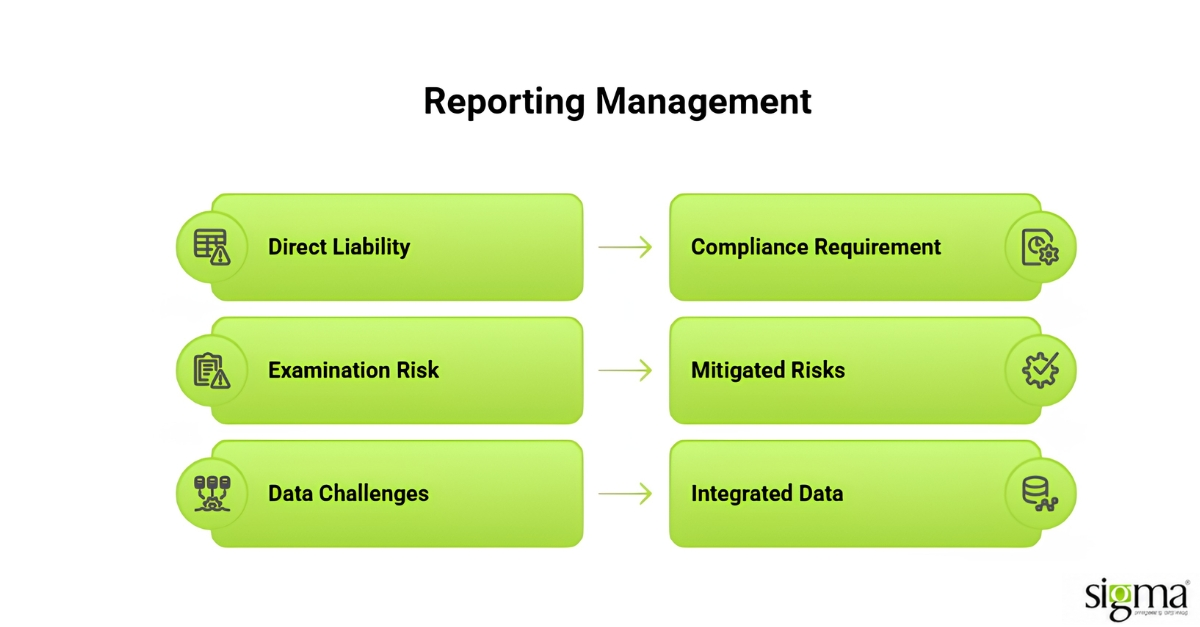
Spreadsheet-managed reporting becomes a direct liability under Basel III, CCAR, and IFRS 9 timelines. Version inconsistencies, data entry errors, and missed submission windows each carry examination risk. The CCAR stress-testing cycle alone requires institutions to produce capital adequacy projections across multiple economic scenarios, with data sourced from systems that do not always share a common schema.
Reporting pipelines draw from the same data sources the core banking system uses for daily operations, which eliminates the transcription step where errors enter spreadsheet-managed reports. The data lineage behind each figure is recorded at the point of output, so documentation requests from regulators are answered in minutes rather than through days of manual reconstruction. When a regulator requests records for a specific reporting period, the institution retrieves a complete, date-stamped record of every data transformation and compliance decision without assembling it afterward.
Compliance teams also gain the ability to model the impact of incoming regulatory changes against current data before those rules take effect. A team preparing for a new provisioning requirement under IFRS 9 can run the new calculation logic against live loan data 90 days before the effective date, identify gaps, and adjust before the examination cycle begins.
Compliance Capability Comparison: Manual vs. Automated Operations
Compliance Function | Manual Approach | Automated Approach |
| KYC Verification | Analyst document review | Automated ID extraction, biometric matching, and risk scoring |
| AML Transaction Monitoring | Static threshold alerts | Behavioral anomaly detection with account-level risk narrative |
| Regulatory Report Generation | Spreadsheet compilation with manual version control | Automated data pipelines with full, date-stamped audit trails |
| Suspicious Activity Reporting | Manual case write-up by analyst | AI-assisted narrative drafting with analyst approval workflow |
| Sanctions Screening | Static name-list matching | Fuzzy matching and contextual entity resolution |
| Audit Trail Management | Fragmented system records assembled on request | Centralized, timestamped, version-controlled documentation |
Multi-Jurisdictional Compliance Architecture
The Cost of Building Compliance Logic Market by Market
A fintech lender licensed in California and operating under FCA oversight in the United Kingdom manages two distinct regulatory regimes from day one. When Australian customers under APRA requirements are added, that number rises to three, each with its own reporting formats, data retention timelines, and examination standards. Building compliance logic separately for each jurisdiction is expensive and structurally fragile. A reporting rule change in one market should not require rebuilding the logic that supports the others.
When the FCA updates its onboarding verification requirements, the change is applied within that jurisdiction’s configuration layer. The California AML thresholds and APRA reporting templates run on separate logic and are unaffected. Pre-built jurisdiction modules carry standard report formats, data retention timelines, and onboarding requirements for each regulated market. Entering a new market means configuring an existing module, not commissioning a full rebuild.
Regional Behavioral Data and Cross-Market Alert Accuracy
Behavioral risk models trained on one market’s transaction data introduce systematic bias when applied to customers from another. A high-frequency micro-payment pattern common among gig-economy workers in Southeast Asia can generate AML alerts when that customer transacts in a UK-regulated account, because the model was calibrated on UK account behavior. Risk models trained on regional transaction data calibrate thresholds to local behavioral norms. The alert fires when behavior is anomalous for that market, not simply unfamiliar to a model trained elsewhere.
How Sigma Infosolutions Delivers RegTech Compliance Automation
Before deployment begins, Sigma Infosolutions maps gaps between the institution’s examination schedule and its existing compliance workflow. This helps identify which operational areas need automation first and which systems require priority integration.
In some organizations, the biggest bottleneck is slow KYC processing. Others struggle with excessive AML alert volumes or reporting deadlines tied to upcoming examinations. The deployment sequence is adjusted around those operational pressures rather than applying the same rollout model to every institution.
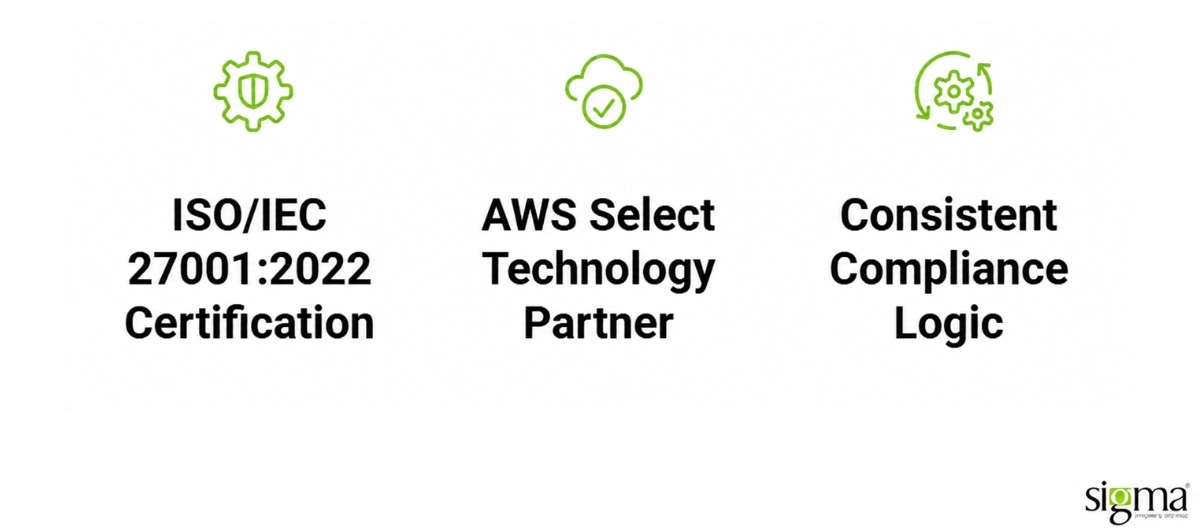
Sigma holds ISO/IEC 27001:2022 certification for information security management and operates as an AWS Select Technology Partner Both certifications satisfy the vendor risk assessment criteria that regulated institutions apply before contracting with any third-party compliance system. OCC and FFIEC examinations test for environment consistency across the deployment pipeline’s compliance logic built on Sigma’s infrastructure executes identically at every stage, from development through production.
Sigma’s integration of Azure OpenAI with the LangGraph framework gives compliance teams the ability to query transaction histories, generate exception reports, and model regulatory scenarios in natural language. An analyst can move from “show me SAR filings from Q1” to “filter for accounts flagged more than twice in the same period” and receive a sequential, coherent result because the system maintains context between queries. Each compliance layer within the modular architecture is independently configurable, isolating rule changes to the jurisdiction where they apply.
For fintech lenders, compliance automation integrates directly into the loan lifecycle. KYC verification, credit bureau checks, and AML screening run within the origination workflow rather than as parallel manual processes, reducing time-to-decision while maintaining a centralized, audit-ready system of record.
Also, read the blog: Discover How RegTech Is Revolutionizing Financial Services with AI-Powered Compliance Automation, Real-Time Risk Monitoring, and Smarter Regulatory Reporting. Read the Full Blog Now.
Conclusion
RegTech compliance automation is no longer something financial institutions can postpone to a future roadmap. Examination standards, alert volume, and cross-border reporting requirements have outgrown what manual compliance teams can realistically manage. Manual processes simply do not scale anymore.
Compliance teams spend less time clearing low-risk alerts and more time reviewing cases that actually require escalation. Many examination findings still come from missing records or inconsistent reporting history, and automated reporting pipelines reduce those issues significantly. Institutions can also expand into new regulated markets faster because they are not rebuilding compliance workflows for every jurisdiction.
Sigma Infosolutions supports these deployments with ISO-certified security practices and cloud infrastructure designed for regulated financial environments. Examination expectations in 2026 are not fundamentally different from previous years, but the operational volume behind those examinations has increased considerably. Institutions with scalable compliance infrastructure are better positioned to complete examinations without major remediation requirements.
Frequently Asked Questions
Q1: What is RegTech compliance automation, and why does it matter for banks in 2026?
RegTech compliance automation replaces manually operated rule engines and spreadsheet-based reporting with systems that detect behavioral anomalies, generate audit-ready documentation, and adapt to regulatory changes without requiring an architecture rebuild. Regulatory volume has grown beyond what manual compliance teams can reliably process at the pace that OCC, FCA, and APRA examinations now require from mid-sized institutions.
Q2: How does behavioral monitoring reduce false positives in AML programs?
Behavioral monitoring compares transactions against the account’s normal transaction history instead of applying the same fixed threshold to every customer. The system raises an alert only when activity looks unusual for that specific account. Institutions using behavioral monitoring have reported alert volume reductions between 40 and 60 percent. That allows compliance teams to spend less time reviewing harmless alerts and more time investigating real risks.
Q3: What compliance architecture supports multi-jurisdictional fintech operations?
Modular compliance frameworks allow report templates, onboarding rules, and risk thresholds to be configured independently per jurisdiction within isolated layers. A regulatory change in one market does not affect the logic governing another. Pre-built modules for markets including the United States, United Kingdom, and Australia reduce the development burden of entering a new regulated environment without a full infrastructure rebuild.
Q4: How does automated regulatory reporting reduce examination risk?
Automated pipelines generate a date-stamped record of every data transformation and compliance decision at the point of output. When a regulator requests documentation, the institution retrieves a complete audit trail in minutes. There is no manual reconstruction involved, and the data lineage behind every reported figure is traceable back to its source without additional preparation.
Q5: What certifications should a RegTech compliance automation vendor hold?
ISO/IEC 27001 certification for information security management is a baseline requirement for any vendor handling compliance data in a regulated environment. Cloud infrastructure meeting OCC, FCA, or APRA standards, combined with documented environment-consistency practices across the deployment pipeline, provides the operational evidence that regulated institutions require during vendor risk assessments before contract award.