The Data Problem That Makes AI Credit Scoring Fail Before It Starts

Key Highlights:
- Alternative data feeds reach scoring models with inconsistent schemas, missing fields, and unverified sources, so scores lose credibility with underwriters.
- Treat data validation, normalization, and lineage as a governed layer that sits between every provider and the model.
- Lenders get scores underwriters can trust, explain, and act on, which keeps automated decisions automated.
- Sigma engineers validated ingestion pipelines and unified lending data platforms on pre-integrated lending infrastructure.
Most lenders that stall on AI credit scoring do not have a model problem. The model usually performs well in validation on a curated historical sample that was cleaned by hand before anyone trained on it.
Production is different: bank transaction feeds arrive with shifting category labels, utility and telco records carry gaps, and bureau responses for thin-file applicants return half-empty. Scores built on those inputs swing without explanation, underwriters stop trusting them, and the lender quietly reverts to manual review while still paying for the model
Why AI Credit Scoring Projects Stall Before the First Credit Decision
AI credit scoring is the use of machine learning models to estimate a borrower’s probability of default from bureau data combined with alternative signals such as bank transactions, utility and telco payments, and cash flow patterns. Applicants’ bureau scores cannot become assessable. The dependency is equally clear, because every one of those signals arrives from a different provider, in a different format, at a different level of reliability.
The typical failure does not look like failure at first. A model is trained on twelve to twenty-four months of historical applications, validated against known outcomes, and approved by the credit committee. Once connected to live feeds, its behavior changes. Scores for similar applicants diverge. Approval rates move after a provider changes a field name. Underwriters see declines they cannot explain to a broker or a borrower.
The response is predictable and rational. Referral thresholds are widened, more applications route to manual review, and automated loan approval shrinks to the narrow band of applicants the old scorecard already handled. The lender now runs two processes, pays for both, and has little evidence either way about whether the model works, because the data it receives in production is not the data it was validated on.
Alternative Data Arrives in Formats No Model Was Trained On
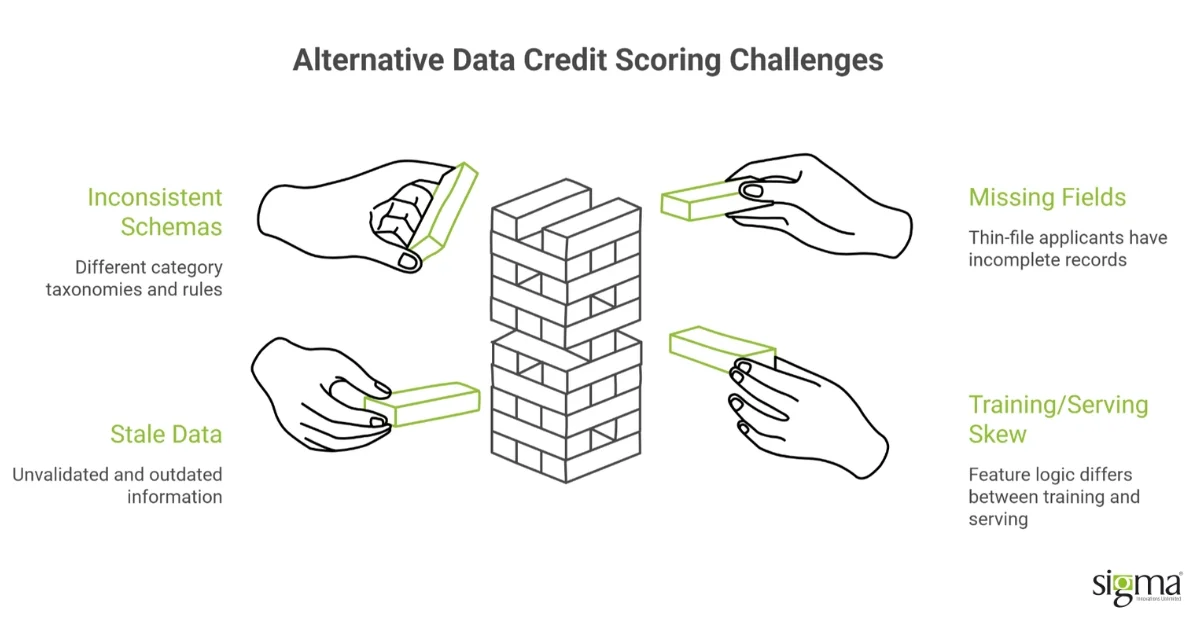
Alternative data credit scoring introduces failure modes that bureau-only scorecards rarely encounter. Four of them account for most stalled implementations.
Inconsistent schemas across providers. Two bank data aggregators can describe the same transaction with different category taxonomies, date conventions, and sign rules for credits and debits. A model trained on one provider’s categories degrades silently when a second provider is added for coverage, because “income” and “transfer” no longer mean the same thing in both feeds.
Missing and sparse fields. Thin-file applicants are the reason most lenders invest in alternative data, and they are also the applicants whose records are most incomplete. A model that treats a missing utility history as zero payments, rather than as an absent signal, penalizes exactly the segment it was meant to reach.
Unvalidated and stale sources. Consent-based bank connections expire, telco feeds lag by weeks in some markets, and some providers return cached responses without flagging their age. Without freshness checks, a score can rest on data that describes a borrower’s situation from months earlier.
Training and serving skew. Historical training data was typically extracted, cleaned, and joined by an analyst. Production data flows through APIs with different transformations. When the feature logic used in training differs from the logic applied at decision time, the model is effectively scoring a different population than the one it learned from.
What a Lender Should Validate Before a Score Reaches an Underwriter
A lender preparing for AI for digital lending should treat the data layer as a product with its own requirements, owner, and monitoring. The controls below are what separate a model that survives production from one that is switched off within a quarter.
A data contract for every source. Each provider feed should have a documented schema, expected value ranges, freshness limits, and a named owner. When a provider changes a field, the contract fails loudly at ingestion instead of silently at scoring.
Validation at the point of capture. Records that fail range, format, or consistency checks should be quarantined or routed for review before they reach the feature store. Catching a malformed record at intake costs seconds; catching it after a decline costs a complaint and a manual reconstruction.
Explicit missing-data policy. Missing signals should be modeled as missing, with the policy documented and reviewed by credit risk, so that thin-file applicants are assessed on the evidence available rather than penalized for its absence.
Lineage from decision back to source. Every score should be traceable to the specific provider responses, versions, and transformations that produced it. This makes it easier for lenders to understand how a decision was reached, investigate unexpected outcomes, and provide clear explanations when a decision is challenged or reviewed.
Per-source drift monitoring. Population stability should be tracked for each provider feed, not just for the final score, so that a change in one source is visible before it moves approval rates.
Connection itself is rarely the hard part. Sigma’s lending platform comes pre-integrated with more than 50 third-party providers across credit bureaus, open banking, fraud detection, income verification, and identity validation, as described in how fintechs use API integration for real-time credit scoring. The harder engineering work is governing what those connections return.
Build In-House, Buy a Score, or Engineer a Governed Data Layer
Lenders typically choose among three approaches to getting alternative data into credit decisions. Each can be appropriate, depending on volume, product mix, regulatory exposure, and in-house data engineering capacity.
| Criteria | Direct Integrations Built In-House | Third-Party Score as a Service | Governed Data Layer on a Pre-Integrated Platform |
| Time to first production decision | Long, one integration at a time | Short | Moderate |
| Control over validation rules | Full, if the team builds it | Limited to what the vendor exposes | Full, configured per source |
| Explainability of inputs | Depends on lineage investment | Often limited to vendor reason codes | Traceable from score to source record |
| Handling of missing and stale data | Custom, frequently inconsistent | Vendor-defined, often opaque | Documented policy per feed |
| Ongoing maintenance | High as provider APIs change | Low, but with vendor dependency | Shared, with integrations maintained centrally |
| Typical fit | Large lenders with dedicated data teams | Early-stage products testing demand | Growth-stage lenders scaling automated decisions |
A score purchased as a service can make sense for a lender validating a new product before committing engineering effort, though it limits how far the lender can explain or tune decisions. Full in-house builds suit organizations with dedicated data engineering capacity and long time horizons. For growth-stage lenders in the US, Canada, and ANZ, scaling lending automation across more than one product, a governed data layer on a pre-integrated alternative lending platform usually balances control, speed, and maintenance cost most effectively.
When Underwriters Start Overriding the Score, the Feed Is Usually the Culprit
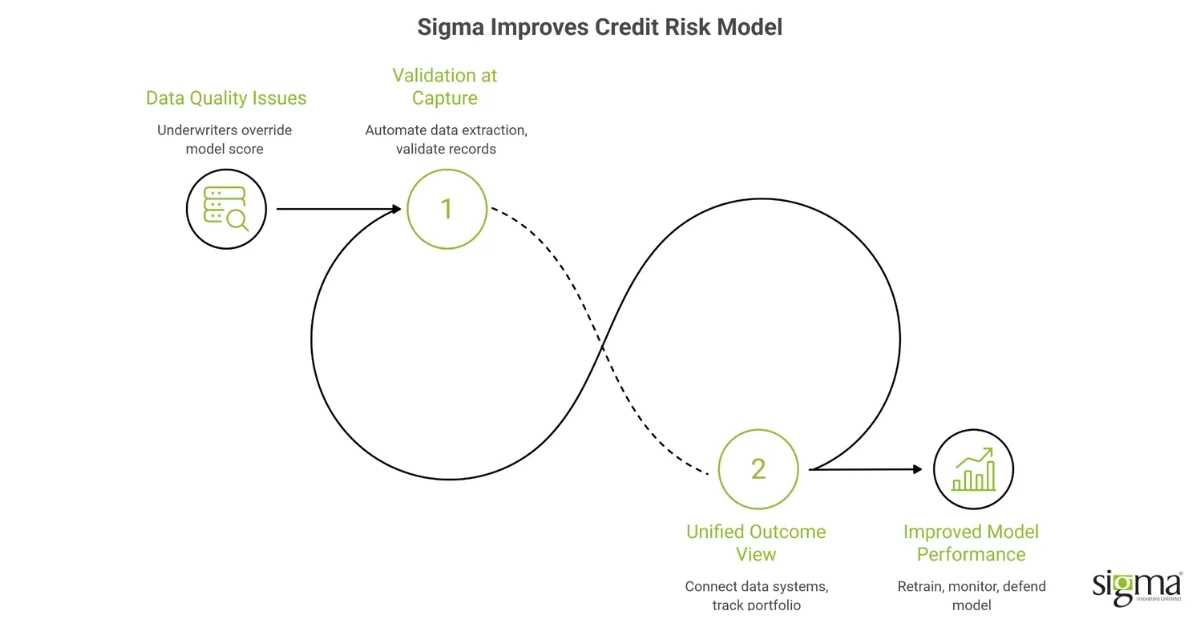
The earliest signs of a data problem show up in operations, not in model metrics. Override rates climb for specific segments. Referral queues grow after a provider release. Underwriters keep side spreadsheets to re-check income because they no longer trust the categorized transactions. Each symptom points upstream, to validation that happens too late or not at all, and Sigma’s diagnostic work starts by mapping those symptoms to the specific feeds and transformations behind them.
Validation at capture is the first control Sigma puts in place, because it is where manual correction work originates. For a regulated lender processing loans generated through cheque-based campaigns, staff were reading cheque images and keying data by hand, and small entry errors caused validation failures and delayed loan creation. Sigma used Azure Document Intelligence to extract fields automatically, validated each record against campaign rules before loan creation, and added a human-in-the-loop review application for exceptions. The pipeline now handles about 5,200 cheques daily and more than 1.8 million annually, at an average extraction confidence of 89%, with operational savings of 90%.
Validation at intake solves only half the problem when origination, servicing, collections, and CRM data still live in separate systems. A scoring model cannot be monitored against outcomes it cannot see. For a fast-growing digital lender that had already moved to Snowflake, dbt, and Airflow, business teams still depended on ad hoc SQL and disconnected dashboards. Sigma built a Snowflake-native lending intelligence platform with an underwriting and credit policy monitor, portfolio health and delinquency tracking, and a Borrower 360 view, governed through role-based access, dynamic masking, row-level security, and audit logging. The architecture was designed to support future AI assistants and predictive models without redesign.
Together, validated intake and a unified outcome view give credit risk teams what they need to retrain, monitor, and defend a model. Sigma typically delivers this work through dedicated engineering teams in long-term partnerships, because data contracts and drift monitoring need an owner well after the first model goes live.
Conclusion
Stalled AI credit scoring programs rarely trace back to the model itself. Validation on curated historical samples hides the variability of live alternative data feeds. Inconsistent schemas, sparse fields, stale sources, and training and serving skew all change what the model receives in production. Underwriters respond to unexplained scores by overriding them, and automated decisions shrink back toward manual review.
Treating the data layer as a governed product is what reverses that pattern. Data contracts, validation at capture, explicit missing-data policy, lineage, and per-source drift monitoring form the core controls. Lineage also supports adverse action explanations and the data quality expectations regulators increasingly apply to credit models.
Lenders can build integrations in-house, buy a score as a service, or engineer a governed layer on pre-integrated infrastructure. Each approach fits a different stage, volume, and level of internal data capacity. For most growth-stage lenders, the governed layer offers the most practical balance of control and speed. Lenders that fix the data first give their models a fair chance to earn underwriter trust.
Frequently Asked Questions
What is AI credit scoring and how does it use alternative data?
AI credit scoring applies machine learning models to estimate default risk from bureau data combined with alternative signals such as bank transactions, rent, utility, and telco payment histories. The models can assess thin-file applicants a bureau score cannot, but their accuracy depends on how consistently those alternative sources are validated, normalized, and kept current in production.
Why do alternative credit scoring models perform worse in production than in testing?
Models are usually validated on historical data that analysts cleaned and joined by hand. Production data arrives through live APIs with different schemas, missing fields, stale responses, and different transformation logic. When the features calculated at decision time differ from those used in training, the model scores a population it did not learn from, and performance drops.
How should lenders handle missing alternative data for thin-file applicants?
Missing signals should be represented as missing rather than converted to zeros or defaults, with a documented policy reviewed by credit risk. Models can then weigh the evidence that exists without penalizing applicants for absent records. Tracking missing-data rates per provider also shows when a coverage gap reflects a feed problem rather than the borrower population.
What data governance controls matter most for automated loan approval?
The most important controls are a documented data contract for each provider, validation at ingestion, explicit missing-data rules, lineage from every decision back to source records, and drift monitoring per feed. Together they keep scores explainable to underwriters and regulators, and they surface provider changes before those changes move approval rates.
Should a lender build alternative data integrations in-house or use a pre-integrated platform?
The answer depends on volume, product mix, and data engineering capacity. In-house builds offer full control but carry heavy maintenance as provider APIs change. Score-as-a-service products launch quickly but limit explainability. A governed data layer on pre-integrated lending infrastructure often suits growth-stage lenders that need control over validation without maintaining every connection themselves.