Credit Decisioning Engine: Rules-Based vs ML Models Compared

Key Highlights:
- Lenders need credit decisions that are fast and accurate, without sacrificing compliance, fairness, or the ability to explain a decline.
- Choose between rules-based and machine learning decisioning deliberately, and in most cases combine them, so each does what it is best at.
- Sigma builds intelligent credit decisioning platforms that blend business rules, ML models, data integrations, and regulatory governance.
Introduction
Every loan decision is a bet, and the engine making that bet sets the odds. A credit decisioning engine is the system that takes an application, weighs the risk, and returns an answer: approve, decline, or refer, often in seconds. Get it right, and you lend more to the right people. Get it wrong, and you either turn away good borrowers or approve bad ones.
For most lenders, the hard part is not making one decision. It is making millions of them, fast, consistently, and inside the rules. A slow or rigid engine bleeds revenue through abandoned applications and manual reviews. A careless one bleeds it through defaults and compliance trouble. Neither is survivable at scale.
That is why the choice between a rules-based approach and machine learning sits at the center of modern lending. Both can power a credit decisioning engine, and neither is automatically the winner. This guide breaks down how each one works, where each wins, why explainability changes the math, and how the strongest lenders end up using both.
What Is a Credit Decisioning Engine?
A credit decisioning engine, sometimes called a credit decision engine or loan decisioning software, is the automated brain of the lending process. It sits inside or alongside the loan origination system and decides how to handle each application based on the data and logic you give it.
The job sounds simple: say yes, no, or maybe. Underneath, the engine pulls data from credit bureaus, bank records, and increasingly alternative data, applies your risk policy, and returns a decision along with the reasoning behind it. Done well, this is automated underwriting that is fast, consistent, and defensible.
Building a high-performing credit decisioning engine starts with a scalable financial software foundation.
How a Credit Decision Engine Works
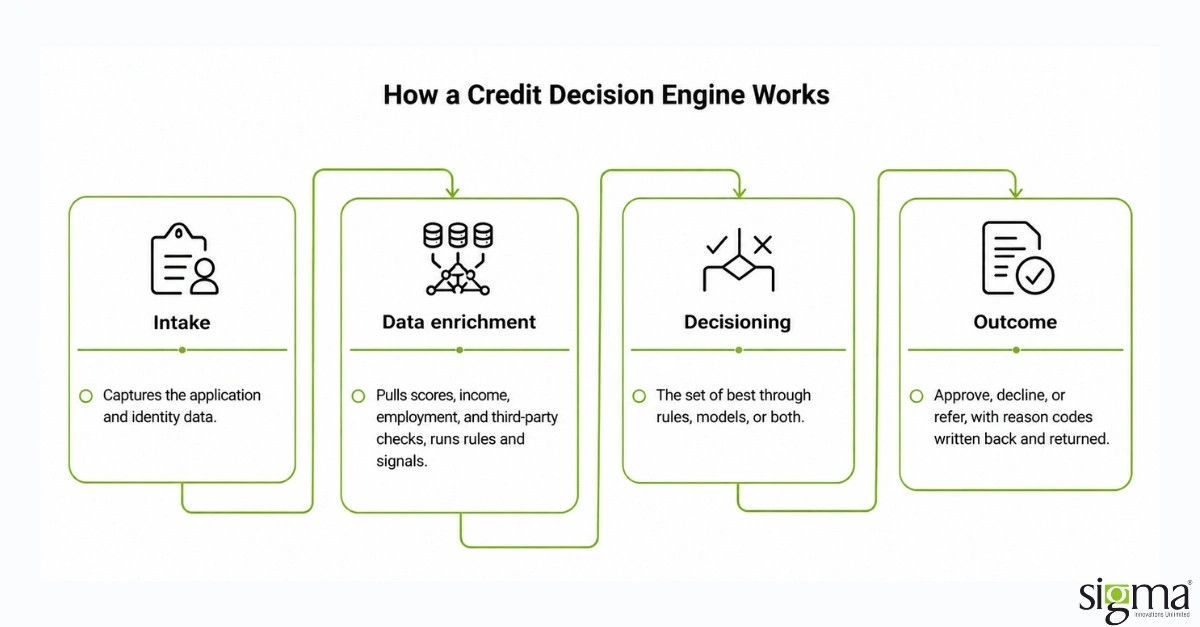
Most credit risk decisioning follows the same path, whatever logic powers it:
- Intake: Capture the application and identity data.
- Data enrichment: Pull bureau scores, income, fraud and KYC checks, and alternative signals.
- Decisioning: Run all of that through rules, models, or both.
- Outcome: Approve, decline, or route to a human, with reason codes attached.
The real difference between engines lives in step three: how the decision actually gets made. That is where rules and machine learning part ways.
Rules-Based Credit Decisioning: Strengths and Limits
A rules-based engine runs on explicit if-then logic that your risk team writes. If the credit score is below a cutoff, decline. If debt-to-income is over a threshold, refer for review. If everything clears, approve. It is a business rules engine pointed at lending.
The appeal is control and clarity. Every decision traces back to a rule you can put your finger on, which makes audits, compliance, and adverse action explanations straightforward. Rules launch fast, non-engineers can read them, and they behave predictably by design.
The limits show up as you scale. Rules are rigid, and they multiply quickly until you have hundreds of them quietly contradicting each other. They capture the patterns you already know but miss the subtle, nonlinear ones buried in the data. And they never adapt on their own, so every market shift turns into more manual upkeep.
Read the blog: Fraud Detection in Fintech Using Machine Learning: Approaches and Best Practices
Machine Learning Credit Decisioning: Strengths and Limits
A machine learning engine learns risk from historical data rather than from hand-written rules. Machine learning credit scoring models weigh hundreds of variables at once, including combinations a human would never think to try, and they often predict default more accurately as a result.
That accuracy is the whole draw. A well-built model can safely approve borrowers a blunt rule would reject, widening access without adding risk. Models handle alternative data well, which helps with thin-file and new-to-credit applicants. And they sharpen over time as they retrain on fresh outcomes.
The trade-offs are just as real. Models can act like a black box, which collides head-on with rules that require you to explain a decline. They can quietly absorb bias from historical data. And they demand serious data quality, drift monitoring, and ongoing governance that a rules engine simply does not.
Ready to move beyond traditional underwriting?
Rules vs ML Credit Decisioning: Side by Side
| Factor | Rules-Based | Machine Learning |
| How it decides | Hand-written if-then logic | Patterns learned from data |
| Explainability | High, fully transparent | Lower, needs added tooling |
| Accuracy on complex risk | Limited | Often higher |
| Speed to launch | Fast | Slower, needs data and training |
| Alternative data | Weak fit | Strong fit |
| Maintenance | Manual, grows over time | Retraining and monitoring |
| Compliance friendliness | Naturally auditable | Requires explainability work |
Read this as a map of trade-offs, not a scoreboard. The right choice depends on your data, your risk appetite, and the regulator looking over your shoulder.
The Explainability and Compliance Question
In lending, being right is not enough. You also have to explain yourself. In many markets, when you decline an applicant, you are required to explain why in specific, accurate terms. That single obligation shapes the entire rules-versus-ML debate.
Rules pass this test easily, because the reason is the rule. Pure ML struggles, because “the model said so” is not an acceptable answer to a regulator or a rejected customer. This is why explainable AI matters so much in credit: techniques that surface clear reason codes turn a model’s output into something you can actually defend.
The takeaway is not to avoid machine learning. It is to treat explainability and fairness as design requirements from day one, rather than something you bolt on the week before an audit.
Read the blog: From Compliance to Confidence: Security by Design in Fintech Cybersecurity
Why the Best Answer Is Usually Hybrid
In practice, most mature lenders stop asking “rules or ML” and start asking “rules and ML.” The two are good at different jobs, so they work best side by side.
Rules handle the hard guardrails: regulatory knockouts, fraud flags, policy limits, anything that must never be crossed. Machine learning does the nuanced risk assessment inside those guardrails, ranking applicants with precision rules cannot reach. Genuine edge cases route to a human. Champion-challenger testing lets you trial a new model against the current one without betting the whole portfolio on it.
This layered setup gives you the accuracy of machine learning with the control and auditability of rules. It is the pattern behind most modern automated credit decisioning, and it is why the debate rarely ends in a clean either-or.
Hybrid credit decisioning depends on trusted data and predictive intelligence.
How to Choose the Right Approach
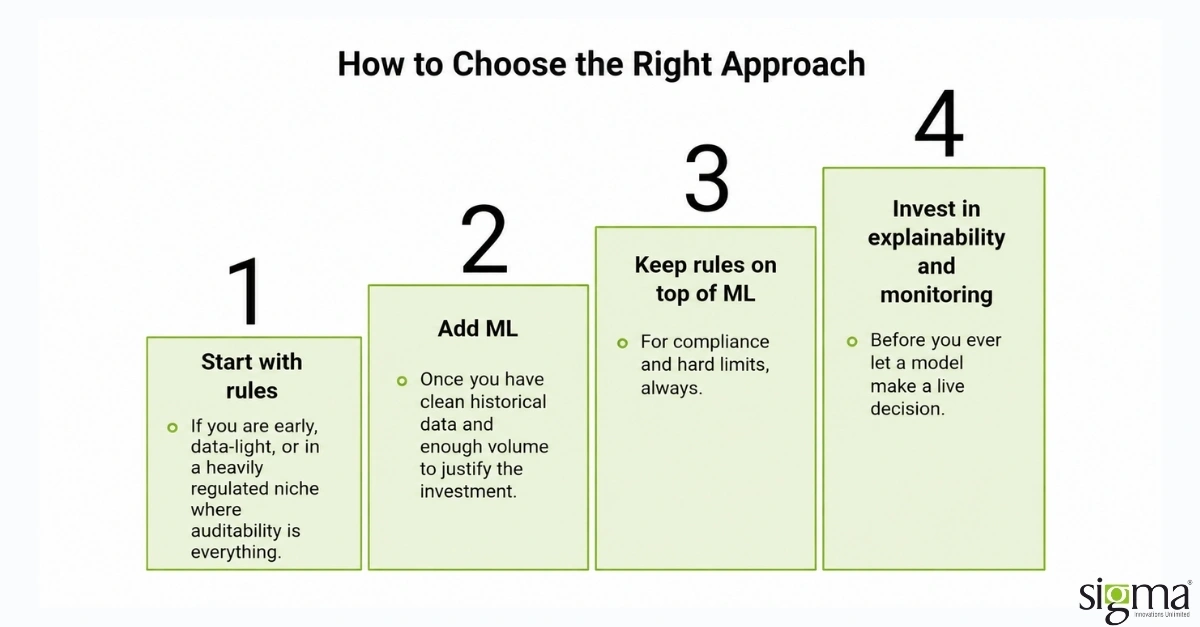
A few honest guidelines for lenders weighing the options:
- Start with rules if you are early, data-light, or in a heavily regulated niche where auditability is everything.
- Add ML once you have clean historical data and enough volume to justify the investment.
- Keep rules on top of ML for compliance and hard limits, always.
- Invest in explainability and monitoring before you ever let a model make a live decision.
The goal is not to chase the most advanced technology. It is to match the approach to your business, your data maturity, and your risk. A decision engine in fintech earns its keep by fitting the lender, not the other way around.
Looking for a lending platform that scales with your business?
How Sigma Infosolutions Builds Smarter Credit Decisioning Platforms
Credit decisioning sits at the intersection of risk strategy, regulatory compliance, AI, and lending operations. Building an effective decision engine requires more than connecting a few APIs or deploying a machine learning model; it demands a platform that consistently delivers explainable, real-time decisions across every loan application.
Sigma Infosolutions combines deep fintech engineering expertise with AI and machine learning capabilities to design intelligent credit decisioning platforms that improve lending outcomes while maintaining governance and regulatory transparency.
Decisioning Designed Around Your Lending Strategy
Every lender evaluates risk differently. Sigma builds configurable decisioning frameworks that align with your credit policies, approval strategies, and portfolio objectives instead of forcing standardized workflows. Whether you’re launching a new lending product or modernizing an existing underwriting process, the decision engine is designed around your business, not the other way around.
Hybrid Intelligence for Better Lending Decisions
Rather than treating rules and AI as competing approaches, Sigma develops hybrid decisioning systems where deterministic business rules enforce policy and compliance while machine learning models strengthen risk prediction. This layered architecture enables lenders to improve approval quality without compromising explainability or operational control.
AI-Powered Underwriting That Remains Explainable
Machine learning is only valuable when lenders can trust and justify every decision. Sigma develops AI-powered underwriting solutions with explainability built into the workflow through transparent decision logic, reason codes, model monitoring, and governance frameworks that support responsible AI adoption in regulated lending environments.
Connected Data for Real-Time Risk Assessment
High-quality decisions depend on high-quality data. Sigma integrates decision engines with credit bureaus, identity verification providers, fraud detection platforms, open banking data, income verification services, and internal lending systems to create a unified view of applicant risk. This enables faster approvals while reducing manual intervention throughout the underwriting process.
Enterprise-Ready Lending Platforms That Scale
Decisioning engines must evolve alongside lending portfolios. Sigma engineers cloud-native, API-first platforms that integrate seamlessly with loan origination systems, servicing platforms, and third-party ecosystems. As lending products, regulations, and risk strategies change, the platform can be extended without disrupting day-to-day operations.
Whether you’re building a next-generation underwriting platform, introducing AI into credit decisions, or modernizing an existing lending ecosystem, Sigma delivers intelligent credit decisioning solutions that balance predictive accuracy, operational efficiency, and regulatory confidence.
Building intelligent lending products requires deep fintech engineering expertise.
Conclusion
A credit decisioning engine is one of the highest-leverage systems a lender owns, which is why the rules-versus-ML choice deserves real thought instead of a default. Rules give you transparency and control. Machine learning gives you accuracy and reach. Each has a place, and each carries a cost.
For most lenders, the answer is not one or the other. It is a hybrid that leans on rules for guardrails and compliance, machine learning for sharper risk assessment, and human review for the gray areas, with explainability woven through all of it. That balance is what turns faster decisions into better ones.
Sigma Infosolutions helps banks, fintechs, and lenders design and build exactly that kind of intelligent, compliant credit decisioning engine.
Frequently Asked Questions (FAQs)
What is a credit decisioning engine?
A credit decisioning engine automates loan approval, decline, and review decisions using predefined rules, machine learning models, or both.
What is the difference between rules-based and machine learning credit decisioning?
Rules-based decisioning relies on fixed business logic, while machine learning uses historical data to predict borrower risk.
Why do lenders use automated credit decisioning systems?
Automated credit decisioning improves approval speed, consistency, operational efficiency, and customer experience.
Are machine learning models more accurate than rules-based credit scoring?
Machine learning models often identify complex risk patterns and can deliver higher predictive accuracy than static rules.
Why is explainability important in credit decisioning?
Explainability helps lenders justify decisions, meet regulatory requirements, and provide clear adverse action reasons to applicants.
What is a hybrid credit decisioning engine?
A hybrid credit decisioning engine combines business rules, machine learning models, and human review to balance accuracy and compliance.
How do credit decisioning engines support regulatory compliance?
They enforce lending policies, maintain audit trails, generate reason codes, and support fair lending practices.
How can Sigma Infosolutions help build credit decisioning platforms?
Sigma Infosolutions develops intelligent lending platforms with rules engines, AI-driven risk models, data integrations, and governance frameworks.