How Robo-Advisors Work: Technology Behind Automated Investment Platforms
Key Highlights
- Wealthtech founders and investment platform teams typically at growth-stage companies of 6–200 people want to build robo-advisory products but lack clarity on the technical architecture, data requirements, and regulatory considerations involved in bringing an automated investment platform to production without a large in-house engineering org.
- A well-engineered robo-advisor platform combines a risk profiling engine, a portfolio construction model, a rebalancing algorithm, market data integrations, and a compliant investor-facing application into a cohesive and scalable system, and it can be built efficiently with the right specialist engineering partner.
- Sigma Infosolutions architects and builds robo-advisory platforms covering portfolio engines, market data integrations, algorithmic rebalancing, and investor UX, acting as a long-term wealthtech engineering partner for fintech founders and investment software teams who need to move fast without sacrificing compliance or accuracy.
Introduction
If you’re a founder or CTO building an automated investment platform, you already know the opportunity is real. Robo-advisors now manage hundreds of billions of dollars in assets globally, and the model has expanded from pure digital-only apps to hybrid offerings that blend algorithm-driven portfolio management with human advisor access.
What catches many wealthtech teams off guard is how technically demanding the build actually is.
The investor-facing interface, clean dashboards, a simple onboarding questionnaire, and real-time performance views are the easy part. The hard part is what runs underneath it: a portfolio construction engine grounded in investment theory, a rebalancing algorithm that manages drift within defined tolerance bands, real-time market data integrations, tax-efficient transaction logic, and a compliance-ready onboarding flow that can withstand regulatory scrutiny.
For a growth-stage team of 6–200 people, you’re unlikely to have all of these disciplines in-house when you start. And underestimating the complexity is expensive; teams that treat robo-advisor development as a standard web application project typically discover the architectural gaps after launch, when fixing them is costly and disruptive.
This article explains how robo-advisors work at a technical level, what each core component does, and what founders and engineering leaders need to know before committing to a technology stack so you can make the right design decisions the first time.
What Is a Robo-Advisor?
A robo-advisor is a digital platform that provides automated, algorithm-driven investment management with minimal human intervention. The investor completes a risk profiling questionnaire, the platform maps their responses to a model portfolio, invests their capital according to that allocation, and manages ongoing rebalancing and reinvestment automatically.
The category spans a range of implementations relevant to different business models:
- Standalone robo-advisory apps targeting retail investors directly
- White-label platforms allowing banks, financial advisors, and fintech companies to offer automated portfolio management under their own brand
- Hybrid platforms blending algorithmic portfolio management with human advisor access for clients who want automation with a safety net
If you’re a fintech founder, you’re most likely building one of these three. Each has a slightly different technical profile, but all share the same core architecture underneath.
Building a robo-advisor requires more than a great user experience.
Sigma provides Investment Software Solutions that support portfolio management, investor onboarding, rebalancing workflows, and compliance-ready operations for modern wealth platforms.
Core Components of a Robo-Advisor Platform
Risk Profiling Engine
The risk profiling engine is the entry point of the robo-advisor experience. It presents the investor with a structured questionnaire capturing investment goals, time horizon, income, existing assets, and risk tolerance. The engine processes responses through a scoring model and assigns the investor to a risk profile tier typically ranging from conservative to aggressive growth.
For growth-stage teams, this component often looks simpler than it is. The questionnaire design and scoring model are simultaneously a product decision and a compliance obligation. Regulatory frameworks in most jurisdictions, including SEC rules in the US and ASIC requirements in Australia, require investment platforms to collect sufficient suitability information before making investment recommendations. Your risk profiling engine must produce a defensible, auditable output that maps investor responses to a recommended portfolio in a way that survives regulatory review.
Getting this wrong at the architecture stage means rebuilding it later under compliance pressure, one of the more expensive mistakes wealthtech teams make.
Portfolio Construction and Model Portfolios
Once an investor is assigned a risk profile, the platform maps that profile to a model portfolio: a target asset allocation expressed as percentage weights across asset classes such as equities, fixed income, real estate, and cash. Model portfolios are typically constructed using Modern Portfolio Theory principles, optimizing for expected return at a given level of risk.
The portfolio construction layer embeds your firm’s investment methodology. Some robo-advisors use static model portfolios reviewed periodically by an investment committee, a lighter engineering lift. Others use dynamic optimization engines that adjust target allocations based on market conditions or macroeconomic signals, a heavier build with stronger differentiation potential.
The choice between these approaches shapes your technical architecture, your data dependencies, and your regulatory disclosure obligations. For most growth-stage teams launching a first product, starting with well-designed static model portfolios and building toward dynamic optimization is the pragmatic path.
See How Sigma’s AI & Data Analytics Solutions Help Fintech Teams Turn Investment Data Into Smarter Decisions.
Rebalancing Algorithm
Portfolio drift is inevitable. As asset prices move, the actual allocation of an investor’s portfolio diverges from the target model. The rebalancing algorithm monitors this drift and executes trades to restore the portfolio to its target weights when drift exceeds a defined tolerance threshold.
Rebalancing logic involves several engineering decisions with real product consequences:
- Threshold-based rebalancing triggers trades when any asset class drifts beyond a set percentage from its target; simple but requires careful threshold calibration to avoid excessive trading costs
- Calendar-based rebalancing reviews and adjusts portfolios on a fixed schedule, predictable and easy to communicate to investors
- Tax-aware rebalancing incorporates tax lot selection logic to minimize realized capital gains, using techniques like tax-loss harvesting to offset gains with strategic loss realizations, meaningfully complex to build, but a strong differentiator for US-market platforms targeting taxable accounts
Each layer adds engineering complexity and testing surface. For a lean team, prioritizing which rebalancing features ship in v1 versus a later release is one of the most consequential early product decisions.
Also, read the blog: Robo advisory: An opportunity or a threat for fintech?
Market Data Integration
Your platform depends on reliable, real-time market data to price portfolios, trigger rebalancing calculations, and provide investors with accurate account valuations. Market data integration requires connections to data providers for equity prices, bond yields, ETF net asset values, foreign exchange rates, and corporate action notifications.
Data quality and latency directly affect portfolio accuracy. A pricing error in the market data feed can trigger unnecessary rebalancing trades, generate incorrect account valuations, or cause tax-lot selection errors with real financial consequences for investors. Production robo-advisors implement data validation logic, cross-source reconciliation, and alerting systems that catch data anomalies before they propagate into portfolio calculations.
For a growth-stage team evaluating data provider options, the build cost of robust validation logic is often underestimated, and it’s not optional in a regulated context.
Brokerage and Custodian Integration
Your platform must connect to a brokerage or custodian that holds client assets and executes trades. This integration typically uses the brokerage’s API to submit orders, receive execution confirmations, retrieve account positions, and pull transaction history for reconciliation.
Order management logic within the robo-advisor determines how rebalancing trades are batched and submitted to minimize market impact and transaction costs. For platforms managing large numbers of small accounts, which is the typical growth-stage trajectory, efficient order batching is a meaningful driver of operating economics and a component that benefits from experienced engineering.
In the US market, common brokerage integration patterns include Apex Clearing, DriveWealth, and Alpaca for fintechs; in Australia, CHESS-based custodian integrations follow different patterns. Knowing which path fits your regulatory context and investor segment before you start the integration saves significant rework.
Investor-Facing Application
The investor-facing application handles account opening and identity verification, displays portfolio performance and holdings, accepts deposits and withdrawal requests, communicates rebalancing activity and tax events, and surfaces the risk profiling questionnaire for new investors.
From a UX perspective, it needs to make complex portfolio information accessible to non-expert investors. From a compliance perspective, it must deliver required disclosures, maintain accurate records of investor acknowledgments, and support the audit trail that regulators and investment advisers need to demonstrate suitability compliance.
For most growth-stage teams, the investor application is the component where product instincts are strongest, but it’s worth being deliberate about not prioritizing UI polish at the expense of the compliance and data infrastructure underneath it.
Regulatory and Compliance Requirements for Robo-Advisors
Robo-advisors that provide investment advice are subject to investment adviser regulations in most jurisdictions. In the United States, platforms meeting the definition of an investment adviser must register with the SEC or applicable state regulators, maintain a compliance program, and deliver required disclosures, including Form ADV and Form CRS. In Australia, platforms providing financial product advice require an Australian Financial Services (AFS) license or must operate under an existing licensee’s authorization.
Compliance requirements shape technical architecture in specific ways. Every investment recommendation the platform makes must be traceable to the investor’s suitability profile. Every rebalancing trade must be recorded with the rationale that triggered it. Every fee calculation must be auditable. These requirements argue that logging infrastructure that captures the full context of every automated decision from day one, retrofitting audit trail capability after launch, is a significant engineering project.
Many wealthtech startups in the US and ANZ markets partner with an existing registered investment adviser or AFS licensee to operate under their regulatory umbrella while building toward their own registration. This simplifies initial compliance obligations but requires your platform architecture to accommodate the compliance workflows and reporting requirements of the partner adviser, something to design for explicitly, not discover during onboarding.
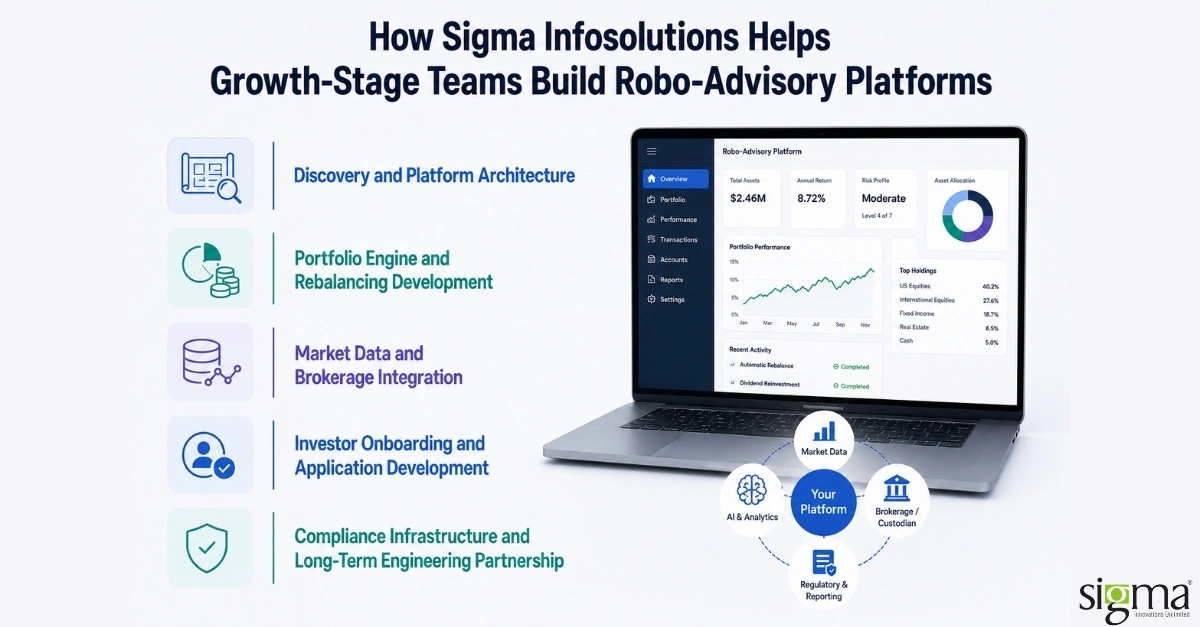
How Sigma Infosolutions Helps Growth-Stage Teams Build Robo-Advisory Platforms
Sigma Infosolutions is a full-stack wealthtech engineering partner with deep capability across investment platform development, AI and data integration, and regulatory compliance infrastructure. For founders and product leaders at growth-stage fintech companies, whether you’re in the US, Canada, Australia, or New Zealand, Sigma works as a dedicated engineering extension of your team, not a project vendor that hands off and disappears.
Discovery and Platform Architecture
Every engagement starts with a structured discovery phase that maps your investment methodology, regulatory context, target investor segment, and technology constraints. Sigma produces an architecture blueprint covering the portfolio engine, rebalancing logic, data integrations, and the application layer, before any code is written, so your founding and engineering leadership are aligned on trade-offs before they become expensive.
Portfolio Engine and Rebalancing Development
Sigma’s engineering team builds the portfolio construction engine and rebalancing algorithm that form the core of your investment platform. This covers model portfolio management tools, drift-monitoring logic, tax-aware rebalancing with tax-loss harvesting support, and order-generation workflows that connect to your chosen brokerage or custodian API.
Market Data and Brokerage Integration
Sigma designs and builds the data integration layer connecting your platform to market data providers, pricing feeds, and custodian APIs. The team implements data validation, reconciliation logic, and alerting infrastructure to ensure portfolio calculations run on accurate, timely data and to catch anomalies before they affect investor accounts.
Investor Onboarding and Application Development
Sigma builds the investor-facing application covering the risk profiling flow, account opening and KYC verification, portfolio dashboard, and transaction management interfaces. The team applies product and UX best practices to make complex investment information accessible while meeting the disclosure and auditability requirements that your regulatory context demands.
Compliance Infrastructure and Long-Term Engineering Partnership
Sigma integrates audit trail logging, regulatory reporting workflows, and suitability documentation into the platform from day one, not as an afterthought. Following launch, the team continues as your engineering partner for feature development, model updates, and adaptation to regulatory changes as your platform scales.
This is structured as a long-term T&M or retainer engagement, the kind of relationship where Sigma’s team develops deep familiarity with your codebase and business context over time, rather than a fixed-bid handoff that leaves your team holding an unfamiliar system.
Conclusion
Building a robo-advisor is a technically sophisticated undertaking that combines investment methodology, algorithmic automation, regulatory compliance, and consumer product design into a single platform. Each component, from the risk profiling engine and portfolio construction model to the rebalancing algorithm and market data integrations, carries engineering and domain complexity that goes well beyond a standard web application.
For a growth-stage fintech team of 6–200 people, the question isn’t whether this is buildable; it clearly is, and companies like yours have done it. The question is whether you have the investment domain knowledge, compliance awareness, and full-stack engineering capability in-house to make the right design decisions at every layer from the start.
Getting the architecture right in the design phase is substantially cheaper than discovering the gaps in production. The teams that ship reliable, compliant investment platforms on their first attempt typically do so with a specialist engineering partner who has built these systems before and can anticipate where the hard problems are before they become your problem.
Sigma Infosolutions brings the wealthtech engineering expertise to help your team build a robo-advisory platform that is accurate, compliant, and architected to scale whether you are launching a standalone investment app, a white-label platform, or a hybrid advisory product in the US, Canadian, or ANZ market.
Building a robo-advisor is just one part of creating modern financial experiences. Whether you’re developing investment platforms, digital lending solutions, payment systems, or wealth management applications, Sigma provides Financial Software Development Services tailored to the demands of regulated financial ecosystems.
FAQs
What is a robo-advisor?
A robo-advisor is a digital investment platform that uses algorithms to recommend, manage, and rebalance portfolios automatically based on an investor’s goals and risk profile.
How do robo-advisors determine investment recommendations?
They use risk profiling questionnaires to assess investor objectives, time horizon, and risk tolerance, then map users to model portfolios aligned with those preferences.
What is portfolio rebalancing in a robo-advisor?
Portfolio rebalancing automatically adjusts asset allocations when they drift from target weights, helping maintain the intended risk and return profile.
Why is market data integration important for robo-advisors?
Accurate market data supports portfolio valuation, performance tracking, rebalancing decisions, and trading activities while reducing the risk of pricing errors.
Can robo-advisors support tax-efficient investing?
Yes. Advanced robo-advisors use tax-aware rebalancing and tax-loss harvesting strategies to help minimize taxable gains and improve after-tax returns.
What compliance requirements apply to robo-advisors?
Robo-advisors must meet investment adviser regulations, maintain audit trails, document suitability assessments, and provide required disclosures to investors.
Should fintech startups build or buy robo-advisor technology?
Many startups customize core workflows while integrating third-party market data, brokerage, and compliance services to accelerate development and reduce complexity.
What are the core components of a robo-advisor platform?
Key components include a risk profiling engine, portfolio construction model, rebalancing algorithm, market data integrations, brokerage connectivity, and investor-facing applications.