Robo-Advisory Platform Architecture: What Wealth Management Leaders Must Evaluate Before Building

Key Highlights:
- A shallow risk-profiling layer can produce recommendations that drift from a client’s actual circumstances, creating downstream portfolio and compliance issues.
- Hardcoded portfolio logic and poorly governed rebalancing can turn routine strategy changes into engineering releases while making trade decisions difficult to audit.
- A governed, configurable architecture connects risk profiling, portfolio construction, rebalancing, compliance, and data governance into one auditable system.
- Sigma brings fintech engineering expertise to architect these layers for scalability, security, and regulatory alignment from the outset.
Introduction
Firms shopping for an automated investment platform, or scoping one internally, often evaluate vendors on the interface and the marketing claim rather than the underlying system that actually determines whether it will hold up in production. That approach misses the point where most robo-advisory failures actually originate. Robo-advisory platform architecture is the set of components, risk profiling, portfolio construction logic, rebalancing automation, and a compliance layer, that together determine whether the platform can operate reliably at scale or whether it will accumulate errors and audit gaps as assets under management grow. Understanding what each component does, and how they depend on each other, is what separates an informed buying or build decision from a demo-driven one made under sales pressure and a tight timeline.
Evaluating an automated investment platform?
Risk Profiling Is Where Most Platforms Cut Corners
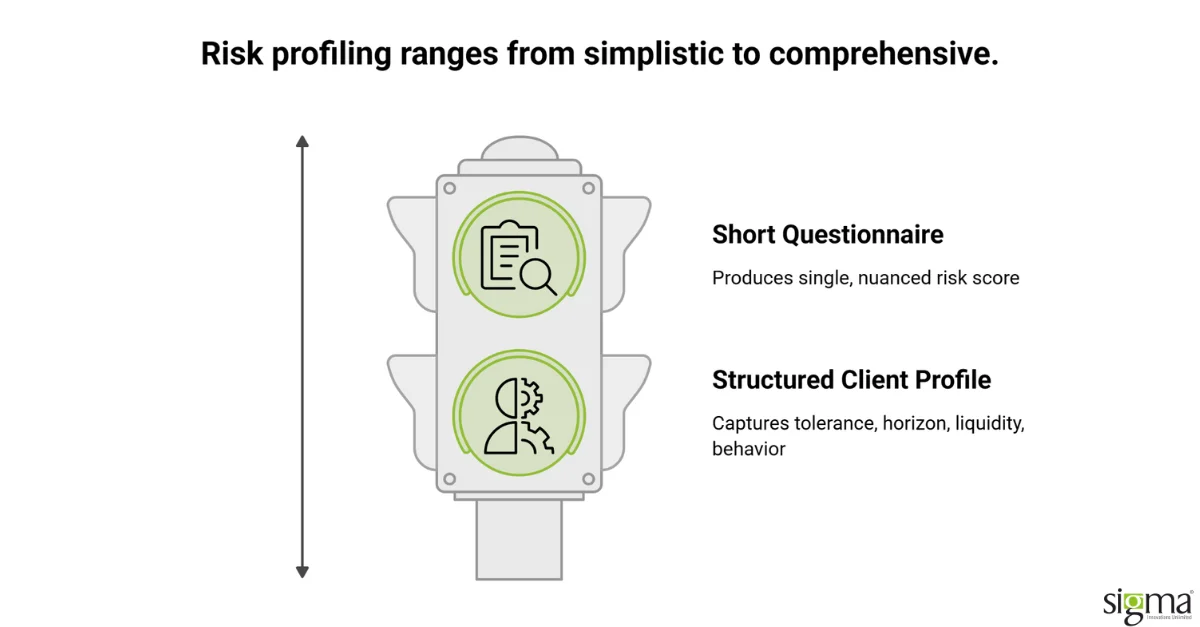
Risk profiling determines the inputs every downstream decision in the platform depends on, yet it is frequently reduced to a short questionnaire that produces a single risk score with limited nuance. A defensible profiling layer captures stated risk tolerance, time horizon, liquidity needs, and behavioral factors, then translates that into a structured client profile the portfolio construction engine can actually use, rather than a static label assigned once at onboarding and rarely revisited. Platforms that treat profiling as a one-time gate, instead of a factor that gets revisited as client circumstances change, tend to produce portfolio recommendations that drift out of alignment with the client’s actual situation over time.
Read the blog: How Robo-Advisors Work: Technology Behind Automated Investment Platforms
How Portfolio Construction Logic Actually Works
Once a risk profile exists, the construction engine allocates assets across a model portfolio built from a defined universe of financial instruments, typically low-cost index funds or ETFs, weighted according to the client’s risk band and stated financial goals. The engineering challenge here is less about the allocation algorithm itself, which is well understood, and more about keeping the model portfolios current as market conditions and available instruments change, without requiring a full platform release each time. Firms that hardcode allocation models directly into application logic instead of a configurable rules engine find that every strategy adjustment becomes a software deployment rather than a business decision, which slows the firm down considerably over time and adds unnecessary engineering overhead to what should be a straightforward portfolio management update.
Why Rebalancing Automation Needs Its Own Governance
Rebalancing is the component most associated with robo-advisory in marketing material, but it is also the one most likely to generate compliance exposure if built without proper governance, since it is where the platform actually moves client money without a human sign-off step. Continuous or threshold-based rebalancing needs clear, documented triggers, tax-aware execution logic where relevant, and a complete audit trail showing why each trade occurred and which client-level factors drove it. A platform that rebalances correctly from a portfolio-theory standpoint but cannot explain a specific trade to a regulator on request has effectively built half a system, since the automation and the accountability for that automation are treated as separate problems rather than one integrated requirement.
Comparing Robo-Advisory Platform Architecture Approaches by Maturity
| Component | Minimum Viable Build | Enterprise-Grade Build |
|---|---|---|
| Risk Profiling | Static questionnaire, one-time score | Dynamic profile, revisited on client-triggered events |
| Rebalancing Logic | Fixed schedule, limited documentation | Threshold-based, fully audit-logged per trade |
| Compliance Layer | Bolted on after launch | Designed alongside the recommendation engine |
| Data Governance | Ad hoc access controls | Row-level security, dynamic masking, full lineage |
The Compliance Layer Cannot Be a Separate Project
Treating compliance as a parallel workstream that catches up to the platform after core features ship is the single most common architecture mistake teams make in this space. Every component described so far, profiling, construction, and rebalancing, generates data that a regulator may eventually ask to see, which means the compliance layer needs to be designed as the system of record for those decisions from the beginning, not layered on as a reporting dashboard once the platform is already live. Firms that get this sequencing wrong end up rebuilding data models mid-flight to support audit requirements the original architecture never anticipated.
That same pattern, governance built into the data layer rather than added afterward, applies just as directly to a robo-advisory platform’s risk profiling and rebalancing data.
The Architecture Sigma Has Deployed for Compliant Robo-Advisory Platform Builds
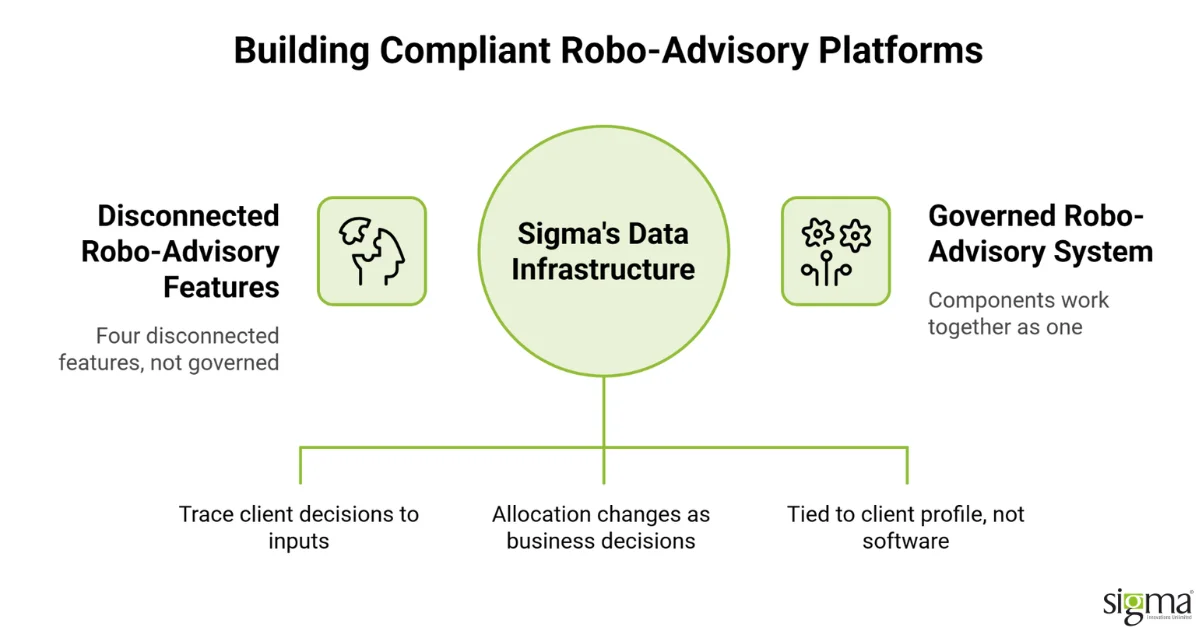
Sigma Infosolutions builds the data infrastructure layer that makes each of these components work together as one governed system rather than four disconnected features, drawing on experience building Snowflake-native platforms for lending and portfolio analytics where governance, AI-driven insight, and real-time data access were engineered in from the start rather than retrofitted after launch. That includes structuring the profiling and rebalancing data models so a compliance team can trace any client-level decision back to the specific inputs that produced it, without a manual reconciliation project every time an auditor asks a question. The same engineering discipline extends to model portfolio management, where a configurable rules engine keeps allocation changes as a business decision rather than a software release, and to rebalancing execution, where every trade carries a documented rationale tied to the client profile that triggered it.
Building a robo-advisory platform?
A platform built this way is also easier to evaluate from a business standpoint, since a clear architecture makes it straightforward to assess where the operational risk actually sits before committing a budget.
Connecting the Architecture Decision to the Business Case
None of these four components exist in isolation from the business question a firm is actually trying to answer, which is whether automated advisory expands the client base it can profitably serve without introducing proportional operational risk. A firm that understands the architecture is better positioned to judge whether a vendor’s platform, or an internal build plan, will hold up as assets under management grow, rather than discovering the gaps only after client volume makes them expensive to fix. Vendor evaluation conversations that stay at the interface level tend to miss exactly the questions that matter most: how profiling data gets revisited, how rebalancing decisions get documented, and whether the compliance layer was designed alongside the recommendation engine or added afterward. That business case, including the hybrid-versus-fully-automated delivery model question and the operational risk it carries, is covered separately and in more depth.
How Sigma Infosolutions Architects Robo-Advisory Platforms
Sigma Infosolutions designs robo-advisory platform architecture with regulatory compliance and data security as first-order constraints, not afterthoughts. Sigma’s approach separates the investment recommendation engine, client data management, and reporting layers so that each can be updated or audited independently as regulatory requirements change.
If you are building or modernizing a robo-advisory platform and need an architecture assessment that accounts for your compliance requirements and integration landscape, speak with Sigma Infosolutions. Sigma’s fintech engineering team can evaluate your current design and identify the structural changes needed to support scale and regulatory alignment.
Conclusion
Robo-advisory platform architecture is the set of engineering decisions, not the client-facing interface, that ultimately determines whether an automated investment platform holds up at scale and under regulatory scrutiny. Risk profiling needs to be dynamic and revisited as client circumstances change, rather than a static score assigned once at onboarding and left untouched. Portfolio construction logic should live in a configurable rules engine so strategy adjustments remain business decisions rather than software deployments requiring a full release cycle. Rebalancing automation needs documented triggers and a complete audit trail for every trade, since automation without explainability creates exposure rather than efficiency. The compliance layer cannot be treated as a parallel project that catches up after core features ship; it needs to be the system of record from the beginning. Firms that sequence the build this way avoid the expensive rework that comes from retrofitting audit capability into a system that was never designed to produce it. Data governance, including row-level security and dynamic masking, belongs in the architecture from day one rather than added as a dashboard later. Evaluating a vendor or an internal build against these four components gives a firm a far clearer picture than evaluating a demo or a marketing claim ever could. The technical architecture and the business case for adopting robo-advisory are connected but distinct questions, and both deserve a direct answer before committing a budget. Firms that understand the architecture are better equipped to ask vendors the right questions during evaluation. Getting this right from the start is considerably cheaper than fixing it after a regulator asks the first hard question.
Frequently Asked Questions
Q: What are the core components of robo-advisory platform architecture?
The core components are risk profiling, portfolio construction logic, rebalancing automation, and a compliance and data governance layer. Each depends on the others functioning correctly, so evaluating a platform on its interface alone misses where reliability and audit readiness actually get determined during the build.
Q: Why does risk profiling matter more than it seems from the client-facing questionnaire?
Risk profiling produces the structured input every downstream decision depends on. A shallow, one-time questionnaire that never gets revisited produces portfolio recommendations that drift out of alignment with a client’s actual circumstances as those circumstances change over months or years, undermining trust in the platform.
Q: How is tax-aware rebalancing different from standard rebalancing?
Tax-aware rebalancing accounts for the tax consequences of a trade, such as realizing gains or losses, before executing it, rather than rebalancing purely on portfolio drift. It requires additional logic and documentation, since each decision needs a defensible rationale tied to both portfolio theory and tax impact.
Q: Can an existing platform be retrofitted with a stronger compliance layer later?
It is possible but expensive, since retrofitting usually means rebuilding data models to support audit trails the original system never captured in the first place. Building the compliance layer alongside the recommendation engine from the outset avoids this rework entirely and is meaningfully faster in most real deployments.
Q: How does data governance affect robo-advisory platform reliability?
Row-level security, dynamic masking, and clear data lineage ensure that sensitive client and portfolio data is both protected and traceable. Without this governance layer, a platform may function correctly day to day but cannot demonstrate to a regulator how a specific recommendation was actually produced.