Why B2B Payment Platforms Struggle With Holiday-Season Invoice and Order Volume Spikes
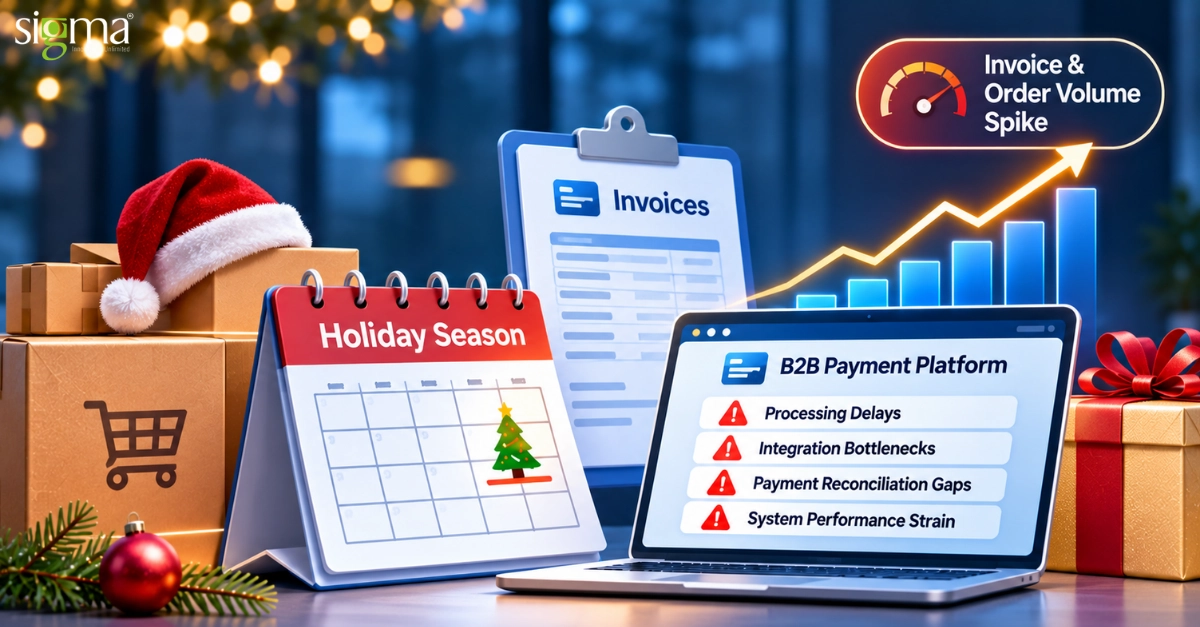
Key Highlights:
- Q4 order and invoice surges create delayed invoice runs, failed payment batches, reconciliation backlogs, and disputes, exactly when a small platform team has the least room to rebuild for peak.
- Every delayed invoice run or failed batch shows up downstream as a cash-flow problem for the businesses relying on the platform, and as a support and trust problem for the platform itself.
- Queue-based, idempotent payment processing, stronger reconciliation and ERP integration, and monitoring built for peak-season volume, not just average-day traffic.
- Sigma re-architects invoicing and payment pipelines for scale, builds the reconciliation and ERP integrations behind them, and stays engaged as a dedicated product engineering team through peak season.
A b2b payments platform built for a normal week’s volume meets its real test in Q4, when order volume climbs, invoice runs multiply, and payment batches queue up behind each other faster than most systems were sized to handle.
Nacha reported roughly 2.1 billion B2B ACH payments in the third quarter, up 10% year over year, worth about $16 trillion, up 8.8%, with Same Day ACH volume within that total up 15%. Every one of those payments still has to clear invoicing, batch processing, and reconciliation, and a platform that handles that sequence smoothly keeps cash flowing on schedule for the businesses that depend on it.
One that doesn’t create delayed invoice runs, failed batches, reconciliation backlogs, and disputes right when customers are least patient for them. This article maps where B2B payment platforms actually slow down during peak volume and the architecture that keeps processing reliable when the queue gets several times longer than usual.
Why Do B2B Payment Platforms Slow Down During Peak Season?
B2B payment platforms slow down during peak season because invoice volume, payment batches, and reconciliation jobs all scale up together, and a system sized for an average week has no headroom left once Q4 volume arrives. The result shows up as delayed invoice runs, payment batches that fail partway through, and reconciliation that falls behind the transactions it is supposed to match, with disputes following close behind each one.
What Causes Payment Reconciliation Delays?
Payment reconciliation delays happen when the matching process between payments, invoices, and ledger entries cannot keep pace with transaction volume, so a backlog forms and the ledger stops reflecting what has actually settled. During Q4, that gap compounds daily: each day’s unmatched transactions add to the next day’s queue, and by the time the backlog is visible, the platform is already reconciling last week’s payments instead of yesterday’s.
How Can Platforms Handle High-Volume ACH and Card Batches?
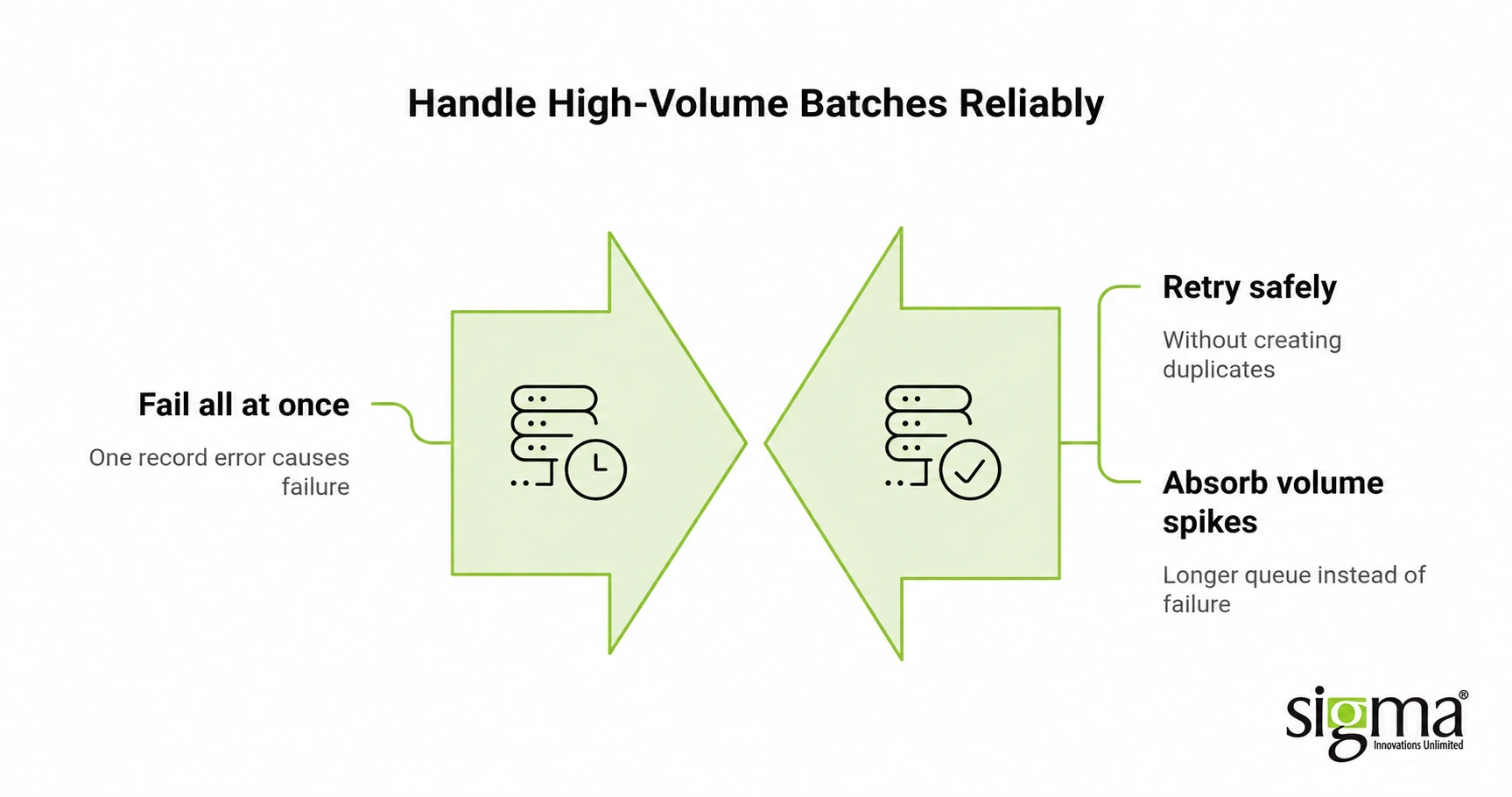
Handling high-volume ACH and card batches without failures means processing them as idempotent, queue-based jobs that can retry safely without creating duplicate transactions, rather than as large synchronous batches that fail all at once if one record causes an error. A platform built this way absorbs a volume spike as a longer queue, not a failed run.
Also, read the blog: Why Payment Latency Increases During Sales Events, and How to Engineer Your Way Out of It
Batch Processing vs. Event-Driven Processing: Which Does a B2B Payment Platform Need at Peak Volume?
| Dimension | Batch processing | Event-driven processing |
|---|---|---|
| Best fit | Scheduled invoice runs and predictable cycles | Real-time order, payment, and status events |
| Peak-season risk | Queue buildup and delayed processing | Requires strong orchestration and monitoring |
| Reconciliation | Often delayed until the end of the cycle | Can reconcile continuously as events occur |
| Business benefit | Simpler operations at low volume | Better cash-flow visibility and faster issue resolution |
Most B2B payment platforms start with batch processing because it is simpler to build and operate at normal volume. The trade-off shows up specifically at peak: a scheduled batch run that queues behind a Q4 volume spike delays every payment behind it, while an event-driven design processes each payment as it arrives and reconciles continuously, at the cost of needing stronger orchestration and monitoring to run well.
Reducing Operational Friction With ERP and Payment-System Integration
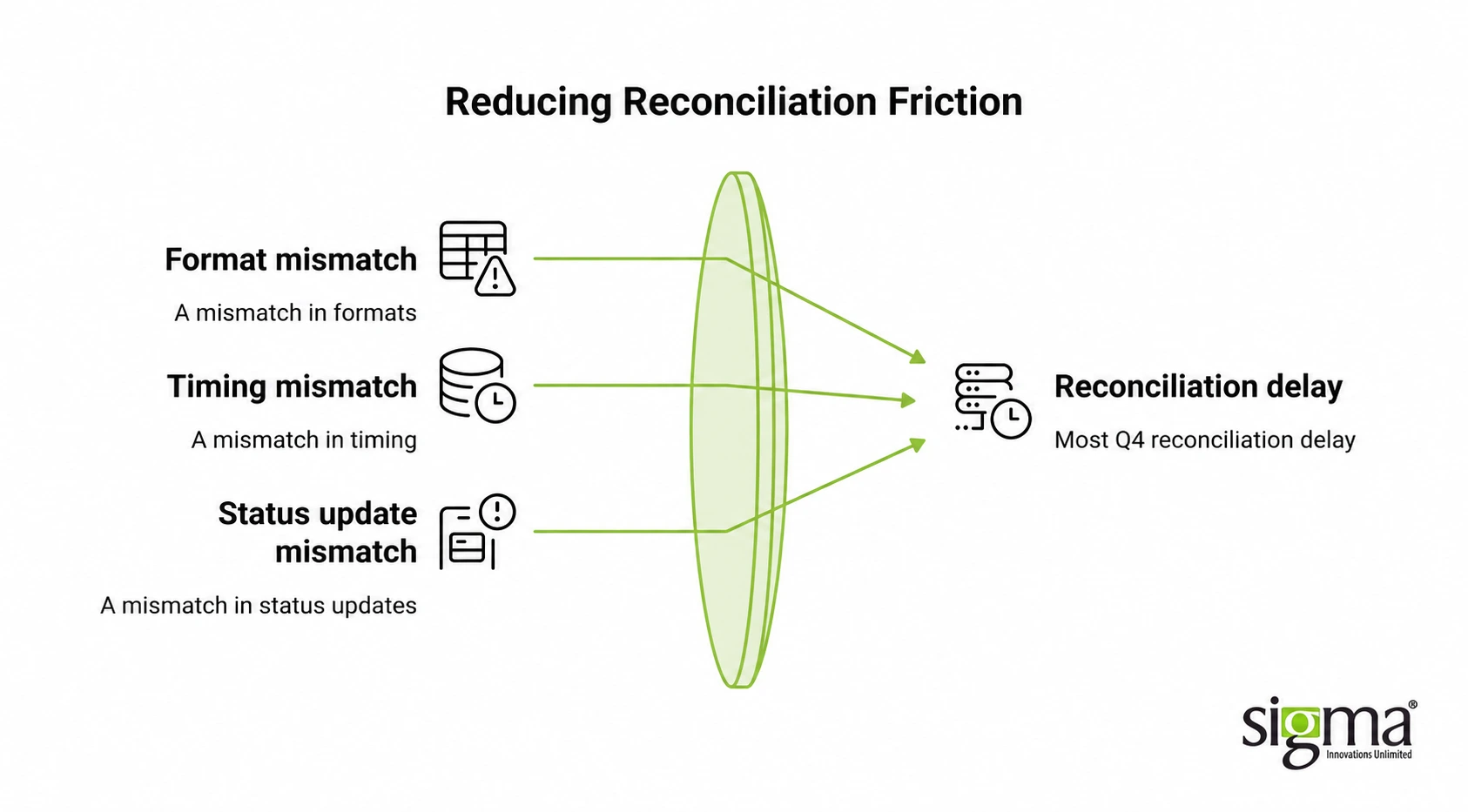
A payment platform rarely fails in isolation. Most of the delay in a Q4 invoice or reconciliation backlog comes from the handoff between the payment system and the ERP or accounting system behind it, where a mismatch in formats, timing, or status updates turns a processed payment into an unreconciled one until someone catches it manually.
Tighter ERP and payment-system integration, built to handle peak volume rather than average-day sync intervals, removes that handoff friction before it becomes a visible backlog.
Prepare your payment infrastructure for peak-season demand with Sigma’s engineering expertise.
How Sigma Builds B2B Payment Infrastructure Fast Enough to Be Ready Before Peak Arrives
The sequence that breaks under Q4 volume usually breaks in the same order: invoice runs queue up first, payment batches start failing behind them, reconciliation falls further behind each day that passes, and disputes follow once customers notice a payment that should have cleared. The platforms that avoid this sequence are not the ones that redesign everything; they are the ones that got the infrastructure ready before volume arrived, which means the work has to move fast without cutting corners on compliance or reliability.
Sigma Infosolutions built exactly that kind of infrastructure for a confidential FinTech client that needed a blockchain-powered, enterprise-grade payment platform to move money faster and more transparently across US, Mexico, and Colombia corridors for businesses and financial institutions. Using an AI-first engineering approach, Sigma delivered the production-ready platform in 10 weeks, roughly 50% faster than a conventional build, without compromising the compliance-ready workflows and enterprise security the client’s institutional customers required.
For a B2B payment, AP/AR automation, or invoicing platform heading into Q4, the same question applies: is the infrastructure behind invoicing, batch processing, and reconciliation ready for several times normal volume, or will it be rebuilt in January after this quarter already exposed the gap? Sigma can run a peak-readiness review as a defined engagement or stay engaged as the product engineering team behind the platform year-round.
Conclusion
A b2b payments platform earns or loses trust during exactly the weeks it is tested hardest, and Q4’s invoice and order volume spike is that test every year. Delayed invoice runs, failed payment batches, reconciliation backlogs, and disputes are not separate problems. They are the same volume spike surfacing at four different points in the same pipeline, and each point has a specific, addressable cause.
Each cause, in turn, has a corresponding architectural fix. Queue-based, idempotent processing absorbs a batch spike as a longer queue instead of a failed run. Reconciliation needs to keep pace with daily transaction volume, not fall into a backlog that compounds with every day it goes unaddressed. The choice between batch processing and event-driven processing is not about which is better in the abstract, it is about which fits the volume and visibility a platform actually needs at peak.
Tighter ERP and payment-system integration removes the handoff friction that turns a processed payment into an unreconciled one. None of these fixes require rebuilding a platform from scratch, but they do require building the infrastructure for peak volume before peak volume arrives, not after a quarter has already exposed the gap.
A platform that treats Q4 readiness as a defined engineering problem protects the cash flow of every business that depends on it. The alternative, discovering the gap in the middle of the quarter, costs more in disputes, support load, and customer trust than the readiness work would have.
Don’t let transaction spikes expose gaps in your payment infrastructure. Strengthen processing, integration, and reconciliation with Sigma’s Fintech Software Development Services.
Frequently Asked Questions
Why do B2B payment platforms slow down during peak season?
B2B payment platforms slow down during peak season because invoice volume, payment batches, and reconciliation jobs all scale up at once, and a system sized for average-week traffic has no headroom left. The result is delayed invoice runs, batches that fail partway through, and reconciliation that falls behind the transactions it should be matching.
What causes payment reconciliation delays?
Payment reconciliation delays happen when the matching process between payments, invoices, and ledger entries cannot keep pace with transaction volume, creating a backlog where the ledger no longer reflects what has actually settled. During Q4, each day’s unmatched transactions add to the next day’s queue, and the backlog compounds quickly.
How can B2B payment platforms handle high-volume ACH and card batches?
Handling high-volume batches reliably means processing them as idempotent, queue-based jobs that retry safely without creating duplicate transactions, rather than as large synchronous batches that fail entirely if one record errors out. A platform built this way absorbs a volume spike as a longer queue rather than a failed run.
When should a B2B payment platform move from batch processing to event-driven processing?
A platform should consider event-driven processing when batch-processing delays start affecting cash-flow visibility or when reconciliation consistently falls behind during peak periods. Event-driven processing reconciles continuously as events occur, trading simpler operations for better real-time visibility and faster issue resolution.
How can ERP and payment-system integration reduce operational friction?
Tighter ERP and payment-system integration removes the handoff friction where a format, timing, or status mismatch turns a processed payment into an unreconciled one. Built to handle peak volume rather than average-day sync intervals, this integration prevents backlogs before they become visible problems.