Digital Lending Platforms Market Size in 2026: Growth Trends, Key Drivers, and Future Outlook

Key Highlights
- Sigma Infosolutions supports lending institutions in modernizing origination and servicing infrastructure through a SaaS-based digital lending system built on a scalable microservices architecture.
- Lenders that deploy purpose-built digital platforms reduce credit decision timelines significantly, which improves borrower conversion rates and lowers the operational cost per funded loan.
- Institutions that delay platform modernization risk losing market share to fintech-native competitors that can approve and fund loans in minutes using automated underwriting and integrated data sources.
- The global digital lending platform market is projected to grow from approximately $3.0 billion in 2024 to $11.0 billion by 2030, representing a compound annual growth rate of 24.5%.
Financial institutions and alternative lenders operating in 2026 face a market where the pace of digital adoption has significantly raised borrower expectations and compressed the acceptable timeframes for credit decisions. Digital lending has moved from an experimental channel to the primary origination method for a growing share of consumer and commercial loan products. Lenders that have not modernized their origination and servicing infrastructure are finding it increasingly difficult to compete on speed, cost, and borrower experience. This blog examines the current size of the digital lending market, the factors driving its expansion, and what lenders should understand about the platform landscape as they evaluate their technology strategies.
The Current State of the Digital Lending Market
Market Size and Structural Expansion
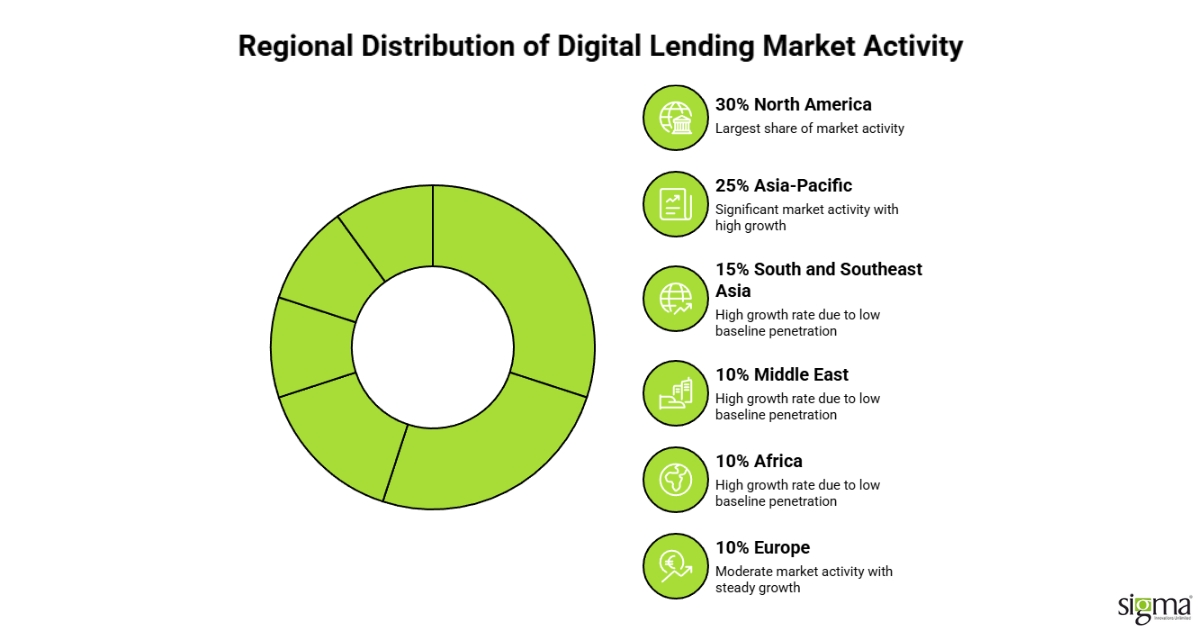
The digital lending market in 2026 reflects years of accelerating investment in automation, data infrastructure, and cloud-based platform architecture. Market research consistently places the total addressable market in the range of $4 to $5 billion for platform software alone, excluding the value of loans originated through these systems. The growth trajectory is driven by demand from non-banking financial companies (NBFCs), credit unions, community banks, and alternative lenders that need to replace aging loan origination systems with platforms capable of supporting real-time decisioning and API-driven integrations.
The expansion is not limited to consumer lending. Small and medium enterprise (SME) credit has become one of the fastest-growing segments within digital lending, as traditional banks have reduced their exposure to this market and left a gap that fintech-enabled lenders are actively filling. Platforms that support both consumer and commercial loan products are particularly well-positioned in this environment, as they allow lenders to diversify their portfolios without building separate origination systems for each product type.
Transform your fragmented lending stack into a unified, high-performance ecosystem with Sigma Infosolutions and turn every loan journey into a seamless growth engine.
Key Drivers of Digital Lending Platform Adoption
Borrower Expectations and Speed-to-Decision
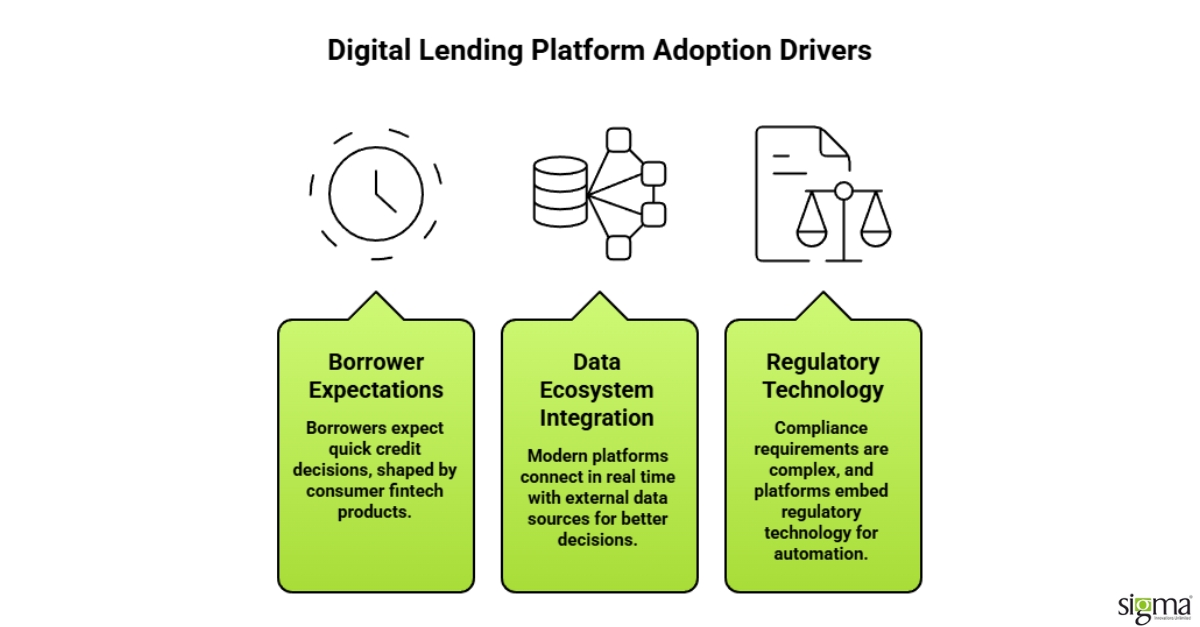
Borrowers in 2026 expect credit decisions to be delivered quickly, in many cases within minutes of submitting an application. This expectation has been shaped by consumer fintech products that use automated income verification, bank account analysis, and machine learning-based risk scoring to approve loans without manual underwriting review. Traditional lenders that still rely on paper-based processes or legacy loan origination systems cannot meet these expectations consistently, which creates measurable attrition at the application stage.
The operational impact of slow decision-making extends beyond conversion rates. When underwriters are required to manually review applications that automated systems could process reliably, the cost per funded loan increases, and the capacity for volume growth is constrained by headcount rather than technology. Lending platforms that incorporate configurable decisioning engines allow institutions to automate the majority of credit decisions while routing only the genuinely complex cases to human review.
Integration with Data Ecosystems
Modern lending platforms are distinguished from legacy systems primarily by their ability to connect in real time with external data sources, including credit bureaus, bank account verification providers, fraud detection engines, identity verification services, and property data platforms. This integration capability allows lenders to make credit decisions based on a more complete picture of borrower risk than traditional credit scores alone provide. The shift toward open banking frameworks in multiple markets has accelerated the availability of transactional data that can supplement bureau data in underwriting models.
The table below compares the characteristics of legacy loan origination systems with modern digital lending platforms across the dimensions most relevant to lending institutions evaluating a technology upgrade.
| Capability | Legacy Loan Origination System | Modern Digital Lending Platform |
| Credit Decision Speed | Hours to days | Seconds to minutes |
| Third-Party Integrations | Manual or batch-based | Real-time API connections |
| Configuration Flexibility | Requires developer changes | Business-user configurable rules |
| Scalability | Limited by on-premise infrastructure | Cloud-native, elastic scaling |
| Compliance Audit Trail | Manual documentation | Automated, system-generated |
| Deployment Model | On-premise or legacy hosted | SaaS, multi-tenant cloud |
Read our success story: Delaware Based Lending Platform Experiences 3X Increase In Performance Of Loan Offer Rendering
Regulatory Technology and Compliance Automation
Compliance requirements for lenders have grown more complex across multiple jurisdictions, covering areas including fair lending documentation, anti-money laundering checks, and consumer data privacy. Lending platforms that embed regulatory technology capabilities directly into the workflow allow institutions to maintain compliance without separate manual review steps that slow the process and introduce human error. This is particularly relevant for lenders operating across multiple states or countries, where the applicable rules differ, and the cost of non-compliance carries significant financial and reputational consequences.
Partner with Sigma Infosolutions to build high-velocity digital lending platforms that turn every borrower interaction into a seamless, conversion-driven experience.
How Sigma Infosolutions Supports the Digital Lending Market
As digital lending continues to evolve into a real-time, data-driven ecosystem, financial institutions are rethinking how lending platforms are designed, integrated, and scaled. The focus is no longer just on digitizing applications, but on building end-to-end lending systems that can adapt to changing borrower expectations, regulatory complexity, and rapid product innovation.
Within this shift, Sigma Infosolutions works with lenders to modernize lending infrastructure through configurable, cloud-native platforms that align with existing business models while enabling long-term scalability.
Modernizing Legacy Lending Systems into Scalable Digital Platforms
Many lending institutions still operate on fragmented or legacy loan origination systems that limit speed, visibility, and automation. Sigma’s approach focuses on helping organizations transition toward unified digital lending ecosystems where origination, underwriting, and servicing operate within a connected workflow.
Instead of disruptive rip-and-replace modernization, the emphasis is on progressive transformation, retaining core business logic while upgrading architecture to support faster decisioning, higher throughput, and improved operational control.
Configurable Lending Workflows Aligned to Business Needs
Different lenders operate with varying credit policies, approval hierarchies, and product structures. Sigma’s digital lending solutions are designed to accommodate this diversity through configurable workflows that support:
- Loan origination and application management
- Rule-based underwriting and decisioning
- Document verification and validation flows
- Loan servicing and lifecycle management
This reduces dependency on custom engineering for every process change and enables business users to adapt lending operations with greater agility.
Connected Lending Ecosystems Through API-Driven Integration
Modern lending ecosystems depend on seamless access to external data and services. Sigma enables lenders to build interconnected platforms that integrate in real time with:
- Credit bureaus and scoring agencies
- Identity verification and KYC providers
- Fraud detection and risk intelligence systems
- Payment gateways and banking APIs
This integration-first architecture strengthens risk assessment, improves onboarding speed, and ensures a more complete borrower profile at every decision point.
Cloud-Native Infrastructure with Built-In Security and Compliance
Scalability and security are foundational to modern lending platforms. Sigma develops cloud-native systems designed to handle high transaction volumes while maintaining performance consistency and operational resilience.
As an AWS Select Technology Partner and with ISO/IEC 27001:2022 certification, Sigma aligns platform engineering with enterprise-grade security standards, supporting institutions that operate in highly regulated financial environments.
Automation-Driven Lending Efficiency
Sigma’s lending solutions introduce automation across key stages of the loan lifecycle, reducing manual dependency in credit evaluation, document processing, and workflow routing. This allows lenders to improve turnaround times, reduce operational bottlenecks, and scale lending volumes without proportional increases in headcount or infrastructure complexity.
Continuous Delivery and Global Execution Model
Digital lending platforms must evolve alongside market dynamics, regulatory changes, and product expansion. Sigma’s global delivery model supports continuous development and iterative enhancement, enabling financial institutions to adapt quickly without disrupting core operations or borrower experience.
Conclusion
As lending becomes increasingly digital, competitive advantage is shifting toward institutions that can unify data, automate decision-making, and deliver seamless borrower experiences at scale. The future of lending infrastructure is not just about digitization, but about building adaptable platforms that can evolve with business and regulatory demands. Sigma Infosolutions supports this transition by enabling lenders to modernize core systems into integrated, cloud-native ecosystems designed for long-term scalability and operational efficiency.
Modernize your lending ecosystem with a platform designed for speed, scalability, and control.
Partner with Sigma Infosolutions’ financial software development services to build a future-ready digital lending foundation that accelerates decisions, improves efficiency, and drives sustainable growth.
Frequently Asked Questions
Q: What is the size of the digital lending platform market in 2026?
A: The global digital lending platform market is estimated at approximately $4 to $5 billion in 2026 for platforms. software, with projections indicating growth to $11.0 billion by 2030 at a CAGR of 24.5%. This growth is driven by demand from NBFCs, community banks, and alternative lenders replacing legacy origination systems.
Q: What are lending platforms, and how do they differ from traditional loan systems?
A: Lending platforms are cloud-based software systems that manage the full loan lifecycle, including origination, underwriting, servicing, and compliance, through configurable workflows and real-time API integrations. They differ from legacy systems primarily in their speed of decision-making, integration capabilities, and ability to scale without on-premise infrastructure constraints.
Q: How is fintech changing the digital lending landscape?
A: Fintech companies have introduced automated underwriting, instant credit decisions, and borrower-friendly digital interfaces that have raised the baseline expectations for all lenders, including traditional banks and credit unions. Institutions that do not match these capabilities in their own digital channels are increasingly losing applicants to fintech-native competitors at the top of the funnel.
Q: What types of lenders benefit most from digital lending platforms?
A: Non-banking financial companies, alternative lenders, community banks, and credit unions benefit most from digital lending platforms because they typically lack the internal technology resources to build custom origination systems but need to compete on speed and borrower experience. SaaS-based platforms allow these institutions to deploy production-grade technology without the capital expenditure of proprietary development.
Q: What role do online loans play in the growth of digital lending?
A: Online loans have become the primary growth driver for consumer and SME lending volume in markets with high smartphone penetration and established credit bureau infrastructure. The ability to apply for and receive online loans without visiting a branch has expanded the addressable borrower base for lenders and increased the volume of applications that platforms must process efficiently.
Q: How do digital lending platforms handle regulatory compliance?
A: Modern lending platforms embed compliance controls directly into the origination and servicing workflows, including automated audit trails, fair lending documentation, and configurable decisioning rules that reflect jurisdiction-specific requirements. This reduces the manual compliance review burden and lowers the risk of regulatory findings during examinations.
Q: What integrations should a digital lending platform support?
A: A production-grade lending platform should support real-time integrations with major credit bureaus, bank account verification services, identity and fraud detection providers, document management systems, and payment processors. The availability of pre-configured connectors for these integrations significantly reduces the time and cost required to launch on the platform.
Q: How does Sigma Infosolutions compare to building a custom lending system?
A: Sigma Infosolutions offers a pre-built, configurable loan origination and servicing solution that reduces development time and costs. Its microservices architecture enables flexible adoption of modules and seamless integration with existing systems without requiring a complete technology overhaul.