AWS vs Azure vs GCP: Which Cloud Platform Should You Build On?

Key Highlights
- Engineering teams at growth-stage companies lose months evaluating AWS, Azure, and GCP without a clear framework, which delays product launches and locks decisions in limbo.
- A use-case-driven comparison across compute, pricing, ecosystem, and compliance helps CTOs and engineering leads make a confident platform decision faster.
- As an AWS Certified Partner, Sigma advises on cloud platform selection, architectures scalable infrastructure, and migrates workloads with deep multi-cloud engineering expertise.
Introduction
Picking between AWS, Azure, and GCP is one of those decisions that shapes everything downstream. The platform you build on determines your deployment model, your hiring pool, your cost structure, and how easily you can scale when growth hits. Get it wrong and you do not just create technical debt. You create organizational drag that compounds with every quarter.
For CTOs, founders, and VP Engineering at growth-stage SaaS, fintech, and enterprise software companies, the challenge is rarely a shortage of options. It is the absence of a structured way to map platform capabilities to real business requirements. Most cloud comparisons recycle the same feature tables without addressing the tradeoffs that actually matter at the team level.
This article provides a practical comparison of AWS, Azure, and GCP across the dimensions that engineering teams care about most: compute and managed services, pricing, ecosystem maturity, and platform-specific strengths. The goal is not to crown a winner. It is to hand you a decision framework that reflects your use case, your team, and where you are headed.
Need expert guidance before committing to a cloud platform? Sigma Infosolutions partners with growth-stage and enterprise organizations to assess cloud requirements, architect scalable AWS environments, and execute seamless cloud migrations.
Where the Cloud Market Stands Today
AWS remains the largest cloud provider by market share, with Azure second and GCP third. But market share is a poor guide for choosing a platform. Each provider has evolved into genuine, defensible strengths in specific domains.
AWS is the default for many teams because of its breadth, global infrastructure, and the sheer depth of community tooling and documentation. Azure has become the natural home for enterprises running Microsoft workloads, with tight integration into Active Directory, Microsoft 365, and the .NET ecosystem. GCP has carved a strong position in data engineering, machine learning, and Kubernetes-native workloads, powered by Google’s internal engineering DNA.
For a growth-stage company making a serious cloud decision, the right starting question is not which provider is biggest. It is which one maps most directly to your team’s skills, your product architecture, and your near-term scaling needs.
AWS: Breadth, Maturity, and Ecosystem Depth
Amazon Web Services is the most mature platform in the market. With over 200 managed services, AWS covers virtually every infrastructure and application needed by a modern software team. Its global region coverage, uptime record, and the density of certified engineers in the hiring market make it the lowest-risk default for most new workloads.
Where AWS stands out for growth-stage product teams:
- Compute flexibility. EC2, Lambda, Fargate, and EKS give you everything from bare VMs to serverless and managed Kubernetes. You pick what fits.
- Managed databases. RDS, Aurora, DynamoDB, and ElastiCache cover relational, NoSQL, and caching with production-grade reliability.
- Developer ecosystem. The volume of third-party integrations, open-source tools, and community support around AWS is unmatched.
- Startup programs. AWS Activate provides credits and technical support that can meaningfully cut early infrastructure costs.
The main tradeoff is pricing complexity. The breadth of services comes with a billing model that punishes teams who move fast without tagging resources or setting budget alerts. Unexpected monthly bills are common for companies that skip cost governance early.
For most SaaS startups and fintech companies building cloud-native applications without a strong dependency on Microsoft or Google, AWS remains the most versatile and well-supported choice.
Also, read the blog : Mid-Year AWS Cloud Security Checklist for Fintech and SaaS Enterprises: 2026 Guide
Azure: Enterprise Integration and the Microsoft Ecosystem
Microsoft Azure is the dominant cloud for enterprise IT, and the reasons are practical. If your organization runs Windows Server, SQL Server, Active Directory, or Microsoft 365, Azure offers native integration that reduces friction across authentication, licensing, and compliance.
Azure’s hybrid cloud story is also strong. Azure Arc lets teams manage on-premises and multi-cloud resources through a single control plane, which matters for organizations that cannot move everything to the cloud overnight.
Key strengths for enterprise-facing product teams:
- Identity and access management. Azure Active Directory is the enterprise standard, and its integration across the platform is seamless.
- Compliance and sovereignty. Azure leads in certifications for regulated industries including financial services, healthcare, and government.
- Hybrid workloads. Azure Stack and Azure Arc offer more flexibility to extend cloud into on-premises environments.
- Microsoft licensing portability. Existing enterprise agreements can often apply discounts to Azure consumption.
Where Azure trails AWS is in service breadth outside the Microsoft ecosystem and in the density of community documentation for non-Microsoft tooling. For teams without existing Microsoft dependencies, Azure’s advantages are less compelling.
Also, read the blog : Sharpen your Security using AWS Security Hub
GCP: Data, AI, and Kubernetes-Native Architecture
Google Cloud Platform is the most technically differentiated of the three, especially for teams building data-heavy applications or investing in machine learning. GCP runs on the same infrastructure that powers Google Search, YouTube, and Gmail, which gives it real performance advantages in specific workloads.
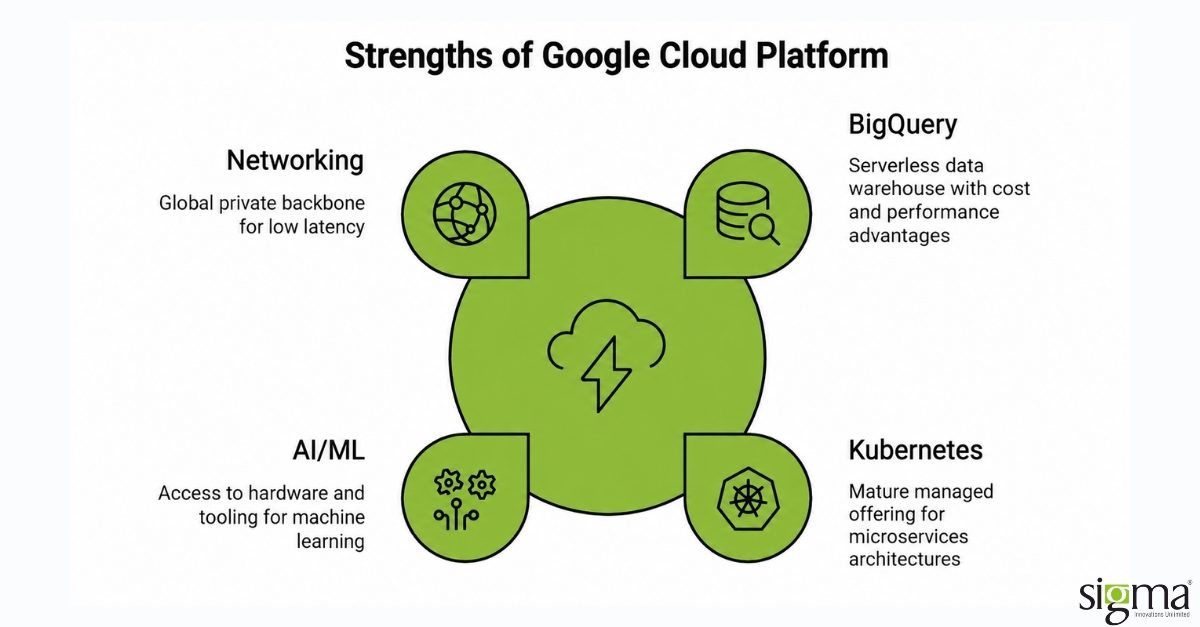
GCP’s strengths are concentrated where it genuinely leads:
- BigQuery. Google’s serverless data warehouse is widely considered the best managed analytics platform available. Teams running large-scale analytics see material cost and performance advantages.
- Kubernetes. Google invented Kubernetes, and GKE remains the most mature managed offering, particularly for complex microservices architectures.
- AI and machine learning. Vertex AI and Google’s TPU infrastructure give ML teams access to hardware and tooling AWS and Azure cannot fully match.
- Networking. Google’s global private backbone delivers consistently low latency for geographically distributed applications.
The downside is a smaller overall service catalog and a thinner partner ecosystem. Hiring engineers with deep GCP experience is also harder than finding AWS-certified talent in most markets. For growth-stage companies without a specific data or ML use case driving the decision, GCP is often a secondary platform rather than the primary one.
How to Choose: A Decision Framework That Actually Helps
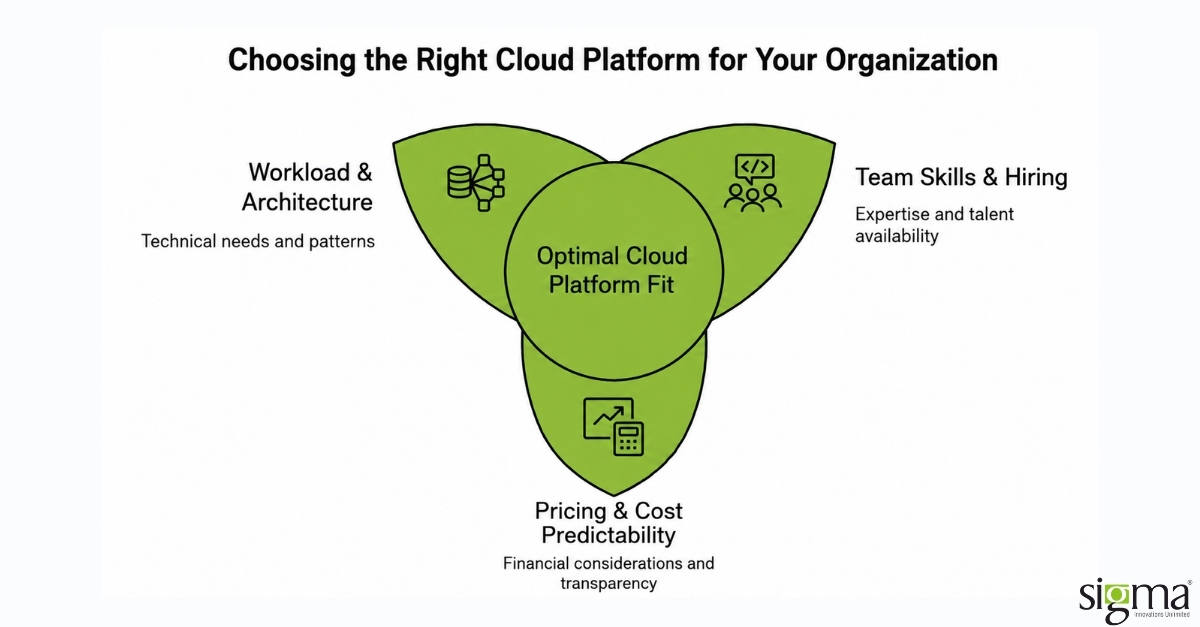
Instead of ranking providers, engineering leaders should evaluate cloud platforms against criteria specific to their organization. Here is a framework that works.
- Workload type and architecture pattern. Cloud-native microservices with heavy Kubernetes usage point toward GCP or AWS. Data warehousing at scale points toward GCP. Microsoft-stack enterprise applications point toward Azure. General-purpose SaaS with no strong dependency points toward AWS.
- Team skills and hiring market. The platform your engineers already know reduces ramp-up time and operational risk. AWS-certified talent is the most available in most markets. Factor hiring into the platform decision, not as an afterthought.
- Pricing model and cost predictability. All three offer free tiers, startup credits, and committed-use discounts. AWS pricing is the most complex. GCP’s sustained-use discounts apply automatically. Azure pricing favors teams with existing Microsoft agreements. Model your expected costs before committing.
- Compliance and data residency. Regulated industries with specific residency or certification requirements should evaluate Azure and AWS first. Both have the broadest compliance coverage.
- Vendor lock-in tolerance. GCP and AWS offer the most Kubernetes-native, open-standard tooling. Teams that prioritize portability should architect around managed Kubernetes and avoid proprietary pipelines regardless of provider.
A fintech startup recently used a similar framework to select AWS as their primary platform. Their decision came down to hiring market density, compliance-ready services for financial data, and the breadth of managed services that kept their infrastructure team lean.
How Sigma Infosolutions Helps You Choose and Build on the Right Cloud
Sigma Infosolutions is an AWS Certified Partner that works with CTOs, founders, and VP Engineering at growth-stage and mid-market SaaS, fintech, and technology companies across the US, Canada, Australia, and Europe. Sigma evaluates cloud platforms objectively, designs scalable architecture, and executes migrations with minimal disruption. Engagements run as dedicated teams or long-term retainer partnerships, not rigid fixed-scope projects.
Cloud Platform Assessment
Sigma maps your current and planned workloads against the capability profiles of AWS, Azure, and GCP. The assessment covers compute requirements, managed service fit, compliance needs, and team skills to produce a recommendation grounded in your context, not a generic default.
Architecture Design
Sigma’s cloud architects design target-state infrastructure that balances performance, cost efficiency, and operational simplicity. Tradeoffs are documented clearly so engineering leadership can make informed decisions before committing.
Migration and Workload Onboarding
Sigma plans and executes cloud migrations using a phased approach that protects production workloads. Whether the team is lifting and shifting or re-architecting for cloud-native deployment, Sigma brings the engineering depth to move quickly and safely.
Cost Governance and Optimization
Cloud cost sprawl is one of the most common problems Sigma helps teams solve. Tagging strategies, budget alerts, reserved instance planning, and right-sizing recommendations keep spend aligned with the product roadmap.
Quality Assurance and Ongoing Support
Backed by ISO 9001 quality management and ISO 27001 information security certifications, Sigma validates every deployment and provides ongoing cloud engineering support as an extension of your team, not just a one-time implementation vendor.
Why Sigma Infosolutions Is the Right Partner for Your Cloud Decision
AWS, Azure, and GCP each bring real strengths, and no single provider is the right answer for every team. AWS delivers the broadest service catalog and the most mature ecosystem for general-purpose cloud-native work. Azure is strongest for teams with Microsoft dependencies and complex compliance needs. GCP leads in data engineering, machine learning, and Kubernetes-native architecture.
The teams that make the best cloud decisions are those that evaluate providers against their specific workloads, team skills, compliance requirements, and growth plans, not the biggest name or the cheapest credit offer. A structured decision framework saves months of re-evaluation and prevents costly migrations later.
Sigma Infosolutions brings the technical depth, AWS Certified Partner credentials, and platform objectivity to help you make that decision with confidence, backed by ISO 9001 and ISO 27001 certifications and a long-term partnership approach. If your team is evaluating cloud platforms or planning a migration, talk to Sigma Infosolutions about a structured cloud assessment.
Frequently Asked Questions
Which cloud platform is best for startups?
AWS is the most common choice for startups because of its breadth, hiring market density, and Activate credits program. The best fit depends on your architecture, team skills, and compliance needs.
Is Azure only for Microsoft shops?
Azure is strongest when you already run Microsoft workloads, but it serves a wide range of use cases. Its advantage shrinks if your team has no existing Microsoft dependencies.
When should I choose GCP over AWS?
GCP is the strongest choice when your product depends on large-scale data analytics, machine learning, or Kubernetes-native architecture. Outside those use cases, AWS typically offers more breadth.
How do I compare cloud pricing across providers?
Model your expected workloads on each provider’s pricing calculator before committing. Factor in sustained-use discounts on GCP, reserved instances on AWS, and Microsoft licensing portability on Azure.
Can I use more than one cloud provider?
Yes, multi-cloud is common, especially when different workloads have different requirements. The tradeoff is added operational complexity, so it should be a deliberate choice rather than an accident.
How do compliance requirements affect platform choice?
Regulated industries should evaluate Azure and AWS first, since both have the broadest certification coverage. Check for specific data residency, encryption, and audit trail requirements before deciding.
How long does a cloud migration take?
Timeline depends on workload complexity, architecture changes, and compliance requirements. A phased migration for a mid-market company typically takes several months from assessment through production cutover.
How does Sigma Infosolutions help with cloud platform decisions?
Sigma assesses your workloads, skills, and compliance needs, then recommends the right platform and architects the infrastructure. As an AWS Certified Partner, Sigma handles migration, cost governance, and ongoing cloud engineering.