Mid-Year AWS Cloud Security Checklist for Fintech and SaaS Enterprises: 2026 Guide
Key Highlights
- Fintech and SaaS enterprises operating on AWS face growing exposure to misconfigured cloud resources, evolving compliance requirements, and sophisticated threat actors that exploit security gaps created by rapid infrastructure growth and insufficient governance practices.
- A structured mid-year AWS security review that covers identity governance, network hardening, data protection, compliance readiness, and cost-performance optimization gives cloud architects, DevOps teams, and security leaders the visibility and control they need to reduce risk and maintain regulatory standing.
- Sigma Infosolutions strengthens AWS environments through comprehensive cloud audits, DevOps automation, infrastructure monitoring, and security optimization that helps fintech and SaaS enterprises close security gaps, improve governance, and operate with confidence at cloud scale.
Introduction
The midpoint of the year is a natural moment for fintech and SaaS enterprises to step back and assess the state of their AWS security posture. Infrastructure that was well-governed at the start of the year can drift significantly over six months of rapid feature development, team growth, and evolving compliance requirements. New services get provisioned without following established security standards. IAM permissions accumulate beyond their original scope. Network configurations that were adequate for a smaller workload become inadequate as the platform scales.
AWS security is not a one-time configuration exercise. It is an ongoing discipline that requires regular assessment, structured governance, and continuous monitoring to remain effective against a threat landscape that evolves as quickly as the cloud platforms themselves. For fintech enterprises operating under financial regulatory frameworks and SaaS platforms managing sensitive customer data, the stakes of a security gap are not limited to technical remediation costs. They extend to regulatory penalties, customer trust erosion, and reputational damage that can be difficult to recover from.
This mid-year checklist gives cloud architects, DevOps teams, CISOs, and SaaS executives a structured framework for evaluating AWS security across the dimensions that matter most: identity and access governance, network security, data protection, compliance readiness, threat detection, and cost-performance optimization. Working through this checklist systematically ensures that the second half of 2026 begins with a clear, accurate picture of where the organization stands and what needs to be addressed.
Why Mid-Year AWS Security Reviews Matter for Fintech and SaaS
Many organizations treat cloud security reviews as an annual exercise tied to audit cycles or compliance renewal periods. This cadence made sense when infrastructure changed slowly and threat actors operated with less sophistication. In 2026, neither condition holds. Cloud environments in fast-growing fintech and SaaS organizations can change dramatically over a six-month period as new product features are shipped, infrastructure is scaled, and third-party integrations are added.
Each of these changes introduces potential security implications that may not be immediately visible. A new microservice deployed without following the organization’s security baseline creates an attack surface that did not exist six months ago. A third-party integration granted broad S3 bucket access for convenience creates a data exposure risk that accumulates over time. A developer who left the organization six months ago may still have active IAM (Identity and Access Management) credentials that represent an ongoing access control vulnerability.
Mid-year reviews catch these accumulations before they become incidents. They also provide an opportunity to evaluate the organization’s security posture against the regulatory requirements that apply to its specific operating environment, which may have evolved since the last formal review. For fintech enterprises subject to frameworks such as PCI DSS, SOC 2, and regional financial data protection regulations, maintaining continuous compliance readiness is significantly less costly than reactive remediation after a finding.
Section One: Identity and Access Management Governance
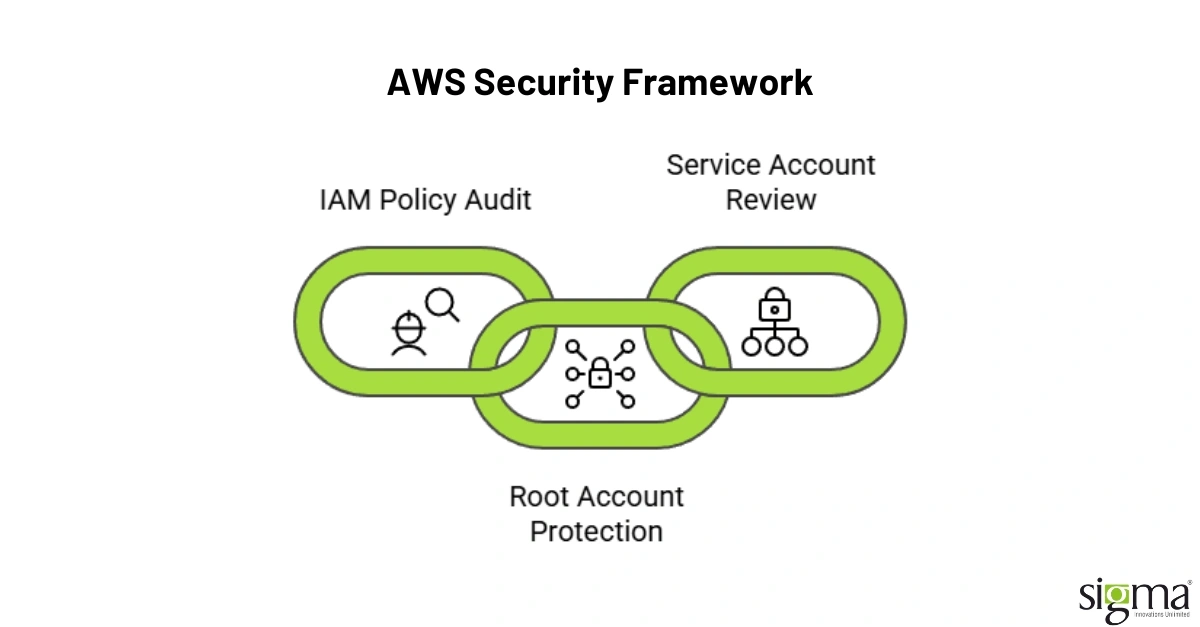
Identity and access management is the foundation of AWS security. Misconfigured IAM permissions are consistently among the most common root causes of cloud security incidents across all industries, and fintech and SaaS environments are not immune.
IAM Policy Audit and Least Privilege Enforcement
The first checkpoint in any mid-year AWS security review is a comprehensive audit of IAM policies across the organization’s AWS accounts. The audit should identify policies that grant permissions beyond what is actually required for the functions they support, with particular attention to wildcard permissions that grant broad access across entire AWS service categories.
Least privilege enforcement requires comparing the permissions granted by each policy against the permissions actually used by the associated principal over a defined historical period. AWS IAM Access Analyzer and AWS CloudTrail provide the data required for this comparison. Permissions that have not been exercised within the review period should be candidates for removal, with confirmation from the relevant application or service owners before changes are applied to production environments.
Root Account Protection and MFA Enforcement
AWS root account credentials represent the highest-privilege access in any AWS environment and must be protected with the strictest controls available. Mid-year reviews should confirm that root account access keys have been deleted, that multi-factor authentication is enforced on the root account, and that the root account is not used for routine operational tasks.
MFA enforcement should extend beyond the root account to all IAM users with console access, particularly those with administrative permissions. Organizations that have not yet transitioned to AWS IAM Identity Center for centralized access management should evaluate whether the transition is appropriate given their current scale and multi-account architecture.
Service Account and Cross-Account Access Review
Service accounts and cross-account access roles are frequent sources of excessive permission accumulation in growing cloud environments. Mid-year reviews should enumerate all service accounts, confirm that each one has a documented owner and business justification, and verify that cross-account trust relationships are scoped to the minimum required permissions and do not include accounts that are no longer part of the organization’s active infrastructure.
Also, read the blog: AWS Cloud Solutions for Building Enterprise-Grade Data Lakes
Section Two: Network Security and Infrastructure Hardening
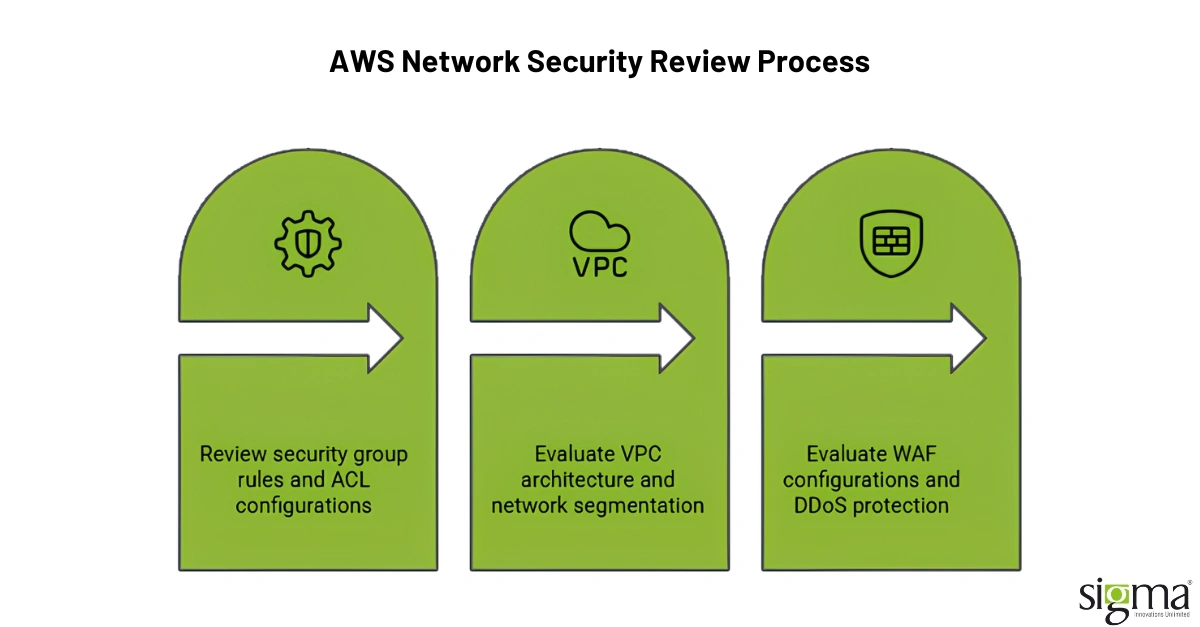
Network security in AWS encompasses the controls that govern how traffic flows between the internet, AWS services, and the resources within the organization’s virtual private cloud environment.
Security Group and Network ACL Audit
Security groups are stateful firewalls that control inbound and outbound traffic for AWS resources. Over time, security group rules tend to accumulate as developers add access rules to resolve connectivity issues without removing the rules when they are no longer needed. Mid-year reviews should audit all security groups for rules that permit unrestricted inbound access from the public internet, particularly on administrative ports such as SSH and RDP that should never be exposed to the internet without additional controls.
Network Access Control Lists provide a stateless filtering layer at the subnet level that complements security group rules. ACL configurations should be reviewed to confirm that they are consistent with the organization’s intended network segmentation model and that they do not inadvertently permit traffic flows that security groups are intended to block.
VPC Architecture and Segmentation Review
Well-designed VPC architecture separates workloads with different security requirements into distinct subnets and, where appropriate, distinct VPCs with controlled connectivity between them. Mid-year reviews should confirm that the organization’s VPC architecture reflects its current workload topology and that resources with internet-facing functions are deployed in public subnets while backend services and data stores are deployed in private subnets without direct internet access.
For fintech platforms processing payment data or managing lending workflows, network segmentation that isolates sensitive workloads from less sensitive ones is both a security best practice and a compliance requirement under frameworks such as PCI DSS. Confirming that this segmentation is correctly implemented and has not been inadvertently relaxed by infrastructure changes made during the first half of the year is an essential mid-year checkpoint.
AWS WAF and DDoS Protection Assessment
Web Application Firewall configurations should be reviewed to confirm that rule sets are current, that managed rule groups are receiving updates, and that custom rules reflect the current threat profile of the organization’s internet-facing applications. AWS Shield Advanced should be evaluated for organizations whose revenue model or regulatory obligations make them particularly sensitive to service disruption from distributed denial-of-service attacks.
Section Three: Data Protection and Encryption Standards
Data protection is the dimension of AWS security with the most direct connection to regulatory compliance for fintech and SaaS enterprises managing sensitive customer and financial data.
Encryption at Rest and in Transit Verification
Mid-year reviews should confirm that all data stores containing sensitive information are encrypted at rest using AWS KMS-managed keys and that encryption configurations have not been modified or disabled since the last review. This includes S3 buckets, RDS database instances, DynamoDB tables, EBS volumes, and any other storage services used to persist customer or financial data.
Encryption in transit should be enforced through TLS for all data moving between services, between the organization’s environment and external parties, and between users and application endpoints. Certificate validity and cipher suite configurations should be reviewed to confirm that they meet current security standards and will not expire unexpectedly during the second half of the year.
S3 Bucket Security and Public Access Controls
S3 misconfiguration remains one of the most common causes of data exposure incidents in AWS environments. Mid-year reviews should use AWS S3 Block Public Access settings at the account level to confirm that no buckets are publicly accessible unless there is a documented and approved business justification for public access. Bucket policies and access control lists should be reviewed to confirm that cross-account access is limited to explicitly authorized principals.
AWS Macie can be used to scan S3 buckets for sensitive data that may have been stored in locations that do not have appropriate security controls, providing an additional layer of assurance beyond policy-level configuration review.
Secrets Management and Credential Hygiene
Hardcoded credentials in application code, configuration files, or environment variables represent a persistent and serious security risk in cloud environments. Mid-year reviews should include a scan of code repositories and deployed infrastructure for hardcoded secrets, with findings remediated by migrating affected credentials to AWS Secrets Manager or AWS Systems Manager Parameter Store.
Secrets Manager rotation policies should be reviewed to confirm that database credentials, API keys, and other sensitive secrets are rotated at intervals consistent with the organization’s security policy and any applicable compliance requirements.
Section Four: Compliance Readiness and Governance Controls
For fintech and SaaS enterprises operating under regulatory frameworks, compliance readiness is not a separate concern from security. It is an integrated dimension of the overall cloud governance posture.
AWS Config Rules and Compliance Monitoring
AWS Config provides continuous monitoring of resource configurations against defined compliance rules, generating findings when resources drift from their intended security baseline. Mid-year reviews should confirm that Config is enabled across all AWS accounts and regions where the organization operates, that relevant managed rules are active, and that findings from the first half of the year have been reviewed and remediated.
Custom Config rules should be developed to enforce organization-specific security requirements that are not covered by AWS-managed rules, ensuring that the compliance monitoring framework reflects the full scope of the organization’s security standards rather than only the generic baseline provided by AWS.
CloudTrail and Audit Logging Completeness
AWS CloudTrail provides the audit log that records API activity across the AWS environment and is a foundational requirement for both security incident investigation and regulatory compliance. Mid-year reviews should confirm that CloudTrail is enabled in all regions, that log file integrity validation is active, and that logs are stored in a dedicated S3 bucket with appropriate access controls and retention policies.
Log analysis should be integrated with a SIEM or log management platform that enables security teams to query CloudTrail data efficiently and configure alerts for high-priority event patterns such as root account usage, security group modifications, or IAM policy changes.
Manual compliance tracking becomes increasingly difficult as AWS environments grow in complexity. Explore Sigma’s AI-Driven RegTech Compliance Automation Solutions to automate compliance monitoring, audit readiness, evidence collection, and regulatory reporting across regulated fintech and SaaS environments.
Section Five: Threat Detection and Incident Response Readiness
Amazon GuardDuty and Security Hub Review
Amazon GuardDuty provides continuous threat detection across AWS accounts by analyzing CloudTrail logs, VPC Flow Logs, and DNS logs for patterns associated with known attack techniques. Mid-year reviews should confirm that GuardDuty is enabled in all active regions, that findings from the first half of the year have been triaged and resolved, and that suppression rules have not been configured in ways that might mask legitimate threats.
AWS Security Hub aggregates findings from GuardDuty, Config, Macie, and other security services into a unified dashboard that gives security teams a consolidated view of the organization’s security posture. The Security Hub findings summary provides a useful starting point for mid-year reviews, highlighting the highest-severity issues that require immediate attention.
Incident Response Plan Validation
A security posture is only as strong as the organization’s ability to respond effectively when an incident occurs. Mid-year reviews should include a validation of the incident response plan to confirm that contact information is current, escalation procedures are understood by all relevant team members, and runbooks for common incident scenarios are accurate and accessible.
Section Six: Cost-Performance Optimization and Operational Efficiency
AWS security and cost optimization are more closely related than they might appear. Unused resources that have not been decommissioned represent both a cost inefficiency and a potential security liability, because unmanaged resources may not receive security patches or configuration updates.
Resource Inventory and Unused Asset Cleanup
Mid-year reviews should include a comprehensive inventory of all AWS resources across the organization’s accounts, with particular attention to resources that are not associated with active workloads. Unused EC2 instances, unattached EBS volumes, idle load balancers, and orphaned snapshots should be identified and decommissioned after confirmation with relevant application owners.
Read the blog: AWS Performance Tuning Explained: How to Fix Application Slowdowns and Improve Reliability at Scale
Reserved Instance and Savings Plan Coverage Review
Organizations running sustained workloads on AWS should review their Reserved Instance and Savings Plan coverage to ensure that committed pricing is applied to the resources that will remain active through the second half of the year. Coverage gaps represent unnecessary cost, while over-commitment to instance types that are being phased out in favor of newer generations creates waste that compounds over time.
How Sigma Infosolutions Strengthens AWS Security for Fintech and SaaS Enterprises
Sigma Infosolutions brings deep expertise in AWS cloud security, DevOps automation, and fintech infrastructure governance to help enterprises identify vulnerabilities, close security gaps, and build the governance frameworks that sustainable cloud operations require.
Cloud Security Audit and Assessment
Sigma conducts comprehensive AWS security audits that evaluate identity governance, network configuration, data protection controls, compliance posture, and threat detection capabilities across the client’s entire AWS environment. Audit findings are prioritized by risk severity and presented with clear remediation guidance that engineering teams can act on immediately.
Security Hardening and Remediation
Sigma’s cloud engineering team implements security hardening measures across IAM, network, data protection, and logging configurations, applying least privilege principles, encryption standards, and monitoring controls that reflect current AWS security best practices and the specific compliance requirements of the client’s operating environment.
DevOps Automation and Infrastructure as Code
Sigma implements infrastructure as code practices using AWS CloudFormation and Terraform that enforce security standards consistently across all new resource provisioning and eliminate the configuration drift that accumulates when infrastructure is managed manually. Automated compliance checks integrated into CI/CD pipelines ensure that security standards are validated before changes reach production.
Continuous Monitoring and Incident Response Support
Sigma configures and optimizes AWS native security services including GuardDuty, Security Hub, Config, and CloudTrail, and integrates these services with centralized monitoring and alerting systems that give security teams the visibility they need to detect and respond to threats quickly.
Conclusion
AWS security for fintech and SaaS enterprises in 2026 demands a level of rigor, consistency, and continuous attention that goes far beyond initial configuration. The mid-year checkpoint is not a bureaucratic compliance exercise. It is a practical opportunity to find and fix the security gaps, governance weaknesses, and compliance risks that accumulate in any cloud environment that is actively used for product development and business operations.
Working through the checklist systematically across identity governance, network security, data protection, compliance monitoring, threat detection, and cost optimization gives cloud architects, DevOps teams, CISOs, and SaaS executives the clear picture they need to make informed decisions about where to invest security resources in the second half of the year.
Sigma Infosolutions is the AWS cloud security partner that fintech and SaaS enterprises trust to conduct thorough assessments, implement effective hardening measures, and build the governance frameworks that protect sensitive data, satisfy regulators, and enable the business to grow with confidence.
Ready to Solve Your Next Technology Challenge?
Whether you’re modernizing legacy systems, building AI-powered applications, scaling cloud infrastructure, or accelerating digital commerce initiatives, Sigma Infosolutions brings the engineering expertise and strategic guidance needed to move from vision to execution. Connect with our team to discuss your goals, challenges, and growth priorities.
FAQs
1. What is an AWS cloud security checklist for fintech and SaaS enterprises?
An AWS cloud security checklist helps fintech and SaaS businesses assess identity management, compliance, network security, and data protection risks.
2. Why are mid-year AWS security reviews important in 2026?
Mid-year reviews identify security gaps, compliance drift, and cloud misconfigurations before they lead to breaches or regulatory penalties.
3. How does IAM governance improve AWS security?
IAM governance enforces least privilege access, secures user permissions, and reduces the risk of unauthorized access in AWS environments.
4. What role does encryption play in AWS cloud security?
Encryption protects sensitive fintech and SaaS data both at rest and in transit, helping organizations maintain compliance and reduce exposure risks.
5. How can fintech companies secure AWS S3 buckets?
Fintech companies can secure S3 buckets by enabling block public access, enforcing bucket policies, and using AWS Macie for sensitive data monitoring.
6. What AWS services support threat detection and compliance monitoring?
AWS GuardDuty, Security Hub, CloudTrail, Config, and Macie provide continuous threat detection, audit logging, and compliance visibility.
7. How does Sigma Infosolutions strengthen AWS cloud security?
Sigma Infosolutions delivers AWS security audits, DevOps automation, infrastructure hardening, compliance monitoring, and continuous threat management.
8. What are the benefits of AWS security optimization for SaaS platforms?
AWS security optimization improves compliance readiness, enhances performance, reduces operational risk, and strengthens cloud governance at scale.