Data Warehousing and BI Development: Building a Scalable Analytics Foundation
Key Highlights
- Enterprise data is growing faster than most organizations can manage, leaving analytics teams working with fragmented systems, inconsistent reporting, and delayed insights that slow down critical decisions.
- Modern data warehousing combined with robust business intelligence development provides a centralized, scalable foundation that unifies data sources and delivers accurate, real-time analytics across the enterprise.
- Sigma Infosolutions modernizes enterprise data infrastructure through scalable data warehousing, optimized ETL pipelines, and centralized analytics systems that turn raw data into actionable business intelligence.
Introduction
Enterprises today generate enormous volumes of data across every business function, from sales and marketing to finance and operations. Without a structured approach to managing that data, organizations struggle to extract meaningful insights, and decision-making suffers as a result. The consequences of fragmented data infrastructure are significant: duplicated reporting, conflicting metrics, and missed opportunities to act on emerging trends.
Data warehousing solves this problem by creating a single, centralized repository where structured data from multiple sources is stored, organized, and made readily available for analysis. When paired with modern business intelligence tools, a well-architected data warehouse becomes the backbone of an enterprise analytics strategy. Organizations that invest in this foundation gain faster reporting cycles, improved forecast accuracy, and a competitive advantage driven by data.
For CIOs, data architects, and analytics leaders, the question is no longer whether to modernize data infrastructure. The question is how to do it effectively, at scale, and with a clear return on investment.
Why Traditional Data Infrastructure Is Holding Enterprises Back
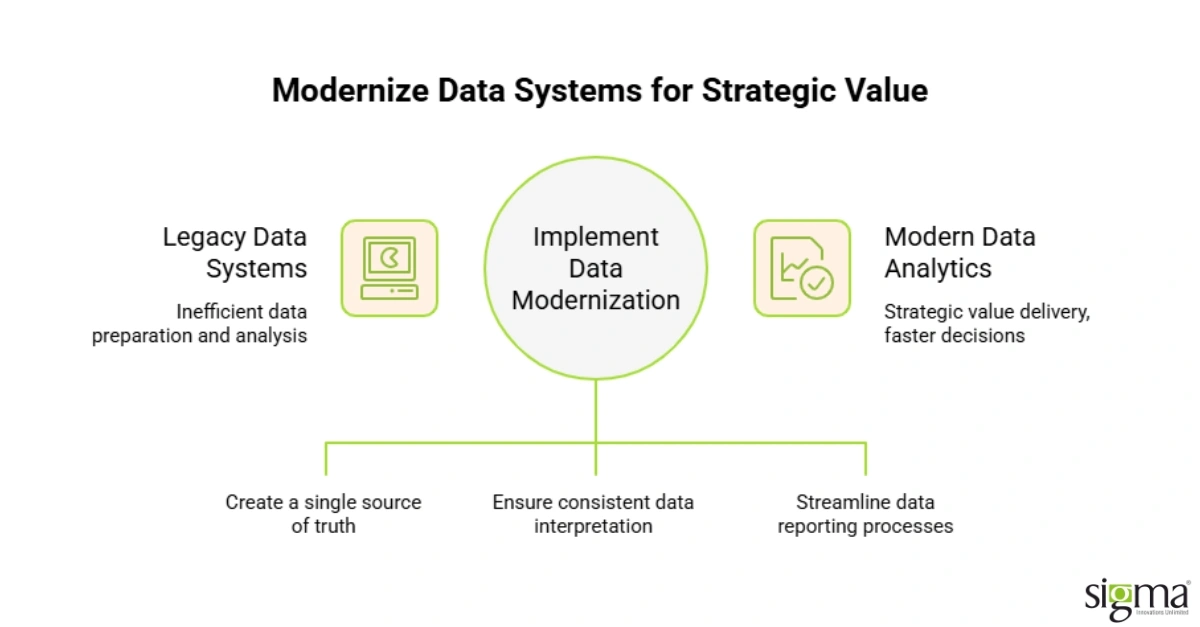
Many enterprises still rely on legacy data systems that were built for a different era of business. These systems were not designed to handle the volume, variety, and velocity of modern data. As a result, analytics teams spend more time preparing and cleaning data than analyzing it, which limits their capacity to deliver strategic value.
Siloed databases, inconsistent data definitions, and manual reporting processes create an environment where different departments operate from different versions of the truth. A finance team may report one revenue figure while sales reports another, leading to confusion at the executive level. This lack of a single source of truth erodes confidence in data and slows down decision cycles.
The cost of inaction is high. Organizations that delay data modernization risk falling behind competitors who are already using centralized analytics to identify market opportunities, optimize operations, and improve customer experiences. For enterprise IT teams, building a scalable data warehousing foundation is not a technology project. It is a business imperative.
Core Components of a Modern Data Warehousing Architecture
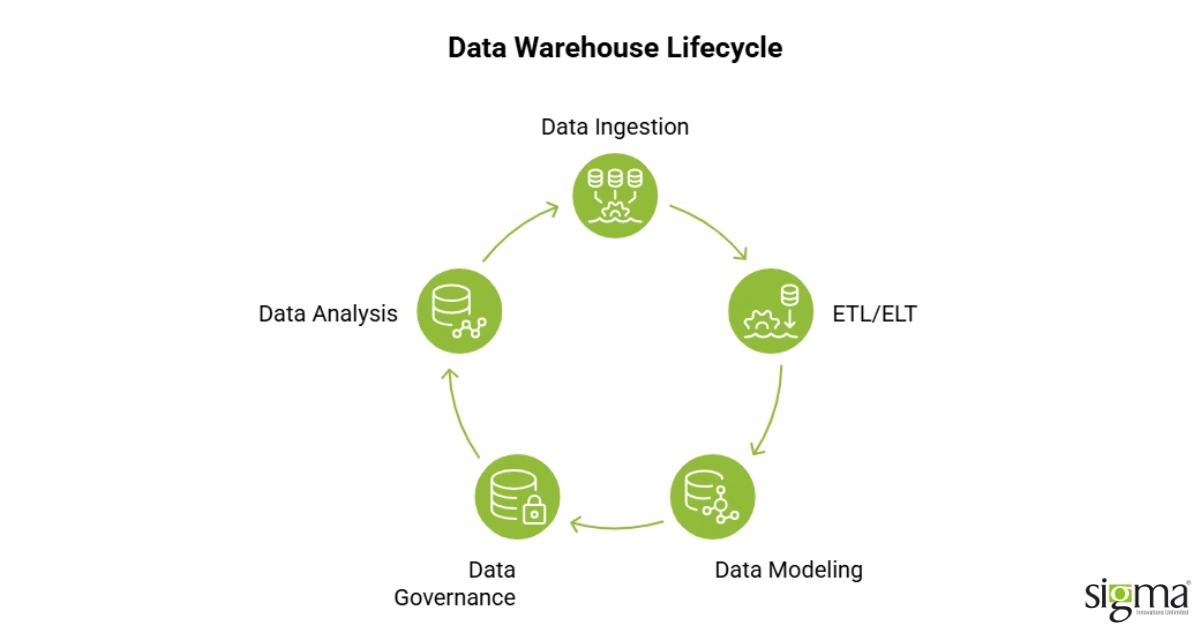
A modern data warehouse is more than a storage solution. It is an integrated architecture designed to support the full lifecycle of data from ingestion to insight.
Centralized Data Repository
At the heart of every effective analytics strategy is a centralized data repository that consolidates data from multiple source systems including CRMs, ERPs, marketing platforms, and operational databases. This centralization eliminates data silos and ensures that every team works from a consistent, governed dataset.
Cloud-native data warehouse platforms such as Amazon Redshift, Google BigQuery, and Snowflake provide the scalability and performance required for enterprise workloads. These platforms allow organizations to scale storage and compute independently, reducing costs while maintaining high query performance across large datasets.
ETL and Data Pipeline Engineering
The quality of a data warehouse depends entirely on the quality of the data that flows into it. ETL (Extract, Transform, Load) pipelines are the critical infrastructure that moves data from source systems into the warehouse in a clean, consistent, and timely manner.
Well-engineered ETL pipelines automate data validation, handle schema changes gracefully, and ensure that data arrives in the warehouse ready for analysis. Modern ELT approaches, where transformation happens inside the warehouse itself, are increasingly popular because they leverage the processing power of cloud platforms and reduce pipeline complexity.
Data Modeling and Governance
Effective data warehousing requires thoughtful data modeling that reflects the way the business actually operates. Dimensional modeling techniques such as star schemas and snowflake schemas organize data in a way that optimizes query performance and makes it intuitive for analysts to explore.
Data governance policies ensure that data definitions are consistent, access controls are enforced, and data lineage is documented. Without governance, even a well-built warehouse can become a source of confusion as teams introduce inconsistent definitions over time.
Connecting the Warehouse to Business Intelligence Tools
A data warehouse only delivers value when business users can access and interact with the data it contains. Business intelligence tools serve as the interface between the warehouse and the people who rely on it to make decisions.
Unified Dashboards and Reporting
Modern BI platforms such as Tableau, Power BI, and Looker connect directly to cloud data warehouses and allow analysts to build interactive dashboards that reflect real-time or near-real-time data. These dashboards give executives and operational managers a consistent view of performance across every business unit.
A leading financial services firm, for example, reduced its monthly reporting cycle from five days to less than four hours after centralizing its data warehouse and connecting it to a modern BI layer. The improvement freed up the analytics team to focus on forward-looking analysis rather than backward-looking report generation.
Self-Service Analytics
One of the most significant advantages of a modern data warehousing and BI architecture is the ability to enable self-service analytics. When data is well-modeled and governed, business users can explore data independently without relying on IT or data engineering teams to build custom reports for every request.
Self-service analytics accelerates the pace of insight across the organization and reduces the backlog of reporting requests that typically overwhelms centralized analytics teams. It also democratizes data access, allowing every function to make evidence-based decisions rather than relying on intuition.
Read the blog: Salesforce Implementation Cost in 2026: What to Expect and How to Plan Your Investment
Scalability and Performance Considerations for Enterprise Analytics
Enterprise analytics workloads are inherently demanding. As data volumes grow and the number of users accessing the system increases, performance and scalability become critical concerns.
Cloud-Native Scalability
Cloud data warehouses are designed to scale on demand, allowing organizations to increase compute capacity during peak reporting periods and scale back during off-peak times. This elasticity eliminates the over-provisioning that characterized on-premise data warehouse deployments and reduces infrastructure costs significantly.
Organizations that have migrated from on-premise warehouses to cloud platforms consistently report improvements in query performance, faster time to insight, and lower total cost of ownership. The shift also reduces the maintenance burden on IT teams, who previously spent significant time managing hardware and database infrastructure.
Real-Time and Streaming Data Integration
Modern enterprises increasingly need access to real-time data to support operational decision-making. Integrating streaming data sources such as clickstream data, IoT sensor outputs, and transaction logs into the data warehouse requires purpose-built ingestion pipelines that can handle high-velocity data without compromising warehouse performance.
Technologies such as Apache Kafka and AWS Kinesis enable real-time data ingestion, while platforms like Snowflake and BigQuery support real-time query patterns that make streaming data accessible to BI tools without significant latency.
How Sigma Infosolutions Helps Build a Scalable Analytics Foundation
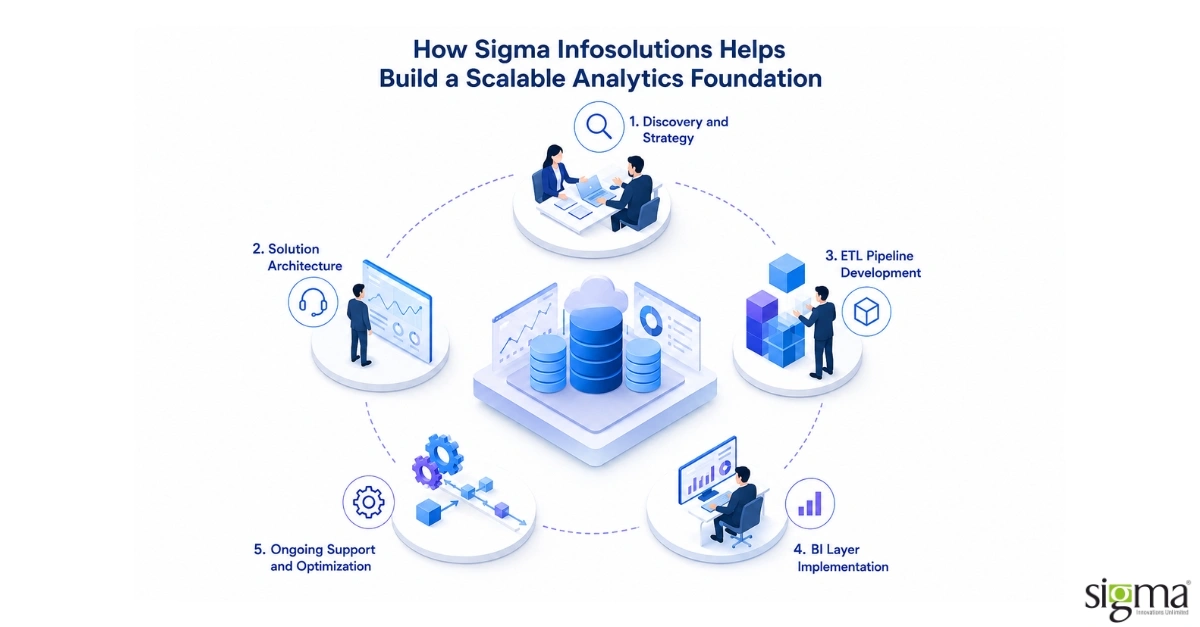
Sigma Infosolutions is an analytics modernization partner and BI transformation consulting firm that helps enterprises evolve their data ecosystems into scalable, governed, and insight-driven platforms. With deep expertise in data platform engineering leadership, Sigma delivers end-to-end capabilities across strategy, architecture, implementation, and ongoing optimization to unlock the full value of enterprise data.
Discovery and Strategy
Sigma begins every engagement with a comprehensive assessment of the client’s existing data landscape. This includes evaluating current data sources, identifying integration challenges, and defining the analytics outcomes the organization needs to achieve.
The discovery phase delivers a clear analytics modernization roadmap, aligning enterprise data architecture with business priorities and long-term decision intelligence goals.
Solution Architecture
Sigma’s data platform engineers design scalable, cloud-native warehousing architectures using platforms such as AWS Redshift, Snowflake, and Google BigQuery.
The architecture is built to support current analytics needs while ensuring flexibility for future expansion, enabling enterprises to scale their BI transformation initiatives without re-architecture risk.
ETL Pipeline Development
Sigma engineers build robust ETL and ELT pipelines that automate data ingestion from diverse enterprise systems while ensuring clean, consistent, and audit-ready datasets.
Designed with engineering rigor, these pipelines reflect Sigma’s strength in data platform engineering leadership, incorporating error handling, monitoring, and intelligent alerting to ensure reliability and freshness at scale.
BI Layer Implementation
Sigma’s BI development team connects modern data warehouses to leading visualization platforms and builds role-based dashboards that support enterprise-wide decision-making.
With a focus on semantic modeling, performance tuning, and governed data access, Sigma ensures BI systems deliver fast, accurate, and consistent insights across all business functions.
Ongoing Support and Optimization
Post-deployment, Sigma provides continuous optimization services to improve pipeline performance, enhance query efficiency, and expand analytics capabilities as enterprise needs evolve.
This long-term partnership approach reinforces Sigma’s role as a BI transformation and analytics modernization partner, helping organizations continuously evolve their data ecosystems.
Conclusion
Data warehousing is the foundation on which every successful business intelligence strategy is built. Enterprises that invest in centralized, scalable, and well-governed data infrastructure are better positioned to make faster decisions, identify growth opportunities, and operate with greater efficiency across every business function.
The combination of modern data warehousing, optimized ETL pipelines, and powerful business intelligence tools creates an analytics ecosystem that delivers consistent, trustworthy insights at enterprise scale. For CIOs, data architects, and analytics leaders, the path forward is clear: modernize the data foundation and unlock the full potential of your data assets.
Sigma Infosolutions is a trusted partner for enterprises ready to take that step. With proven expertise in data warehousing architecture, ETL engineering, and BI development, Sigma helps organizations build the scalable analytics foundation they need to compete in a data-driven world. Contact Sigma Infosolutions today or explore our BI and Analytics Development Services to start your modernization journey.
Ready to modernize your analytics foundation?
FAQs
1. What is data warehousing in enterprise analytics?
Data warehousing is the process of consolidating data from multiple enterprise systems into a centralized repository. It enables consistent reporting, historical analysis, and faster decision-making across the organization.
2. How does business intelligence (BI) work with a data warehouse?
BI tools connect to a data warehouse to transform raw, structured data into dashboards, reports, and visual insights. This allows business users to analyze performance metrics and trends in real time.
3. Why is data warehousing important for enterprises?
It eliminates data silos, ensures a single source of truth, improves reporting accuracy, and supports scalable analytics across departments such as finance, sales, and operations.
4. What are the key components of a modern data warehouse?
A modern data warehouse typically includes a centralized data repository, ETL/ELT pipelines, data modeling frameworks, governance layers, and BI tool integration for analytics and reporting.
5. What is the difference between ETL and ELT in data pipelines?
ETL transforms data before loading it into the warehouse, while ELT loads raw data first and transforms it inside the warehouse using cloud computing power. ELT is more common in modern cloud-based architectures.
6. Which tools are commonly used for data warehousing and BI?
Popular data warehouse platforms include Snowflake, Amazon Redshift, and Google BigQuery. Common BI tools include Tableau, Power BI, and Looker.
7. How does data warehousing improve business decision-making?
It provides clean, structured, and unified data that enables faster reporting, real-time insights, and more accurate forecasting, helping leaders make informed decisions.
8. What challenges do enterprises face without a modern data warehouse?
Common challenges include data silos, inconsistent reporting, delayed insights, manual reporting processes, and lack of a single source of truth.
9. How does scalability work in cloud data warehousing?
Cloud data warehouses allow organizations to scale storage and compute independently based on demand, ensuring performance efficiency and cost optimization.
10. How does Sigma Infosolutions support data warehousing and BI development?
Sigma Infosolutions delivers end-to-end data modernization including strategy, solution architecture, ETL pipeline development, BI implementation, and ongoing optimization to build scalable analytics foundations.