False Positives in Fraud Detection Are a Pricing Problem, Not a Model Problem

Most fraud programs report a detection rate to the board and a decline rate to nobody. False positives in fraud detection sit in that gap, absorbing revenue, servicing capacity, and customer patience without ever appearing as a line item. A risk team can raise recall by two points and lose more margin to declined good customers than the incremental fraud it prevented. Where a threshold sits is therefore a pricing decision, and most institutions make it with an incomplete price. Reported fraud losses in the United States reached roughly $16 billion in 2025, and the pressure that figure creates is exactly what pushes teams to tighten controls without costing the consequences.
Key Highlights:
- Fraud thresholds are tuned to detection rate, so revenue lost to declined good customers never enters the decision.
- Price a wrong decline and a missed fraud in the same currency, then set thresholds against review capacity rather than a target recall figure.
- Precision becomes a budgeted, defensible number that survives a board review and a regulatory examination alike.
- Sigma builds fraud models against the cost of a wrong decline, with the feature pipeline, review tooling, and drift monitoring that hold that cost steady.
A False Positive Is a Priced Decision, Not a Technical Error
A false positive is a legitimate transaction, application, or account that a fraud control blocks or holds for review. False positives in fraud detection are generally treated as model error and reported as a rate, which encourages teams to manage them as a quality issue owned by data science. That framing conceals the fact that every wrongly declined customer carries a calculable cost with three parts: the margin on the blocked transaction, the servicing cost of the resulting complaint, and the probability that the customer does not come back. Until those three numbers exist, a threshold cannot be set rationally. It can only be defended by instinct, which is a poor position in front of a credit committee.
Risk leaders frequently assume the aggregate cost is small because each individual decline is small. Distribution is what makes it material. A control that blocks one percent of good volume at a high-value lender tends to reject the customers with the thickest files and the largest balances, because those profiles carry the unusual attributes that rules were written to catch in the first place. The false positive rate is an average that hides a concentration of the most valuable relationships in the book.
Read to know more: Fraud Detection in Fintech Using Machine Learning: Approaches and Best Practices
What False Positives in Fraud Detection Actually Cost
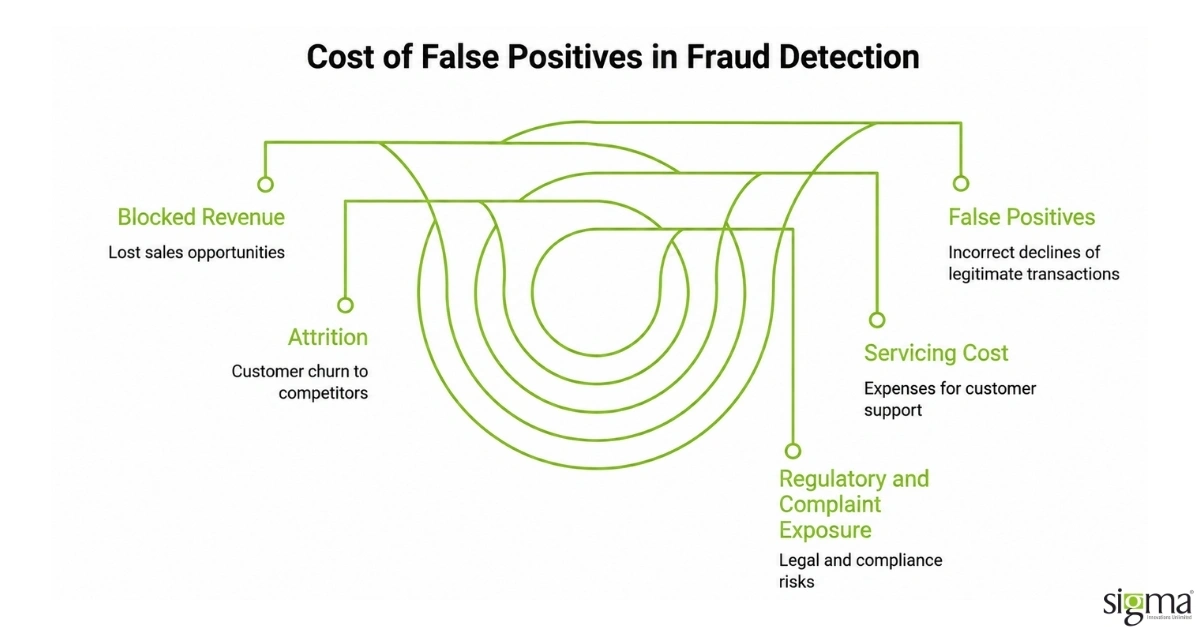
The cost of a wrong decline resolves into four components, and only the first is usually measured. Blocked revenue is the visible one, recoverable in part when a customer retries or calls in. Servicing cost is the second, covering the contact, the manual review, and the reinstatement, and it lands on a support function that did not choose the threshold. Attrition is the third and largest at scale, because a customer who declined at a moment of intent frequently completes the same purchase or application elsewhere and stays there. Regulatory and complaint exposure is the fourth, and it grows sharply where declines correlate with a protected characteristic, even where no such attribute is in the model.
Institutions that quantify all four typically discover that their optimal threshold sits meaningfully looser than the one they run. That result is uncomfortable, because it means the current setting is buying fraud reduction at a price the business would not knowingly pay. Building the cost model first, before touching the decision logic, is what converts an argument between risk and revenue into an arithmetic problem with an answer.
Ownership is what usually stalls the exercise. Blocked revenue sits with the commercial team, servicing cost sits with operations, attrition sits with marketing, and complaint exposure sits with compliance, so no single function holds the whole number, and none of them is accountable for the threshold that generates it. Assigning the cost model to the risk function, with a mandate to collect the other three inputs quarterly, is a governance change rather than a technical one. It is also the change that makes every subsequent tuning decision faster, because the arithmetic is already agreed upon before the argument starts.
Put a defensible number on precision before you tune another threshold.
Rules Plateau Because They Cannot Price Uncertainty
Rules engines produce a binary verdict with no confidence attached, which is the structural reason they cannot be tuned economically. A rule either fires or does not, so the only lever available is adding, removing, or narrowing rules, and each change shifts precision and recall together in ways nobody can forecast before deployment.
Scored approaches attach a probability to every decision, and a probability can be multiplied by a cost. That single property is what makes economic threshold setting possible at all, and it is the substantive argument for machine learning fraud detection over a purely rules-based control.
| Consideration | Rules only | Supervised model | Hybrid |
| Decision output | Binary verdict | Probability score | Score with rule overrides. |
| Threshold tuning | Not available | Continuous and priceable | Continuous within policy limits |
| Novel attack response | Manual rule authoring | Retraining and drift signals | Rules cover the gap while the model retrains. |
| Review queue load. | Fixed by rule breadth | Adjustable to capacity | Adjustable with hard policy floors |
| Explainability | Direct and inherent | Requires attribution tooling | Direct for overrides, attributed for scores |
| Cost to change | Low per rule, high in aggregate | High to build, low to adjust | High to build, low to adjust |
The accumulation problem deserves attention on its own. Rules are cheap to add and politically difficult to remove, since deleting one requires somebody to state on the record that a category of loss is now acceptable. A mature rules estate therefore grows for years, and interactions between rules written by different people at different times produce declines nobody intended, and nobody can trace. Institutions running several hundred active rules often cannot say which of them are still earning their keep, which makes any economic assessment of the current threshold impossible before the estate is rationalized.
Most regulated institutions land on the hybrid column, and the reason is rarely technical preference. Certain declines must happen for policy or sanctions reasons regardless of what a score suggests, so a rule layer stays in place as a floor while the model governs the economically discretionary band above it.
Precision Is Set by the Review Queue, Not the Model
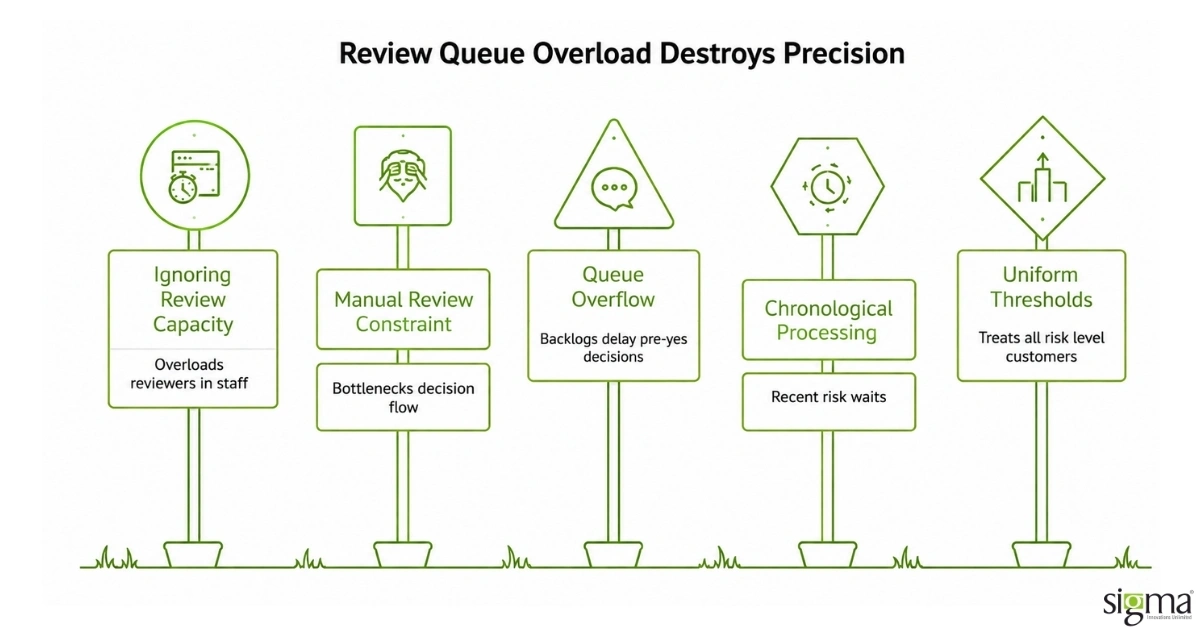
A fraud threshold that ignores review capacity will be overridden within a week by the people staffing the queue. Manual review is the actual constraint in most programs: the model proposes a volume of holds, and a finite team decides how many of them get worked before the service level breaks. When the queue overflows, analysts start clearing items quickly to keep the backlog moving, which destroys the precision the threshold was set to achieve and leaves the reported metrics unchanged.
Designing to the constraint means treating queue capacity as an input to threshold selection rather than a downstream consequence of it. Prioritization does most of the work here, since ranking held items by expected loss lets a fixed team recover far more value than working the queue chronologically. Segment-level thresholds do the rest, because a new customer with no history and an established customer with four years of clean behavior should not face the same score cutoff.
What the queue produces should also feed back into the model, and in most programs it does not. Analyst dispositions are the closest thing a fraud team has to labeled ground truth on marginal cases, since they represent a human judgment on exactly the population the model found hardest. Capturing those dispositions in a structured form, with the reason attached rather than a single cleared or confirmed flag, gives the next training cycle information it cannot get anywhere else. Programs that discard this signal retrain on the easy cases and wonder why precision at the boundary never improves.
Tuning a Threshold When Every Decision Has to Survive an Audit
The hardest constraint in regulated fraud work is not accuracy. It is that every automated decline must be explainable and reproducible months after it happened to an examiner who will ask why this applicant was rejected and what the model saw. That requirement rules out a large part of what makes models accurate in unregulated settings. Opaque feature interactions, unlogged third-party signals, and silent retraining all improve measured performance, and all fail an examination. Sigma designs to that constraint first, because a model that cannot be defended is worth less than a rule set that can.
In practice that shapes the build in specific ways. Feature pipelines are versioned so the exact inputs behind any historical decision can be reconstructed, which matters more than it sounds when a dispute arrives eight months later.
Scoring is separated from policy, so sanctions and regulatory declines execute as auditable rules rather than being absorbed into a probability the institution then has to explain. Retraining runs through champion-challenger validation against live traffic, so an accuracy improvement is verified before it touches customer-facing decisions rather than after. Drift monitoring watches the input distribution as well as the output, because a feature quietly changing shape upstream is the most common cause of a threshold that was correct in March and expensive by September.
Sigma’s fintech data and analytics work covers the surrounding layer that determines whether any of this holds: anomaly detection, device intelligence, and predictive fraud scoring feeding a real-time decision path. The review tooling matters as much as the model, since case management that routes a held item to the right queue with the evidence attached is what allows a fixed team to work at the precision the threshold assumed. Sigma treats this as a continuing engagement rather than a delivery, because a fraud system that is not recalibrated becomes a fraud detection software liability at roughly the speed that attack patterns change.
The lending engagements below show the origination and decisioning foundation this work sits on.
See how an automated decision path was rebuilt inside a live mortgage operation. Read the mortgage lending modernization story
Servicing and collections carry the same auditability requirement once a decision has been made, and the constraint compounds across the loan lifecycle rather than ending at origination.
Understand what an auditable loan management build requires end to end. Read the loan management system story
Conclusion
False positives in fraud detection are an economic quantity that most institutions manage as a technical one, which is why thresholds drift toward caution and stay there. Pricing a wrong decline against a missed fraud converts an unresolvable argument between risk and revenue into a calculation the business can actually settle.
Scored decisioning makes that calculation possible, since only a probability can be multiplied by a cost, and only a priced decision can be defended to a board. Review capacity then sets the practical ceiling, because a threshold the queue cannot absorb will be undone by the people working it. Regulated institutions carry one further constraint throughout, which is that every one of these decisions has to remain explainable long after it was made.
Is legacy technology slowing growth?
FAQs
Q1. What is a false positive in fraud detection?
A1. A false positive is a legitimate customer, transaction, or application that a fraud control blocks or holds for manual review. It is normally reported as a rate against total good volume. Each one carries blocked revenue, a servicing cost, and a real probability of losing the customer permanently.
Q2. How do you calculate the cost of a false positive?
A2. Combine four figures: the margin on the blocked transaction, the servicing cost of the resulting complaint and review, the expected value lost when the customer does not return, and any complaint or regulatory exposure. Owning functions differ, so the risk team should collect and refresh all four quarterly.
Q3. Why do machine learning models handle false positives better than rule engines?
A3. Rules return a binary verdict with no confidence attached, so they cannot be tuned economically. A scored model returns a probability, and a probability can be multiplied by a cost. That single property allows thresholds to be set against an actual financial trade-off rather than adjusted by instinct.
Q4. What false positive rate should a lender target?
A4. No universal target exists, because the correct rate depends on margin per approved customer, review capacity, and the cost of a missed fraud. Institutions that price all three usually find their optimal threshold sits looser than the one currently running, often materially so across higher-value segments.
Q5. How often should fraud detection thresholds be recalibrated?
A5. Recalibration should follow input drift rather than the calendar, monitored continuously on both feature distributions and score outputs. Most regulated programs also run a scheduled quarterly review of threshold economics, since margin, review headcount, and attack patterns all shift enough over a quarter to move the optimal setting.