How AI Is Changing Shopify eCommerce
Key Takeaways:
- AI Discovery Is Reshaping eCommerce: Unstructured product data can limit visibility across AI-powered shopping journeys.
- Enabling AI Isn’t Enough: Weak catalogs, unclear checkout paths, and missing attribution create readiness gaps.
- Build the Foundation First: Optimize product data, channels, and analytics before scaling AI commerce.
- Sigma Makes It Practical: Assess readiness, optimize Shopify catalogs, and engineer AI-powered commerce solutions.
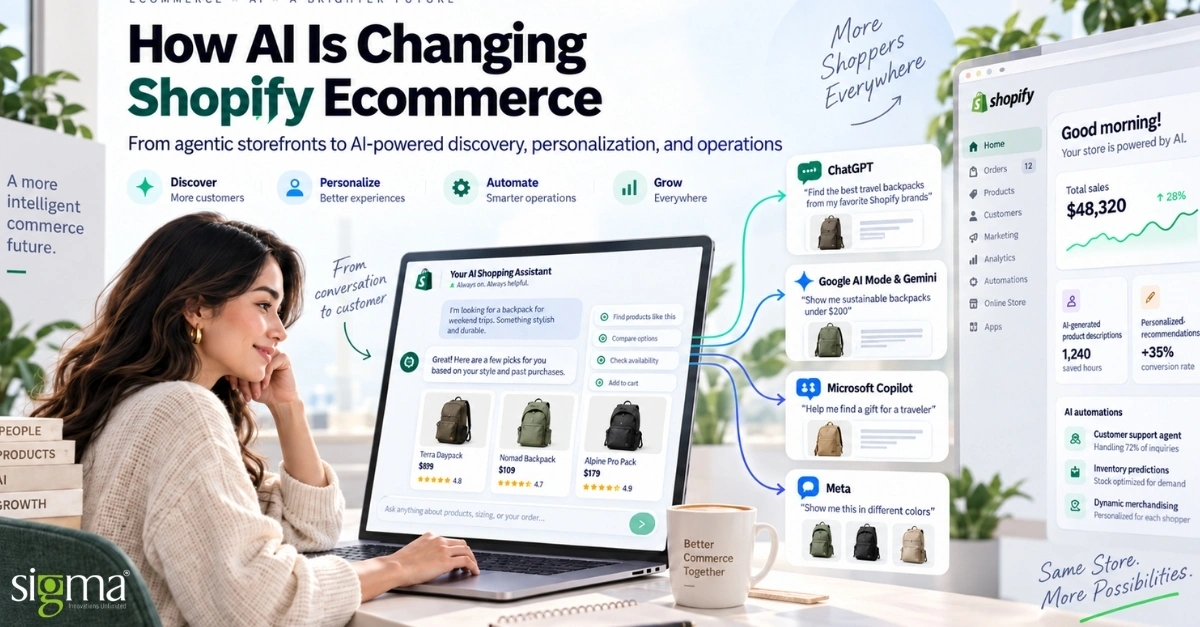
Shopify eCommerce is entering a new phase. Customers are no longer discovering products only through search engines, ads, email, or direct website visits. Increasingly, they are using AI assistants to ask questions, compare options, and receive product recommendations before they land on a merchant website.
That shift changes the strategic question for Shopify merchants. The question is no longer only, “How do we improve our online store?” The better question is, “Is our Shopify business ready to be discovered, understood, recommended, and transacted through AI-powered buying journeys?”
Why AI in eCommerce Matters for Shopify Merchants
AI commerce changes where product discovery begins. In a traditional Shopify journey, a customer browses collections, uses filters, searches products, visits a PDP, and checks out. In an AI-powered journey, the customer may start inside ChatGPT, Google AI Mode, Gemini, Microsoft Copilot, or Meta with a natural-language prompt.
This makes product data, catalog structure, variant clarity, inventory accuracy, policies, reviews, and channel settings more important. A good-looking Shopify storefront is no longer enough. The catalog also needs to be AI-ready.
What Are Shopify Agentic Storefronts?
Shopify agentic storefronts allow customers to discover and purchase products through supported AI channels. Products are made available mainly through Shopify Catalog. For Google AI Mode and Gemini, product discovery can also use the Google & YouTube sales channel or Google Merchant Center.
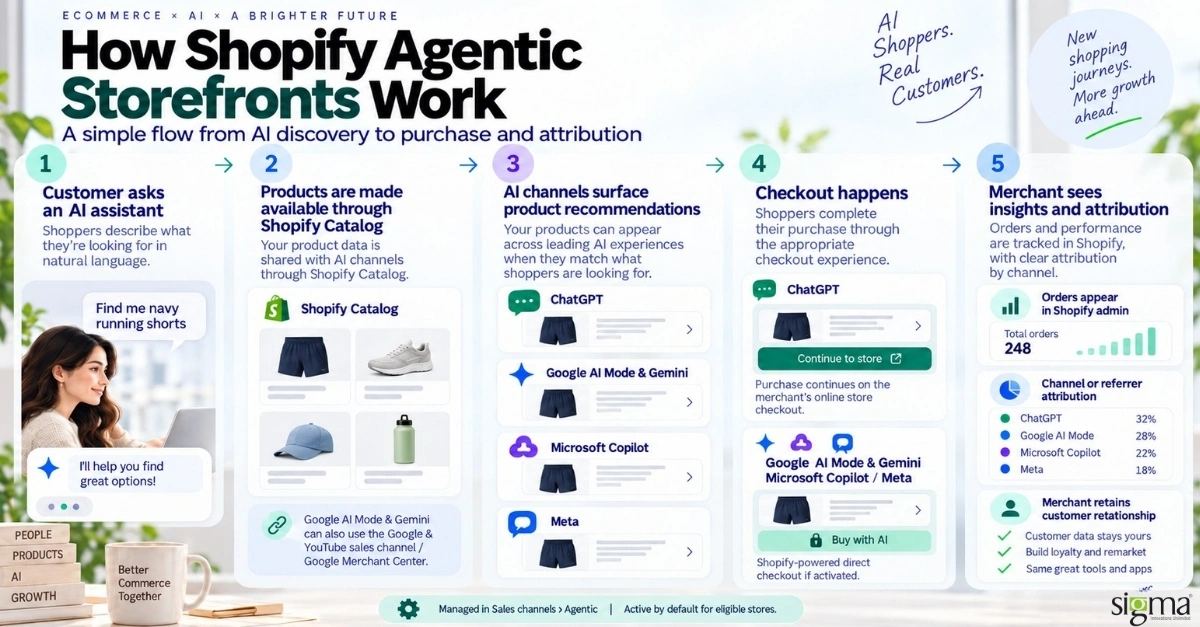
| Step | What Happens | Business Meaning |
|---|---|---|
| Customer asks an AI assistant | The shopper describes what they want in natural language. | Discovery begins inside an AI conversation. |
| Shopify shares product data | Shopify Catalog makes eligible product data available to AI channels. | AI systems can understand product details more clearly. |
| AI recommends products | The AI channel shows relevant Shopify products. | Merchants can reach shoppers earlier in the decision journey. |
| Customer checks out | Depending on the channel, checkout happens on the merchant store or through Shopify-powered direct checkout. | The buying path becomes shorter and more distributed. |
| Merchant tracks performance | Orders and attribution appear in Shopify admin. | Teams can measure AI-channel impact. |
A key channel difference matters. ChatGPT currently works mainly as a discovery-focused referrer, where customers complete checkout on the merchant online store. Other supported AI channels can offer Shopify-powered direct checkout where activated.
Ready to Build AI-Powered Commerce?
Turn smarter discovery, personalization, and ecommerce operations into measurable outcomes with Sigma.
What Often Blocks AI Readiness in eCommerce
Many stores may enable AI channels but still fail to get meaningful value because the product data is not strong enough. AI in eCommerce depends on clarity. If product data is weak, AI systems may not understand when and why to recommend a product.
| Area | Common Problem | AI Commerce Impact |
|---|---|---|
| Product titles | Generic, inconsistent, or keyword-stuffed titles. | AI may not match products to customer intent accurately. |
| Product descriptions | Missing use cases, materials, sizing, compatibility, or benefits. | Products may appear less relevant or less trustworthy. |
| Variants | Size, color, fit, pack size, or compatibility is unclear. | AI may struggle to recommend the correct option. |
| Images | Limited images or missing context images. | Product representation may be weaker in AI channels. |
| Metafields | Important attributes are stored in custom fields without proper mapping. | Useful data may not be visible to agentic storefronts. |
| Inventory and pricing | Stock or price data is not updated accurately. | Customers may see outdated product information. |
| Policies | Shipping, return, and refund information is incomplete. | Trust signals may be weaker. |
AI Commerce Needs Diagnosis Before Automation
Turning on agentic storefronts is only the starting point. Before scaling AI for eCommerce, merchants should check whether the store is ready from a data, channel, checkout, analytics, and governance perspective.
| Readiness Area | What to Check |
|---|---|
| Catalog quality | Product titles, descriptions, images, variants, attributes, and availability. |
| Shopify Catalog readiness | Whether product data is complete, structured, and mapped correctly. |
| Channel settings | Which AI channels can access products and where direct checkout applies. |
| Checkout strategy | Whether customers should complete checkout on the online store or through supported direct checkout. |
| Analytics | AI-channel sales, orders, sessions, conversions, and attribution. |
| Governance | Who reviews AI-generated content, product data, and channel performance. |
Beyond Agentic Storefronts: Other AI Areas in Shopify
Agentic storefronts are the most visible change, but AI is also reshaping the wider Shopify commerce stack. Shopify Magic and Sidekick are helping merchants create content, generate reports, build customer segments, complete store tasks, and automate workflows.
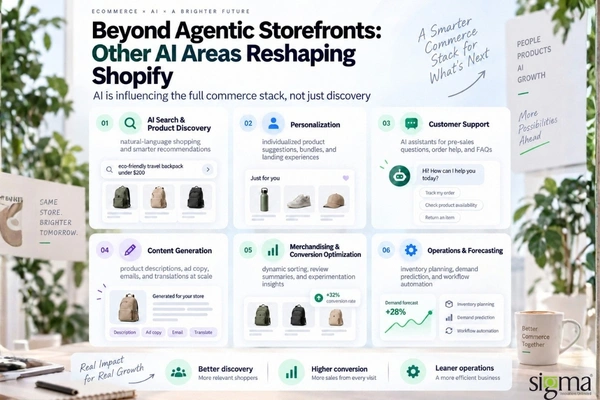
| AI Area | How It Helps |
|---|---|
| AI search and discovery | Helps shoppers find products using natural-language prompts. |
| Personalization | Supports better product recommendations, bundles, and targeted experiences. |
| Customer support | Answers common questions about products, orders, returns, and availability. |
| Content generation | Creates product descriptions, email copy, blogs, and campaign text faster. |
| Merchandising | Helps identify product trends, review themes, and conversion opportunities. |
| Operations | Supports reporting, segmentation, workflows, and back-office automation. |
Agentic Storefronts vs. Traditional Shopify Storefronts
| Criteria | Traditional Shopify Storefront | Agentic Storefronts |
|---|---|---|
| Starting point | Customer visits the website. | Customer starts in an AI channel. |
| Discovery method | Search, filters, collections, ads, and SEO. | Natural-language prompts and AI recommendations. |
| Product dependency | Good data helps SEO and conversion. | Good data helps AI understand and recommend products. |
| Checkout | Usually merchant Shopify checkout. | Store checkout or Shopify-powered direct checkout, depending on the channel. |
| Reporting | Standard Shopify and analytics reporting. | AI-channel attribution appears in Shopify admin. |
| Role | Main owned ecommerce experience. | Additional AI-powered discovery and sales layer. |
What Leadership Should Require Before Investing
AI in eCommerce should be treated as a business capability, not only a technical feature. Before investing heavily, leadership should require clear answers to these questions:
- Is the product catalog complete and structured?
- Are important product attributes available and mapped correctly?
- Which AI channels are enabled, and who owns those settings?
- How does checkout work by channel?
- Can the business track AI-channel sales and attribution?
- Who reviews AI-generated content and catalog quality?
- Which measurable outcome is the business trying to improve?
How Sigma Can Help?
Sigma can help Shopify merchants take an evaluation-first approach to ecommerce AI. The objective is not to add AI everywhere. The objective is to use AI where it improves discovery, conversion, operational efficiency, and customer experience.
| Sigma Support Area | Outcome for Shopify Merchants |
|---|---|
| AI commerce readiness audit | Understand product data, catalog, analytics, and channel gaps. |
| Agentic storefront configuration review | Validate Shopify Catalog access, channel settings, and direct checkout readiness. |
| Catalog and product data optimization | Improve descriptions, variants, images, metafields, and product attributes. |
| AI workflow enablement | Use Shopify Magic, Sidekick, Shopify Flow, and apps for useful automation. |
| Measurement and optimization | Track AI-channel performance and continuously improve results. |
Planning Your Next Shopify Move?
Build, optimize, and scale a Shopify store ready for evolving customer journeys and AI-powered commerce
The Decision Framework in Practice
| Question | If the Evidence Points to Readiness | If Optimization Should Come First |
|---|---|---|
| Catalog readiness | Product data is complete, structured, mapped, and maintained. | Product data is incomplete or hidden in unmapped custom fields. |
| Channel strategy | AI channels and direct checkout settings are understood and governed. | Default settings are active but not reviewed. |
| Checkout and analytics | The team understands checkout paths and attribution by channel. | Checkout behavior and reporting are unclear. |
| Content and merchandising | AI can accelerate workflows with human review. | Generated content may create quality or accuracy risk. |
| Operations | AI is connected to reporting, support, segmentation, and workflows. | AI is used only as an isolated content tool. |
| Governance | Roles are defined for catalog quality, privacy, and channel management. | No clear owner exists for AI settings or output review. |
Conclusion
AI is changing Shopify eCommerce by changing how customers discover, compare, and buy products. Shopify agentic storefronts are a major step in this shift because they allow products to appear in AI-powered shopping journeys and create new paths from conversation to purchase.
The real opportunity goes beyond storefronts. AI can improve product discovery, personalization, content creation, support, merchandising, reporting, and operations. The merchants that benefit most will be the ones that prepare their catalog, govern AI channels, measure performance, and keep customer trust at the center.
Build an eCommerce Experience That Drives Growth. Modernize your commerce experience to increase conversion, improve customer journeys, and scale with your business.
Frequently Asked Questions
What are Shopify agentic storefronts?
They allow eligible Shopify products to be discovered and purchased through supported AI channels.
Are agentic storefronts active by default?
Yes. Shopify says agentic storefronts are active by default for eligible stores.
Does ChatGPT support Shopify checkout directly?
Shopify documentation says ChatGPT works as a discovery-focused referrer, with checkout completed on the merchant online store.
Why is product data important for AI commerce?
AI channels rely on product data to understand what a product is, who it is for, and when to recommend it.
Is AI commerce only about agentic storefronts?
No. AI also affects content, support, personalization, merchandising, reporting, segmentation, and operations.