Mobile Payment Platforms and the New Year Resolution Spike: Scaling for Fitness, Finance, and Subscription Sign-Ups

Key Highlights
- January’s resolution-driven sign-up surge concentrates new subscriber volume into roughly two weeks, and mobile payment platforms that handle normal volume fine start failing first charges, dropping authentication flows, and losing wallet transactions exactly when the most new subscribers are trying to pay for the first time.
- Every failed first charge is a subscriber lost before their first renewal, and involuntary churn from failed payments already accounts for 20% to 40% of total subscription churn industry-wide, a cost that compounds sharply during a volume spike.
- Decline-reason-aware smart retry, tokenized card-on-file handling that survives network-level card updates, authentication tuned to risk level instead of applied uniformly, and wallet support sized for peak demand.
- Sigma engineers subscription and mobile payment flows built for sign-up spikes, adds failed-payment recovery logic, and stays engaged as the retained product team protecting first-charge and renewal revenue year-round.
January doesn’t just fill gyms, it floods mobile payment platforms with new subscribers, and a meaningful share of those sign-ups stall before the first renewal. Adapty’s analysis of US subscription apps across the holiday season found trial starts peaking 49% above a normal October day on January 1, and first payments peaking 55% above normal on January 10, with weekly transaction volume running 42% above baseline during the January 12-18 surge window. Health and fitness apps specifically bottomed out at Christmas, 30% below a normal week, then rose 13% in the first days of January as resolution-driven sign-ups arrived, and budgeting and personal-finance apps see their own version of the same pattern as New Year’s financial resolutions drive new account creation in the same window. That concentrated volume is exactly where mobile payment infrastructure gets tested hardest: first-charge authorization, card-on-file tokenization, and retry logic all have to hold up against a spike most platforms only see once a year. For CEOs, CTOs, and product leaders running fitness, finance, and subscription platforms at growth-stage scale, getting this wrong isn’t abstract, it’s a subscriber who churns before they ever become a customer.
Why Do Mobile Payments Fail During Sign-Up Surges?
Mobile payments fail during sign-up surges because the systems that process a first charge, authenticate the cardholder, and record the payment method all get tested by volume concentrated into a narrow window, and each one fails in its own way.
| Funnel stage | Failure | Fix |
|---|---|---|
| Account creation and first charge | Soft declines (risk holds, insufficient-funds flags) spike under concentrated new-card volume, with no differentiation from hard declines | Decline-reason-aware retry logic that treats soft and hard declines differently, not one retry policy for every failure |
| Card-on-file tokenization | Tokens generated under load go stale when a card is reissued or expires, with no update mechanism | Token-vault integration kept current through network token updates, not a one-time tokenization at signup |
| Authentication (3DS, biometric) | Added verification steps meant to cut fraud add drop-off exactly when a first-time subscriber is least patient | Authentication tuned to risk level, so a low-risk first charge doesn’t carry the same friction as a high-risk one |
| Wallet payments (Apple Pay, Google Pay) | Wallet volume spikes faster than card volume during a sign-up surge, and wallet-specific decline codes get handled the same as card declines | Wallet-aware retry and monitoring, not generic card-decline handling applied to wallet failures |
| Dunning and recovery | A failed first charge gets the same generic retry schedule as a failed renewal, missing the narrow window a new subscriber is most likely to fix it in | Recovery messaging and retry timing tuned specifically to first-charge failures, not reused renewal-dunning logic |
Wallet payments carry their own version of this problem at a faster pace. PYMNTS Intelligence data suggest roughly a third of US consumers had used a digital wallet online in the prior 30 days, and 21% had abandoned a cart in that window because their preferred payment method wasn’t available, a gap that widens during a volume spike if wallet support wasn’t built to the same standard as card processing.
The tokenization failure deserves its own mention because it is the hardest to catch in normal testing. Card networks issue their own account-updater signals whenever a card is reissued, reported lost, or hits its expiration date, and a payment platform that doesn’t subscribe to and apply those signals keeps charging a token that quietly went stale. Under normal volume, that shows up as a trickle of renewal failures spread across a year. During a January sign-up surge, where a large share of first charges land on cards that are also, independently, due for routine reissue cycles, the same gap shows up as a spike in first-charge failures that looks like a payments outage even though nothing about the platform itself changed.
How Do You Reduce Failed Subscription Payments?
Reducing failed subscription payments starts with treating failure causes differently rather than retrying every decline the same way, and investing specifically in the retry logic and timing already proven to recover revenue.
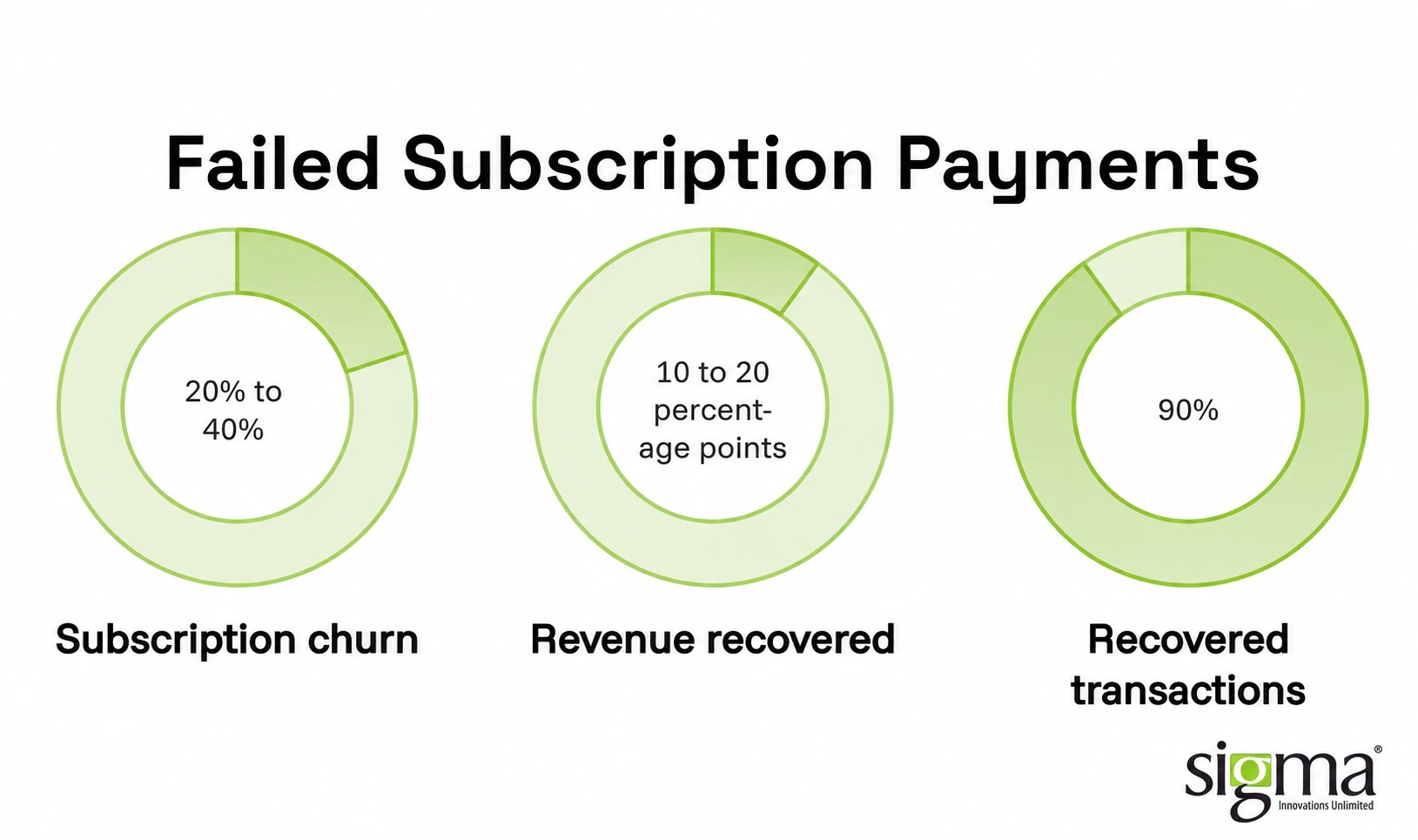
Recurly’s analysis of payment-recovery data found failed payments already account for 20% to 40% of total subscription churn, with expected revenue lost to involuntary churn industry-wide reaching $129 billion for 2025. The same analysis found optimized, network-informed retry strategies recovered 10 to 20 percentage points more revenue than single-merchant retry logic on identical transaction sets, and that 90% of recovered transactions happen within the first 10 days after a failure, a window a platform loses if its dunning and retry logic isn’t built to move that fast.
What Is Smart Payment Retry?
Smart payment retry is retry logic that varies the timing and channel of a second attempt based on why the first charge failed, rather than retrying every decline on the same fixed schedule.
A soft decline, a temporary hold or an insufficient-funds flag that often clears within days, succeeds on a well-timed retry far more often than a hard decline, a closed account or a stolen-card flag, which needs a different payment method entirely. Treating both the same wastes retry attempts on charges that will never succeed and delays the attempts that would. Smart retry also accounts for network-level signals, a card issuer’s own update to a reissued or expired card, so a retry doesn’t fail again on stale token data, and it varies retry timing by decline reason rather than firing every second attempt on the same fixed interval, since a soft decline tied to a payday cycle recovers on a different schedule than one tied to a temporary fraud hold. For a subscription platform absorbing a January-scale sign-up surge, this distinction is what determines whether the surge converts into retained subscribers or into a support queue full of customers who never successfully paid at all.
Also, read the blog: Stopping Revenue Leakage with Prefunded Wallets & Real-Time Fee Management
Why a Failed First Charge Is a Retention Problem, Not Just a Billing One
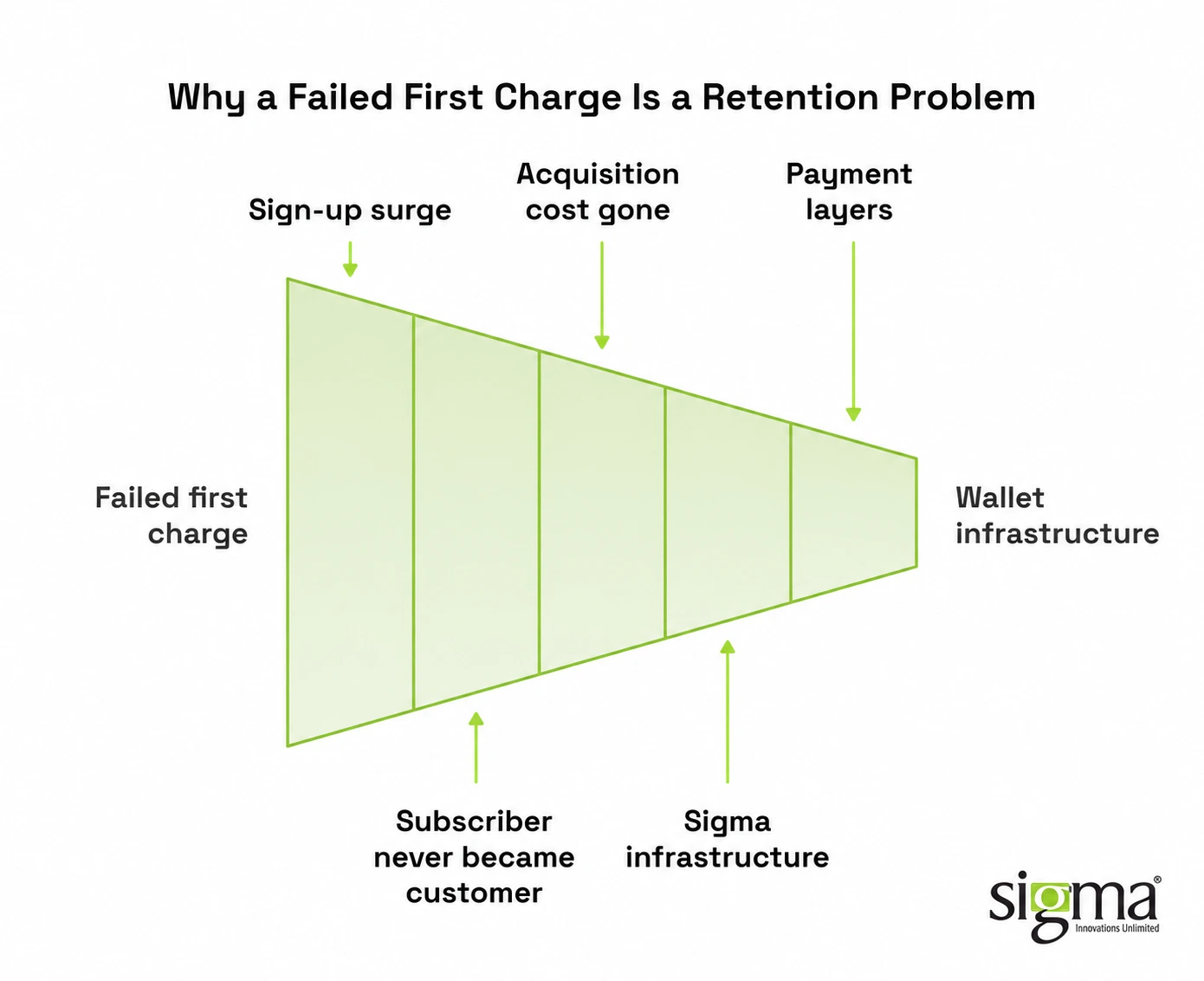
Most of the content a platform leader finds while researching this problem treats a failed payment as a billing-ops configuration issue, something for finance or the payments team to tune in a dunning tool after the fact. That framing understates what is actually lost: a failed first charge during the sign-up surge isn’t a delayed renewal the way a failed renewal charge is, it’s a subscriber who never became a customer in the first place, and the acquisition cost already spent to get them through sign-up is gone regardless of whether the payment itself eventually succeeds on a later retry.
Sigma Infosolutions has built exactly this kind of consumer payment infrastructure before. For Algopay, a US-based B2C e-wallet fintech startup, Sigma built the mobile app and admin backend behind a secured OTP signup flow, a MasterCard-powered stored-value debit card, and wallet-to-wallet and business-to-wallet transfer with refund handling, covering the same account-creation, authentication, and transaction layers a subscription platform’s first-charge flow depends on. That engagement covers onboarding security and wallet transaction infrastructure rather than subscription retry logic specifically, which is disclosed here rather than implied as a direct match; no published Sigma case study on subscription-billing recovery specifically was found after a targeted search.
The same underlying discipline, treating onboarding, authentication, and transaction handling as parts of one connected system rather than separate vendor integrations, is what a subscription platform needs when its own sign-up surge arrives.
For a fitness, finance, or subscription platform heading into another January, the real choice is between hardening payment and retry logic before the surge arrives, or losing newly acquired subscribers to a failed first charge they never get the chance to fix. Sigma can run that hardening as a focused engagement through its fintech product engineering services, or stay engaged as the retained product team protecting conversion and renewal revenue through every peak on the calendar.
Conclusion
Mobile payment platforms don’t fail randomly during January’s resolution-driven sign-up surge, they fail at the exact points where volume concentration meets logic built for an ordinary week: first-charge authorization, card-on-file tokenization, authentication, and wallet handling. Adapty’s data on US subscription apps shows trial starts peaking 49% above normal on January 1 and first payments peaking 55% above normal on January 10, with fitness apps climbing 13% in the surge’s first days after a Christmas dip. That volume doesn’t excuse a failed first charge, it explains why first charges fail more often exactly when the most new subscribers are trying to pay. Recurly’s recovery data puts failed-payment churn at 20% to 40% of total subscription churn and $129 billion in expected lost revenue for 2025, a cost concentrated hardest during a volume spike a platform didn’t build retry logic to absorb. Smart retry, timed and tuned to why a specific charge failed rather than applied on one fixed schedule, is what closes that gap, recovering 10 to 20 percentage points more revenue than generic retry logic on the same transaction set. Reducing failed subscription payments means treating soft declines, hard declines, and wallet-specific failures differently, not retrying every decline the same way. Authentication adds its own friction: a first-time subscriber is least patient exactly when a platform is most likely to add an extra verification step, so authentication tuned to risk level protects conversion that uniform friction would cost. Wallet payments carry the same risk at a faster pace, since digital wallet adoption keeps climbing among US consumers while wallet-specific decline codes still get lumped into generic card-decline handling on many platforms. None of this requires rebuilding a platform from scratch, it requires testing first-charge, retry, authentication, and wallet logic against realistic January-level volume before the surge arrives, not during it. A fitness, finance, or subscription platform that hardens its mobile payment platforms infrastructure ahead of the January surge protects the subscriber it already paid to acquire, instead of losing them to a failed charge they never got the chance to fix. The alternative, discovering the gap between support tickets and a drop in first-charge conversion, is the costlier way to learn the same lesson.
Frequently Asked Questions
Why do mobile payments fail during sign-up surges?
Mobile payments fail during sign-up surges because first-charge authorization, card-on-file tokenization, authentication, and wallet handling all get tested by volume concentrated into a narrow window. Each fails differently: soft declines spike, tokens go stale, added authentication friction costs conversion, and wallet-specific failures get treated the same as card declines.
How do you reduce failed subscription payments?
Reducing failed subscription payments means treating decline reasons differently rather than retrying every failure on the same schedule. Decline-reason-aware retry timing, token-vault integration kept current through card-network updates, and risk-tuned authentication together recover revenue that generic retry logic and uniform friction would otherwise leave on the table.
What is smart payment retry?
Smart payment retry is retry logic that varies the timing and approach of a second attempt based on why the first charge failed, rather than retrying every decline on a fixed schedule. It distinguishes soft declines likely to succeed on retry from hard declines that need a different card, recovering revenue a one-size retry schedule misses.
Why does the January sign-up surge concentrate payment failures?
The January sign-up surge concentrates new subscriber volume into roughly two weeks, as resolution-driven sign-ups for fitness, finance, and subscription apps arrive at once. That volume tests first-charge and authentication logic harder than normal traffic does, which is why failures rare the rest of the year become visible during this specific window.
When should a subscription platform test its payment flow for a sign-up surge?
Testing should happen before the surge begins, since first-charge authorization, retry logic, authentication, and wallet handling all need validation against realistic concurrent volume, not an average day’s traffic. A platform that waits until new subscribers are already failing has no runway left to fix what the testing would have caught.