Why Payment Gateways Buckle on Boxing Day: Engineering for Retail’s Biggest Single-Day Spike

Key Highlights:
- Boxing Day creates a concentrated authorization spike that exposes capacity limits, acquirer dependency, and observability gaps that a normal week never reveals.
- Every failed or slow authorization on Boxing Day is a lost sale at the retailer’s highest-stakes moment, and merchants losing sales to gateway failures lose trust in the gateway, not just the day.
- Capacity planning tested against real peak-day volume, multi-acquirer routing with intelligent failover, idempotent retry controls, real-time observability, and proactive merchant communication during incidents.
- Sigma builds and hardens payment infrastructure fast enough to be ready before a single-day spike arrives, without compromising compliance or security.
Searches for payment gateway uk mostly come from merchants comparing providers, but for the team running the gateway itself, Boxing Day is the day that tests every capacity assumption at once. Checkout.com’s UK holiday transaction data shows Boxing Day spending jumping 43% compared with Christmas Day and running 29% above the adjusted period average. That rise in spend does not prove authorization volume climbed by the same margin, but it supports the same underlying premise: transaction demand concentrates sharply into a single retail day. A separate Checkout.com study, run across UK online shoppers, found that UK online payment failures cost retailers an estimated £31.3 billion a year, with 48% of shoppers reporting a checkout payment failure, 40% of them abandoning the purchase entirely, and 32% buying the same item from a competitor instead. That £31.3 billion is an annual, UK-wide estimate, not a Boxing Day-specific loss figure; it establishes the financial stakes of checkout failure generally, not the cost of a single bad day. A gateway that handles a normal day’s authorization volume smoothly can still buckle on the one day that volume arrives several times over, in a single concentrated window. For payment gateway providers, Boxing Day is more than a traffic spike. It is a live test of authorization resilience, transaction throughput, and the engineering decisions behind every successful payment. Sigma’s Digital Payment Solutions brings the integration, engineering, and scalability expertise needed to build payment infrastructure that stays reliable when transaction demand peaks.
Why Do Payment Gateways Fail on Boxing Day?
A well-prepared gateway does not automatically fail on Boxing Day, but the ones that do tend to fail for the same handful of reasons: capacity that was never load-tested against real peak volume, a single-acquirer dependency that turns one provider’s slowdown into a platform-wide problem, retry logic that creates duplicate authorizations instead of safely resolving failed attempts, and monitoring built around server uptime rather than the authorization and decline metrics that actually predict a failing checkout.
The terms gateway, acquirer, and issuer get used loosely in most coverage of this topic, but they play different roles and fail in different ways. The gateway, or payment service provider, initiates a transaction and routes it onward. The acquirer processes that transaction into the card networks on the merchant’s behalf. The issuer, the shopper’s own bank, approves or declines it. A Boxing Day failure can originate at any one of these three layers, which is exactly why a fix aimed at only one of them, swapping gateways without addressing acquirer concentration, for example, often leaves the real risk untouched.
None of these weaknesses is unique to Boxing Day. A gateway running at 60% of normal peak capacity, with one acquirer and generic retry logic, can run for months without a visible problem, because normal traffic never pushes any of those limits far enough to matter. Boxing Day removes that margin in a single afternoon, and it does so for every retailer on the platform simultaneously, which is what turns an isolated weak point into a platform-wide incident rather than a contained one.
| Cause | Symptom | Resilience fix |
|---|---|---|
| Insufficient peak capacity | Timeouts and slow authorizations | Autoscaling, capacity thresholds, and failover |
| Single-acquirer dependency | Broad decline or outage impact | Multi-acquirer routing and intelligent failover |
| Retry storms | Duplicate authorizations and reconciliation issues | Idempotent processing and controlled retry policies |
| Poor observability | Late detection of declining approval rates | Real-time authorization, latency, and decline monitoring |
| Weak merchant communication | Merchant distrust during incidents | Status dashboards, alerts, and incident communication |
Each row in that table tends to surface in a predictable order during an actual incident. Capacity strain appears first, as authorization latency creeps upward during the morning volume ramp. Retry storms follow soon after, once shoppers and client applications start resubmitting requests that appear to have failed. Reconciliation problems and merchant complaints usually arrive last, often hours after the authorization-rate drop that caused them, which is exactly the lag that real-time observability is built to close.
How Do You Prepare a Payment Gateway for Peak Traffic?
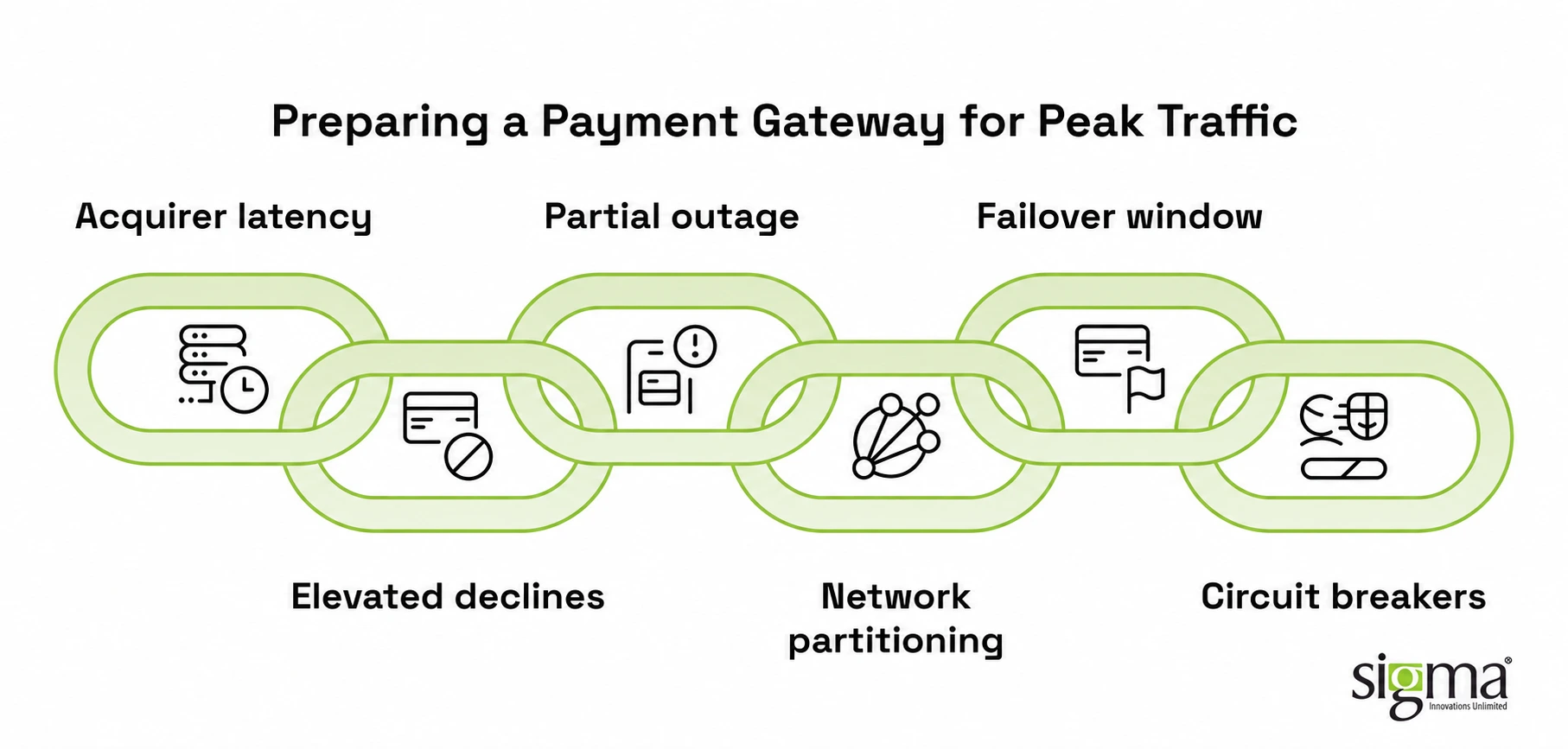
Preparing a payment gateway for peak traffic means testing capacity thresholds against realistic Boxing Day volume models, not against the previous average day’s load, and validating failover between acquirers under simulated failure conditions before the day arrives rather than discovering the failover path does not work during a live incident.
In practice, a peak-readiness review covers several things together, rather than one at a time:
- Defining the target service levels before testing against them, specifically the authorization success rate, p95 and p99 authorization latency, timeout rate, and how quickly fallback routing is expected to activate once a threshold is breached.
- Load testing the full authorization path at several multiples of average daily volume, modeled on the concentrated single-day spike Boxing Day actually produces, not a smoothed average.
- Running chaos-style tests that simulate acquirer latency, an elevated decline rate, a partial outage, and network partitioning, not only a single generic “degraded acquirer” scenario.
- Validating acquirer failover under those simulated conditions, confirming the switch actually completes within the target window rather than assuming it will, and pairing multi-acquirer routing with circuit breakers so a degraded acquirer stops consuming capacity instead of continuing to absorb requests it cannot process.
- Auditing retry logic for a full safe-state model, not idempotency keys alone: request-state tracking that distinguishes a confirmed failure from an unknown outcome, a defined timeout policy, and a reconciliation process for authorizations that resolve after the gateway already reported them failed.
- Confirming that authorization-rate and decline-rate alerting is tuned to flag an anomaly within minutes, not after a day’s worth of lost sales has already accumulated.
Routing decisions also have to work inside the rules of the card networks and regulators, not just around acquirer performance. Scheme rules, 3-D Secure and other authentication requirements, regional processing rules, and data-residency obligations can all constrain which acquirer a transaction is legally or contractually allowed to route through, which is why a peak-readiness review has to involve compliance alongside engineering, not after it.
A Boxing Day runbook ties this all together: a named incident commander, a set cadence for merchant status updates, defined rollback criteria, the specific thresholds that trigger an acquirer switch, and a post-incident reconciliation plan for any transactions the day’s retry activity left in an uncertain state.
What Is Multi-Acquirer Routing?
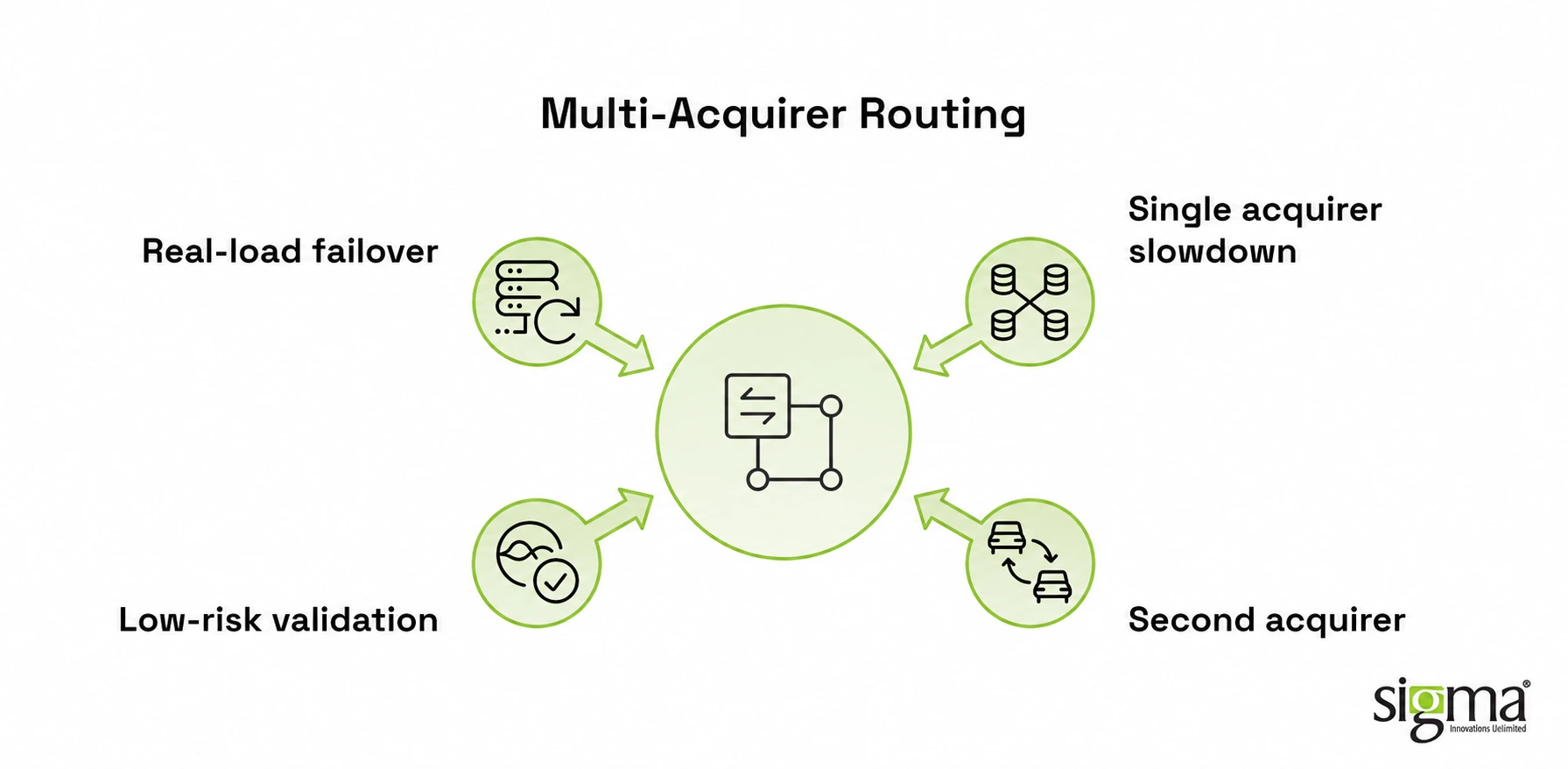
Multi-acquirer routing is the practice of connecting a payment gateway to more than one acquiring bank or processor and routing transactions dynamically between them based on real-time performance, cost, or availability, rather than depending on a single acquirer for every transaction. When one acquirer slows down or declines at an unusual rate, a gateway with multi-acquirer routing can shift volume to a healthier path automatically, which reduces exposure to that acquirer’s problem rather than passing it straight through to every merchant on the platform. It does not eliminate every acquirer-side risk on its own; card-network rules, issuer-level fraud behavior, and settlement constraints still apply regardless of which acquirer a transaction routes through.
The routing decision itself typically weighs three signals continuously rather than once at setup: each acquirer’s current approval rate, its live response latency, and its per-transaction cost. A gateway that only checks these signals during a nightly batch job, rather than in near real time, still carries most of the single-acquirer risk even if a second acquirer is technically connected, because the failover decision arrives too late to protect the transactions that mattered most.
Why Single-Acquirer Simplicity Becomes a Liability at Peak Volume
Most gateways start with a single acquirer because it is simpler to build, monitor, and reconcile, and at normal volume that simplicity rarely causes a problem worth solving. The trade-off becomes visible only at peak: a single acquirer experiencing even a modest slowdown or elevated decline rate on Boxing Day affects every transaction routed through it, with no healthier path available to absorb the difference.
This is the same trade-off that shows up in payment infrastructure generally: simplicity that works fine most of the year concentrates risk into the one day that risk is most expensive. A gateway that only ever operated through one acquirer has no tested failover path to fall back on, which means the first time that path gets exercised is during the incident itself, not before it, and an untested failover is often slower or less reliable than no failover plan at all. The fix is rarely a full rebuild. It is usually a staged rollout: connecting a second acquirer for a defined slice of traffic first, validating the routing logic against real transactions at low risk, then widening the split once the failover path has proven itself under genuine load rather than a lab test alone.
Why Boxing Day Resilience Takes Engineering, Not a Vendor Swap
A gateway team rarely discovers a capacity gap from a dashboard first. It usually discovers it from a merchant asking why its approval rate dropped an hour into Boxing Day morning, or from a reconciliation report that will not balance once retry-driven duplicate authorizations start appearing in it. By the time either signal arrives, the fix is reactive rather than planned, and reactive fixes during a live incident carry their own risk of making the underlying routing or retry logic worse rather than better.
The engineering work that prevents this is rarely glamorous. It is load-testing scripts written against realistic Boxing Day traffic shapes rather than average-day assumptions, failover paths exercised on a schedule instead of left untested until the day they are needed, and alerting thresholds tuned against a platform’s own authorization data rather than copied from a generic monitoring template. None of that shows up in a sales deck, but it is the difference between a gateway that absorbs a 43% single-day spike without a merchant noticing and one that spends Boxing Day afternoon fielding support tickets about declines nobody can yet explain.
Sigma Infosolutions has built exactly the kind of enterprise-grade, compliance-ready payment infrastructure this resilience work requires. For a confidential FinTech client, Sigma designed and delivered a blockchain-powered cross-border payment platform supporting institutional payment corridors between the United States, Mexico, and Colombia, using an AI-first engineering approach to deliver the production-ready platform in 10 weeks, roughly 50% faster than a conventional build, without compromising the compliance-ready workflows and enterprise security the client’s institutional customers required.
For a gateway or payment-platform leader serving UK, Canadian, Australian, or New Zealand retailers, the question before Boxing Day is whether capacity, routing, retry logic, and observability have all been tested together under realistic peak conditions, or whether the first real test will happen live, on the one day approval rates matter most. Sigma can run a peak-readiness review as a defined engagement or stay engaged as the team behind the platform through peak season and beyond.
Conclusion
A payment gateway uk search usually comes from a merchant comparing providers, but the platform behind that gateway faces its hardest test on Boxing Day, when authorization volume concentrates into a single day more than almost any other point in the retail calendar. Checkout.com’s data shows Boxing Day spending running well above the surrounding period’s average, and a UK-wide study puts the annual cost of payment failures at checkout at roughly £31.3 billion, with a meaningful share of affected shoppers abandoning the purchase or buying from a competitor instead. Insufficient peak capacity, single-acquirer dependency, retry storms, poor observability, and weak merchant communication are not five unrelated risks. They are the same underlying gap, infrastructure built for a normal week and tested only on the one day it cannot afford to fail. Capacity planning that models realistic Boxing Day volume, rather than extrapolating from an average day, closes the first gap directly. Multi-acquirer routing with intelligent failover means one acquirer’s slowdown does not become every merchant’s outage, provided the routing decision runs in near real time rather than on a delayed batch cycle. Idempotent, controlled retry logic prevents a spike in failed authorizations from turning into a spike in duplicate ones that reconciliation has to untangle afterward. Real-time observability built around authorization and decline rates, rather than server uptime alone, catches a developing problem while it is still a latency trend and before it becomes a visible drop in sales. Merchant communication during an incident matters just as much as fixing the incident itself, since a merchant watching sales drop with no explanation loses confidence faster than one who sees a status dashboard and a clear timeline. None of this requires rebuilding a gateway from scratch, but it does require testing these systems together under realistic peak conditions well before Boxing Day arrives. A payment gateway uk platform that treats this as a defined engineering readiness problem, rather than a vendor comparison exercise, protects both approval rates and merchant trust on the one day that trust is hardest to win back once it is lost.
Frequently Asked Questions
Why do payment gateways fail on Boxing Day?
Payment gateways fail on Boxing Day because weaknesses a normal week tolerates, insufficient capacity, single-acquirer dependency, and retry logic that creates duplicate authorizations, all get tested at once by a concentrated spike. The same gaps exist year-round; Boxing Day is simply the day volume is high enough to expose them clearly and all at once.
How do you prepare a payment gateway for peak traffic?
Preparing a payment gateway for peak traffic means testing capacity thresholds against realistic Boxing Day volume models rather than an average day’s load. It also means validating failover between acquirers under simulated failure conditions before the event, with monitoring tuned to flag an authorization or decline-rate anomaly within minutes, not after a day of lost sales has already passed by.
How do you test failover without creating real duplicate payments?
Failover is tested first in a sandboxed acquirer connection, using test card ranges that never settle real funds, then validated against a small, controlled slice of live traffic rather than switched on fully. That staged approach surfaces any gap between simulated and live behavior at low risk, instead of during a live Boxing Day incident.
What metrics distinguish an acquirer issue from a merchant-specific issue?
An acquirer-side issue shows up as a decline-rate or latency spike affecting multiple merchants routed through that acquirer at once, while a merchant-specific issue stays isolated to one merchant’s own configuration or fraud rules. Comparing decline rates across merchants on the same acquirer in real time is usually the fastest way to tell which is happening.
How should a gateway platform communicate with merchants during a Boxing Day incident?
A gateway platform should give merchants real-time status dashboards and proactive alerts during an incident rather than leaving them to discover a decline-rate spike through their own falling sales figures. Clear, early communication protects merchant trust even in cases where the underlying incident itself cannot be fully avoided.