Why Holiday Financing Applications Spike, and Stall, During Christmas Week

Key Highlights:
- Christmas week concentrates financing application volume into a few days, and applications stall at decisioning latency, bank-data verification, and fraud screening exactly when approval speed matters most.
- A stalled application does not simply wait; it goes to a competitor, or it sits exposed to fraud in a manual review queue built for ordinary-week volume.
- Automated document and income verification, bank-data ingestion, real-time fraud signals, configurable risk scoring, and workflow orchestration across the loan origination system close the gap.
- Sigma automates lending decisioning and fraud checks, then stays engaged as a dedicated product engineering team through peak volume.
Searches for buy now pay later no credit check reflect borrowers shopping for financing options during the holidays, but the real story for a digital lender, BNPL provider, or embedded finance platform is what happens on the other side of that search: a surge of financing applications arriving in a few concentrated days, each one needing a fast, accurate decision.
Adobe Analytics reports BNPL spending reached $8.2 billion in the US, up 9% year over year, with mobile accounting for $6.7 billion of that total. Every one of those applications still has to clear identity verification, bank-data checks, and fraud screening, and the platforms that scale this volume smoothly fund more of the loans they already attracted.
The ones that don’t push qualified applicants into a manual review queue, or lose them to a faster competitor, while review capacity stays fixed against several times the normal load. This article maps where holiday-week financing applications actually stall and the automation that keeps decision-making fast without loosening risk controls.
Why Financing Applications Stall During the Holidays
Christmas week concentrates financing application volume into a handful of days, creating pressure on lenders to process applications without increasing review capacity. Every application still has to pass through the same sequence: identity and income verification, bank-data checks, fraud screening, and underwriting. However, these steps now compete for review capacity against several times the normal volume. A lender that treats holiday week like any other week may discover the gap only when qualified applicants are already sitting in a manual review queue, with the window to fund them before they apply elsewhere closing fast.
Every one of those applications still has to pass through the same sequence it would any other week: identity and income verification, bank-data checks, fraud screening, and underwriting, except now it is competing for review capacity against several times the normal volume. A lender that treats holiday week like any other week usually discovers the gap only when qualified applicants are already sitting in a manual review queue, with the window to fund them before they apply elsewhere closing fast.
What Causes Credit Decisioning Latency During Peak Volume?
Credit decisioning latency during peak volume comes from the same few sources every holiday season: manual document and income review that cannot scale with application count, bank-data verification that queues behind a fixed number of reviewers, and rigid credit rules that route more marginal applicants to manual review exactly when review capacity is already stretched thin.
How Can Lenders Scale Fraud Checks Without Increasing Application Abandonment?
Scaling fraud checks without slowing legitimate applicants down means moving screening from a manual queue to real-time identity, device, behavioral, and transaction risk signals that score an application the moment it is submitted. This catches the same fraud patterns a reviewer would flag manually, without adding the wait that pushes a legitimate borrower to abandon the application partway through.
| Bottleneck | Business impact | Automation fix |
|---|---|---|
| Manual document and income review | Slower approvals and higher abandonment | Automated document capture, verification, and exception routing |
| Bank-data verification delays | Delayed credit decisions and lost funded loans | Bank-data ingestion, transaction analysis, and cash-flow signals |
| Fraud screening queues | Higher fraud exposure and operational backlog | Real-time identity, device, behavioral, and transaction risk signals |
| Rigid credit rules | More marginal applicants routed to manual review | Configurable rules plus AI-assisted risk scoring |
| Fragmented LOS workflows | Poor visibility and repeated handoffs | Workflow orchestration across onboarding, underwriting, and servicing |
Accelerate lending decisions with AI-powered automation.
Where Can Alternative Data Underwriting Reduce Verification Friction?
Alternative data underwriting reduces verification friction where traditional documentation is slow to produce or inconsistently available, using bank transaction history and cash-flow signals to support a decision instead of waiting on a pay stub or tax form. It is not a replacement for documentation review in every case, mainly a faster path for the applicants where cash-flow signals already tell most of the story, freeing manual review capacity for the cases that genuinely need it.
Preventing Manual Underwriting Queues From Becoming a Holiday Bottleneck
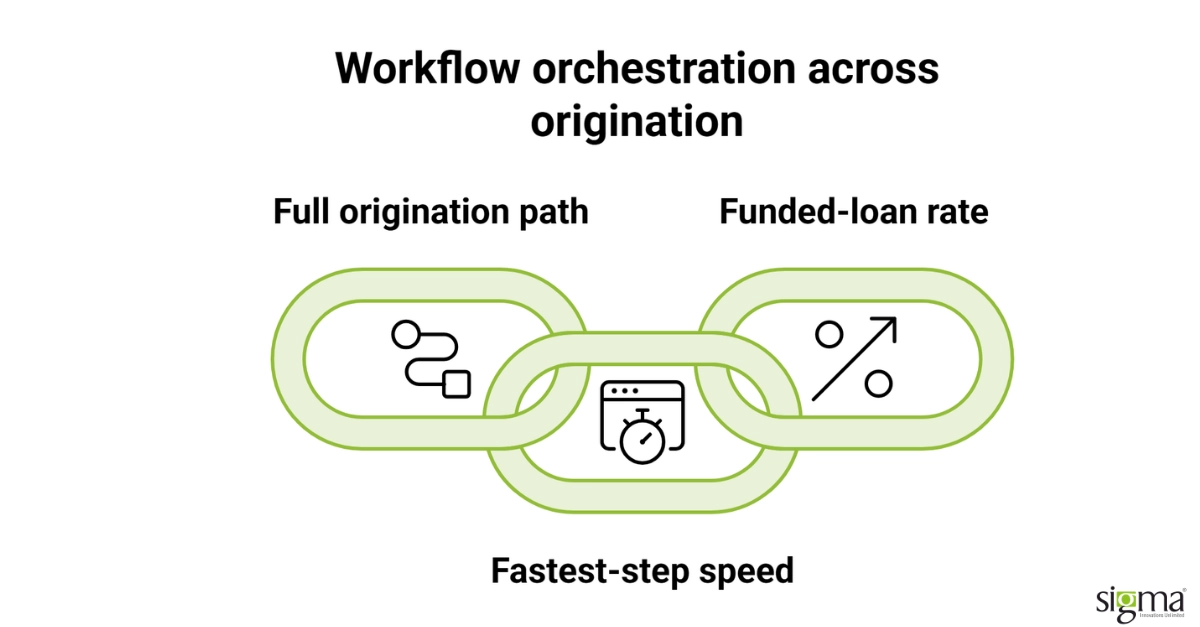
Fragmented loan origination workflows are often the reason a holiday volume spike turns into a visible bottleneck rather than a manageable one. When onboarding, underwriting, and servicing live in separate systems with manual handoffs between them, every one of the fixes above, faster decisioning, faster verification, faster fraud screening, still has to pass through the same disconnected workflow, and the gains get absorbed by the handoffs rather than showing up in time-to-decision.
Workflow orchestration across the full origination path turns those individual fixes into a measurable improvement in funded-loan rate, because an application moves through the whole process at the speed of its fastest step rather than its slowest handoff.
Prepare for holiday application surges with Sigma’s Digital Lending Solutions.
How Sigma Helped One Lender Turn a Manual Approval Bottleneck Into a Same-Day Funding Record
A 20-year small business lender came to Sigma with a familiar version of this problem: a legacy loan origination system where credit decisioning and offer generation depended on manual, inconsistent review. Approvals that should have taken hours were taking days, and the inconsistency was not just a speed problem, it was a risk problem, since similar applicants could land in different outcomes depending on which reviewer handled the file and how backed up the queue was that week.
Sigma re-engineered the origination system to shift credit decisioning and offer generation from that manual, inconsistent process to a high-velocity automated model. The result was not simply a faster system; it was a single-day funding record, achieved while improving compliance and consistency rather than trading one for the other. That distinction matters for a holiday-week scenario specifically, because a faster approval path that quietly loosens risk controls is not actually a win, it is a different problem deferred to January.
The same discipline, automating verification without loosening the controls behind it, applies to partner and dealer onboarding as much as borrower origination. Sigma connected a specialty finance company’s CRM to its lending platform to automate partner verification end to end, cutting manual work by roughly 80% while keeping compliance and risk controls in place as the partner network scaled.
Explore how Sigma automated partner verification and cut manual work by roughly 80 percent for a specialty finance company.
For a digital lender, BNPL provider, or embedded finance platform heading into Christmas week, the question is not whether application volume will spike, it reliably does, but whether the decisioning, verification, and fraud-screening systems behind the application are built to absorb that spike without a manual queue forming. Sigma can run a peak-readiness review as a defined engagement or stay engaged as the product engineering team behind the platform through the season and beyond.
Conclusion
Holiday searches for buy now pay later no credit check reflect real borrower demand, but the test for a digital lender, BNPL provider, or embedded finance platform is whether that demand turns into funded loans or stalls in a review queue. Christmas week concentrates financing application volume into a few days, and applications stall at predictable points: decisioning latency, bank-data verification, fraud screening, and rigid credit rules that route too many marginal applicants to manual review.
None of these bottlenecks is a vague seasonal slowdown. Each has a specific, addressable cause, and each cause has a corresponding automation fix. Automated document and income review, bank-data ingestion, real-time fraud signals, and configurable risk scoring close most of that gap directly. Alternative data underwriting adds a faster path for applicants where cash-flow signals already support a decision. It does not replace documentation review everywhere it is still needed, and none of these fixes show their full value if the loan origination workflow underneath them stays fragmented, since gains at one step get absorbed by handoffs at the next. Workflow orchestration across onboarding, underwriting, and servicing is what turns individual fixes into a measurable improvement in time-to-decision and funded-loan rate.
Compliance requirements, FCRA, ECOA, adverse-action obligations, and evolving BNPL oversight, are a constraint automation has to work within, not an obstacle to design around. A platform that treats holiday-week readiness as a diagnosable, compliance-aware engineering problem recovers funded loans from demand it already has. The alternative, a faster-looking approval path that quietly loosens risk controls to hit a speed target, trades one holiday-week problem for a bigger one in January.
Build lending solutions that scale with demand.
Frequently Asked Questions
Why do financing applications stall during the holidays?
Financing applications stall during the holidays because Christmas-week volume arrives in a concentrated window while review capacity, decisioning, bank-data verification, fraud screening, stays fixed at ordinary-week levels. The same application steps that work fine most of the year back up into a manual queue once volume runs several times higher than normal.
What causes credit decisioning latency during peak application volume?
Credit decisioning latency during peak volume comes from manual document and income review that cannot scale with application count, bank-data verification queued behind a fixed number of reviewers, and rigid credit rules that route more marginal applicants to manual review exactly when capacity is already stretched.
How can lenders scale fraud checks without increasing application abandonment?
Lenders can scale fraud checks by moving screening from a manual queue to real-time identity, device, behavioral, and transaction risk signals scored the moment an application is submitted. This flags the same fraud patterns a manual reviewer would, without adding the wait that causes a legitimate borrower to abandon the application.
Where can alternative data underwriting reduce verification friction?
Alternative data underwriting helps most where traditional documentation is slow to produce, using bank transaction history and cash-flow signals to support a decision instead of waiting on a pay stub or tax form. It is a faster path for applicants whose cash-flow data already tells most of the story, not a full replacement for documentation review.
How can lenders prevent manual underwriting queues from becoming a holiday bottleneck?
Preventing a manual-queue bottleneck means orchestrating the full origination workflow, onboarding, underwriting, and servicing, so individual fixes like faster decisioning and faster verification are not absorbed by disconnected handoffs between systems. Workflow orchestration turns those separate fixes into a measurable gain in time-to-decision and funded-loan rate.