Why Loan Application Forms Lose Mobile Users During Black Friday’s Traffic Surge

Key Highlights:
- BFCM financing promotions drive a surge of mobile traffic into loan application forms, and applicants drop off at predictable steps, identity verification, income documents, and long forms, exactly when acquisition spend is highest.
- Every abandoned mobile application during this specific week converts paid traffic into a completed session with no funded loan, and the cost shows up in blended acquisition cost for the whole quarter.
- Mobile-first loan origination, shorter forms, progressive disclosure, automated identity verification, document upload built for a phone camera, and autosave, tested against BFCM-level concurrency.
- Sigma modernizes loan origination systems and automates verification and decisioning, then stays engaged as a dedicated product engineering team through peak financing season.
BFCM financing promotions, point-of-sale installment offers, BNPL tie-ins, and holiday personal loan campaigns pull a surge of mobile traffic into mobile loan application forms that were not built for that volume or that device. Adobe Analytics research insights suggest that Buy Now, Pay Later spending reached $8.2 billion in the US between November 1 and 28, up 9% year over year, with mobile accounting for $6.7 billion of that total, and mobile overall driving 52.2% of online revenue over the same four weeks. Every one of those mobile sessions has to pass through an application form, and applicants drop off at the same few steps every time: identity verification, income documentation, and long multi-page forms designed for a desktop screen and a patient applicant. For a digital lender or embedded finance platform, every abandoned mobile application during this specific week is acquisition spend that converted to a click and nothing else. Addressing these bottlenecks requires more than a form redesign. It calls for digital lending solutions that connect mobile-first origination, automated verification, and scalable application workflows. This article maps where mobile loan applications lose applicants and what lending platforms should fix before BFCM traffic arrives.
Prepare Your Lending Platform for BFCM Traffic
Strengthen mobile-first loan origination, automate verification, and scale application workflows with tailored digital lending solutions.
Why Mobile Loan Applications Lose Applicants During BFCM
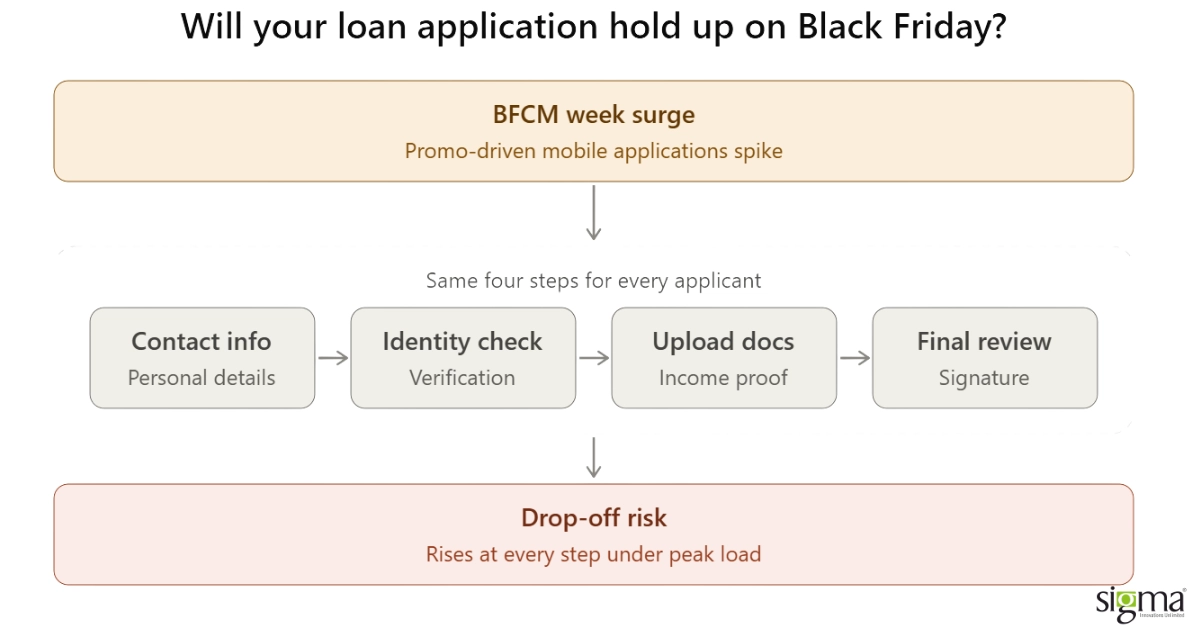
For a digital lender, BNPL provider, or embedded finance platform, BFCM week can concentrate a significant volume of mobile loan applications into a few days. Financing offers tied to Black Friday and Cyber Monday promotions bring more applicants onto mobile channels, putting additional pressure on application workflows, identity verification, and document processing systems.
Every one of those applications has to clear the same sequence: contact and personal information, identity verification, income or document upload, and a final review and signature step. A form that performs adequately under normal mobile traffic gives a platform no real evidence it will hold applicants, rather than lose them, under BFCM-scale volume.
Why Do Borrowers Abandon Mobile Loan Applications?
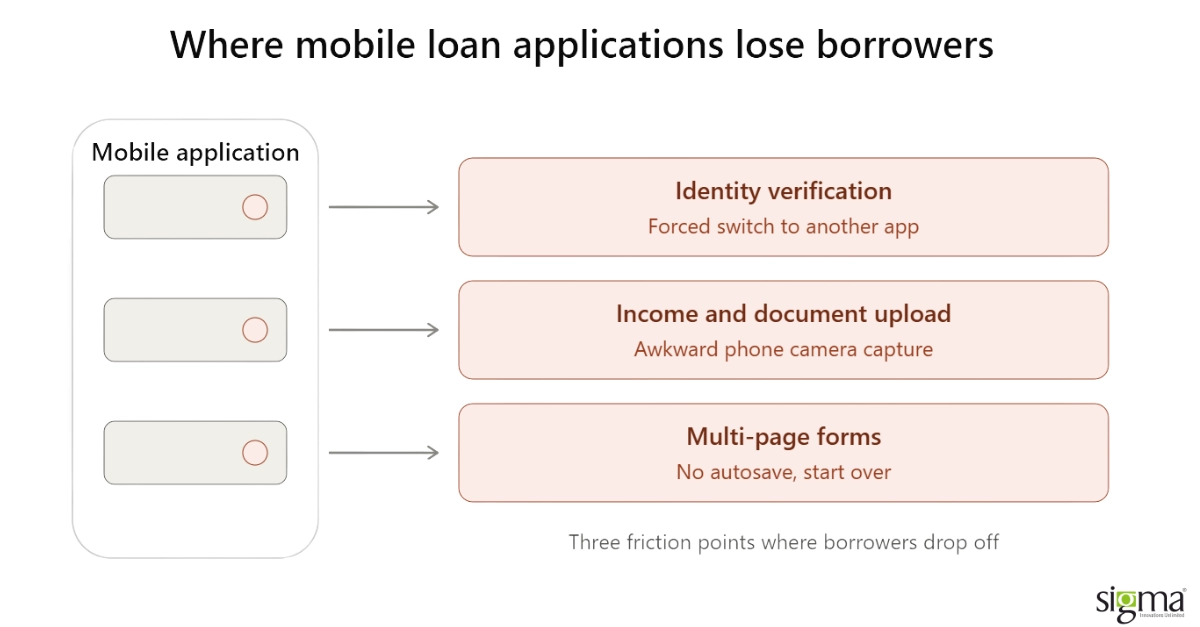
Borrowers abandon mobile loan applications most often at three predictable points: identity verification that requires switching to a separate app or device, income or document upload steps that are awkward to complete with a phone camera, and multi-page forms with no autosave, where losing a session means starting over from the beginning.
Each of these points adds friction that a desktop applicant, sitting at a larger screen with a stable connection, tolerates more easily than someone applying on a phone in the middle of a shopping session.
What Is Loan Origination Software?
Loan origination software is the system that takes an application from initial submission through verification, underwriting, and funding. For a mobile-first lending platform, the origination system is not just back-office infrastructure sitting behind the form. It is the engine deciding how fast identity checks resolve, whether a document upload succeeds on the first try, and whether a session survives if a connection drops mid-application.
A mobile form redesigned without attention to the origination system behind it can look faster while still failing applicants at the same rate, because the actual bottleneck was never in the form’s design.
How Do You Improve Mobile Loan Application Conversion?
Improving mobile loan application conversion means fixing the specific step where applicants actually drop off, not redesigning the whole form at once. Shorter sections, progressive disclosure that requests information in stages, automated identity verification that does not require switching devices, and autosave that preserves a session address the most common points of loss directly.
| Application step | Drop-off cause | Fix |
| Personal and contact info | Long initial form before any value is shown to the applicant | Progressive disclosure, with a conditional pre-qualification estimate shown early |
| Identity verification | Switching to a separate app, SMS code, or device to complete verification | In-flow identity verification that stays inside the mobile session |
| Income and document upload | Awkward to photograph and upload tax forms or pay stubs on a phone | Camera-optimized upload with automatic cropping and quality checks, plus compliant bank-data alternatives where available |
| Multi-page form navigation | A dropped connection or interrupted session with no way to resume | Autosave with a resumable link, so an applicant can finish later without restarting |
| Final review and e-signature | Long disclosure text and an unclear next action at the final step | Mobile-formatted disclosures and a single, clearly labeled signature action |
Building for BFCM-Scale Traffic, Not Just a Better Form
A better mobile form does not help if the identity verification service, the document processing pipeline, or the underwriting decision engine behind it cannot handle BFCM-level concurrency. A platform that improves its form in isolation, without confirming the systems behind it hold up under a traffic surge, risks trading one failure mode, a form abandoned by choice, for another, a form abandoned because the system timed out.
The same testing discipline that applies to checkout and payment infrastructure during BFCM applies here: model the expected surge in applications from this year’s financing promotions, confirm identity verification and document processing hold up under that load, and define what counts as acceptable performance before launch, not after a traffic spike reveals it.
Why Compliance Requirements Are the Real Constraint on a Faster Mobile Loan Form
The hardest constraint on a faster mobile loan application is not design. It is compliance. ECOA and TILA disclosure requirements, e-signature validity rules, and state-by-state licensing differences cannot be shortened or skipped to make a form feel faster, and a platform that treats compliance as an obstacle to remove usually ends up redesigning the same form twice, once for speed and once to fix what the first redesign broke.
Sigma Infosolutions re-engineered a legacy loan origination system for a 20-year small business lender, shifting credit decisioning and offer generation from a manual, inconsistent process to a high-velocity automated model, achieving a single-day funding record while improving compliance and consistency rather than trading one for the other.
The same discipline, automating verification without loosening the controls behind it, applies to onboarding as much as origination. Sigma connected a specialty finance company’s CRM to its lending platform to automate partner verification end to end, cutting manual work by roughly 80% while keeping compliance and risk controls in place as the partner network scaled.
For a digital lender or embedded finance platform heading into BFCM 2026, the mobile form is the visible part of a larger system that has to hold up under both traffic and regulatory scrutiny at once. Sigma can run a mobile origination audit as a defined engagement or continue as the product engineering team behind the platform year-round.
Conclusion
Mobile loan application abandonment during Black Friday and Cyber Monday is not random; it concentrates on identity verification, document upload, and long multi-page forms. BFCM financing promotions pull a disproportionate share of mobile traffic into these forms at the exact moment acquisition spend is highest. Each drop-off point has a specific, addressable cause, not a vague loss of interest, and each cause has a corresponding fix. Progressive disclosure, in-flow identity verification, camera-optimized document upload, and autosave address the most common points of loss directly. A faster form does not help if the identity verification service or document processing pipeline behind it cannot handle BFCM-level concurrency. Compliance requirements, ECOA and TILA disclosures, e-signature validity, state licensing, are the real constraint on how fast a mobile loan application can become, not a design choice to be worked around. A redesign that treats compliance as an obstacle to remove typically ends up rebuilt twice, once for speed and once to restore what the first attempt broke. Mapping each application step against its specific drop-off cause gives a lending platform a prioritized fix list rather than a general redesign. Testing the systems behind the form against modeled BFCM traffic protects both conversion and compliance during the platform’s highest-traffic week. A platform that treats mobile loan application conversion as a diagnosable, compliance-aware engineering problem recovers funded loans from traffic it already paid to acquire. The alternative, a faster-looking form built without addressing the actual drop-off causes or the systems behind it, risks the same abandonment under a different name.
Build Better Digital Lending Experiences
Frequently Asked Questions
Why do borrowers abandon mobile loan applications?
Borrowers abandon mobile loan applications most often at identity verification that requires switching devices or apps, income and document upload steps that are awkward on a phone camera, and multi-page forms with no autosave, where a dropped connection means starting over. Each point adds friction a desktop applicant tolerates more easily than a mobile one.
How do you improve mobile loan application conversion without weakening compliance?
Improving conversion means fixing the specific step where applicants drop off, in-flow identity verification, camera-optimized document upload, autosave, and progressive disclosure, rather than shortening the disclosures or verification steps that compliance actually requires. The form gets faster around the compliance requirements, not by cutting them.
What is loan origination software, and why does it matter for mobile conversion?
Loan origination software is the system that takes an application from submission through verification, underwriting, and funding. For a mobile-first lender, it is the engine behind the form itself, deciding how fast identity checks resolve and whether a document upload succeeds on the first try, not just back-office infrastructure.
Why does Black Friday and Cyber Monday traffic specifically strain mobile loan applications?
BFCM financing promotions and BNPL tie-ins pull a surge of mobile applicants into origination systems at volume far above normal, while verification and document pipelines face their own peak load at once. A form that performs fine under normal traffic can still fail applicants this specific week if the systems behind it were never tested at that scale.
Should a lending platform redesign its mobile application form or test its origination system first?
Testing the origination system, identity verification, document processing, and decisioning, against modeled BFCM traffic should happen alongside or before a form redesign, not after. A faster-looking form built on a system that cannot handle peak concurrency simply trades one abandonment cause for another, and discovers that trade during the platform’s highest-traffic week.