Salesforce Agentforce Deployments Are Stalling: Is Your Org Ready for AI Agents?

Key Highlights:
- Teams watch an Agentforce demo, see how simple agent creation looks, then discover that the real work is data readiness, permission architecture, and governance their org was never set up for. Sigma Infosolutions addresses that readiness gap before configuration begins, helping organizations move from an impressive sandbox demo to a production-ready Agentforce deployment.
- A properly scoped Salesforce Agentforce deployment puts AI agents on top of your existing CRM workflows with the right data access, guardrails, and change control, rather than shipping an agent that confidently does the wrong thing.
- Organizations that treat agent configuration as an admin task rather than an architecture decision end up with agents that answer out-of-scope questions, act on stale data, or get switched off after the first compliance incident.
- The gap between buying Agentforce and operationalizing it follows the same pattern as early Einstein adoption: the platform works, but orgs that skipped data quality, permission audits, and governance find their agents stalling in sandbox rather than shipping to production.
Introduction
The demo is genuinely impressive. Someone opens Agentforce Builder, describes what the agent should do in plain language, connects a few actions, and within twenty minutes there is a working agent answering questions in a sandbox. Your RevOps lead reasonably concludes an admin could have this live by quarter end.
Then the project starts, and the first three months go to things nobody demoed: which objects the agent should read, why the knowledge articles it retrieves are four versions out of date, whether agent permissions match human permissions, and who signs off when someone edits an agent’s instructions. Salesforce Agentforce is capable, but the gap between how easy it looks and what deploying it demands is where projects lose a quarter. Sigma’s Salesforce Consulting Services help organizations do the unglamorous readiness work first, so agents reach production rather than stalling in evaluation.
Despite roughly 29,000 deals closed and around $800M in ARR, Agentforce adoption sits near 5.3% of Salesforce customers. Practitioner consensus is consistent: the platform works, implementation is where teams stall.
The Adoption Number Tells the Story
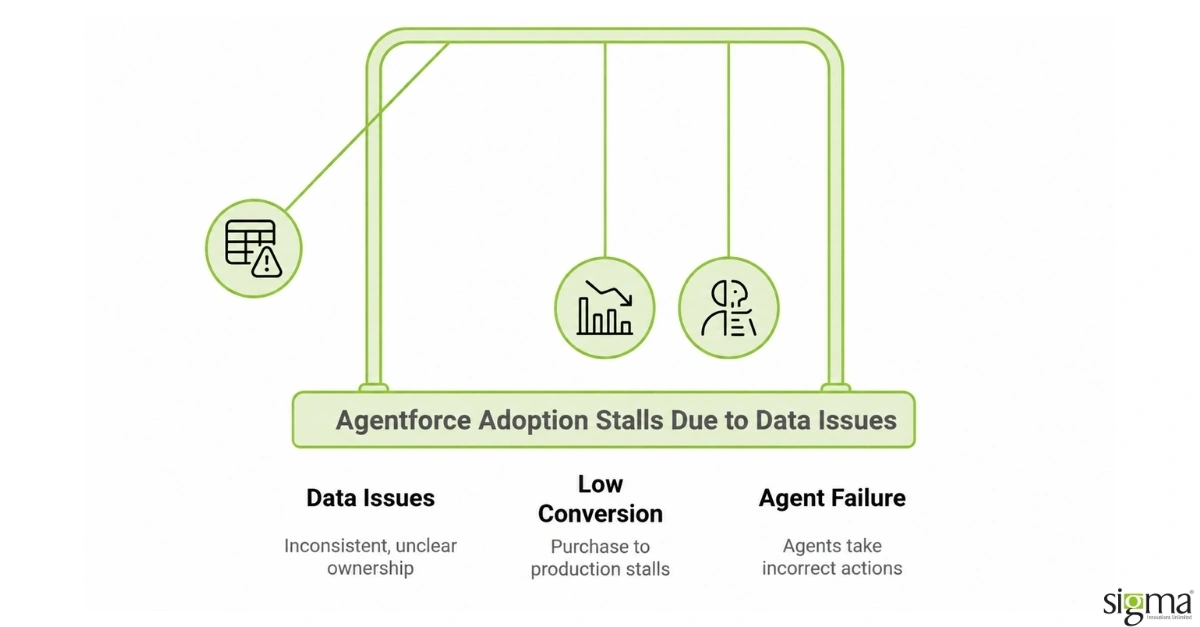
Salesforce Agentforce is not struggling for commercial traction. Tens of thousands of deals have closed, and the product line generates meaningful recurring revenue. What it struggles with is conversion from purchase to production.
The pattern is familiar to anyone who lived through early Einstein adoption. Salesforce Einstein features shipped with real capability and stalled in orgs where the underlying data was inconsistent, ownership was unclear, and nobody had budgeted for the cleanup that predictive features assume. Agentforce agents repeat that pattern with higher stakes, because an agent does not just score a record. It takes actions and talks to customers.
Building the Agent Is the Easy Part
Once you get past the builder interface, the work that determines whether an agent succeeds falls into four areas, and none of them are about the agent.
Data readiness. An agent grounded in stale, duplicated, or inconsistently structured records produces confident, well-formed, wrong answers. Articles accurate two years ago get retrieved with the same authority as current ones. Duplicate accounts mean the agent answers about the wrong entity. This is why realistic single-use-case timelines start at four to six weeks only when data quality is already reasonable.
Permission architecture. An agent operating on a user’s behalf inherits an access model, and most orgs have never audited whether that model makes sense for a non-human actor. Should the agent see every field the rep sees? What about records shared through a rule the agent cannot evaluate contextually? Getting this wrong is either a data exposure problem or an agent locked out of half the object model.
Knowledge quality. Salesforce AI agents inherit their knowledge base’s problems. If articles contradict each other, the agent picks one. If coverage is thin, it generalizes from adjacent content. Neither failure throws an error.
Scope definition. Deciding what the agent explicitly must not do is harder and more important than deciding what it should do, and it is the step most often skipped.
Ready to Move Agentforce From Sandbox to Production?
Is your Salesforce org ready for Agentforce, or is data, permissions, and governance holding deployment back? Get the readiness architecture right before another quarter is lost in evaluation.
The Governance Gap Nobody Planned For
Traditional Salesforce governance covers objects, fields, flows, and Apex. Change management processes evolved around those artifacts. Agent topics, instructions, and action configurations are a genuinely new category: natural language scripts that control behavior and do not fit existing review workflows.
This creates practical questions most orgs have no answer to. Who approves a change to an agent’s instructions? How do you version-control a paragraph of natural language? What is the rollback procedure when a well-meaning edit changes behavior in a way that is subtle rather than broken?
Industry write-ups on Agentforce agents include a scenario worth internalizing: an admin at a healthcare organization broadened an agent’s topic description to make it “more helpful,” pushed it directly to production without review, and within 48 hours the agent was answering questions about medication interactions, a category that had been deliberately excluded for compliance reasons. Nothing errored. No alert fired. The change looked like an improvement.
That is the defining characteristic of agent failure. It is semantic rather than technical. A traditional bug throws an exception you can trace. An agent returns a plausible, well-formed response that is wrong for the situation, and there is nothing in the logs to indicate a problem.
The architectural layer that enables governed, API-driven Agentforce deployment at scale: mastering Salesforce Headless 360.
| What Teams Focus On | What Actually Determines Success |
| Which model powers the agent | Data 360 integration and record quality |
| How clever the agent instructions are | Permission set design for non-human actors |
| Number of actions configured | Knowledge base accuracy and coverage |
| Speed of initial build | Explicit scope exclusions and guardrails |
| Demo performance | Change control for natural language instructions |
| Launch date | Semantic monitoring after go-live |
What a Realistic Timeline Looks Like
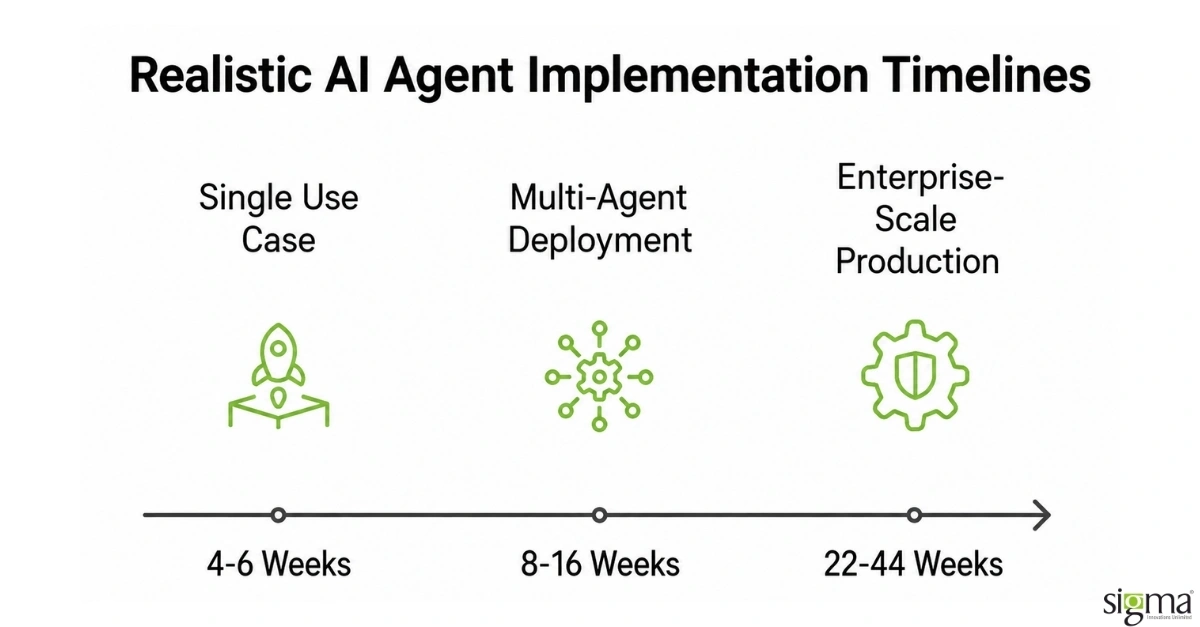
Expectations set by the builder interface are the single biggest source of project friction, so it helps to anchor on reported ranges.
A single, well-scoped use case in an org with reasonable data quality goes live in roughly four to six weeks. Complex multi-agent deployments run eight to sixteen weeks. Full enterprise-scale production, covering multiple departments with proper governance, has been estimated at twenty-two to forty-four weeks. Implementation cost estimates in the ecosystem land around $50,000 to $150,000 upfront with ongoing advisory beyond that.
There is also a licensing prerequisite that catches teams late: Agentforce requires Service Cloud Enterprise Edition or higher before you can build at all. Discovering that during planning is fine. Discovering it after you have socialized a launch date is not.
What the Org Audit Finds Before the Builder Opens
A B2B SaaS company brought Sigma an Agentforce project with a launch date already socialized internally. Their admin could build the agent. What they wanted was help accelerating it.
The first phase went nowhere near Agentforce Builder. It went into the object model and the service knowledge base, because a Salesforce Agentforce deployment inherits whatever condition those are in. The knowledge base held 340 articles. Roughly a third had not been reviewed in over two years. Eleven pairs contradicted each other outright, describing the same policy with different terms, different thresholds, or different escalation paths.
None of that was visible from the admin console, and none of it would have thrown an error. An agent shipped on that foundation would have retrieved a two-year-old article with the same confidence as a current one, picked arbitrarily between contradicting pairs, and delivered both answers in the same authoritative tone to customers. Nothing in the logs would have flagged it.
So knowledge remediation and an article ownership model came first. The agent came second, and worked on its first serious test rather than its fourth.
Faster onboarding through real-time Salesforce integration that eliminated the manual data transfers an agent would otherwise inherit: transforming dealer onboarding for a finance company.
The permission surface is the other half of the audit, and it rarely survives contact with a non-human actor. A FinTech client had clean data but fifteen years of accumulated sharing-rule exceptions, and nobody could articulate what an agent operating on a rep’s behalf would actually be able to see. Sigma mapped the effective permission surface for the agent persona specifically and found four object paths granting visibility beyond what the compliance team had ever intended. That work finished before any agent configuration began.
30% productivity gain after unifying a fragmented CRM into a single operational view: modernizing contact centers with Salesforce and Amazon Connect.
Agent topics and instructions then get treated as deployable artifacts with review and rollback, which is the part of Sigma’s Salesforce Consulting Services engagement that prevents an admin from broadening a topic description on a Tuesday and discovering the consequence on Thursday.
Conclusion
The Agentforce platform is capable, and the builder genuinely does make agent creation straightforward. That is exactly why so many deployments stall: the easy part is visible in the demo and the hard part is not. Data readiness, permission architecture for non-human actors, knowledge quality, explicit scope exclusions, and change control over natural language instructions determine whether an agent ships and stays shipped. Organizations that sequence those first get agents that work. Organizations that start in the builder get a pilot that never leaves the sandbox. Sigma Infosolutions helps Salesforce customers do the unglamorous readiness work first, so Salesforce Agentforce deployments reach production rather than stalling in evaluation.
Make Agentforce Part of a Smarter Salesforce Strategy
From AI-powered customer interactions to connected CRM workflows, build an architecture that supports what comes next.
Frequently Asked Questions
What is Salesforce Agentforce and what does it require to deploy?
Salesforce Agentforce is Salesforce’s platform for building AI agents that act within CRM workflows. Deployment requires Service Cloud Enterprise Edition or higher, clean and well-governed data, a permission architecture designed for non-human actors, an accurate knowledge base, and change control over agent instructions and topics.
Why do Agentforce implementations take longer than expected?
Agent creation itself is fast. The time goes to org readiness: cleansing duplicate and stale records, auditing sharing rules, remediating contradictory knowledge articles, and defining scope exclusions. Single use cases typically reach production in four to six weeks when data quality is already reasonable; complex multi-agent work runs considerably longer.
How are Salesforce AI agents different from Salesforce Einstein features?
Salesforce Einstein capabilities largely score, predict, and recommend within existing interfaces. Salesforce AI agents take actions and hold conversations, which raises the consequence of bad data or overly broad permissions. Both depend on data quality, but agents introduce action risk and require explicit behavioral guardrails.
What governance do Agentforce agents need?
Agentforce agents are configured through natural language topics, instructions, and actions that do not fit traditional Salesforce change management. Organizations need defined approval for instruction changes, version control for those instructions, a rollback path, and semantic monitoring, because agent failures produce plausible wrong answers rather than errors.
How does Sigma help organizations deploy the Agentforce platform?
Sigma assesses org readiness before touching the Agentforce platform builder, covering data quality, knowledge base accuracy, and the effective permission surface an agent would inherit. The team remediates those foundations, defines scope exclusions and guardrails, configures agents, and establishes change control so instruction edits go through review rather than straight to production.