How to Choose a Tableau Implementation Partner That Delivers Past Go-Live

Key Highlights:
- Tableau investments can lose value after launch when implementation is treated as a dashboard project rather than an ongoing analytics capability.
- The right Tableau implementation partner should demonstrate delivery experience, governance expertise, data integration capabilities, and long-term support.
- Governance and adoption decisions made during implementation can reduce reporting sprawl, access risks, and low user adoption later.
- Sigma approaches Tableau engagements around business requirements, governed data, scalable analytics, and ongoing engineering ownership.
Introduction:
Selecting Tableau is only part of the analytics investment. Choosing the right Tableau implementation partner determines how effectively that investment translates into usable, governed, and maintainable business intelligence.
For a VP of Analytics, CIO, or IT Director evaluating Tableau consulting services, certification badges and dashboard portfolios provide only part of the picture. The more important questions are whether a partner understands your data environment, can work within your governance requirements, and has a clear approach to supporting the analytics environment as business needs change.
A strong evaluation therefore goes beyond “Can this partner build Tableau dashboards?” The better question is whether the partner can build an analytics capability that remains useful as data, users, and reporting requirements evolve.
Why Tableau Rollouts Stall After the Initial Build
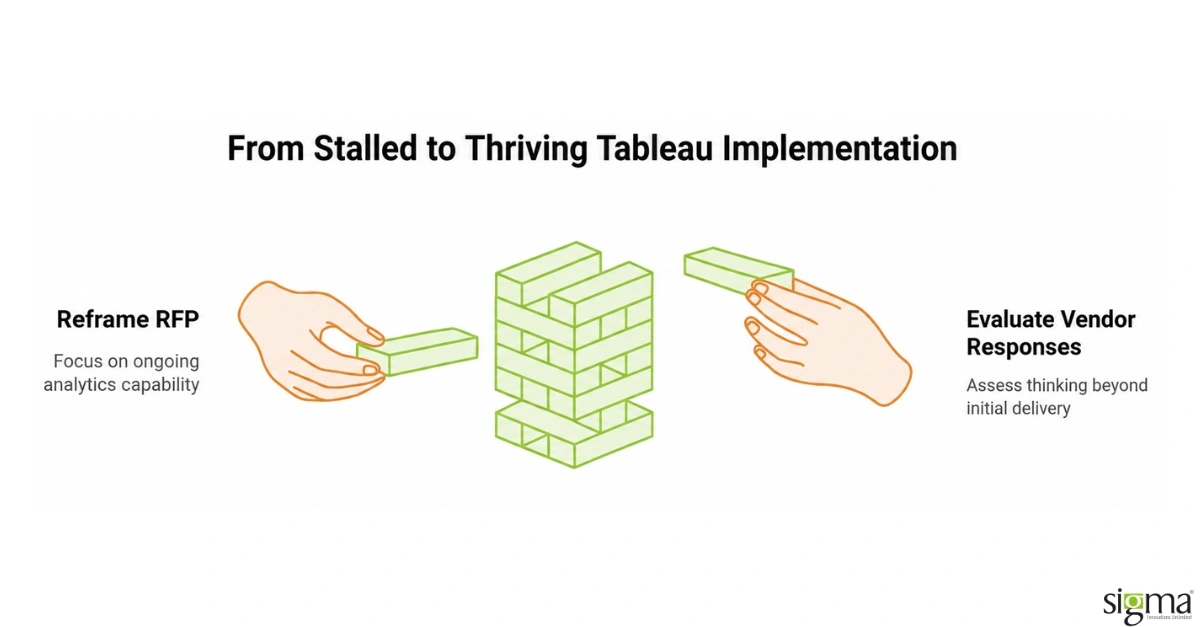
Many Tableau implementations appear successful at launch but lose momentum afterward. The dashboards work, yet new data sources are difficult to incorporate, adoption remains limited, and responsibility for maintaining workbooks and access controls becomes unclear.
The problem is often related to implementation scope rather than the BI platform itself.
When an engagement is defined around a fixed number of dashboards, the partner is incentivized to deliver those outputs efficiently. Requirements that emerge later, such as new data sources, changing KPIs, additional user groups, or evolving governance requirements, may fall outside the original engagement.
This creates an important distinction for buyers. A partner focused on dashboard delivery may be appropriate for a tightly defined reporting requirement. An organization building a broader analytics capability may need a partner that can address the data, governance, adoption, and support requirements surrounding those dashboards.
Is Your BI Environment Built to Scale?
Move beyond dashboards with BI and analytics development aligned to your data, reporting, governance, and growth requirements.
Criteria for Evaluating a Tableau Implementation Partner
| Evaluation Criteria | What Strong Delivery Looks Like | Common Red Flag |
| Delivery Track Record | Named, verifiable engagements with comparable data complexity and scale | Vague client references or logos with no describable project detail |
| Governance Scoping | Row-level security, data classification, and publishing permissions scoped upfront | Governance treated as a follow-on request after launch |
| Data Source Integration | Experience connecting Tableau to the organization’s actual source systems | Generic connector claims without specifics on your data environment |
| Support Model | A defined post-launch support structure, whether retainer or dedicated team | Support ends at go-live with no ongoing engagement offered |
| Certification Depth | Certified Tableau developers who can show recent, applied project work | Certification badges with no recent delivery evidence behind them |
Governance and Adoption Should Be Part of the Initial Scope
Governance should not be treated as cleanup work after dashboards are already in use. Requirements such as row-level security, data classification, publishing permissions, and access policies can affect how the analytics environment needs to be structured from the beginning.
The business case for addressing governance early is straightforward: broader access to analytics can increase decision-making speed, but uncontrolled access can introduce operational and compliance risk. The right approach depends on the organization’s data sensitivity, user structure, and regulatory requirements.
Adoption also needs to be considered before implementation is complete. A dashboard has limited business value if users do not know when to rely on it, what decisions it supports, or how it fits into existing reporting processes.
A mature partner should therefore discuss governance and adoption during discovery, rather than treating them as separate activities after the dashboards are delivered.
Why CTOs and CIOs Must Prioritize Custom Tableau Dashboards? Read to know more
Support Structure Determines Whether Gains Hold After Launch
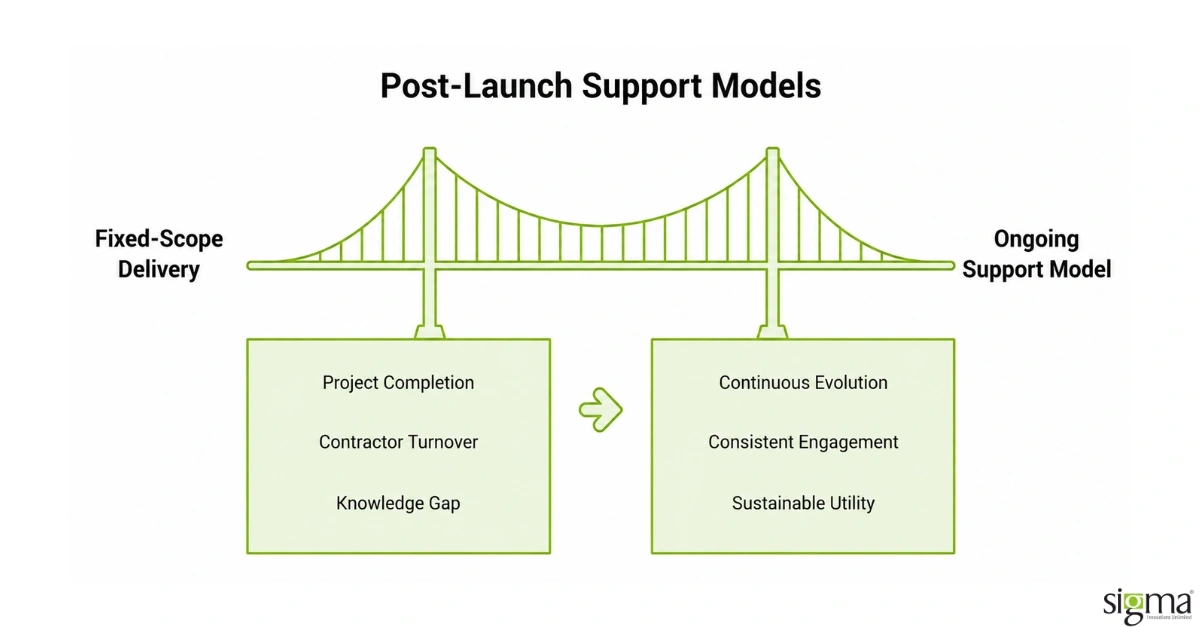
The analytics environment continues to change after implementation. Data sources evolve, business priorities shift, and dashboards may need to be extended, consolidated, or retired.
That makes the post-launch support model an important part of the buying decision.
A fixed-scope implementation can make sense when requirements are stable and the organization has strong internal ownership. For organizations that expect continued analytics expansion, a dedicated team or ongoing support arrangement may provide greater continuity.
Buyers should also understand how knowledge is retained after go-live. Ask whether the implementation team remains involved, how new requirements are prioritized, and who owns changes to dashboards, data connections, and access policies.
The goal is not simply to secure support hours. It is to ensure the analytics environment has clear technical ownership as the business evolves.
How Sigma Approaches Tableau Implementation
Sigma approaches Tableau implementation as an analytics engineering engagement, not simply a dashboard-building exercise.
The starting point is the business requirement: which decisions need better data, who needs access, what information already exists, and where the current reporting process creates friction. From there, the implementation approach can account for data readiness, governance, dashboard requirements, user adoption, and future expansion.
This also means determining what belongs in Tableau and what should be addressed within the underlying data environment. In some organizations, improving the data foundation may be more important than immediately creating additional dashboards. In others, the priority may be consolidating fragmented reporting or establishing appropriate access controls before expanding self-service analytics.
That assessment-led approach matters because the right implementation depends on the organization’s existing architecture, reporting maturity, data requirements, and growth plans.
For organizations evaluating a Tableau implementation partner, the objective should be similar: choose a partner capable of understanding the broader analytics environment, making informed technology decisions, and taking ownership beyond the initial dashboard release.
If you’re comparing Tableau and Power BI before selecting an implementation partner, evaluate both against your data environment, governance requirements, user needs, existing technology investments, and long-term analytics strategy.
Conclusion:
Choosing a Tableau implementation partner is ultimately a technology and operating-model decision, not simply a vendor comparison.
The right partner should demonstrate relevant delivery experience while understanding the implications of data integration, governance, adoption, scalability, and ongoing ownership. Certification can establish baseline expertise, but it does not by itself demonstrate the ability to translate Tableau into a durable analytics capability.
Organizations should also recognize that different implementations require different approaches. A narrowly defined dashboard project may need limited ongoing support, while an enterprise analytics initiative may require continuous engineering, governance, and data integration.
For a VP of Analytics, CIO, or IT Director, the most useful evaluation question is therefore:
Can this partner build what we need today while helping us manage what the analytics environment will need tomorrow?
That is the standard Sigma brings to Tableau engagements: understand the business requirement, assess the technology environment, recommend the appropriate approach, and take ownership of delivery and ongoing improvement.
Choosing the Right Tableau Implementation Partner? Evaluate your data, governance, and analytics requirements with a partner built for long-term ownership.
Frequently Asked Questions
What is the most important factor in choosing a Tableau implementation partner?
Delivery track record on projects with comparable data complexity matters most, since it predicts whether the partner can handle your actual environment rather than a simplified demo scenario. Governance scoping and a defined post-launch support model are close behind, since both determine whether early gains hold over time.
How do I verify a Tableau partner’s certification claims are backed by real delivery experience?
Ask for specific, describable recent projects rather than accepting a client logo list at face value. A partner with genuine delivery depth can walk through data source complexity, governance decisions, and adoption challenges from a recent engagement without vague generalities standing in for concrete detail.
Should governance be included in the initial Tableau implementation scope or added later?
Governance, including row-level security, data classification, and publishing permissions, should be scoped from the outset rather than treated as a follow-on request. Retrofitting access controls onto dashboards that business teams are already using is more disruptive and error-prone than planning for it during initial implementation.
What support model should a Tableau implementation partner offer after go-live?
A dedicated team or time-and-materials retainer, where the implementation team continues owning maintenance and extension after launch, tends to hold gains better than a fixed-scope project with no post-launch structure. Ask specifically what happens to dashboard accuracy and access reviews after the initial contract ends.
How long does a typical Tableau implementation engagement take with a qualified partner?
An initial rollout covering core dashboards and governance setup for a mid-market organization typically spans six to twelve weeks depending on data source count and complexity. Ongoing support, adoption expansion, and new data source integration commonly continue for months afterward under a retainer arrangement, which should be discussed during initial scoping.