Data Bottlenecks Are Slowing Your Business: Should You Build a Data Mesh or Data Fabric?
Key Highlights:
- As data teams, systems, and domains grow, fragmented data and overloaded central teams become business bottlenecks, slowing access to trusted data and delaying decisions.
- Understanding data mesh vs data fabric helps identify whether the core problem is data ownership, discoverability, integration, or governance, so investment targets the actual constraint.
- The right solution is rarely a framework choice alone. Data mesh, data fabric, governance, integration, and analytics capabilities must work together to create a scalable, usable data environment.
- Sigma’s BI & Analytics Development Services bring together data engineering, modern data architecture, BI, analytics, integration, and governance to diagnose the bottleneck, design the right architecture, and implement it in stages.
Introduction
The symptom is always the same. A product manager needs a dataset joined to another dataset. The request goes to the central data team, which is three sprints deep in a backlog, so it lands in week seven. By then the question has changed or the decision has been made without it. Multiply that across eight domains and forty stakeholders and you have an organization where data exists, is reasonably clean, and still cannot be used at the speed the business moves.
At this point, someone circulates an article about data mesh vs data fabric, and the conversation becomes an architecture debate before anyone has diagnosed the actual constraint. Sigma’s BI & Analytics Development Services help enterprise data leaders run that diagnosis first and implement the result in stages rather than as a single large bet.
The two approaches solve genuinely different problems, and choosing between them is less about technology preference than about an honest read of where your organization is failing.
Data bottlenecks slowing decisions?
What Each Approach Actually Proposes
Data mesh is an organizational answer. It argues that the central data team is a structural bottleneck and that the fix is distributing ownership to the domains that generate the data. Each domain treats its data as a product, with an owner, documented interfaces, quality guarantees, and consumers it is accountable to. A central platform team provides self-serve infrastructure, and federated governance sets the standards everyone follows.
Data fabric is a technical answer. It argues the problem is fragmentation across systems and that the fix is a unifying layer of metadata, cataloging, and automated integration letting consumers find and access data regardless of where it lives. Ownership stays roughly where it is. The intelligence goes into the metadata layer, increasingly using machine learning to infer relationships and automate integration work engineers previously did by hand.
The distinction that matters: mesh changes who is responsible, fabric changes how things connect.
| Dimension | Data Mesh | Data Fabric |
| Primary nature | Operating model and ownership change | Technology and metadata layer |
| Core problem solved | Central team is a delivery bottleneck | Data is fragmented and hard to discover |
| Ownership | Distributed to domain teams | Largely unchanged, often central |
| Prerequisite | Domain teams with data engineering capability | Comprehensive metadata and catalog coverage |
| Governance style | Federated, standards agreed centrally | Centralized policy applied across sources |
| Main failure mode | Domains lack skills or incentive to own products | Platform deployed but adoption never happens |
| Time to first value | Slow, requires organizational change | Faster, incremental technical rollout |
The Diagnostic Question Most Teams Skip
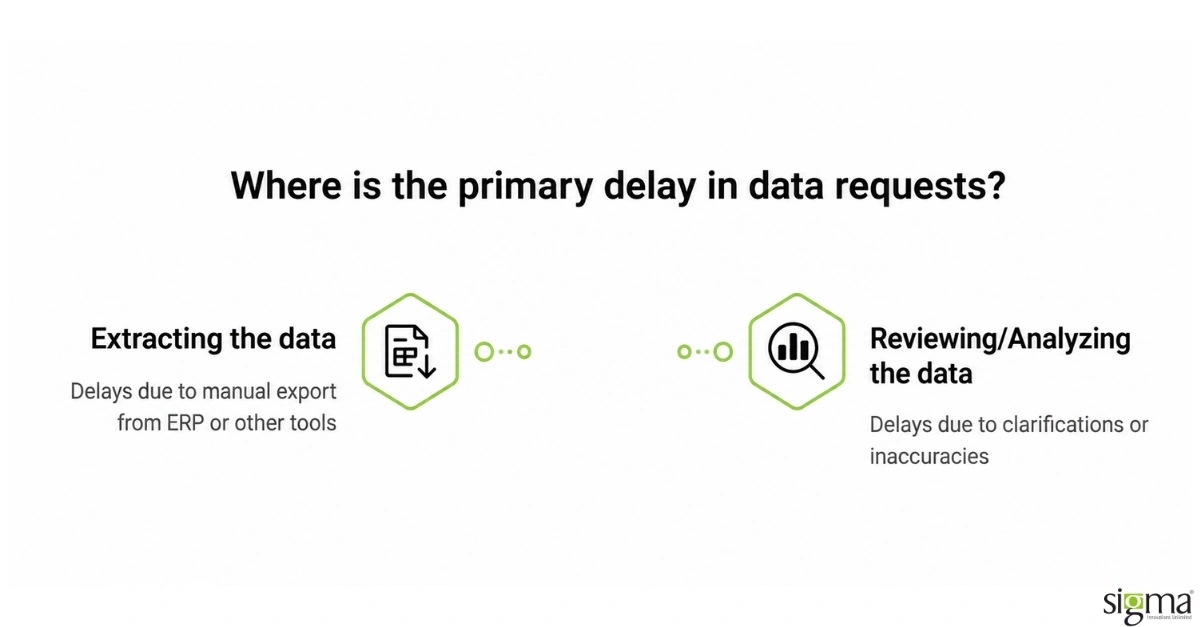
Before comparing the two, answer one question honestly: when a data request takes too long, where does the delay actually occur?
If the delay is that a small central team is saturated and domain experts are waiting in a queue for people who understand the data less well than they do, that is an ownership problem. More tooling will not fix a queue. Data mesh architecture addresses it by moving the work to the people with the context.
If the delay is that people cannot find what exists, do not know whether a dataset is trustworthy, or spend days reconciling three systems that describe the same entity differently, that is a discovery and integration problem. Redistributing ownership will not fix it and may make it worse, because now eight teams are independently producing datasets nobody can locate. Data fabric architecture addresses it by making the estate navigable.
Most organizations have some of both. The question is which one is currently the binding constraint, because that determines where the first investment goes.
If your diagnosis points to fragmentation, here is how the integration plumbing actually works: ETL pipelines as the key to solving data fragmentation.
Where Data Mesh Goes Wrong
Mesh fails in a predictable way, and it is worth naming because the failure is expensive.
The model assumes domain teams can own data products. That means someone in marketing writing and maintaining pipelines, defining SLAs, handling consumer support, and monitoring quality. Many domain teams have no such capability and no headcount to acquire it. Ownership gets declared in a slide deck and nothing changes, except the central team now has less authority to fix problems it is still blamed for.
The second failure is skipping the self-serve platform. Mesh without genuinely usable shared infrastructure is just decentralization, which produces eight incompatible pipelines and no governance.
The third is treating federated governance as optional. Without agreed interoperability standards, domains produce data products that cannot be joined, recreating the original fragmentation with more owners.
Where Data Fabric Goes Wrong
Fabric fails differently. The technology gets deployed, and nobody uses it.
A catalog is only valuable if it is comprehensive and current. Partial coverage means consumers check it, do not find what they need, and stop checking. Metadata that is stale is arguably worse than absent, because it produces confident wrong answers about lineage and ownership.
The deeper issue is that fabric can make data findable without making anyone accountable for it. A consumer locates a dataset, sees it has no clear owner, and cannot get a question answered about how a field is calculated. Discovery improved; trust did not. This is why organizations that invest in data fabric and see limited return often have an ownership problem they diagnosed as a discovery problem.
The Combination Most Organizations Land On
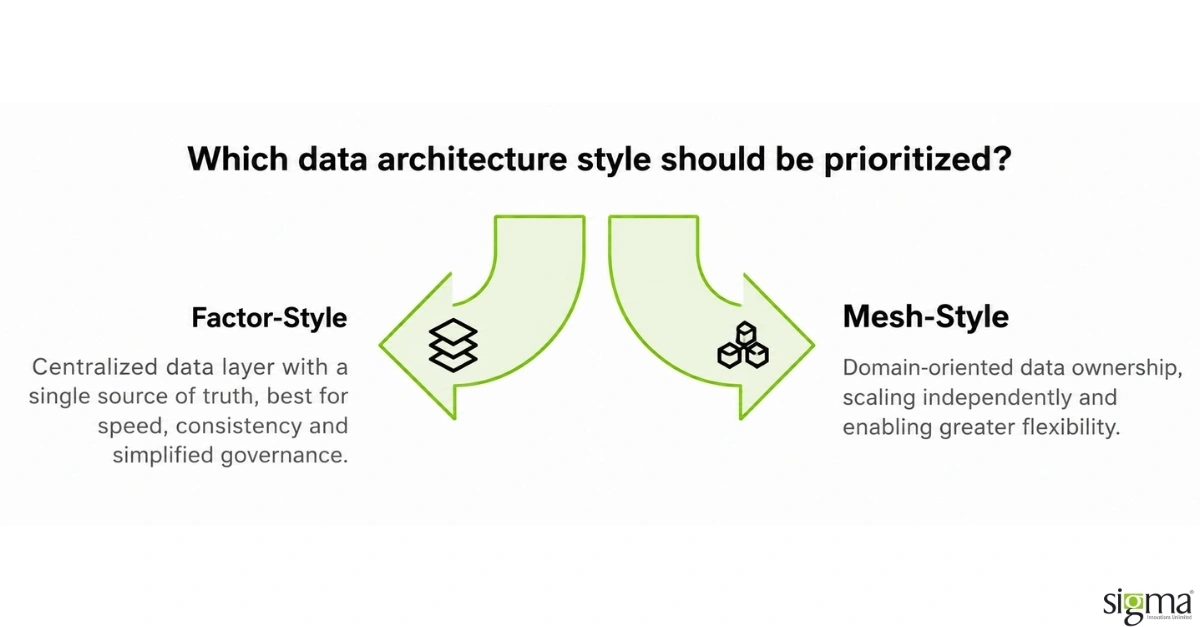
In practice, the strict either-or framing is a conference construct. Large organizations commonly adopt fabric-style technology, comprehensive cataloging, automated lineage, and unified access, while selectively applying mesh-style ownership in domains capable of taking it.
That hybrid works because the two are not opposed. A domain publishing a data product needs consumers to find it, which is a fabric concern. A catalog needs someone accountable for each entry, which is a mesh concern. The data architecture decision is less “which one” and more “which one first, and how far.”
Sequencing usually favors fabric-style foundations first, because cataloging and lineage deliver value incrementally without organizational change, and they make subsequent ownership distribution far easier to manage.
How Sigma’s BI & Analytics Capabilities Turn Fragmented Data Into Usable Intelligence
Sigma’s BI and Analytics approach starts with the data landscape, not the architecture label. The focus is on how data is collected, integrated, governed, accessed, and ultimately used for business decisions. This helps determine whether the priority should be stronger integration, governed data foundations, modern analytics, or a combination.
Unified Data for Lending Intelligence
For a financial services organization, Sigma unified lending, servicing, CRM, and marketing data into a governed Snowflake-native platform with role-based access. The resulting foundation brought fragmented operational data together to support real-time portfolio analytics and more accessible decision-making.
Read to know more: A Snowflake-native lending intelligence platform.
Integrated Enterprise Data for Better BI
For a technology services organization, Sigma consolidated data from CMDB, service catalog, and multiple systems of record through engineered integration. The engagement demonstrates how Sigma connects disparate enterprise data sources to create a more structured foundation for business intelligence and analytics.
Together, these engagements highlight Sigma’s BI and Analytics capabilities across data integration, governed data platforms, role-based access, and analytics. Rather than treating data mesh or data fabric as an end in itself, Sigma builds the data architecture around the organization’s actual data challenges, existing systems, and business requirements.
Read to know more: A BI platform transforms data analytics for VC-Funded Silicon Valley Company
Conclusion
Data mesh vs data fabric is not a technology bake-off with a correct answer. Data mesh redistributes ownership to solve a bottleneck problem and demands domain capability that many organizations do not have. Data fabric unifies discovery and integration to solve a fragmentation problem and delivers little if nobody is accountable for what it catalogs. The organizations that choose well diagnose first, identify whether the binding constraint is ownership or discoverability, and sequence accordingly, usually starting with the foundations that deliver value without requiring reorganization. Sigma Infosolutions helps enterprise data leaders run that diagnosis honestly and implement the result in stages rather than as a single large bet.
Data bottlenecks slowing your decisions? Connect with Sigma’s BI & Analytics experts to diagnose your data challenges and build the right architecture for scalable, actionable intelligence.
Frequently Asked Questions
What is the core difference between data mesh and data fabric?
Data mesh is an operating model that distributes data ownership to domain teams treating data as a product. Data fabric is a technology layer using metadata, cataloging, and automated integration to unify access across fragmented systems. Mesh changes who is responsible; fabric changes how systems connect.
How do I know whether I need mesh or fabric?
Identify where delay actually occurs. If domain experts wait in a queue behind a saturated central team, that is an ownership problem suited to data mesh architecture. If people cannot find datasets or trust their quality, that is a discovery problem suited to fabric. Most organizations have both and must sequence.
Why do data mesh implementations commonly fail?
Data mesh assumes domain teams can build and maintain data products, which requires engineering capability many domains lack. It also fails when the self-serve platform is skipped, producing uncoordinated pipelines, or when federated governance is treated as optional, leaving domain outputs that cannot be joined together.
Why do data fabric platforms see low adoption?
Partial catalog coverage causes consumers to stop checking after a few unsuccessful searches, and stale metadata produces misleading lineage. Data fabric architecture can also make data findable without making anyone accountable for it, so discovery improves while trust does not, limiting the return on the platform investment.
Can an organization use both data mesh and data fabric?
Yes, and many do. Fabric-style cataloging and lineage provide foundations that deliver incremental value without organizational change, while data mesh ownership is applied selectively in domains with the capability to sustain it. The practical data architecture question is which to prioritize first rather than which to choose exclusively.