Why Holiday Financing Applications Stall During Christmas Week: A Lender’s Peak-Volume Playbook

Key Highlights:
- Loan processing bottlenecks during Christmas week come from treating a predictable seasonal spike as an unplanned surprise, with no defined pre-peak audit, peak-week operating plan, or post-peak review.
- Without a plan, the same decisioning, verification, and fraud-check capacity that was fine in November gets discovered as inadequate in real time, during the one week it is most expensive to fix on the fly.
- A three-phase playbook, pre-season capacity audit, peak-week operational discipline, and post-peak review, turns a reactive scramble into a repeatable operating process.
- Sigma automates decisioning, verification, and fraud checks, then stays engaged as a dedicated product engineering team through peak volume and the review that follows it.
Loan processing bottlenecks during Christmas week are predictable enough to plan around, yet most digital lenders, BNPL providers, and embedded finance platforms still treat each holiday season as a surprise. Application volume rises sharply in the days around Christmas as last-minute financing offers and BNPL promotions drive demand, and the same systems that handled a normal week’s volume smoothly now have to process several times that load in a compressed window. The lenders who come through this week without a backlog are rarely the ones with the most sophisticated technology; they are the ones who ran a plan before volume arrived instead of reacting once it did. This article lays out that plan as a three-phase playbook: what to audit before peak week, what to run during it, and what to review once it is over.
Why Loan Processing Bottlenecks Appear During Christmas Week
Loan processing bottlenecks appear during Christmas week because application volume concentrates sharply while review capacity, decisioning speed, bank-data verification, and fraud screening, stays fixed at ordinary-week levels. The gap between demand and capacity is not a technology failure in most cases; it is a planning failure, since the volume increase is foreseeable every year and the systems behind it are rarely stress-tested against it in advance.
Phase One: Auditing Decisioning and Verification Capacity Before Peak Arrives
The first phase of the playbook happens weeks before Christmas, not during it. This is the point to audit credit decisioning latency, bank-data and income verification turnaround, and the rules that route marginal applicants to manual review, against a realistic model of this year’s expected peak volume, not last year’s actual volume, since financing promotions and BNPL adoption tend to grow year over year. An audit that only checks whether the system worked last December misses the gap between last year’s peak and this year’s.
Also, read the blog: Why Holiday Financing Applications Spike, and Stall, During Christmas Week
Phase Two: Running Fraud Checks and Underwriting During Peak Week Without Slowing Approvals
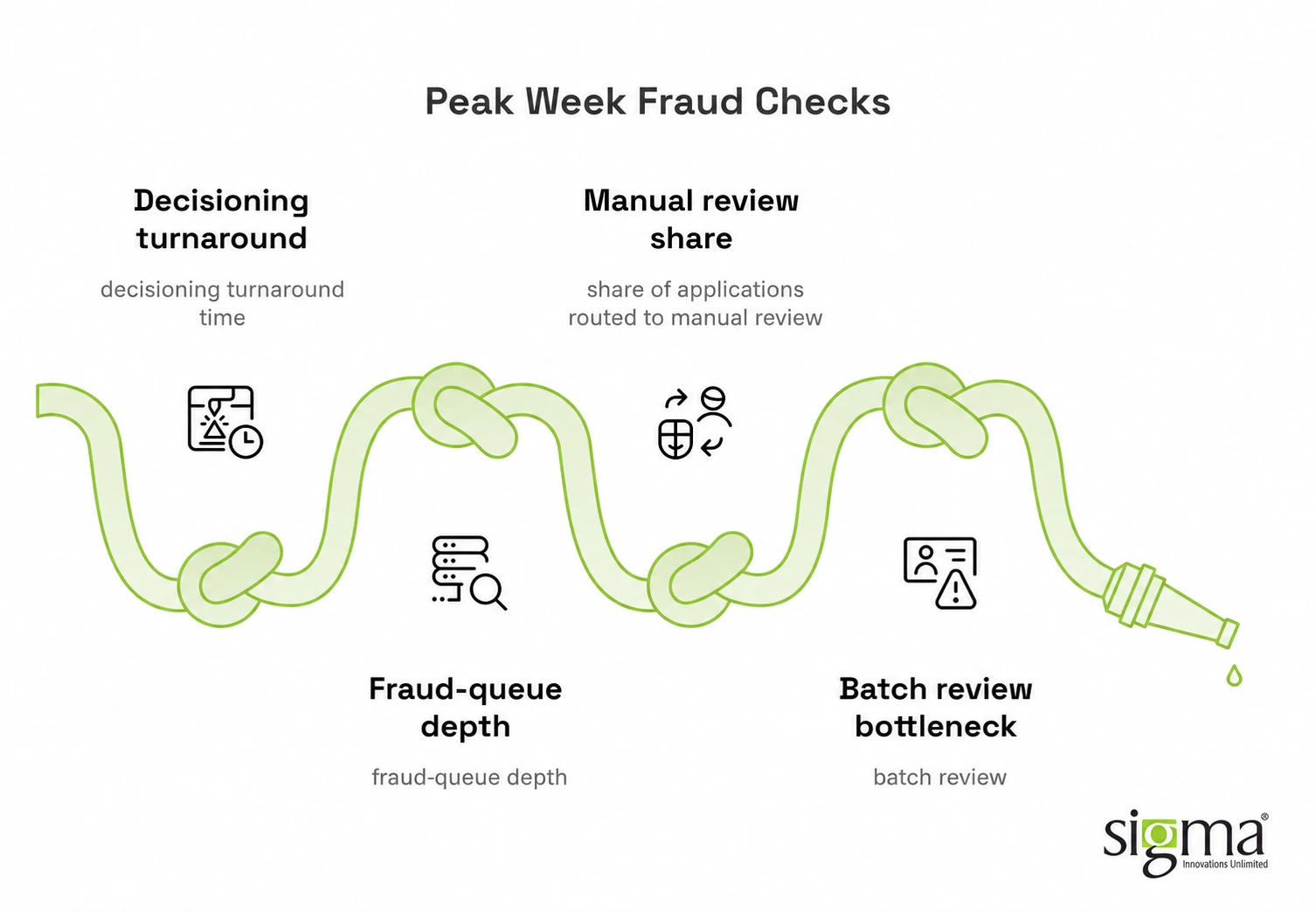
Peak week itself is not the time to redesign anything; it is the time to execute the plan built in Phase One while watching the specific signals that indicate stress before it becomes a backlog: decisioning turnaround time, fraud-queue depth, and the share of applications routed to manual review. Real-time fraud screening, scored the moment an application is submitted rather than queued for batch review, is what keeps fraud checks from becoming the week’s bottleneck in their own right.
Phase Three: Reviewing What Broke and What Held, After Christmas Week
The phase most lenders skip is the one that makes next year’s peak week easier: a structured review of where decisioning slowed, where verification queued, and where fraud screening either caught something real or added friction without catching anything. Without this review, each holiday season starts from the same baseline instead of building on what was learned the year before.
Where Alternative Data Underwriting Fits in the Playbook
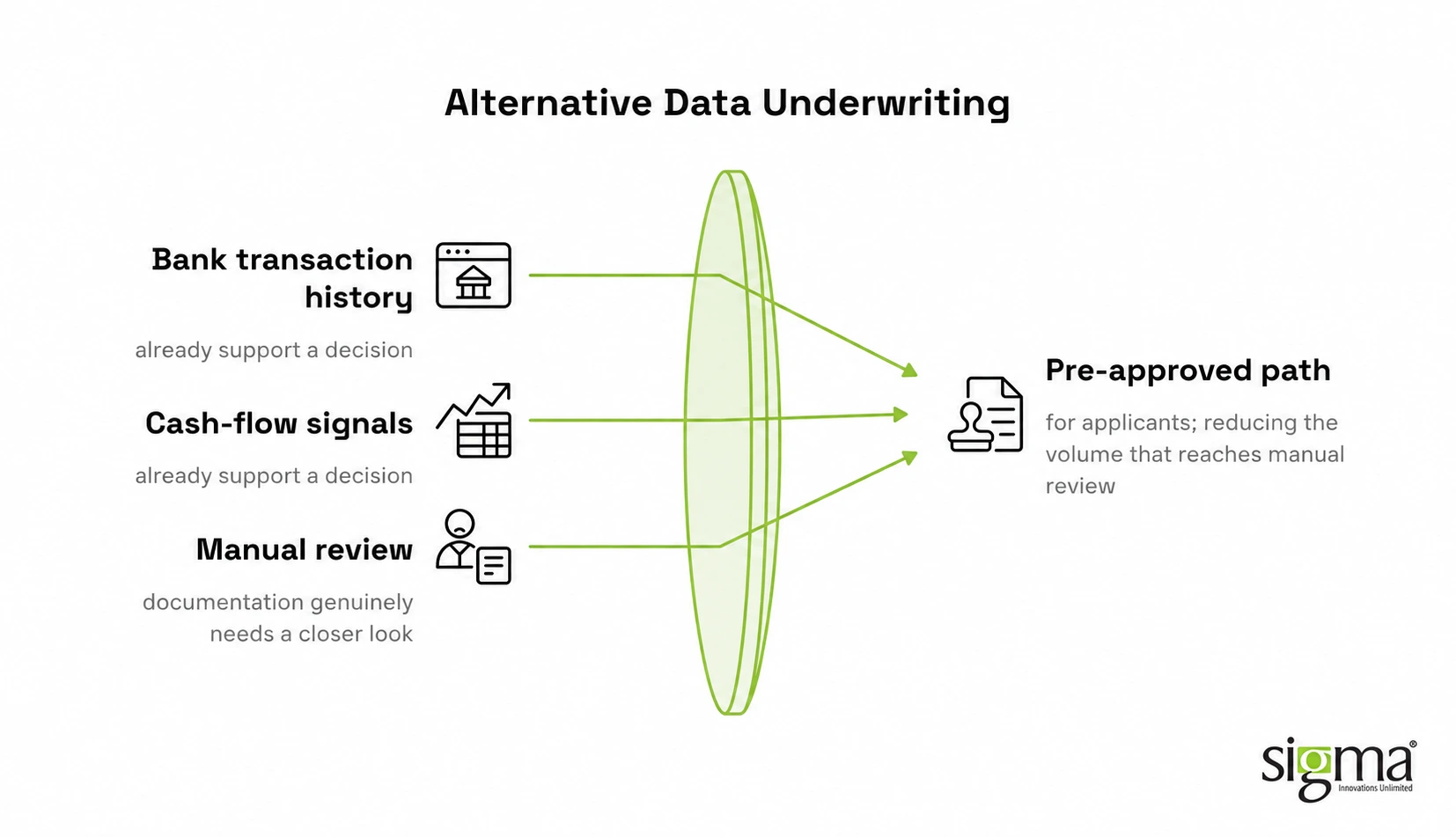
Alternative data underwriting fits best in Phase One, as a pre-approved path for the applicant segment where bank transaction history and cash-flow signals already support a decision, reducing the volume that reaches manual review during peak week rather than trying to speed up manual review itself. Manual review is still necessary for the applicants whose documentation genuinely needs a closer look, and the playbook’s job is to route correctly between the two, not to eliminate manual review altogether.
A Playbook in Practice: How Sigma Helps Lenders Automate Verification and Decisioning for Peak Week
Fraud and verification automation is often the piece lenders underestimate until peak week exposes it. Sigma connected a specialty finance company’s CRM to its lending platform to automate partner verification end to end, cutting manual work by roughly 80% while keeping compliance and risk controls in place as the partner network scaled, exactly the kind of verification automation that keeps Phase Two from becoming a bottleneck of its own.
Decisioning speed is the other half of the playbook, and it is where a legacy system most often falls short under load. Sigma re-engineered a legacy loan origination system for a 20-year small business lender, shifting credit decisioning and offer generation from a manual, inconsistent process to a high-velocity automated model, achieving a single-day funding record while improving compliance and consistency rather than trading one for the other.
For a digital lender, BNPL provider, or embedded finance platform planning for Christmas week, the playbook above works whether Sigma runs a defined peak-readiness audit now or stays engaged as the product engineering team behind decisioning and verification through the season and the review that follows it.
Conclusion
Loan processing bottlenecks during Christmas week are predictable, which means they are plannable, and a three-phase playbook turns that predictability into an operating advantage instead of an annual scramble. Phase One, auditing decisioning and verification capacity against this year’s expected volume rather than last year’s actual volume, catches the gap between what a system can handle and what it will actually face. Phase Two, running fraud checks and underwriting during peak week itself, is about watching the right signals, decisioning turnaround, fraud-queue depth, and manual-review share, close enough to catch stress before it becomes a backlog. Phase Three, the post-peak review most lenders skip, is what turns one holiday season’s lessons into next year’s readiness instead of starting from the same baseline every December. Alternative data underwriting belongs in the first phase, reducing the volume that reaches manual review rather than trying to speed manual review up directly, while leaving genuine documentation questions for a person to resolve. None of these three phases works in isolation. A strong pre-season audit without disciplined peak-week execution still produces a backlog, and peak-week execution without a post-peak review repeats the same gaps next year. The lenders who treat this as one connected process, rather than three separate initiatives run by three separate teams, are the ones who actually close the loop from one December to the next. Fraud and verification automation and decisioning-speed improvements matter because they give each phase something concrete to execute, not because either one alone solves the whole problem. Lenders that run all three phases as a connected process convert a predictable seasonal spike into funded loans instead of lost ones. The technology that supports each phase matters less than having a phase for each part of the problem in the first place.
Frequently Asked Questions
Why can holiday financing applications rise while loan processing slows during Christmas week?
Holiday financing applications rise because BNPL promotions and last-minute financing offers drive genuine borrower demand, while loan processing slows because decisioning, verification, and fraud-screening capacity stays fixed at ordinary-week levels. The mismatch between rising demand and fixed capacity is what creates the bottleneck, not a drop in system performance itself.
How can digital lenders reduce credit decisioning latency during peak application volumes?
Digital lenders reduce credit decisioning latency during peak volume by auditing capacity against a realistic model of this year’s expected peak, not last year’s actual volume, before the season starts. Automated document and income review, plus configurable risk scoring, address the manual-review steps that most often create delay under load.
How can lenders prevent manual underwriting queues from becoming a holiday bottleneck?
Preventing a manual-queue bottleneck starts with routing correctly in advance: using alternative data underwriting for applicants whose cash-flow signals already support a decision, so only the applications that genuinely need manual judgment reach that queue during peak week, when review capacity is most constrained.
Where can alternative data underwriting reduce verification friction, and when is manual review still necessary?
Alternative data underwriting reduces friction for applicants whose bank transaction history and cash-flow signals already tell most of the underwriting story, letting those applications skip a slower documentation-based review. Manual review is still necessary where that data is incomplete or where the application genuinely needs a closer look that automated signals cannot resolve.
What should a lender’s post-peak review cover after Christmas week?
A post-peak review should cover where decisioning turnaround slowed, where verification or fraud screening queued longer than planned, and whether alternative data underwriting routed the right applications away from manual review. This review is what turns one season’s bottlenecks into specific fixes for the next, rather than repeating the same gaps.