AWS Auto Scaling Architecture: Handle Demand Spikes Without Overspending
Key Highlights:
- Over-provisioned infrastructure wastes budget during quiet periods, while under-provisioned infrastructure causes downtime and lost revenue during traffic spikes.
- A well-designed AWS auto scaling architecture adjusts capacity in real time, absorbing demand surges without manual intervention and scaling back down when the traffic subsides.
- Companies that rely on static provisioning will either pay for idle capacity year-round or discover their infrastructure ceiling during the worst possible moment: a product launch, a seasonal promotion, or a viral traffic event.
- Sigma designs AWS auto scaling architectures using Auto Scaling Groups, container orchestration, and serverless workloads, tuning capacity to real traffic patterns for resilient performance and cost efficiency.
- AWS predictive scaling uses machine learning to forecast demand based on historical patterns, allowing infrastructure to pre-provision capacity before a spike arrives rather than reacting after the fact.
Introduction
Growth-stage companies running on AWS routinely face two versions of the same problem. Provision for peak traffic, and the monthly bill balloons during quiet periods. Provision for average, and the application buckles the moment a promotion, product launch, or viral moment sends demand five to ten times higher within minutes.
A well-designed AWS auto scaling architecture resolves both by making infrastructure elastic, so capacity grows with demand and shrinks when the spike passes. Sigma’s AWS Cloud Solutions help teams engineer that elasticity into production without either overspending or losing uptime during the moments that matter most.
Why Monitoring Matters Before Scaling
Auto scaling decisions are only as good as the data behind them. AWS CloudWatch provides the monitoring layer that continuously tracks CPU utilization, memory usage (through custom metrics), request counts, latency, and application health. These metrics act as the feedback loop for AWS auto scaling architecture, triggering scaling policies that add or remove capacity based on real-time demand. By combining continuous monitoring with automated scaling, organizations can respond to traffic changes without manual intervention while maintaining application performance.
See how AWS DevOps pipelines reduce rollbacks in high-traffic production environments by pairing scaling policies with safer release practices.
The Real Cost of Static Provisioning

Static provisioning forces a binary choice: provision for peak and overpay during normal operations, or provision for average and accept downtime during spikes. Neither option works for growth-stage companies where traffic patterns are variable, and budgets are tight.
The financial cost of over-provisioning is straightforward. EC2 instances running at 15% CPU during off-peak hours are burning money. EBS volumes, idle load balancers, and underutilized targets all accumulate charges. For a SaaS company spending $15,000 per month on AWS, static over-provisioning can account for 30% to 50% of that bill.
The business cost of under-provisioning is harder to quantify but often larger. A FinTech platform that drops transactions during a spike loses revenue and trust. An eCommerce store that slows during a flash sale loses customers who will not return. These pain points drive growth-stage companies toward cloud modernization and elastic architecture.
Three Scaling Patterns That Actually Work
AWS auto scaling architecture is not a single service. It is a combination of scaling patterns, each suited to different workload types. The right architecture usually combines two or three of these patterns depending on the application’s structure.
Choosing the right AWS services is only part of the solution. Effective AWS auto scaling architecture begins by understanding how each workload behaves under real traffic conditions. Rather than applying a single scaling strategy across the entire application, growth-stage teams map individual workloads to the architecture pattern that best matches their demand profile. That approach turns infrastructure decisions into business outcomes—maintaining performance during demand spikes while avoiding unnecessary cloud spend during quieter periods.
Before workloads can scale effectively, incoming requests need to be distributed intelligently. An Application Load Balancer (ALB) routes traffic across healthy application instances or container tasks, while Target Groups ensure requests are directed only to available resources. Together, ALBs, Target Groups, CloudWatch metrics, and auto scaling policies form the foundation of an elastic AWS architecture that remains responsive as traffic fluctuates.

EC2 Auto Scaling Groups
Auto Scaling Groups (ASGs) are the foundation of horizontal scaling on AWS. An ASG maintains a pool of EC2 instances, adding or removing instances based on scaling policies. Target tracking policies are the simplest starting point: set a target CPU utilization (typically 50% to 60%), and the ASG adjusts instance count to maintain that target. For workloads with predictable demand patterns, such as weekday business traffic, monthly billing cycles, or seasonal promotions, AWS Predictive Scaling uses machine learning to analyze historical CloudWatch metrics and forecast future capacity requirements. Instead of waiting for utilization thresholds to be breached, it launches additional EC2 instances before demand arrives, reducing startup delays during traffic surges. Predictive scaling works best when paired with reactive scaling policies, allowing infrastructure to prepare for expected spikes while still responding to unexpected traffic events in real time.
Container Orchestration with ECS and Fargate
For applications built on microservices, container orchestration through Amazon ECS with Fargate provides a more granular scaling model. Instead of scaling entire EC2 instances, Fargate scales individual container tasks. A checkout service can scale independently from a catalog browsing service, which means the infrastructure cost follows the actual demand pattern of each service rather than scaling the entire application as a monolith.
ECS Service Auto Scaling uses the same target tracking approach as EC2 ASGs but applies it at the task level. The scaling is faster because container tasks typically start within 10–30 seconds, depending on container image size and initialization time, compared to the several minutes often required to provision and configure a new EC2 instance. For growth-stage companies practicing AWS workload optimization, Fargate also removes the need to manage the underlying EC2 fleet entirely, reducing operational overhead.
Serverless AWS with Lambda
Serverless AWS through Lambda takes the scaling abstraction one step further. Lambda functions scale automatically to match incoming request volume with no capacity configuration required. There is no concept of idle cost because Lambda charges per invocation and per millisecond of compute time. If nobody calls the function, the cost is zero.
Lambda is best suited for event-driven workloads: API endpoints with variable traffic, file processing triggers, webhook handlers, and scheduled jobs. It is less suited for long-running processes or workloads that require persistent connections.
The following table compares these three patterns across the dimensions that matter for growth-stage companies:
| Dimension | EC2 Auto Scaling Groups | ECS with Fargate | Lambda (Serverless) |
| Scaling granularity | Instance level | Container task level | Per-request level |
| Scale-out speed | 2 to 5 minutes (instance boot) | 10 to 30 seconds (task start) | Milliseconds (cold start aside) |
| Idle cost | Minimum instance count always running | Minimum task count always running | Zero when not invoked |
| Operational overhead | Manage AMIs, patching, instance types | Manage container images and task definitions | Manage function code only |
| Best fit | Stateful apps, legacy workloads | Microservices, API backends | Event-driven, variable-traffic endpoints |
Combining Patterns for Real-World Architecture

Most production architectures do not use a single pattern in isolation. A typical growth-stage SaaS application might run its core API on ECS with Fargate for fast, granular scaling, use Lambda for webhook processing and background jobs that spike unpredictably, and keep a small EC2 ASG for workloads that require persistent connections or specific instance configurations.
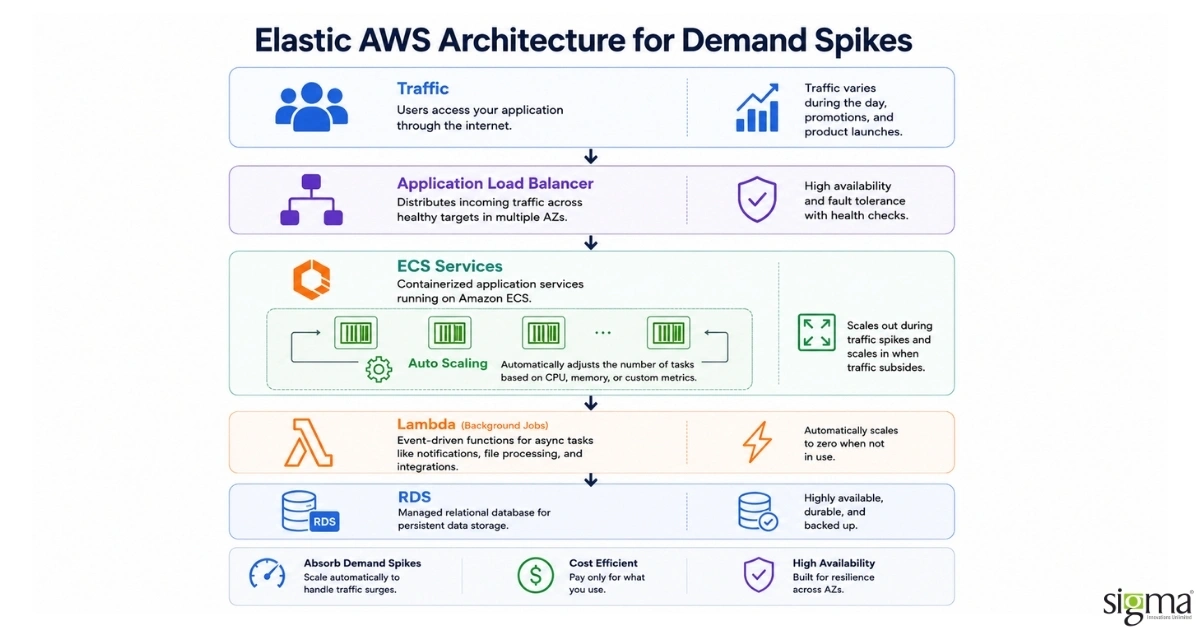
The key design principle is matching each workload to the scaling pattern that fits its traffic shape. CloudWatch dashboards and application-level metrics tie these components together by providing a unified view of utilization, latency, error rates, and scaling events. This operational visibility allows engineering teams to continuously refine scaling policies as workloads evolve. Workloads with steady, predictable traffic belong on reserved or savings-plan-backed EC2 instances. Workloads with variable, bursty traffic belong on Fargate or Lambda where capacity follows demand automatically. Workloads with zero-to-peak patterns like batch processing or event-driven triggers belong on Lambda where idle cost is zero.
Getting this mapping right is the core of AWS workload optimization. It is also where most growth-stage teams need help, because the decision requires understanding both the application’s traffic patterns and the cost model of each AWS service.
Elastic capacity solves the traffic side of the equation, but a bad deployment can still take down a healthy fleet during a spike.
Build Cloud Platforms That Scale with Your Business
Beyond auto scaling, Sigma’s Platform Engineering Services help standardize cloud infrastructure, automate operations, and accelerate cloud-native delivery.
Sizing Infrastructure Against Real Traffic, Not Peak Anxiety
Two clients arrived with the same complaint about auto scaling and opposite problems underneath it.
The first was an eCommerce platform paying $22,000 a month to AWS while CPU utilization sat at 18% outside promotional windows. Nothing was broken. The infrastructure had been sized for a Black Friday spike two years earlier and nobody had touched it since, because touching it meant risking the next Black Friday. Sigma restructured the workload across an EC2 ASG with target tracking, moved the product search API to ECS Fargate so it could scale independently of the catalog, and shifted image processing to Lambda where idle cost is zero. The bill dropped to $13,000. The next traffic spike was absorbed without anyone watching a dashboard.
Read our success story: Multi-tenant AWS architecture that scaled securely while cutting operational cost: Cloud-native transformation for scaling smart.
The second client had the inverse problem. A FinTech platform running fixed infrastructure that was cheap enough nobody questioned it, until end-of-month payment runs pushed transaction volume past the ceiling and timeouts started. Cost was never the issue. Capacity was, and only for roughly three days a month. Sigma implemented container orchestration on ECS with predictive scaling tuned specifically to the billing cycle, so capacity arrives before the run rather than in response to it. The platform now handles 4x baseline without manual intervention.
Read our success story: Real-time payment processing on a cloud-native platform built for variable transaction volume: An AI-powered blockchain platform for cross-border payments.
What both engagements had in common was that the answer came from the client’s own CloudWatch and billing data, not from a reference architecture. Scaling policies get tuned against real traffic, dashboards and billing alerts get set up, and the retainer exists because traffic patterns keep moving.. Sigma’s AWS Cloud Solutions covers the audit, the restructure, and the ongoing tuning as traffic evolves.
Why Sigma for AWS Cloud Solutions and Auto Scaling Architecture
Growth-stage SaaS, FinTech, and eCommerce companies need more than scalable infrastructure—they need an AWS Cloud Solutions partner that aligns cloud architecture with business growth. As an AWS Select Tier Services Partner, Sigma designs AWS auto scaling architectures that optimize cloud costs, improve application resilience, and maintain performance during unpredictable demand spikes. Instead of relying on static provisioning or one-size-fits-all reference architectures, Sigma builds elastic AWS environments tailored to real production traffic patterns and long-term scalability.
Sigma’s AWS Consulting Services combine cloud modernization, platform engineering, container orchestration, serverless architecture, and AWS workload optimization to create infrastructure that scales intelligently. By analyzing CloudWatch metrics, application dependencies, and cloud spending, Sigma helps technology leaders implement the right mix of Auto Scaling Groups, Amazon ECS with Fargate, Lambda, and predictive scaling policies. The result is an AWS environment that reduces idle infrastructure costs, prevents performance bottlenecks during traffic surges, and continuously adapts as workloads evolve—enabling organizations to scale confidently while keeping cloud operations efficient and cost-effective.
Build auto scaling architectures, modernize cloud workloads, and optimize infrastructure costs with AWS solutions engineered for business growth.
Conclusion
Demand spikes are not emergencies. They are predictable engineering challenges that a well-designed AWS auto scaling architecture handles automatically. The combination of EC2 Auto Scaling Groups for baseline workloads, container orchestration for microservices, and serverless AWS for event-driven functions gives growth-stage companies the elasticity to absorb traffic surges without overspending during normal operations. The companies that get this right treat cloud modernization as an ongoing practice, not a one-time migration. Sigma Infosolutions helps them build that practice, tuning auto-scaling infrastructure to real traffic patterns and real cost constraints.
Stop Paying for Idle Capacity. Start Scaling with Confidence.
Whether you’re modernizing legacy workloads or optimizing an existing AWS environment, Sigma designs cloud architectures that deliver cost-efficient scalability and consistent performance.
Frequently Asked Questions
What is AWS auto scaling architecture and how does it work?
AWS auto scaling architecture automatically adjusts compute capacity based on real-time demand using scaling policies tied to CloudWatch metrics. When traffic increases, the architecture adds EC2 instances, ECS tasks, or Lambda invocations. When traffic decreases, it scales back down, ensuring performance during spikes and cost efficiency during quiet periods.
When should a company use containers versus serverless on AWS?
Container orchestration through ECS or Fargate suits microservices that need fast, granular scaling with persistent process state. Serverless AWS through Lambda suits event-driven workloads with variable or unpredictable traffic where per-invocation billing eliminates idle cost. Most production architectures combine both based on each workload’s traffic pattern.
How does AWS workload optimization reduce cloud costs?
AWS workload optimization matches each workload to the scaling pattern and pricing model that fits its traffic shape. Steady workloads go on reserved capacity. Variable workloads go on auto-scaling groups or Fargate. Bursty workloads go on Lambda. This prevents over-provisioning for peak demand and eliminates idle resource costs during off-peak periods.
What is the difference between reactive and predictive auto scaling?
Reactive scaling responds to current CloudWatch metrics, adding capacity after demand increases. Predictive scaling uses machine learning to analyze historical traffic patterns and provisions capacity before the expected spike arrives. Combining both ensures fast response to unexpected surges and pre-positioned capacity for predictable patterns like business-hour traffic or monthly billing cycles.
How does Sigma help with cloud modernization for auto scaling?
Sigma analyzes the client’s actual AWS traffic and cost data, identifies workloads suited for each scaling pattern, implements the auto-scaling infrastructure, and tunes policies against real demand. The team stays engaged through a retainer to adjust scaling parameters as traffic evolves, treating cloud modernization as an ongoing optimization rather than a one-time project.
How do Auto Scaling Groups and Load Balancers work together?
Application Load Balancers distribute incoming traffic across EC2 instances managed by Auto Scaling Groups. As new instances launch during traffic spikes, they are automatically registered with the load balancer, allowing applications to scale horizontally without disrupting user requests.