AWS Cloud Migration: What Getting It Wrong Actually Costs
The migration finished on schedule, nothing broke, and the monthly bill is larger than the data center it replaced. This is the ordinary outcome of an AWS cloud migration executed as an infrastructure project, and it is not a failure of engineering. Every workload moved successfully. What did not move was any mechanism for deciding how much each workload should cost, which means the organization has swapped a capital expense it controlled through procurement for an operating expense that nobody approves before it is incurred. The costs described here are not migration costs. They are the costs of a migration that succeeded on its own terms and left the economics unowned.
Key Highlights
- Leaders promised savings receive a larger bill, because inefficiency was moved onto metered infrastructure without anyone acquiring authority over consumption.
- Install cost controls as migration deliverables with named owners, rather than scheduling an optimization phase that will be deprioritized once the cutover succeeds.
- Cloud spend becomes a governed, forecastable line rather than a monthly surprise that erodes the business case retroactively.
- Sigma treats cost governance as part of the migration scope, because the optimization phase that follows a completed migration is the one most reliably cancelled.
AWS Cloud Migration Is a Cost Governance Project in Infrastructure Clothing
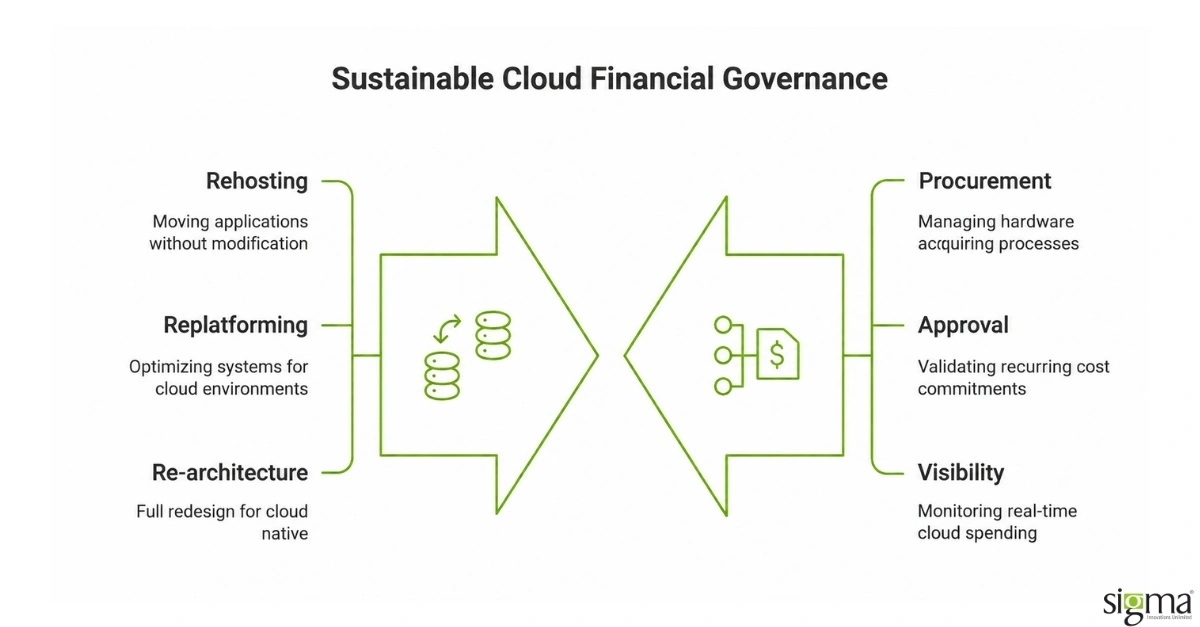
AWS cloud migration is the movement of applications, data, and infrastructure from an existing environment into AWS, using one of the strategies AWS documents in its migration guidance, which range from rehosting without modification through replatforming to full re-architecture. The technical work is well understood and increasingly automated. The part that determines whether the business case survives is organizational, and it concerns who is allowed to spend.
On premises, capacity is a procurement event. Somebody requests hardware, somebody approves a purchase order, and the constraint is enforced by a finance process that predates the request. In AWS, capacity is an API call. An engineer solving a legitimate problem at two in the morning can commit the company to a recurring cost with no approval step, and that cost will not be visible for weeks. Migrating without replacing the approval mechanism removes a control that everyone had stopped noticing, which is why bills rise even when every individual decision was reasonable.
Five Ways the Bill Grows After the Migration Succeeds
Over-provisioning is the first and largest. Instance sizes are chosen to match the on-premises servers being replaced, and those servers were sized for a peak that may never have occurred, plus a safety margin, plus the fact that nobody wanted to be the person who under-specified. That accumulated conservatism transfers intact and is then billed hourly.
Data transfer is the second and the most surprising to finance, because it has no on-premises equivalent. Traffic between availability zones, between regions, and out to the internet is metered, and architectures designed without reference to those boundaries generate charges that appear on no forecast. The control is architectural review before cutover rather than analysis afterward, since moving data paths after the fact means changing the application.
Orphaned resources are the third. Migrations generate test instances, duplicated volumes, snapshots, and load balancers, and the project ends before anyone reconciles what should still exist. Storage class drift is the fourth, where logs and backups accumulate indefinitely in expensive storage because no lifecycle policy was ever written. Licensing is the fifth and the one with the largest single-event risk, since certain commercial licenses behave differently on virtualized infrastructure and produce liabilities that surface at audit rather than on a bill.
| Failure mode | Why it happens | Control that prevents it | When to install it |
| Over-provisioning | On-premises sizing carried across unchanged | Utilization-based right-sizing per workload | During wave planning, before cutover |
| Data transfer charges | Zone and region boundaries not in the design | Architectural review of data paths | Before cutover, not after |
| Orphaned resources | Project ends before reconciliation | Mandatory tagging with an owner per resource | At account setup |
| Storage class drift | No lifecycle policy defined | Retention rules written with the workload | During migration of that workload |
| Licensing exposure | Terms differ on virtualized infrastructure | License review inside the assessment | Before any workload is selected |
Reading the right-hand column together explains why post-migration cost programs underdeliver. Every one of these controls is materially cheaper to install before the workload moves than after, and several are close to impossible to retrofit. Tagging is the clearest case: applied at account creation it costs nothing, while applied to a running estate it requires reconstructing who owns what from deployment history and the recollection of people who have since moved teams.
Make cost governance a migration deliverable rather than a later project.
Lift and Shift Is Not the Mistake. Stopping There Is.
Rehosting has a reasonable case, and the criticism it attracts is frequently unfair. Moving workloads with minimal modification shortens the migration window, reduces the number of variables changing simultaneously, and gets an organization operating in AWS where it can build the skills that later optimization requires. As a first phase, it is defensible and often correct.
The anti-pattern is treating the rehost as the destination while having budgeted for the savings that only optimization produces. The business case presented to the board assumed a modernized cost profile. The delivered migration produced an unmodernized one running on metered infrastructure, which is structurally more expensive than the equipment it replaced, because the safety margin that was free on owned hardware is now billed by the hour. The gap between those two positions is what the optimization phase was supposed to close.
That phase is then cancelled, and predictably so. It arrives after a successful cutover, when the organization is exhausted, the migration budget is spent, and the infrastructure team has a backlog it deferred for a year. Optimization is unglamorous, produces no new capability, and competes against work with visible business sponsors. Anyone who has watched this sequence twice stops treating the optimization phase as a plan and starts treating it as an intention.
Modernization works best as a controlled transition, not a wholesale replacement. The architecture can evolve in stages while the customer experience remains intact. Read the legacy modernization analysis
There is a narrower version of the anti-pattern worth naming separately, because it is harder to detect. A migration can be technically optimized, with correctly sized instances and sensible storage, and still fail commercially if nobody holds a forecast. Right-sizing is a one-time act, whereas cost governance is a recurring one, and an estate that was correctly configured at cutover drifts within two quarters as teams deploy against it. The control that matters is not the initial configuration but the standing review that catches drift while it is small.
Downtime Cost Belongs to Whoever Did Not Plan the Cutover
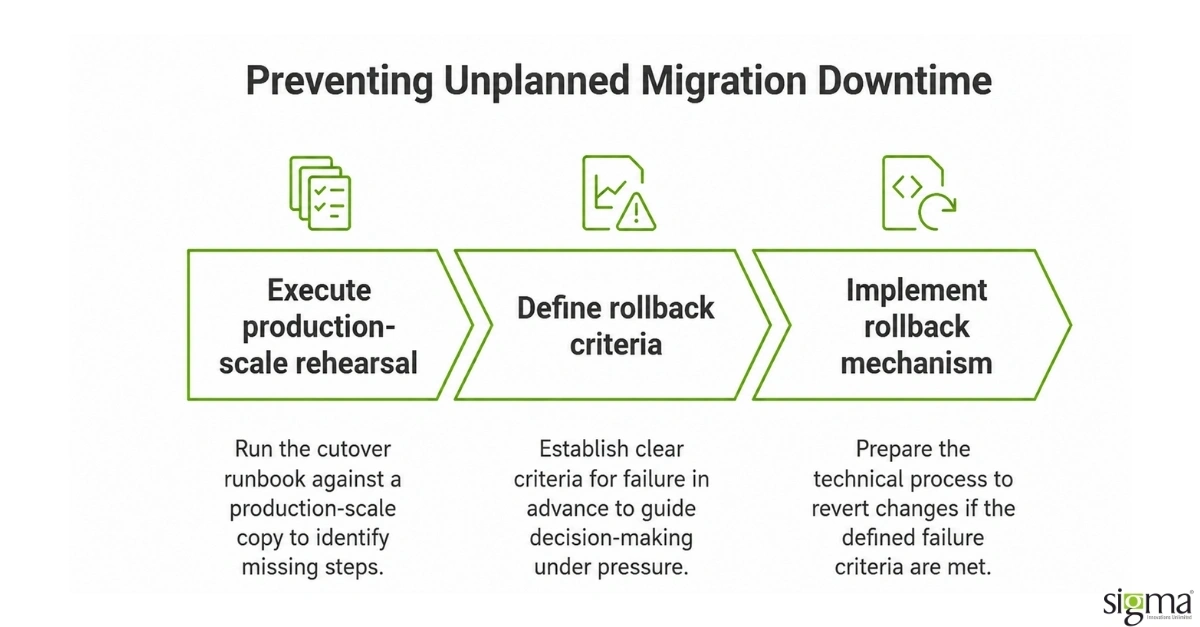
Unplanned downtime during migration is expensive in a way that rarely appears in the post-mortem, because the cost lands outside the technology budget. Revenue that does not transact, support capacity consumed by the incident, contractual service credits, and the reputational effect on enterprise customers watching how the vendor handles it are all real and none of them is charged to the migration.
Preventing it is mostly a matter of rehearsal rather than design. A cutover runbook that has been executed against a production-scale copy behaves differently from one that has been reviewed in a document, and the difference appears in the steps nobody wrote down. Defining the rollback criteria in advance matters more than the rollback mechanism, since teams under pressure at four in the morning will keep pushing forward through a failing cutover unless somebody agreed beforehand what constitutes failure.
The Optimization Phase That Never Happens
The migration plan often treats optimization as something that happens after go-live. That is when it is least likely to happen. The migration budget has been consumed, the infrastructure team is focused on stabilizing the new environment, and the work responsible for producing the promised savings is now competing with operational priorities.
A stronger approach builds cost control into migration decisions from the beginning. That means examining workload utilization before a migration wave, accounting for data movement and storage behavior in the target architecture, and establishing ownership before resources are provisioned. AWS migration becomes not just a move between environments, but a chance to establish how the environment will be operated afterward.
Right-Size Before the Workload Moves
Replacing an on-premises server with an equivalent AWS instance does not necessarily produce an equivalent cost profile. The original infrastructure may have been sized for historical peaks, planned growth, or simply because excess capacity was cheaper than the risk of under-provisioning.
Migration planning should therefore use actual utilization data to determine the target configuration. Workloads can be assessed for compute, storage, and performance requirements before each wave, reducing the likelihood that oversized infrastructure becomes the new baseline.
This is also where migration architecture matters. Instance selection, storage configuration, and workload placement should be considered together rather than treated as separate infrastructure decisions.
Make Ownership a Provisioning Rule
Cost visibility becomes difficult when nobody owns the resources generating the cost. Test environments, temporary instances, snapshots, and duplicated infrastructure can remain active long after the project that created them has ended.
Resource tagging and ownership policies are inexpensive to establish before workloads arrive and considerably harder to reconstruct afterward. Account structure, tagging standards, and provisioning controls can therefore be established as part of the migration foundation rather than introduced once the estate has already grown.
Treat Data Movement as an Architecture Decision
Data transfer charges are often discovered after the architecture has already been deployed. Traffic between availability zones, regions, and external services can introduce recurring costs that were invisible in the original on-premises environment.
Migration planning should examine these data paths before cutover. Application dependencies, service placement, storage choices, and network architecture all influence the resulting cost profile. Reviewing them as part of workload assessment makes the migration architecture more deliberate and reduces the need for expensive changes after deployment.
Sequence Waves to Test the Economics
Migration waves should provide more than a schedule for moving applications. They should create opportunities to validate the assumptions behind the business case.
Workloads with clearer utilization patterns and fewer dependencies are useful early candidates because they provide measurable evidence about actual AWS consumption. If the forecast differs from reality, the sizing, architecture, or cost assumptions can be adjusted before more complex workloads move.
This turns wave planning into a feedback mechanism rather than a simple exercise in prioritization.
Know What Should Not Move Yet
A migration inventory does not mean every workload belongs in the next migration wave. An application scheduled for replacement, a workload with unresolved licensing constraints, or a system whose target architecture has not been established may be better deferred.
That decision can be commercially inconvenient, but migrating a workload simply because it appears on the inventory can create cost without creating durable value. A sound AWS migration strategy therefore includes the ability to sequence, redesign, retire, or defer workloads rather than treating migration as an obligation to move everything.
Keep Finance Inside the Migration
Finance should not encounter the AWS cost model only after the first production bill arrives. The assumptions behind projected run rate need to be reviewed as workloads move, particularly where actual utilization, data transfer, storage growth, or licensing behavior differs from the original estimate.
Comparing forecast against actual consumption at each migration wave creates a series of smaller corrections instead of leaving the organization with one large variance to explain after go-live.
The result is a different definition of migration success. The workload has moved, the architecture reflects its actual requirements, ownership and cost controls are established, and the organization has a mechanism for keeping the environment aligned with the economics that justified the migration in the first place.
Read our success story: Upgrading the Magento Platform and Implementing Headless Architecture for an Oceania-based client
Conclusion
An AWS cloud migration that moves every workload successfully can still fail commercially, because the mechanism that governed spending was left behind with the hardware. Over-provisioning, metered data transfer, orphaned resources, storage that never ages out, and licensing terms that change on virtualized infrastructure account for most of the gap between the projected bill and the actual one. Rehosting is a defensible first phase and becomes a costly destination when the optimization work that justified the business case is scheduled for a period in which it will not be funded. Controls installed during the migration, with named owners and utilization evidence, survive the cutover in a way that a subsequent optimization project does not. The organizations that end up with the economics they projected are the ones that treated the cost question as part of the migration rather than as its sequel.
FAQs
Q1. Why does the bill increase after a successful AWS cloud migration?
A1. Because the approval mechanism was left behind with the hardware. On premises, adding capacity required a purchase order and a finance process. In AWS, capacity is an API call any engineer can make at any hour, with the cost surfacing weeks later. Nothing replaced the control procurement used to enforce.
Q2. What are the largest hidden costs in an AWS migration?
A2. Five dominate the gap between forecast and actual. Instance sizes carried across unchanged from over-specified servers, metered data transfer between availability zones and regions, orphaned test resources nobody reconciled at project close, logs and backups aging in expensive storage classes, and commercial licenses whose terms differ on virtualized infrastructure.
Q3. Is lift and shift a mistake?
A3. Rehosting is defensible as a first phase. It shortens the migration window and reduces simultaneous variables. The mistake is treating it as the destination while having budgeted for savings that only the later optimization work produces, since that phase competes badly for funding after cutover.
Q4. When should cloud cost controls be put in place?
A4. Before workloads move, in every case without exception. Resource tagging belongs at account setup, right-sizing during wave planning using observed utilization rather than hardware specifications, retention rules alongside each workload, and license review inside the initial assessment. Retrofitting any of these onto a running estate costs considerably more.
Q5. How do you prevent unplanned downtime during a cutover?
A5. Rehearsal matters more than design here. A runbook that has been executed against a production-scale copy behaves differently from one reviewed on paper. Defining the rollback criteria in advance matters most of all, because teams under pressure will keep pushing forward through a failing cutover unless failure was defined beforehand.