Why Technically Strong Cloud BI Business Cases Still Fail Budget Review

Key Highlights:
- A technically sound cloud BI proposal can still stall in budget review when it is framed around platform capabilities instead of a business problem finance can evaluate.
- Anchoring the request to a specific, cost reporting bottleneck gives finance a concrete basis for comparing the investment against other priorities.
- A phased approach with a defined early proof point can reduce perceived investment risk and give leadership a measurable checkpoint before expanding the initiative.
- The strongest business cases account for platform costs, implementation effort, internal resources, migration, governance, and expected business value rather than focusing only on subscription costs.
- Sigma works with data leaders to connect cloud BI strategy, cost modeling, scope, governance, and delivery planning before an initiative moves into execution.
Introduction
Most cloud BI initiatives do not stall because the technology case is weak. They stall because the business case does not give finance enough evidence to approve the investment.
A Head of Data or VP of Analytics may have a clear reason to move away from an aging reporting environment. Reporting may take too long to produce, data may remain fragmented across systems, infrastructure costs may be increasing, or leadership may be making decisions using information that is already outdated by the time it reaches them.
But a proposal that simply says the organization needs modern cloud BI can struggle in budget review. Finance is not deciding whether cloud BI is technically capable. It is deciding whether the proposed investment is justified against competing priorities, what the organization will spend, what risk it is taking, and what measurable outcome it can reasonably expect.
That changes how the business case needs to be built. A credible cloud BI business case connects a specific operational problem to a defined investment, a measurable outcome, a realistic timeline, and a controlled implementation path.
This post examines why technically strong cloud BI proposals often stall, what finance and business leadership are actually evaluating, and how data leaders can structure the case around evidence rather than platform features.
Need a stronger cloud BI strategy?
Why Most Cloud BI Pitches Stall Before Approval
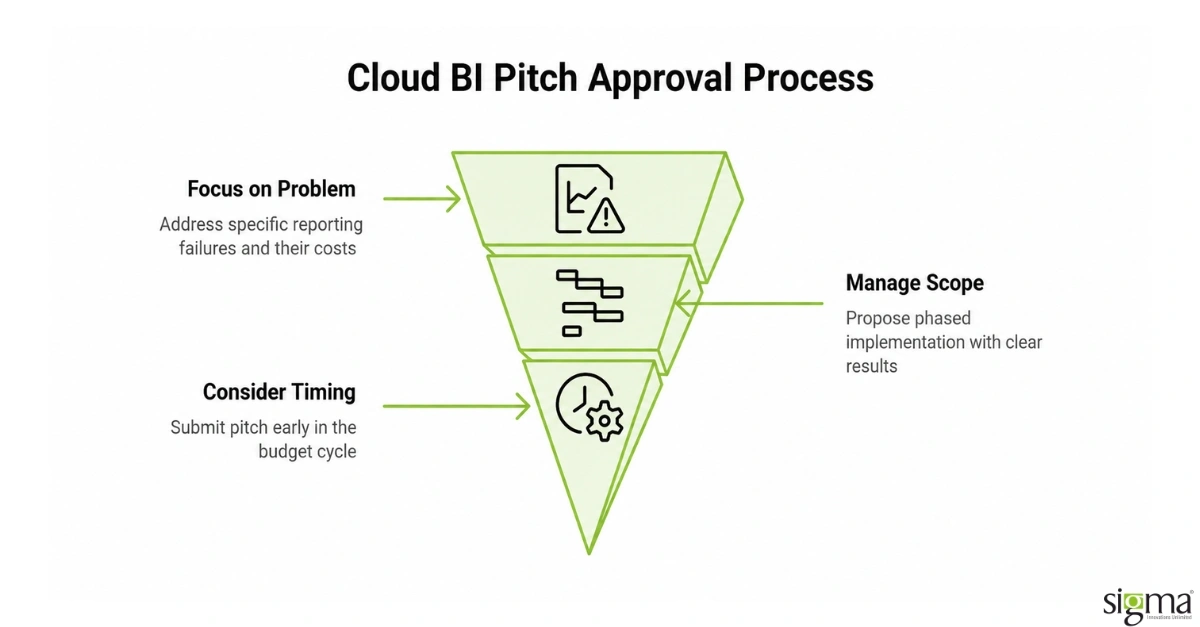
The most common reason a cloud BI business case stalls is that it leads with the platform rather than the problem. A proposal centered on Power BI, Snowflake, another cloud-native analytics option, or a list of BI capabilities may demonstrate that the technology is suitable. But it does not necessarily answer the question finance needs answered: what business problem are we paying to solve?
A statement such as “our BI infrastructure needs modernization” creates another question: what is the current cost of leaving it as it is, and what changes if the organization invests now? A stronger business case identifies the operational consequence first. If analysts spend hundreds of hours each month consolidating reports manually, that effort represents a measurable operating cost. If executives wait several days for updated performance information, the delay represents a decision-making constraint. If an on-premise environment requires recurring infrastructure investment to accommodate increasing data volumes, that cost becomes part of the comparison.
The objective is not to make every benefit look like a dollar figure. It is to establish a clear relationship between the current problem, proposed investment, and expected business outcome. That gives finance something concrete to evaluate instead of asking it to approve modernization based primarily on technology preference.
Scope is another common reason proposals stall. Teams may try to justify a complete replacement of dashboards, data sources, infrastructure, and reporting processes in a single request. That can make the initiative appear larger and harder to evaluate before the organization has demonstrated value from the first phase.
A phased business case can present a different risk profile. Instead of requesting funding for the entire BI environment, the proposal can prioritize a high-value reporting bottleneck, establish a defined first phase, and identify how the results will inform subsequent investment. This does not mean every cloud BI initiative should be implemented in small phases. A broader migration may be appropriate when the existing environment has reached a point where incremental modernization creates more complexity than value.
The important point is that scope should reflect the organization’s risk tolerance, business priorities, architecture, and expected value rather than being predetermined by the technology itself.
Timing also matters. A strong proposal submitted after the annual budget has largely been committed may still struggle against a proposal of similar merit submitted during the organization’s planning cycle. Understanding when discretionary technology spending is evaluated can therefore be as important as the contents of the business case itself.
Read the blog: Data Warehousing and BI Development: Building a Scalable Analytics Foundation
What Finance Is Actually Evaluating in a Cloud BI Business Case
Finance and operating leadership typically need to understand three things: what the organization will spend, what business problem that investment will address, and how and when leadership will know whether the investment is delivering value.
The cost model should extend beyond the cloud BI subscription. Depending on the existing environment and scope, the business case may need to account for cloud BI platform and consumption costs, implementation and integration effort, data migration and transformation, internal team capacity, dashboard redevelopment, user migration, governance, security, data quality remediation, and ongoing support and optimization.
The value side should also be grounded in measurable business conditions. Relevant measures may include analyst hours currently spent on manual reporting, reporting production costs, delays in management reporting, existing infrastructure costs, duplicate licensing, data reconciliation effort, time required to produce critical reports, or operational impact caused by delayed and inconsistent information.
The goal is not to manufacture a guaranteed ROI figure. It is to give decision-makers enough evidence to determine whether the proposed investment is proportionate to the problem being addressed. The stronger the connection between the current cost, proposed change, and measurable outcome, the easier it becomes for finance and business leadership to evaluate the request.
On-Premise BI vs. Cloud BI: Business Case Comparison
The table below captures the business-case dimensions finance and technology leadership may evaluate when comparing continued investment in an on-premise BI environment with a move toward cloud BI.
| Business Case Dimension | On-Premise BI | Cloud BI |
| Upfront Cost | High: server hardware, software licenses, and implementation costs committed before any value is realized | Lower upfront; subscription and implementation cost spread across phases, first value visible earlier |
| Scalability | Fixed; expanding capacity requires additional infrastructure spend and procurement lead time | Elastic; capacity scales with usage, up or down, without procurement delays |
| Time to Insight | Weeks to months before the first usable dashboard is live; provisioning drives the timeline | Days to weeks for a working proof of concept on priority data sources |
| IT Dependency | High; every change requires IT involvement for infrastructure provisioning, patching, and capacity management | Lower for routine operations; IT focus shifts to governance, integrations, and cost management |
| Maintenance Burden | Ongoing: hardware refresh cycles, software version management, and security patching owned entirely by the internal team | Reduced: infrastructure maintenance handled by the vendor; team focuses on data quality, access governance, and analytics |
The comparison is not an argument that cloud BI is automatically the better financial decision. The appropriate choice depends on the organization’s existing architecture, data volumes, reporting requirements, security model, internal capabilities, licensing structure, and expected growth.
A credible business case should therefore evaluate the total cost and business implications of both staying and moving, rather than assuming migration is inherently more economical.
Anchoring the Case to a Specific, Costed Bottleneck
A cloud BI business case built around a specific reporting bottleneck is easier to evaluate than one built around the general state of the analytics environment. Consider a weekly reporting process that requires a defined number of analyst hours across multiple teams. The business case can establish how much time the process currently consumes, where manual work occurs, how frequently the process runs, which systems contribute data, what decisions depend on the output, and what portion of the process the proposed initiative would address.
That turns an abstract modernization request into a business problem with measurable dimensions. The same principle applies to other bottlenecks. A data refresh delay, fragmented reporting environment, recurring reconciliation process, or infrastructure constraint can become the starting point if its business impact can be demonstrated.
This also changes the scope of the request. Rather than asking finance to approve a complete BI transformation immediately, the proposal can establish a priority problem, define the investment required to address it, and identify the criteria that would support subsequent phases.
However, the first bottleneck should not be selected simply because it is technically easy to solve. The strongest candidate is usually the one that combines meaningful business impact, manageable delivery risk, accessible data, and a clear way to measure improvement.
| Pitch Element | Scoped, Single-Bottleneck Request | Full-Environment Request |
| Approval Path | Often within a department head’s discretionary budget | Usually requires full executive committee review |
| Time to First Result | Weeks, tied to one proof of concept | Quarters, no visible result until later phases |
| Risk Presented to Finance | Small, bounded, and easy to compare against other requests | Large, harder to weigh against competing budget priorities |
| Typical Outcome | Faster sign-off, phased plan reviewed again after phase one | Deferred rather than rejected, stalls on the roadmap |
The objective is not to make the smallest possible request. It is to make the most defensible request for the organization’s current business need.
Read the blog : What cloud business intelligence actually changes operationally once a migration begins.
Building the Timeline to Value That Earns Sign-Off
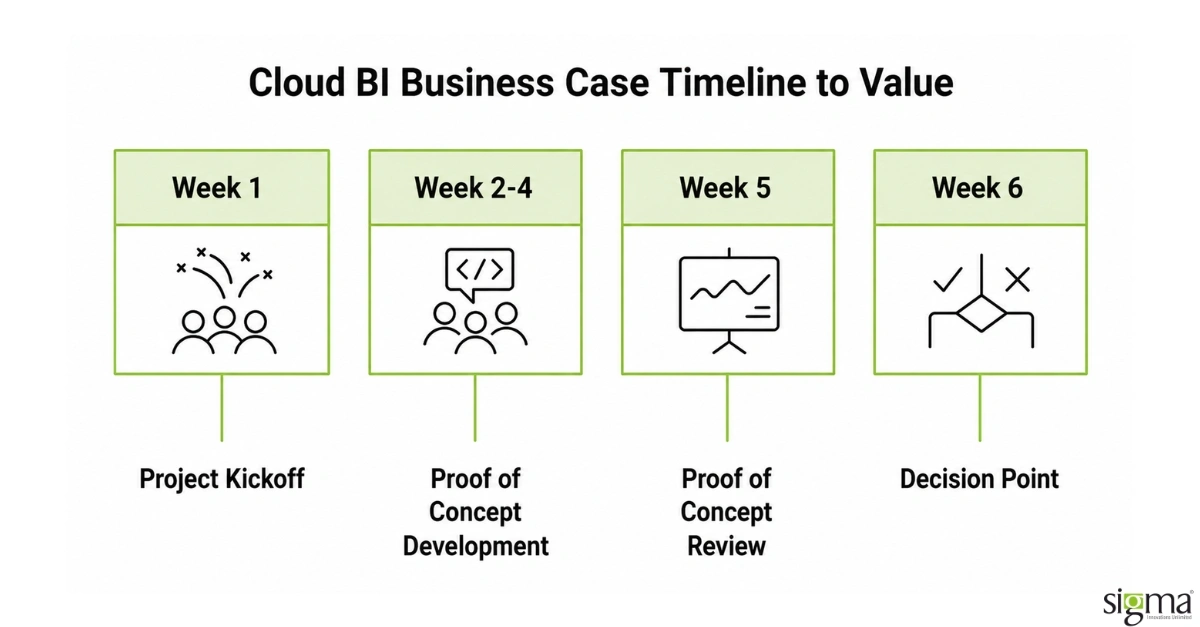
A strong cloud BI business case does more than state the expected benefits. It explains when leadership can reasonably expect to see evidence that the investment is progressing.
That evidence may come from a proof of concept, a priority dashboard, an automated reporting workflow, a specific data source brought into the analytics environment, or another measurable business outcome. The right milestone depends on the initiative, so a proof of concept should not be treated as a generic requirement. Its purpose is to reduce uncertainty around the assumptions that matter to the investment decision.
Leadership may need evidence that priority data sources can be integrated within the expected architecture, reporting automation can materially reduce manual effort, required governance controls can be implemented without unacceptable complexity, the selected architecture can support expected data growth, or users can access the information they need within the proposed operating model.
The business case should also acknowledge what happens if the early result does not meet expectations. Defining success criteria, review points, dependencies, and decision gates makes the proposal more credible because leadership can see how the organization will manage uncertainty rather than simply being presented with the upside.
The timeline should therefore connect investment to milestone, evidence, and decision. That creates a more practical governance model for the initiative than a simple promise of long-term transformation.
Translating BI Investment Projections Into a Case Finance Will Approve
Sigma works with data leaders before cloud BI implementation begins, when the platform, architecture, scope, and investment case are still being evaluated. That stage matters because the assumptions used to build a business case should ultimately connect to the realities of delivery.
A cost estimate that does not account for data integration, migration complexity, governance, security, internal resources, or reporting redevelopment can create a gap between the approved business case and the actual implementation. Bringing those considerations into the planning stage creates a more realistic view of what the initiative will require.
Sigma’s engagement with Numerify illustrates the value of an evidence-led approach. For the cloud-based analytics provider serving Fortune 500 clients, Sigma built more than 250 ETL jobs across primary data sources on Amazon Redshift and automated weekly, monthly, and year-end reporting processes. The engagement eliminated more than 500 hours of manual reporting work, providing a measurable operational outcome rather than relying only on a general modernization claim.
In another engagement, Sigma built a Snowflake-native lending intelligence platform using Streamlit. Row-level security and dynamic data masking were incorporated into the solution scope alongside self-service analytics capabilities, demonstrating why governance and security requirements need to be considered as part of the original architecture and investment discussion rather than treated as later additions.
These examples point to an important business-case principle: the investment model should reflect the solution the organization is realistically going to build. That means evaluating architecture, data complexity, governance, implementation effort, and ongoing operating requirements before the budget is finalized.
See how Sigma approaches business intelligence consulting with an evidence-led view of architecture, scope, governance, and delivery.
Once a cloud BI initiative is funded and moves into execution, the questions change. Leadership then needs to understand how platform costs, data source growth, governance, adoption, and ongoing analytics operations will evolve as the environment becomes part of the organization’s operating model.
Conclusion
A cloud BI business case does not become stronger simply by adding more platform capabilities, architectural detail, or transformation language. It becomes stronger when it makes the investment easier to evaluate.
The most defensible cases connect a specific business problem to a defined investment, measurable outcomes, realistic delivery assumptions, and a clear way to assess progress. They recognize that cloud BI can change the organization’s cost structure and operating model, rather than assuming that moving analytics to the cloud automatically reduces costs.
For some organizations, the right decision may be a phased cloud BI initiative focused on a high-value reporting bottleneck. For others, the scale of the existing environment may justify a broader migration. The right approach depends on the current architecture, business priorities, data landscape, governance requirements, and investment objectives.
That assessment should happen before the technology decision becomes the business case. Sigma works with data leaders to evaluate those factors, connect technology decisions to business requirements, and build cloud BI solutions around a delivery plan that accounts for architecture, governance, cost, and long-term operational needs.
If your cloud BI initiative is struggling to clear budget review, build a stronger case around cost, risk, scope, and measurable business value.
Conclusion:
A cloud BI business case that gets funded looks different from the one most teams draft first, and the difference is specificity, not enthusiasm. Pitches built around platform features and general modernization language stall in budget review because they answer a question finance did not ask. The stronger version anchors the request to a single, costed reporting bottleneck and states the cost, the outcome, and the timeline in terms finance already knows how to evaluate. Scoping the request around one bottleneck first, rather than a full-environment replacement, gives approvers a lower-risk decision to make and a natural checkpoint before the next budget cycle. Pairing that cost model with a defined proof-of-concept timeline, including what happens if the early result falls short, builds more credibility than a pitch that only presents the favorable case. Data leaders who build the business case this way consistently move faster through approval than those who lead with technology and hope the value case follows. That difference shows up long before a single data source is migrated, in how the pitch itself is structured and who it is actually written for. It is also the difference between a business case that gets one shot at approval and one that can be revised and resubmitted with a stronger, more specific argument. The leaders who get funded fastest treat the business case as a document written for finance, not a technical summary written for other data professionals. Building that case earlier, alongside the cost and scope planning a delivery partner would use anyway, produces a pitch grounded in a real implementation plan rather than a rough estimate. That grounding is what separates a cloud BI initiative that gets approved this cycle from one that quietly waits for the next.
Frequently Asked Questions
What does finance actually look for in a cloud BI business case?
A defined cost range, a specific business outcome tied to a bottleneck the company already tracks, and a timeline short enough to check progress within a budget cycle. Pitches built around platform features rather than a costed problem and a measurable outcome tend to stall regardless of technical merit.
How much detail does the cost model need before presenting to finance?
Enough to name three components separately: the platform subscription cost, implementation cost if a partner is involved, and the internal time cost of migration and retraining, since finance frequently asks about that last figure specifically. A single bundled estimate without this breakdown invites follow-up questions the pitch cannot answer well.
Should a cloud BI business case request budget for a full migration or a phased approach?
A phased approach, starting with a single costed bottleneck, is easier to get approved than a full-environment request. It gives finance a lower-risk first decision, and a working proof of concept from that phase strengthens the case for funding the remaining scope in a later cycle.
What is the biggest reason a technically sound cloud BI pitch fails to get funded?
The pitch is framed around modernization or general platform capability rather than a specific, costed business problem the company already tracks. Finance evaluates spending decisions against a comparable cost and outcome, and a pitch that cannot supply both figures tends to get deferred rather than rejected outright.
How early should a delivery partner be involved in building the business case?
Before the platform is selected, since the cost model and phased scope a strong business case needs are the same inputs a partner uses to scope delivery accurately. Building them together, rather than after budget approval, produces a business case grounded in a real implementation plan.