Magento Speed Optimization Services Built to Recover Lost Conversions

Key Highlights:
- A slow Magento storefront quietly suppresses conversion rate, paid search efficiency, and organic rankings at the same time, which makes Magento speed optimization a revenue problem before it is a technical one.
- Sigma’s approach combines Hyvä theme migration, server and cache tuning, and database cleanup to resolve the layered causes of Magento slowdown without a full replatform.
- Retailers that complete a structured Magento performance optimization engagement typically see Core Web Vitals move from failing to passing thresholds within a single release cycle.
- Sigma delivers this work as a dedicated engineering engagement, pairing Adobe Commerce-certified developers with ongoing monitoring so performance gains hold as the catalog and traffic grow.
For growing retailers, Magento performance is more than a technical metric. As traffic, catalog size, integrations, and storefront functionality increase, performance debt can affect conversion opportunities, paid acquisition efficiency, customer experience, and the engineering effort required to keep the store stable. The right optimization strategy addresses the underlying architecture while protecting the Magento investment already supporting the business.
Magento’s flexibility comes at a cost: every extension, customization, and unmanaged cache setting adds weight that slows the storefront down. Magento speed optimization is the discipline of finding and removing that weight in a deliberate order, from server configuration through to the browser, rather than chasing individual symptoms. For a retailer running a catalog of any real size, this is not a cosmetic concern. Slow pages suppress conversion rate, weaken Core Web Vitals scores that feed into search ranking, and waste paid media budget on visitors who leave before the page finishes loading. The technical causes are well understood and mostly fixable inside the existing platform, provided the work is sequenced correctly and owned by engineers who know where Magento’s performance debt tends to accumulate.
Need Magento development that scales with your storefront?
Why Magento Stores Lose Speed as They Grow
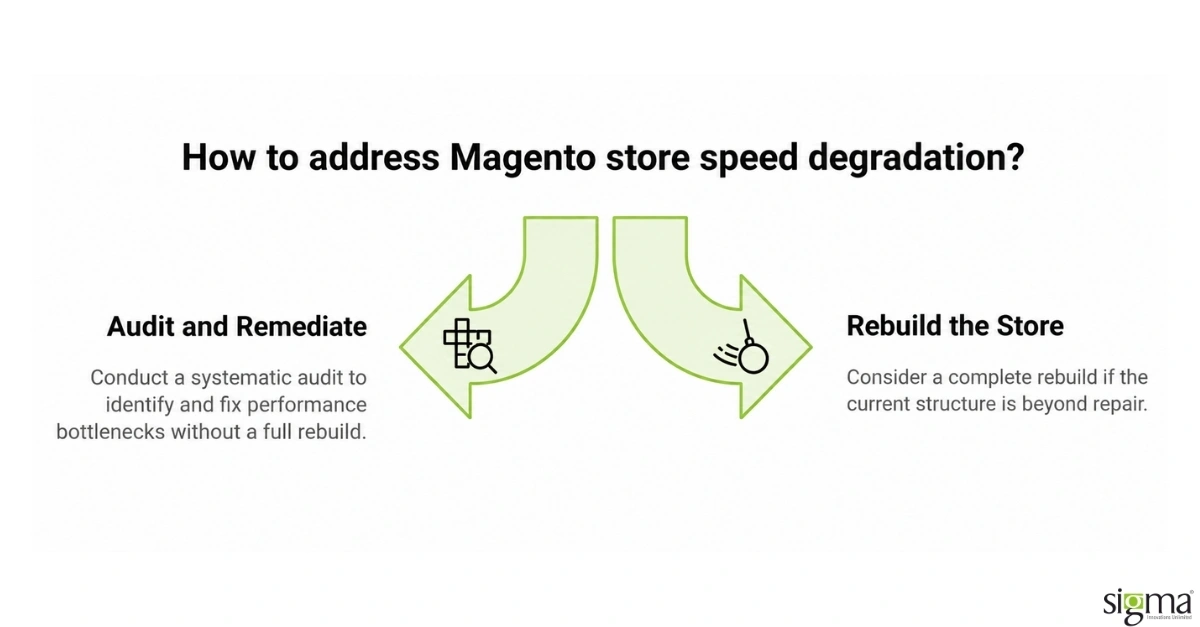
Magento performance degrades gradually, not all at once. A store that launched fast accumulates third-party extensions, unoptimized product images, and layered customizations over several release cycles, and each addition introduces a small performance cost that compounds with the others. The default Luma theme, built on Knockout.js and RequireJS, generates a JavaScript payload that grows heavier with every extension that injects code into the global scope, which is why a mid-size Luma-based store frequently scores in the 30 to 50 range on Google PageSpeed Insights, well below Google’s “good” Core Web Vitals threshold. Caching gaps compound the problem: a misconfigured full-page cache or missing Redis integration for session storage forces the server to rebuild pages that should be served from memory in milliseconds. None of this is unusual. It is the predictable result of a platform that prioritizes extensibility, and it is recoverable with a methodical audit rather than a rebuild.
The business impact compounds alongside the technical debt. A slow product or checkout experience can turn otherwise valuable traffic into abandoned sessions, while engineering teams spend increasing time working around infrastructure and code constraints. For growth-stage retailers, the question is therefore not simply how to make Magento faster, but which performance constraints are limiting growth and which can be resolved without disrupting the existing commerce operation.
Most engineering teams inherit this problem rather than create it. A store built to hit a launch deadline gets extended by successive vendors and internal developers over several years, and no single person retains full visibility into what every extension does or why it was added. Hosting decisions made early, when traffic and catalog size were smaller, often go unrevisited as the business grows, which leaves a mid-size retailer running infrastructure sized for a much smaller store. Recognizing that the problem is structural rather than a coding failure changes how a team approaches the fix: the work is a systematic audit and prioritized remediation plan, not a search for a single culprit.
Performance targets should be treated as engineering objectives rather than guaranteed outcomes. Actual results vary based on hosting architecture, catalog size, page type, extension footprint, third-party scripts, traffic patterns, and the condition of the existing codebase. The following ranges provide illustrative targets for prioritizing optimization work and measuring progress consistently.
Illustrative Magento Performance Targets
| Optimization Area | Typical Unoptimized State | Post-Optimization Target |
| Google PageSpeed Score (Mobile) | 25 to 45 | 85 to 95 |
| Largest Contentful Paint (LCP) | 5 to 8 seconds | Under 2.5 seconds |
| Total Blocking Time (TBT) | 800ms to 2,000ms | Under 200ms |
| Time to First Byte (TTFB) | 1.2 to 2.5 seconds | Under 600ms |
Hyvä Theme Migration Is the Highest-Leverage Front-End Fix
Hyvä replaces the Luma front-end with a lightweight stack built on Tailwind CSS and Alpine.js, which removes the Knockout.js dependency entirely and cuts the JavaScript payload on every page. Stores that complete Hyvä theme migration consistently reach mobile PageSpeed scores above 90, a result that is structurally difficult for a Luma-based theme to match regardless of how aggressively it is tuned. The migration is not a drop-in swap: existing extensions need compatibility work, and the front-end team needs to rebuild custom components against Hyvä’s simpler architecture. That investment pays back in three ways: measurable Core Web Vitals Magento improvement, better organic visibility, and a front-end codebase that is materially easier to maintain going forward.
Hyvä is not automatically the right first step for every Magento store. If slow server response, caching gaps, database queries, or extension conflicts are driving the majority of the performance problem, those constraints should be addressed first. A diagnostic-led approach determines whether the existing front end can be optimized effectively or whether a Hyvä migration provides enough performance and maintainability value to justify the additional investment.
Ready to move beyond Luma?
Server, Cache, and Database Work Carries the Rest of the Gain
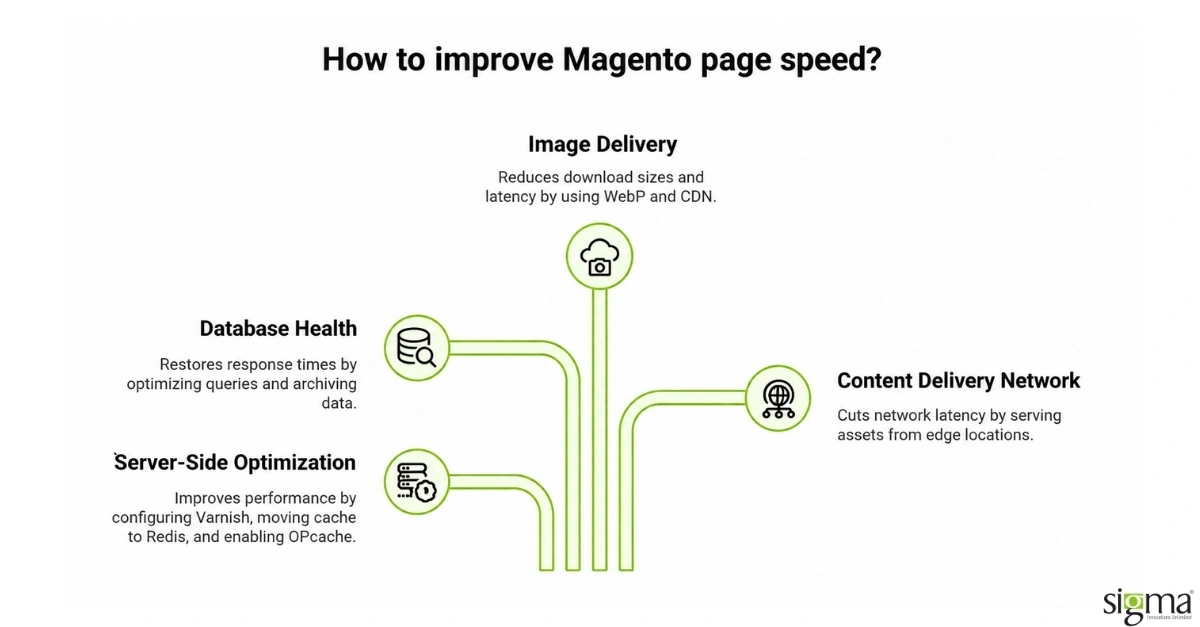
Front-end work alone will not fix a store with server-side bottlenecks. Configuring Varnish correctly as the full-page cache, moving session and default cache storage to Redis, and running a supported PHP version with OPcache enabled typically produce the fastest, most visible wins because they touch every page request without any front-end changes. Database health matters just as much: long-running queries against bloated log and quote tables are a common source of slow Time to First Byte, and adding targeted indexes or archiving stale data restores response times without infrastructure spend. Image delivery rounds out the list. Unoptimized product images served without WebP conversion or a content delivery network force mobile users to download files several times larger than their screen needs, which is one of the most consistent contributors to poor Magento page speed across retail catalogs.
These improvements are particularly valuable when a retailer wants to improve performance without changing the storefront experience or replacing its existing commerce architecture. Addressing infrastructure and data-layer constraints first can recover meaningful performance while keeping the catalog, integrations, and customer journeys intact.
A content delivery network deserves particular attention for retailers with a geographically distributed customer base. Serving static assets, images, scripts, and stylesheets from edge locations close to each visitor cuts network latency in a way that server-side optimization alone cannot, since the physical distance between a customer and the origin server sets a floor on response time no amount of caching removes. Pairing CDN delivery with responsive image sizing, so a mobile visitor never downloads a desktop-resolution product photo, typically closes a meaningful share of the gap between an unoptimized and a fully optimized store on its own, before any theme or infrastructure work begins.
For technology leaders, the optimization strategy matters as much as the individual fixes. Performance work needs to improve speed without introducing instability into a revenue-generating storefront. That means prioritizing changes by impact and implementation risk, validating them in staging, and scheduling higher-risk work around major campaigns and peak trading periods.
Sequencing the Work Without Disrupting the Storefront
The order of operations matters because each layer’s gains depend on the one below it being sound. Sigma starts with a full performance audit across server, database, cache, extensions, and front end to identify the actual bottlenecks rather than guessing from symptoms. Server and caching fixes come first, since they are lower-risk and produce the fastest measurable improvement without touching a single line of storefront code. Database and extension cleanup follow, removing code and data that no longer serve a purpose and often surfacing conflicts between modules that were never designed to run together. Hyvä migration, where warranted, comes last, because it is the highest-effort change and benefits from a store that is already running clean underneath it, which shortens the compatibility work needed for existing extensions. Each stage is deployed through staging and verified against the benchmark table above before it touches production traffic, which keeps the storefront stable throughout the engagement rather than risking downtime during a single large cutover.
For retailers running seasonal promotions, sequencing also has to account for timing. Scheduling the highest-risk changes, such as a Hyvä migration or a major caching overhaul, outside of peak campaign windows protects revenue while the work is validated under real traffic. Lower-risk fixes, including image optimization and database indexing, can proceed at any point in the calendar since they carry minimal regression risk and produce visible gains almost immediately after deployment.
A practical way to manage the process is to follow five stages: audit the current architecture, prioritize the highest-impact constraints, optimize the existing stack, modernize components where the evidence supports it, and continuously monitor performance after release. This approach gives engineering and business leaders a clear path from identifying performance debt to protecting the gains as the store evolves.
Performance does not remain fixed after a successful release. New extensions, integrations, catalog growth, merchandising changes, and traffic increases can gradually introduce new bottlenecks. For this reason, performance is better treated as an ongoing engineering responsibility than as a one-time audit, particularly for retailers whose commerce operation continues to evolve.
Sigma Infosolutions Runs This as a Continuous Discipline, Not a One-Time Project
Sigma approaches Magento performance as part of the broader engineering lifecycle. The engagement can begin with a focused audit and remediation program, then continue through dedicated engineering or T&M support as the storefront evolves. This model keeps performance work connected to releases, infrastructure changes, integrations, and growth rather than treating optimization as a standalone project with a fixed endpoint.
Most Magento performance engagements fail the second time around, not the first, because the store keeps changing after the fix ships. New extensions, catalog growth, and content updates reintroduce the same problems within a few release cycles if nothing is watching for regressions. Sigma treats Magento speed optimization as an ongoing discipline: after the initial audit and remediation, the engagement shifts to monitoring Core Web Vitals trends, server response behavior, and extension impact so that performance decline is caught before it shows up in conversion data. This is delivered as a dedicated engineering team or a T&M retainer rather than a fixed-scope project, which matters because the work genuinely does not end at go-live.
Sigma completed a comparable performance and UX overhaul for an Atlanta-based installment lender’s site, where plugin cleanup, caching, and a full front-end rebuild produced a 40 percent increase in new user traffic and a 50 percent improvement in user retention. The platform in that engagement was WordPress rather than Magento, but the underlying discipline- systematic audit, targeted remediation, and post-launch monitoring- is the same one applied here.
On the Magento side specifically, for a US- based wholesaler , Sigma migrated their platform from Magento 1 to Magento 2.4, rebuilding custom attribute systems, product comparison features, and Elasticsearch-based search, work that produced a 12 percent increase in average order value over the following two years once the platform was faster and the customer experience improvements had time to compound.
The WordPress engagement demonstrates Sigma’s broader audit-led performance engineering approach rather than Magento-specific results. The Hansen Wholesale engagement provides the Magento-specific example, showing how platform modernization, custom functionality work, and a faster commerce experience can support longer-term commercial improvement.
That engagement demonstrated how audit-led remediation, not a platform rebuild, recovers both traffic and retention when the real bottleneck is code and configuration debt. The same structured discipline applied to an actual Magento platform, where catalog scale and legacy architecture were the genuine constraints, produced compounding gains in average order value that held for two years after go-live.
Conclusion:
Magento speed optimization delivers the most value when treated as an engineering discipline tied to business outcomes rather than a one-time technical cleanup. The causes of a slow Magento store are well understood, spanning front-end code bloat, caching and server misconfiguration, unoptimized media, and database drift. Each cause is addressed through a specific, verifiable fix rather than guesswork applied at random.
Hyvä theme migration delivers the largest structural front-end gain available to a Magento store today. Server tuning, caching configuration, and database work recover most of the remaining performance without touching the storefront’s design or catalog structure. Sequencing this work in the right order protects the store from disruption while producing measurable improvement in Core Web Vitals, page speed, and conversion rate.
Retailers that treat performance as ongoing, monitored work rather than a single project hold their gains through catalog growth, seasonal traffic spikes, and new integrations. Those that treat it as a one-time fix typically see the same problems return within two or three release cycles. Sigma Infosolutions supports this work as a dedicated Adobe Commerce engineering engagement, spanning initial audit, Hyvä migration where warranted, and long-term monitoring after launch.
For growth-stage retailers, the objective is not simply to achieve a faster PageSpeed score. It is to build a commerce operation that can handle increasing traffic, catalog complexity, integrations, and customer expectations without performance debt becoming a constraint on growth. Sigma brings that perspective to Magento performance through a structured cycle of audit, optimization, modernization, and ongoing engineering oversight, helping retailers improve the existing commerce investment before taking on the risk and cost of a broader replatform.
Ready to scale your digital storefront?
Frequently Asked Questions
What does Magento speed optimization actually involve?
It is a structured audit and remediation process that covers server configuration, caching, database health, extension behavior, and front-end code. The goal is reducing load time and improving Core Web Vitals without replacing the underlying platform, working through each layer in an order that compounds the gains rather than chasing symptoms in isolation.
Can Magento performance be fixed without a full rebuild?
In most cases, yes. Configuration, caching, and code issues accumulate gradually across release cycles and are usually recoverable through targeted engineering work rather than a costly, risky replatform. A full rebuild is rarely necessary once the actual bottlenecks are identified through a proper audit rather than assumed.
What is Hyvä theme migration and when is it worth the investment?
Hyvä theme migration replaces Magento’s default Luma front-end with a lightweight Tailwind CSS and Alpine.js stack that removes the Knockout.js dependency entirely. It is worth the investment once server and caching issues are already resolved and the store needs the largest remaining front-end performance gain available.
How does Magento speed affect search rankings, not just conversions?
Core Web Vitals are a confirmed Google ranking signal, so a slow store competes from behind in organic search in addition to losing conversions directly on-site. Fixing speed therefore improves two revenue channels at once, which is why engineering leaders increasingly own this metric rather than marketing alone.
How long does a Magento speed optimization engagement typically take?
A targeted engagement covering caching, database cleanup, and image delivery can run three to five weeks from audit to deployment. A full Hyvä theme migration for an established store with multiple extensions and custom components typically takes eight to sixteen weeks depending on catalog complexity.