New Year Personal Loan Demand: Why Slow Pre-Qualification Flows Lose Applicants
Key Highlights
- January’s personal loan demand brings applicants who compare multiple lenders simultaneously, making slow prequalification a major conversion risk.
- Sequential bureau calls, manual review queues, and fragmented data orchestration create delays that cause applicants to abandon slower lending flows.
- Mapping funnel latency and optimizing data orchestration, decisioning logic, and offer delivery can accelerate prequalification without compromising decision quality.
- Sigma’s digital lending solutions strengthen prequalification workflows through integrated data sources, optimized decision engines, and scalable microservices architecture.
Every January, personal loan search volume climbs as holiday debt comes due and New Year resolutions turn into refinancing and debt-consolidation applications. Many applicants compare offers from several lenders in parallel rather than waiting on one, and go with whoever responds first. A soft-pull prequalification flow that takes minutes instead of seconds, or that depends on a manual review step before showing a rate, loses applicants not to a better offer but to a faster one. This piece breaks down where that latency actually comes from inside a typical prequalification flow, what a competitive response time looks like, and what digital lending platforms building toward January’s demand spike need to have in place before it arrives.
Why Do Slow Prequalification Flows Lose Applicants?
Personal loan demand has a predictable January shape. Holiday spending lands on statements in late December and early January, and a share of that balance gets refinanced into a personal loan rather than carried on a card. LendingTree’s loan-shopping data shows how thoroughly today’s applicants compare offers before committing: among borrowers who received offers, those with scores of 760 and above received at least three 97.4% of the time and at least six 87.9% of the time, and even borrowers in the 640–679 range received six or more offers 67.4% of the time. Multiple offers in hand is the typical outcome once an applicant starts prequalifying, which is consistent with most January applicants shopping several lenders in parallel rather than approaching one at a time.
That changes what “losing an applicant” means. It isn’t that a competitor undercuts a rate; it’s that a competitor’s prequalification form returns an indicative offer before this one has finished loading. An applicant who sees a number from Lender B while Lender A’s form is still “processing” has little reason to wait and see what Lender A comes back with. The cost of a slow flow isn’t a worse conversion rate on the applicants who stay; it’s never knowing how many applicants left during the wait.
Losing Applicants to Slower Prequalification?
Where Does Prequalification Latency Actually Come From?
Soft-pull prequalification is supposed to be close to instant: a soft inquiry, a bureau or alternative-data lookup, and a decision-engine pass that returns an indicative rate and amount without affecting the applicant’s credit score. In practice, the step that’s advertised as instant is rarely the one that’s slow.
| Prequalification step | Where latency actually comes from | What fixes it |
|---|---|---|
| Identity and consent capture | Form fields that re-ask for data already typed, or validation that only runs on submit | Progressive capture with inline validation; pre-fill from prior session where consent allows |
| Soft credit pull | Usually fast on its own (seconds), but queued behind other steps in the flow | Fire the soft pull as soon as minimum required fields are valid, not after the full form submits |
| Bureau and alternative-data orchestration | Sequential calls to multiple sources (bureau, bank data, alternative scoring) that wait on the slowest one | Parallel calls with a timeout and fallback, so one slow source doesn’t block the whole decision |
| Decision engine evaluation | Rules or models that depend on a manual underwriting queue for anything outside a narrow auto-approve band | Widen the auto-decision band and route only genuine edge cases to a human, instead of defaulting borderline cases to a queue |
| Offer presentation | Backend decision is fast, but the result sits in a queue before it’s rendered to the applicant | Push the decision to the front end the moment it’s available, rather than batching it with other post-decision processing |
The pattern across all five rows is the same: the components that feel like they should be instant (a database lookup, an API call) usually are. What isn’t instant is the orchestration logic connecting them, because it’s usually written to wait for every source to respond rather than to move as soon as enough of them have.
How Fast Should Loan Prequalification Be?
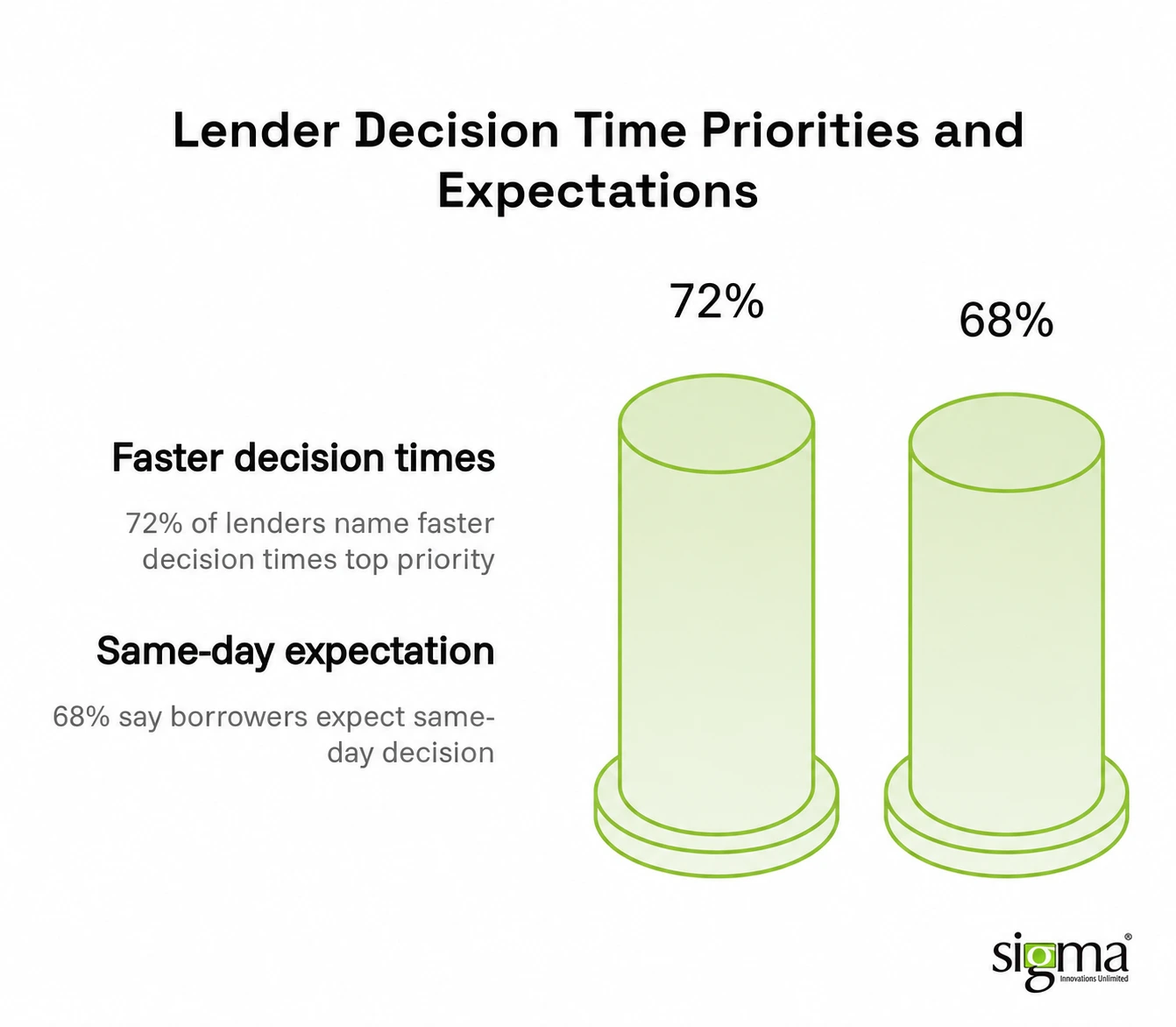
LendFusion’s 2026 Lending Operations Benchmark Report, surveying specialist lending professionals, found that 72% of lenders now name faster decision times as their top priority, ahead of compliance; 68% of those surveyed lenders said borrowers now expect a same-day decision as a baseline, not a premium feature. The same survey found that a third of lenders still take three or more days to respond. That gap, between what applicants now expect and what a third of lenders still deliver, is the opening a faster platform can take.
“Same-day” is the outer bound borrowers will tolerate before shopping elsewhere; it isn’t the standard a prequalification flow should aim for. A soft-pull prequalification response that depends only on automated data orchestration, with no manual step in the critical path, should return an indicative offer in seconds to low single-digit minutes. Anything that stretches into “a few hours” or “by end of day” is, from the applicant’s seat, indistinguishable from a lender who didn’t respond before they committed elsewhere.
What Is a Soft Credit Pull?
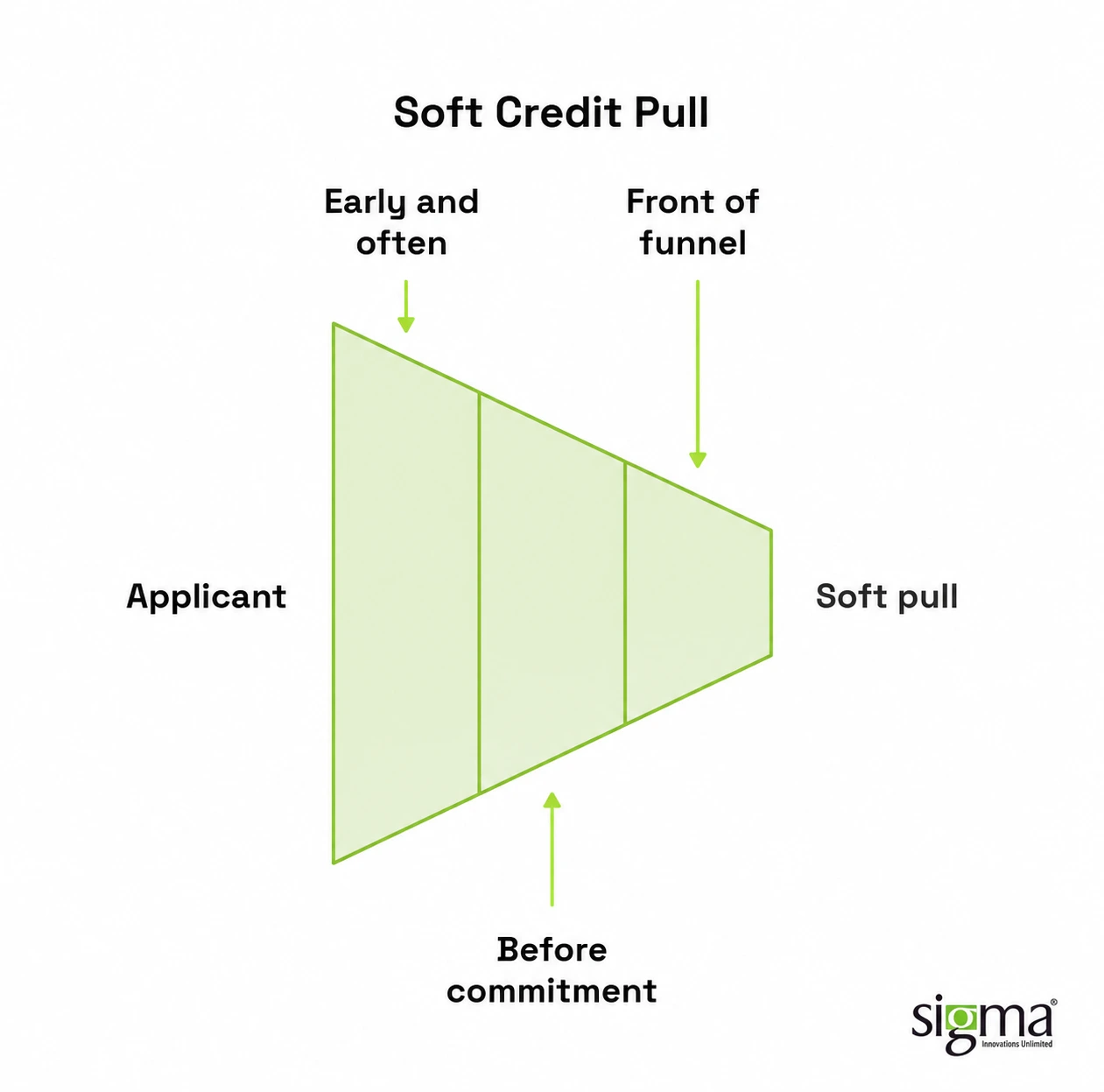
A soft credit pull is a credit check that a lender runs to generate a prequalified offer without affecting the applicant’s credit score and without showing up to other lenders as a hard inquiry. For the platforms running these flows, the operational point isn’t the applicant-facing distinction between soft and hard pulls; it’s that a soft pull is explicitly designed to be run early and often, before an applicant has committed to anything, which is exactly why it belongs at the front of the funnel rather than queued behind document upload or manual review.
Soft-pull prequalification in the US operates under FCRA permissible-purpose rules, and ECOA’s adverse-action notice requirements may apply once a lender actually takes adverse action on an application that follows; several states layer on their own disclosure or licensing requirements for the offers a prequalification flow can present. None of that changes the architecture question here, but it does mean the orchestration layer discussed above has to carry audit and disclosure logic alongside the speed logic, not after it. In Canada and Australia/New Zealand, soft-pull norms and consumer-reporting rules follow a similar shape but sit under different statutes, which matters for platforms expanding beyond the US; some markets and data providers in Western Europe may also have slower or batch-based data availability, a lighter version of the same latency problem.
What It Takes to Compete on Speed-to-Offer
Fixing prequalification latency is rarely a single bottleneck with a single fix. It’s closer to the pattern Sigma found while rebuilding a dealer-financing platform’s application infrastructure: that client’s New Dealer Portal depended on pulling data from seven separate third-party sources, including Transunion, Experian, Spectrum, and a document-automation integration with Rubex running against Decision Lender, to get from application to decision. None of those individual integrations was the problem; the difficulty was in getting them to work together inside one architecture without one slow call holding up the rest. Sigma’s team rebuilt that integration layer and migrated the platform from a monolithic to a microservices architecture, which is the same shape of fix a personal loan platform’s latency diagnosis usually points toward: not replacing the data sources, but changing how the decision engine waits on them.
For a personal loan or digital lending platform preparing for January’s demand, that means treating prequalification speed as infrastructure, not UX polish. Sigma builds and tunes the decision engines and data-orchestration layers behind soft-pull prequalification, integrates bureau, bank, and alternative-data sources into one decisioning flow, and works through where a given funnel’s actual latency sits, step by step, mapping every step against where time is actually spent the same way Sigma’s team did for the dealer portal, with a dedicated product engineering team rather than a one-off contractor. The output teams track isn’t form-completion rate; it’s prequal-to-funded conversion, which is the number that actually reflects whether speed is winning or losing applicants once they’re in the funnel.
Sigma’s work on a comparable integration challenge is detailed in the case study on rebuilding that same portal’s decision architecture. Note that this case study is from a dealer-financing platform rather than a direct-to-consumer personal loan lender, but the underlying problem (multiple bureau and data sources feeding one decision flow without any single source bottlenecking it) is the same one most prequalification latency traces back to.
Mobile prequalification traffic surfaces the same lesson under a different seasonal event: see why loan application forms lose mobile users during Black Friday’s traffic surge for how the same funnel-friction problem shows up earlier in the calendar.
For a personal loan or digital lending platform heading into another January, the real choice is between a funnel latency review that finds the orchestration step actually costing applicants, or finding it out live as a competitor’s form finishes first. Sigma can run that review as a defined engagement or stay engaged as the product team behind the decision engine through every demand peak on the calendar.
Conclusion
January brings a predictable rise in personal loan demand, driven by holiday balances coming due and resolution-driven refinancing. Many of the applicants behind that demand are comparing more than one lender in parallel. A personal loan prequalification flow that takes minutes instead of seconds doesn’t lose applicants to a better rate; it loses them to whichever competitor’s form finished first. The latency usually isn’t in the soft credit pull itself, which is fast on its own. It sits in the orchestration layer that waits on bureau calls, alternative-data lookups, and manual review gates to all finish in sequence before returning a decision. Lenders increasingly know this: industry benchmarking for 2026 found faster decision times now outranking compliance as the top priority for most lending organizations, even as a third of lenders still take several days to respond. Those same lenders report that borrowers have adjusted their expectations to match, treating a same-day response as a baseline rather than a differentiator. Closing that gap starts with mapping where a specific funnel’s time actually goes, not assuming the bottleneck is wherever it looks like it should be. For platforms building toward January’s demand window, that mapping exercise matters most, paired with a decision engine built to move as soon as enough data sources have responded rather than waiting for all of them. Together, those two moves are what turn prequalification speed into a converted application instead of an abandoned one. The platforms that treat personal loan prequalification speed as core infrastructure this January are the ones applicants will actually finish applying with.
Build Faster, More Competitive Lending Experiences
FAQs
What is a soft credit pull in loan prequalification?
A soft credit pull is a credit check a lender runs to generate a prequalified rate and amount without affecting the applicant’s credit score or showing to other lenders as a hard inquiry. It’s built to run early, before an applicant commits, which is why prequalification architecture should place it ahead of slower steps like document upload, not behind them.
How long should personal loan prequalification take?
An automated, soft-pull prequalification response with no manual review in the critical path should return an indicative offer in seconds to a few minutes. Industry benchmarking found 68% of surveyed lenders say borrowers now expect a same-day decision as a baseline, so anything stretching past same-day reads to most applicants as a lender who effectively didn’t respond in time.
Why do slow prequalification flows lose applicants?
Most applicants prequalify with several lenders in the same sitting rather than one at a time. A slow flow doesn’t typically lose on rate; it loses because a competitor’s form returns an offer first, and an applicant with one result in hand rarely waits to see what a slower lender comes back with.
What usually causes prequalification latency if the credit pull itself is fast?
The soft pull itself is usually quick, often a matter of seconds. The delay comes from orchestration: sequential calls to bureau, bank, and alternative-data sources that wait on the slowest one to finish, plus decision logic that routes borderline cases straight to manual review instead of trying to resolve them automatically first.
What compliance rules apply to soft-pull prequalification in the US?
Soft-pull prequalification operates under FCRA permissible-purpose rules, and ECOA’s adverse-action notice requirements may apply once a lender takes adverse action on a full application. Several states add their own disclosure or licensing requirements on top of these federal baselines, which is why the orchestration layer needs to carry compliance logic alongside its speed logic, not bolt it on afterward.