Platform Engineering IDP: Stop Losing Developer Velocity to Tooling Chaos

Key Takeaways:
- Tooling chaos quietly drains developer velocity. Environment setup, inconsistent deployment patterns, undocumented dependencies, and unclear ownership consume engineering time without appearing as tickets, incidents, or measurable operational costs.
- An internal developer platform turns recurring friction into self-service. Standardized service templates, golden paths, automated provisioning, consistent deployment, and service ownership let engineers ship without waiting on platform teams or relying on tribal knowledge.
- The highest-value IDPs start with the friction engineers actually experience. Measuring time lost across service creation, environment provisioning, deployment, and troubleshooting helps teams prioritize a narrow platform foundation instead of overbuilding a portal or abstraction layer nobody adopts.
- Sigma’s Product Engineering Services connect platform engineering to measurable delivery outcomes. By identifying where engineering velocity is being lost and building the smallest self-service capabilities that remove those bottlenecks, Sigma helps teams improve developer productivity without adding another process layer.
Introduction
Ask an engineer at a 60-person company how long it takes to get a new service running in production, and the honest answer is usually a story rather than a number. They will describe copying a Terraform module from another repo, discovering it references a module that was deprecated, asking in Slack, being told to use a different pattern, finding that pattern requires a secret nobody documented, and eventually getting it working on day four with a configuration that differs subtly from every other service in the estate.
Nothing about that is a crisis. No incident was declared. It just consumed most of a week and produced one more slightly unique snowflake for someone to maintain. Multiply that across every service, every new hire, and every environment, and you have the quiet velocity tax that a platform engineering IDP exists to remove. Sigma’s Platform Engineering practice helps engineering teams quantify that friction and then build the smallest platform that eliminates it.
The Cost Nobody Measures
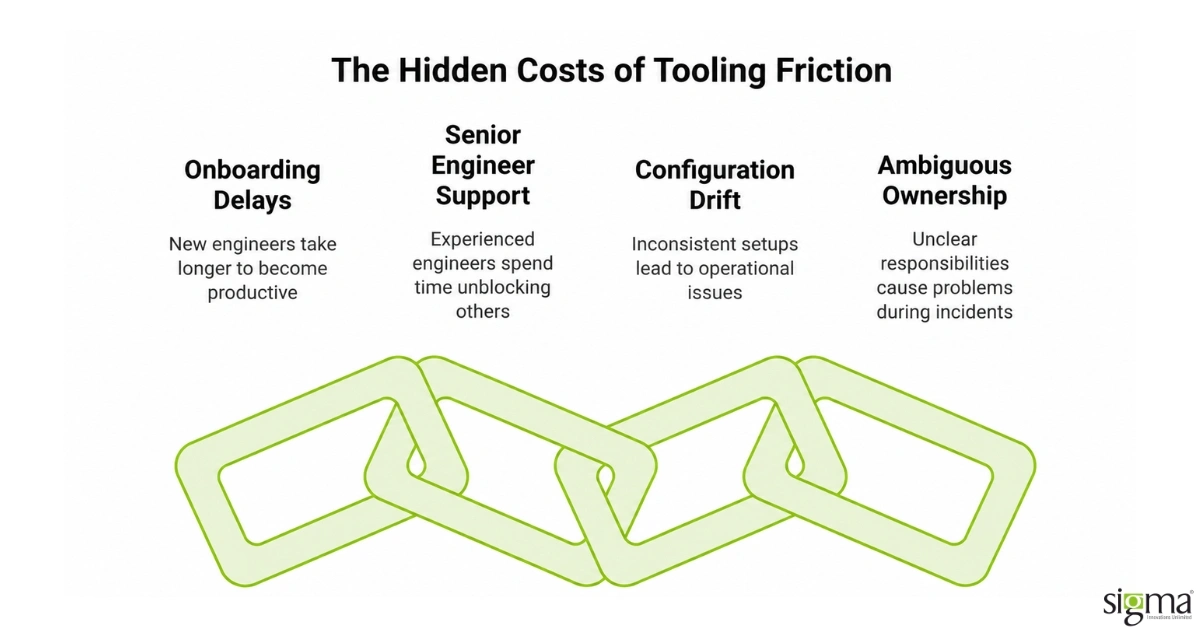
Tooling friction does not show up on any dashboard, which is precisely why it persists. There is no alert for “engineer spent Tuesday figuring out how deployment works here.”
Onboarding stretches. A new backend engineer at a company with a well-built platform is deploying to production in their first week. At a company without one, they are shadowing someone for a month, because the knowledge required to ship lives in people rather than in tooling. The gap compounds with every hire.
Senior engineers become support. When provisioning requires tribal knowledge, the people who hold that knowledge get interrupted constantly. Your most expensive engineers spend a meaningful share of their week unblocking others, which is invisible in their output and very visible in their frustration.
Configuration drift accumulates. Every service set up by hand differs slightly. Different logging setup, different health check conventions, different secret management. Each difference is small and reasonable in isolation. Collectively, they mean no runbook applies universally, and every incident starts with archaeology.
Ownership stays ambiguous. When it is unclear whether the platform team or the product team owns a piece of infrastructure, both assume the other has it. That ambiguity surfaces during incidents, which is the worst possible time to discover it.
What an Internal Developer Platform Actually Is
The term gets used loosely, which causes teams to buy a tool and wonder why nothing improved. An internal developer platform is not a dashboard and not a single product. It is the layer that turns organizational infrastructure knowledge into self-service capability.
Concretely, a working IDP gives a developer four things without requiring a request: provisioning (create a new service from a template that encodes standards), golden paths (an opinionated, documented route from empty repo to running production service), deployment (ship to any environment through a consistent mechanism), and visibility (see what services exist, who owns them, and how they perform).
| Capability | Without an IDP | With an IDP |
| New service setup | Copy from another repo, ask in Slack, days | Template-generated, standards built in, hours |
| Environment provisioning | Ticket to platform team, wait | Self-service within guardrails |
| Deployment path | Varies by team and service age | One documented golden path |
| Ownership clarity | Discovered during incidents | Recorded in the service catalog |
| New hire to first deploy | Weeks to months | Days |
| Standards enforcement | Code review and hope | Encoded in templates and pipelines |
The broader shift from DevOps to platform engineering, and why IDPs are replacing ad-hoc tooling across growth-stage teams: What is platform engineering and how is it different from DevOps.
The Failure Mode: Building a Platform Nobody Uses
The most common way this goes wrong is that a platform team forms, builds something technically impressive, and discovers that product engineers keep doing things the old way.
This happens when the platform is treated as an infrastructure project rather than a product. Infrastructure projects get specified by the people building them. Products get specified by the people using them. If the platform team decides what developers need without watching how they actually work, the resulting abstraction will be wrong in ways that make it easier to bypass than to adopt.
The second failure is mandating adoption before the platform is genuinely better than the alternative. Forced migration to an immature platform generates resentment that outlives the technical problems. The stronger position is making the golden path the fastest option and letting adoption follow.
The third is building for imagined future scale. A 40-engineer organization does not need the platform a 400-engineer organization needs, and building one is a multi-year detour that delivers nothing in the interim.
Where to Start Without Boiling the Ocean
The highest-return starting point is almost always service creation, because it is the moment when standards either get applied or get lost forever.
A single well-maintained service template that generates a repository with CI configured, observability instrumented, health checks defined, secrets wired to the right manager, and deployment pipeline ready removes more cumulative friction than any dashboard. It also means every new service starts compliant rather than being retrofitted later.
From there, self-service environment provisioning is usually next, because waiting on someone else for a test environment is the friction developers feel most acutely.
A service catalog with ownership metadata comes third. It sounds administrative until the first incident where knowing the owner saves twenty minutes.
Everything beyond that is refinement. The point is that a developer platform delivers value incrementally, and teams that try to launch the complete vision at once usually launch nothing.
Quantifying Friction Before Funding a Platform
A developer platform should not begin with a portal, an abstraction layer, or a three-year technology roadmap. It should begin with evidence. Before deciding what to build, engineering leaders need to understand where developers are actually losing time, which dependencies create recurring delays, and which workflows are worth standardizing.
Measure the Delivery Friction Before Designing the Platform
Platform investments are often scoped around an ideal future state: self-service infrastructure, a developer portal, standardized workflows, and a complete abstraction layer. The problem is that building toward that vision can take months before developers see meaningful value, while their actual friction continues unchanged.
A stronger approach starts by reconstructing the path from repository creation to production deployment. Look at how long engineers spend waiting for environments, finding documentation, resolving configuration issues, requesting infrastructure changes, and figuring out deployment conventions. The goal is to separate engineering work from engineering waiting.
At an engineering-heavy B2B SaaS company, Sigma spent two weeks shadowing engineers and reconstructing timelines across recent service launches. Median time from repository creation to first production deployment was 19 days. Roughly 11 of those days were spent waiting on other teams or rediscovering setup that had never been documented.
That measurement changed the platform conversation. Instead of funding a broad developer portal based on anecdotal frustration, the organization had a measurable delivery bottleneck to address.
Build the Smallest Platform That Removes the Bottleneck
Once the friction is measurable, the platform scope becomes easier to define. The objective is not to automate everything. It is to remove the highest-cost dependency with the smallest reusable capability.
For the same B2B SaaS organization, the initial platform consisted of one service template covering the two most common service shapes, a self-service path for test-environment provisioning, and a service catalog capturing ownership. There was no developer portal and no broad infrastructure abstraction layer.
The result was more important than the feature count. Median time to first deployment fell from 19 days to four days within the first quarter. Developers adopted the template without a mandate because it was simply faster than starting from another repository and reconstructing the setup themselves.
That is the practical value of platform engineering services: turning measured delivery friction into reusable engineering capabilities without introducing another layer of process.
Multi-tenant AWS architecture that scaled securely while reducing operational overhead: Cloud-native transformation for scaling smart.
Design Around the Engineers Who Have to Use It
A platform can be technically sound and still fail if its abstractions hide the information engineers need when something goes wrong. Adoption problems often reveal a mismatch between how the platform team thinks developers work and how developers actually troubleshoot, deploy, and operate services.
In one rescue engagement, the client already had a functioning internal developer platform, yet product engineers routinely bypassed it. Sigma started by interviewing the engineers avoiding the platform rather than redesigning it from the platform team’s perspective.
The underlying problem was visibility. The abstraction concealed configuration that developers needed during debugging. When something failed, engineers dropped directly into the underlying infrastructure and had little reason to return to the platform.
The solution was not another layer of abstraction. It was a more transparent platform that exposed generated configuration and preserved the underlying context engineers needed to troubleshoot confidently.
Legacy platform modernized on AWS with CI/CD automation that reduced deployment friction and cut costs by 30%: AI-driven mortgage POS modernization.
The principle is straightforward: the best internal developer platform is not the one with the most capabilities. It is the one that makes the common path faster without making the difficult path harder.
Conclusion
Velocity loss from tooling chaos is expensive precisely because it never announces itself. It hides in onboarding timelines, in senior engineers answering the same questions, in configuration drift that makes every incident an investigation, and in ownership ambiguity that surfaces at the worst moments. A platform engineering IDP addresses it by turning infrastructure knowledge into self-service capability: templated service creation, golden paths to production, self-service environments, and a catalog that records who owns what. The organizations that succeed treat the platform as a product with real users, start narrow, and earn adoption rather than mandating it. Sigma Infosolutions helps engineering teams quantify the friction first and then build the smallest platform that removes it.
Frequently Asked Questions
What is a platform engineering IDP and what does it include?
A platform engineering IDP is the layer that converts organizational infrastructure knowledge into developer self-service. It typically includes templated service and resource provisioning, an opinionated golden path from repository to production, consistent deployment mechanisms with defined rollback, and a service catalog recording ownership and dependencies.
How does an internal developer platform improve engineering velocity?
An internal developer platform removes waiting and rediscovery from the delivery path. Developers provision environments without filing requests, new services start from templates that already encode security and observability standards, and deployment follows one documented route rather than varying by team, which shortens onboarding and reduces senior engineer interruption.
Why do internal developer platforms fail to get adopted?
The common causes are building the platform as an infrastructure project rather than a product, so the abstraction does not match how developers actually work; mandating adoption before the platform is better than existing workflows; and over-engineering for imagined future scale, which delays any value delivery for months or years.
Where should a team start when building a developer platform?
Start with service creation templates, since that is the moment standards are either applied or permanently lost. Follow with self-service environment provisioning, which addresses the friction developers feel most, then a service catalog with ownership metadata. A developer platform should deliver value incrementally rather than launching complete.
How does Sigma help organizations build a platform team capability?
Sigma begins by quantifying friction, reconstructing timelines from repository creation to first production deploy to identify where time is actually lost. The team then builds the narrowest platform that addresses it, typically templates and self-service provisioning first, and works with the client’s platform team on adoption without mandates.