RAG Enterprise Architecture: Why Your LLM Hallucinates on Proprietary Data

Key Highlights:
- LLM pilots that look impressive in demos fall apart in production because generic models hallucinate when asked questions about company-specific policies, products, and internal knowledge they were never trained on.
- RAG enterprise architecture grounds LLM outputs in your proprietary documents at the moment of generation, reducing hallucinations while keeping your data under your control and out of model weights.
- Companies that deploy LLMs without retrieval grounding will face trust erosion from inaccurate answers, compliance exposure from fabricated citations, and pilot abandonment when users realize the tool cannot answer questions about their own business.
- The primary differentiator between enterprise GenAI pilots that ship to production and pilots that stall is whether the architecture grounds generation in retrieved proprietary documents or relies on the model’s static training data.
Introduction
The demo went well. Your team built an internal knowledge assistant powered by GPT-4 or Claude. It answered questions about your product documentation fluently and confidently. Leadership was impressed. Then someone asked it a question about your company’s refund policy, and it generated an answer that sounded authoritative but was completely fabricated. It cited a policy document that does not exist. It quoted a number that appeared nowhere in your knowledge base. And it did all of this with the same confident tone it used when it was actually correct.
This is the hallucination problem, and it is not a bug that gets fixed with a better prompt. It is a structural limitation of how LLMs work. They generate statistically plausible text, not factually grounded answers. RAG enterprise architecture solves this by retrieving relevant documents from your proprietary knowledge base and injecting them into the LLM’s context before it generates a response, grounding every answer in your data rather than the model’s training data. Sigma’s Artificial Intelligence Development Services help growth-stage companies build that retrieval infrastructure, so their LLM applications are reliable in production, not just impressive in demos.
The enterprise RAG market is projected to grow from $1.94 billion in 2025 to $9.86 billion by 2030 at a 38.4% CAGR, while MIT research found that 95% of enterprise GenAI pilots fail to reach measurable business impact, with retrieval architecture being the primary differentiator between pilots that ship and pilots that stall.
Why LLM Pilots Fail on Proprietary Knowledge
The excitement around enterprise LLM applications has outpaced the infrastructure needed to make them reliable. Most pilots follow the same trajectory.
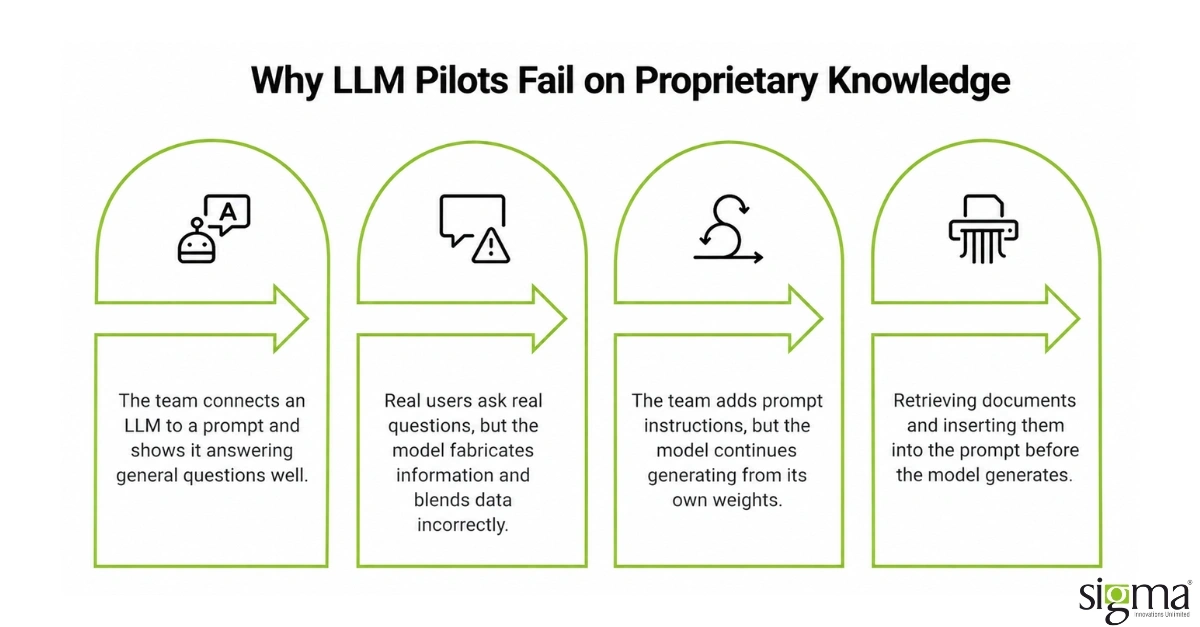
Phase 1: The impressive demo. The team connects an LLM to a prompt and shows it answering general questions well. Leadership greenlights a pilot for internal knowledge: HR policies, product documentation, compliance guidelines.
Phase 2: The quiet failures. Real users ask real questions. The model confidently answers about policies that changed six months ago. It fabricates document titles. It blends information from different product lines into answers that are wrong for all of them. Users lose trust within two weeks.
Phase 3: The workaround spiral. The team adds “only answer based on provided documents” to the prompt. This helps marginally but does not solve the core problem: no documents were actually provided. The model is still generating from its own weights.
The root cause is architectural. A bare LLM cannot access your proprietary data at query time. Retrieval-augmented generation adds that mechanism by retrieving your documents and inserting them into the prompt before the model generates.
Read the blog: The broader LLM integration landscape beyond RAG, including fine-tuning, guardrails, and the most common deployment pitfalls: LLM integration for growth-stage companies.
How a RAG Pipeline Works
A RAG pipeline has four stages that execute on every user query.
Indexing. Your proprietary documents (PDFs, Confluence pages, wikis, support tickets) are chunked into passages, converted into vectors using an embedding model, and stored in a vector database like Pinecone, Weaviate, or pgvector. Updated incrementally as content changes.
Retrieval. The user’s query is embedded using the same model and compared against stored vectors. The system returns the top 5 to 15 most semantically relevant passages.
Context assembly. Retrieved passages are assembled with the query into a prompt instructing the LLM to answer only from the provided context.
Generation. The LLM generates a response grounded in retrieved context, citing specific source documents so users can verify the answer.
The following table compares a bare LLM deployment against a RAG-grounded deployment:
| Dimension | Bare LLM | RAG-Grounded LLM |
| Knowledge source | Static training data (months to years old) | Your live proprietary documents |
| Hallucination rate | 8% to 80%+ depending on domain specificity | 70–90% reduction versus bare LLM |
| Update mechanism | Expensive model retraining | Update the document index (no retraining) |
| Source citations | Cannot cite real documents | Cites specific passages from your knowledge base |
| Data control | Proprietary data may enter model weights via fine-tuning | Data stays in your vector store under your access controls |
| Compliance auditability | Cannot trace how an answer was generated | Full retrieval trail: query, retrieved docs, generated response |
Where RAG Systems Break in Production
Building a working RAG system is straightforward. Building one that stays reliable in production is where most teams struggle.
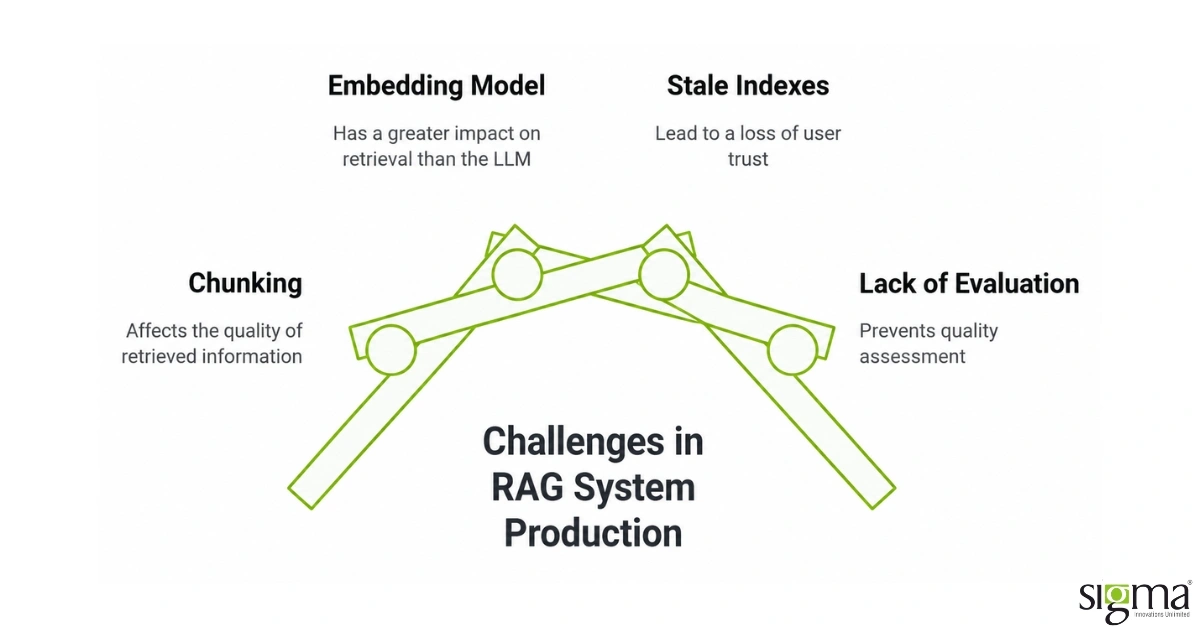
Chunking determines retrieval quality. If documents are chunked too small, the model loses context. Too large, and irrelevant content dilutes useful passages. A 500-token chunk that splits a policy statement across two passages retrieves half the answer, and the model hallucinates the rest. Document-aware chunking that respects section headers, numbered steps, and table boundaries is not a nice-to-have. It is the single highest-leverage improvement most teams can make.
Embedding model choice matters more than LLM choice. Teams spend weeks evaluating generation models and minutes picking embeddings. The embedding model determines whether the right documents are retrieved. If retrieval fails, the best generation model still hallucinates.
Stale indexes erode trust. A RAG architecture accurate at launch becomes unreliable as documents change. Incremental indexing that detects changes and re-embeds affected chunks is not optional.
No evaluation means no quality signal. Without a golden dataset of test questions, teams cannot measure hallucination rate or retrieval precision. They learn about problems only when users report wrong answers. Tools like RAGAS and LangSmith provide systematic measurement but require deliberate setup.
Building Enterprise RAG That Lasts
Enterprise RAG done right has four layers needing continuous attention. The data layer handles ingestion, chunking, embedding, and incremental updates. The retrieval layer manages query embedding, similarity search, and re-ranking. The generation layer handles prompt construction and citation extraction. The evaluation layer monitors faithfulness and hallucination rate against a golden dataset.
Growth-stage companies evaluating RAG enterprise architecture should resist building all four from scratch. The retrieval and generation layers are well-served by existing frameworks (LlamaIndex, LangChain). The data and evaluation layers require custom engineering because they depend on your specific document structure and your users’ actual questions.
Fixing Retrieval Before Blaming the Model
Teams arrive with a working prototype and a credibility problem. It answers some questions well and others confidently wrong, and nobody can predict which. The instinct is to swap the generation model.
The generation model is almost never the issue. If the right passages reach the context window, a mid-tier model produces a correct grounded answer. If they do not, the best model available hallucinates fluently. Retrieval quality sets the ceiling, and everything above it is decoration.
That principle determines where the work starts. For a B2B SaaS company building an internal knowledge assistant across 4,000 pages of product documentation and support runbooks, Sigma’s diagnosis was that default fixed-size chunking was splitting procedural steps across chunk boundaries. The model retrieved half a procedure, generated the remainder, and presented the fabricated workflow with a citation to the genuine document. Rebuilding the pipeline with document-aware chunking that respected section headers, numbered steps, and table boundaries lifted retrieval precision from 61% to 87%. Hallucination rate on procedural questions fell from 34% to under 6%. The LLM never changed.
The same principle explains a different failure. A knowledge-intensive B2B organization had compliance documentation spanning three regulatory frameworks that used identical terminology with different definitions. The embedding model could not separate them, so retrieval returned passages from the wrong framework, and the RAG pipeline blended requirements across all three. Sigma implemented metadata-filtered retrieval, tagging each document with its regulatory domain and routing queries to the correct subset before similarity search ever ran.
See how Sigma improved retrieval precision in production AI systems:
AI answers grounded in actual enterprise data with query validation at every step: a LangGraph-powered conversational BI agent.
An FAQ engine trained on client-specific knowledge and verified sources rather than general model knowledge: an AI-powered intake platform.
Incremental indexing, evaluation against a golden dataset drawn from the client’s real user questions, and post-deployment retrieval monitoring ship as part of the build rather than as a phase two nobody funds. Retrieval-first sequencing is what Sigma’s Artificial Intelligence Development Services build enterprise RAG around.
Conclusion
LLMs are impressive generators. They are not reliable knowledge systems. Without retrieval grounding, every answer about your proprietary data is a confident guess. RAG enterprise architecture changes this by retrieving your actual documents and injecting them into the model’s context at query time, turning a generative model into a knowledge system that cites its sources and stays current as your documents change. The companies that build this architecture properly, with document-aware chunking, quality embeddings, incremental indexing, and systematic evaluation, will ship internal AI tools that users actually trust. Sigma Infosolutions helps growth-stage companies build that RAG pipeline infrastructure so their LLM applications are reliable in production, not just impressive in demos.
Frequently Asked Questions
What is RAG enterprise architecture and why does it matter?
RAG enterprise architecture connects an LLM to your proprietary knowledge base through a retrieval pipeline that fetches relevant documents at query time. This grounds every response in your actual data rather than the model’s training data, reducing hallucinations by 70 to 90% and enabling source citations that users and compliance teams can verify.
How does retrieval augmented generation reduce LLM hallucinations?
Retrieval augmented generation retrieves specific document passages relevant to the user’s query and injects them into the LLM’s prompt before generation. The model generates its answer from your retrieved context rather than from patterns in its training data, dramatically reducing fabricated facts and nonexistent citations.
What are the most common failure points in a RAG pipeline?
The most common RAG pipeline failures are poor chunking that splits important content across boundaries, weak embedding models that retrieve irrelevant passages, stale indexes that fall behind document changes, and absent evaluation frameworks that leave hallucination rates unmeasured until users report obviously wrong answers.
What is the difference between RAG and fine-tuning for enterprise AI?
A RAG system retrieves your documents at query time without modifying model weights, keeping proprietary data out of the model and enabling instant updates by re-indexing documents. Fine-tuning modifies the model’s weights using your data, which is expensive, slow to update, and risks data leakage. RAG is preferred when accuracy, auditability, and data control are priorities.
How does Sigma build enterprise RAG systems?
Sigma architects the full enterprise RAG stack: document-aware chunking pipelines, embedding model selection, vector store configuration, metadata-filtered retrieval, incremental indexing for freshness, and evaluation frameworks using golden datasets. The team builds inside the client’s existing data infrastructure and monitors retrieval quality post-deployment.