Real-Time Streaming Analytics: When Batch Reporting Fails Time-Sensitive Decisions

Key Highlights:
- Batch pipelines that refresh overnight cannot support decisions that need to happen in seconds, so fraud gets flagged after the money moved and inventory shows in stock after the last unit sold.
- Real-time streaming analytics processes events as they arrive, giving operational teams sub-second visibility and enabling automated action at the moment a condition is met rather than the next morning.
- Organizations stuck on batch-only analytics will keep making time-sensitive decisions on stale inputs, and they will lose ground to competitors whose systems react while the event is still relevant.
- Streaming infrastructure has moved from a niche capability to a core enterprise investment, with the majority of data engineering leaders now treating event-driven architecture as foundational rather than optional for operational analytics.
Introduction
A payment clears at 11:40 p.m. It is fraudulent. Your fraud model is good and would have caught it, but the model runs against a table that populates at 4 a.m., so the alert lands after breakfast, roughly nine hours after the money left. The analyst who reviews it does good work. There is simply nothing left to do.
This is not a modelling problem or a data quality problem. It is a latency problem, and it is the single clearest signal that a business has outgrown batch analytics. Real-time streaming analytics exists to close that gap, processing events as they occur so the decision happens while it can still change the outcome. Sigma’s BI & Analytics Development Services help growth-stage data teams scope where streaming genuinely changes outcomes and build the transport, processing, and serving layers to support it.
Confluent’s data streaming research found 89% of IT leaders consider data streaming platforms key to their data goals, with 64% increasing investment and 44% reporting 5x returns, while IBM’s roughly $11 billion acquisition of Confluent in late 2025 signalled how central streaming infrastructure has become to enterprise AI.
The Decisions Batch Cannot Support
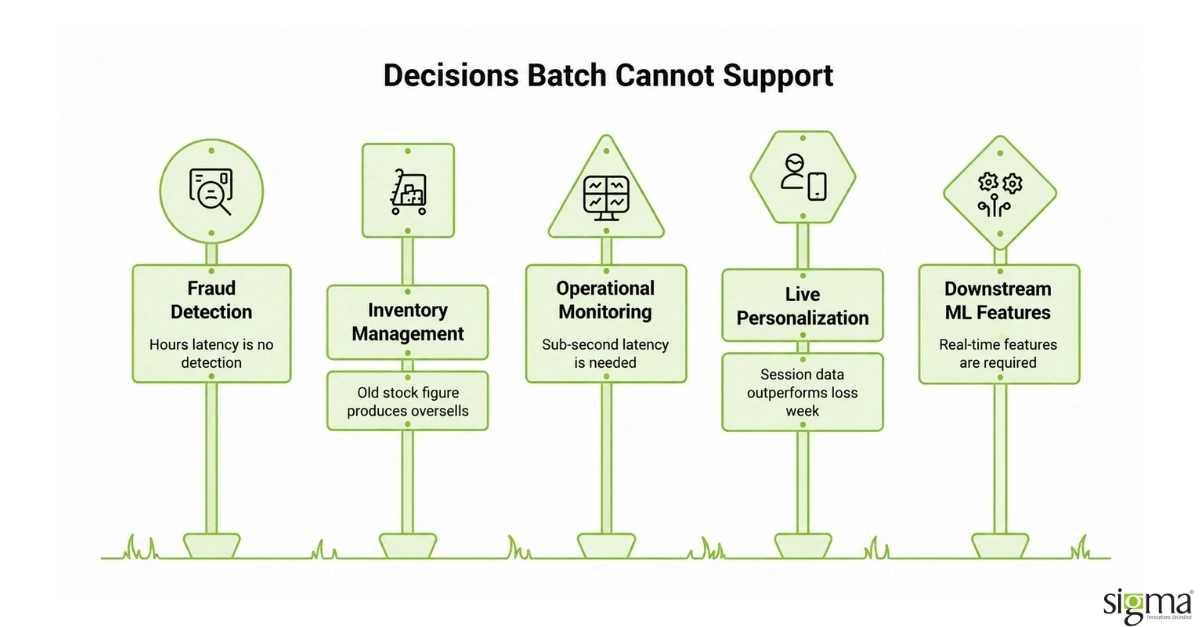
Batch is not obsolete. Most reporting is perfectly well served by a nightly refresh, and teams that migrate everything to streaming out of enthusiasm end up paying operational costs for no benefit. The useful question is narrower: which decisions lose their value if they arrive late?
Fraud and risk decisioning. A transaction either gets blocked before settlement or it does not. Detection latency measured in hours is functionally the same as no detection at all.
Inventory and availability. For retailers running promotions or flash sales, a stock figure that is twenty minutes old produces oversells, cancellations, and refunds. The cost is not just the margin; it is the customer.
Operational monitoring. Dashboards that operations teams watch during a shift need sub-second latency to be useful. If the number on screen describes the state of the business an hour ago, people stop looking at it.
Live personalization. Recommendations informed by what the shopper did in this session outperform recommendations informed by what they did last week. That requires the event stream to be available to the serving layer immediately.
Downstream ML features. Models that score in real time need features computed in real time. A fraud model with a feature set refreshed nightly is a nightly model regardless of how fast inference runs.
Why Teams Stay on Batch Longer Than They Should
The delay is usually rational rather than negligent. Batch pipelines are understood, debuggable, and cheap to operate. When something fails, you rerun the job. The failure mode is a late table, which is annoying but recoverable.
Stream processing has a different operational profile. Failures are continuous rather than discrete. State has to live somewhere. Event ordering is not guaranteed unless you engineer for it. Exactly-once processing is achievable but not free. A team that has never run a streaming data pipeline in production is right to be cautious, because the on-call burden is genuinely different.
The mistake is not caution. The mistake is treating the decision as all-or-nothing. Most organizations that succeed here run both: batch for reporting, reconciliation, and anything historical, streaming for the narrow set of decisions that are worthless when late. The architecture is hybrid by design, not by compromise.
How the Pieces Fit Together
The confusion that slows teams down most is thinking of Apache Kafka and Apache Flink as alternatives. They are not. They occupy different layers and are routinely deployed together.
Apache Kafka is the backbone: a distributed, durable log that ingests events, retains them, and delivers them to consumers with replay and ordering guarantees within a partition. It is where events live.
Apache Flink is the processing engine: it consumes streams, maintains state across events, computes windowed aggregations, joins streams against each other or against reference data, and emits results. It is where events become insight.
The serving layer is the third piece, and the one teams forget to plan. Computed results need somewhere to land that supports fast reads, whether that is a real-time OLAP store, a key-value cache feeding an application, or a materialized view a dashboard queries.
| Layer | Role | Common Choices | Failure If Missing |
| Ingestion and transport | Durable event log with replay | Kafka, Redpanda, managed equivalents | No replay, no backpressure handling |
| Stream processing | Stateful computation, windowing, joins | Flink, Kafka Streams | Raw events with no derived insight |
| Serving | Fast reads for apps and dashboards | Real-time OLAP, cache, materialized views | Results computed but unqueryable |
| Schema governance | Contract enforcement across producers | Schema registry | Silent breakage when producers change |
| Observability | Lag, throughput, state size monitoring | Streaming-native metrics and alerting | Failures discovered by users |
The AI decisioning layer that sits on top of this infrastructure: Event-driven architecture for real-time fraud scoring, credit decisioning, and personalization.
What Actually Makes Streaming Hard
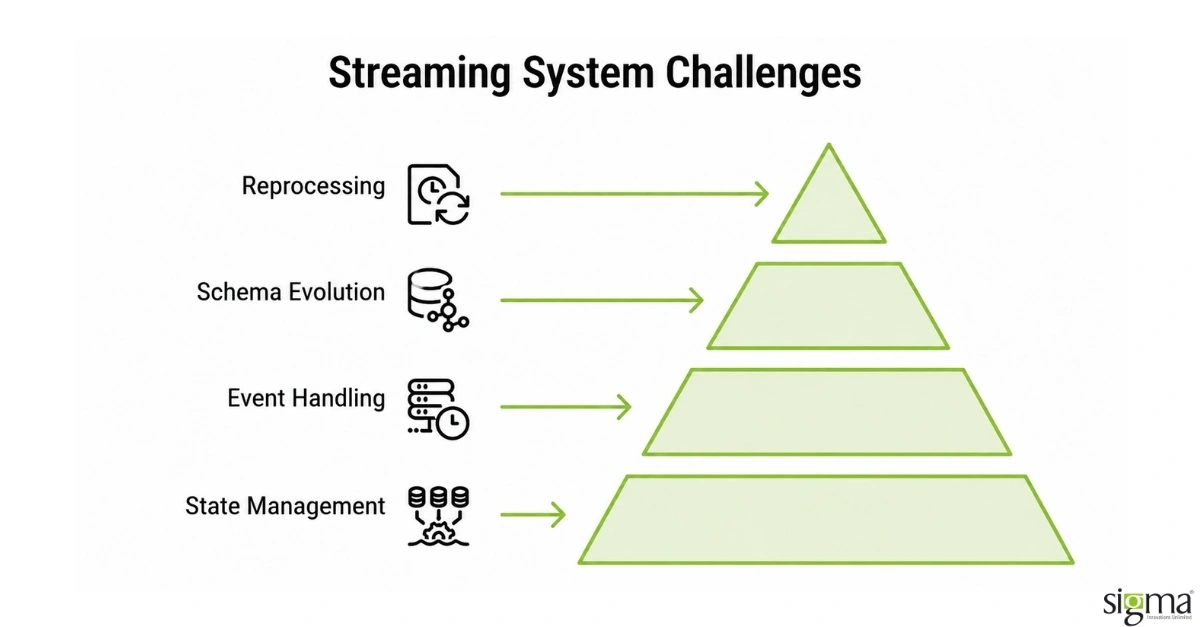
The technology is mature. The difficulty is in a handful of design decisions that batch never forced you to make.
State management. A windowed aggregation over a rolling hour holds state. That state has to survive restarts, scale with cardinality, and be recoverable. Teams that treat this as an afterthought discover it during their first incident.
Late and out-of-order events. Networks retry. Mobile clients buffer offline. Events arrive out of sequence and sometimes very late. Stream processing frameworks give you watermarks and allowed lateness to handle this deliberately, but only if someone decides what the correct behavior is.
Schema evolution. In batch, a producer changing a field breaks tomorrow’s job, and you fix it. In streaming, it corrupts a live pipeline feeding a decision system. Schema registries and compatibility rules are not optional infrastructure.
Reprocessing. When logic changes, you need to recompute history. This is why Kafka retention policy is a product decision rather than a storage setting.
Narrowing “We Need Real-Time” to Three Decisions
The request that arrives is almost always broader than the requirement. Someone wants analytics moved onto streaming infrastructure. The first conversation is not about Kafka topics or Apache Flink state backends. It is four questions.
Which decisions actually change if the data arrives in seconds rather than tomorrow morning? Who acts on each one, and are they available when the signal fires? What happens today when the answer is late, and what does that cost? And which of these decisions has nobody assigned to it at all, because a faster signal to an empty seat changes nothing.
For a FinTech client, the initial ask was to move analytics onto stream processing broadly. Working through the decision inventory narrowed it to two use cases where latency genuinely altered outcomes: transaction risk scoring at authorization, and a live exposure dashboard the risk team monitored during trading hours. Everything else, including the entire regulatory reporting estate, stayed on the existing batch warehouse where it belonged. The streaming footprint was a fraction of the original scope and reached production in roughly the time the broad version would have spent in design review.
Real-time portfolio analytics replacing fragmented dashboards and manual SQL for a digital lending organization: A Snowflake-native intelligence platform.
The diagnostic runs differently when infrastructure already exists. An eCommerce client had a working Apache Kafka deployment producing no value, and the reason was structural rather than a tuning problem: events flowed, were retained correctly, and nothing consumed them into anything queryable. There was no serving layer. Sigma added Flink for the stateful aggregations the business actually needed, put a real-time store behind it, and connected the dashboards that already existed. Infrastructure they had already paid for started producing output within six weeks.
Real-time transaction processing on a cloud-native platform built for variable volume: An AI-powered blockchain platform for cross-border payments.
Schema registry with compatibility enforcement, consumer lag alerting, defined late-event behavior, and a documented replay procedure shipped before go-live rather than after the first incident. Scoping narrowly and building the operational foundations properly is what Sigma’s BI and Analytics Development Services approach to a streaming data pipeline is built on, because a streaming platform nobody trusts in month eight is worse than the batch job it replaced.
I’d place this after “Narrowing ‘We Need Real-Time’ to Three Decisions” and before the Conclusion. That gives Sigma a natural role: the article has diagnosed the problem, shown how to scope it, and then Sigma becomes the engineering path for teams that need to operationalize that decision.
Turning Real-Time Data Into Operational Intelligence
Once the right real-time use cases have been identified, the next challenge is making the data usable across the business. A Kafka deployment, a stream processor, or a real-time dashboard on its own does not create operational intelligence. The value comes from connecting data engineering, processing, modeling, analytics, and decision workflows into an architecture that teams can actually rely on.
That is where Sigma’s BI & Analytics Development Services fit into the picture. Sigma works across the data foundation and analytics layer, combining data engineering, data modeling, reporting and visualization, predictive analytics, AI and ML, and data quality management to turn fragmented data into decision-ready intelligence. Its BI & Analytics practice also works across technologies including Apache Kafka, Snowflake, Power BI, Tableau, AWS, and other modern data platforms.
For organizations moving beyond batch reporting, the important distinction is not simply whether Sigma can implement streaming technology. It is whether the resulting architecture answers the business question that triggered the investment in the first place: what decision needs to become faster, and what data infrastructure is required to make that decision reliable?
That can mean extending an existing analytics environment rather than replacing it, adding real-time processing to a specific operational workflow, modernizing data models and reporting layers, or connecting streaming data to predictive and AI-driven decision systems. Sigma’s experience spans these layers, including real-time BI environments and lending analytics use cases where operational visibility directly affects decision-making.
The result is a more deliberate path from event → processing → insight → action, without forcing every analytical workload onto a streaming architecture simply because real-time technology is available.
Conclusion
Batch analytics is not the problem. Applying batch analytics to decisions that expire is. Fraud blocking, inventory accuracy, operational monitoring, live personalization, and real-time model features all lose most of their value when the answer arrives hours late, and no amount of pipeline tuning changes that. Real-time streaming analytics built on Apache Kafka for transport, Apache Flink for stateful processing, and a proper serving layer closes the gap for the decisions that need it, while batch continues doing what it does well. The teams that get this right scope narrowly, build the operational foundations properly, and expand from there. Sigma Infosolutions helps growth-stage data teams find that line and build on the right side of it.
Is Batch Analytics Holding Back Time-Sensitive Decisions?
Identify where real-time analytics can change outcomes and build the right data architecture to act faster.
Frequently Asked Questions
What is real-time streaming analytics and how does it differ from batch?
Real-time streaming analytics processes events continuously as they arrive rather than in scheduled jobs. Batch computes over a bounded dataset at intervals, so results describe a past state. Streaming maintains state across an unbounded event flow, enabling sub-second insight and automated action while a condition is still current.
When is real-time analytics worth the added complexity?
Real-time analytics is justified when a decision loses value if it arrives late. Fraud blocking, inventory availability during promotions, operational dashboards used during a shift, live personalization, and real-time ML features all qualify. Historical reporting, reconciliation, and month-end analysis remain better served by batch.
Do you need both Apache Kafka and Apache Flink?
They serve different layers and are commonly used together. Apache Kafka is the durable event log handling ingestion, retention, and delivery. Apache Flink is the processing engine that maintains state, computes windowed aggregations, and joins streams. Kafka moves events; Flink turns them into results.
What makes stream processing operationally harder than batch?
Stream processing introduces state that must survive restarts, out-of-order and late-arriving events requiring explicit handling, schema evolution that can corrupt live pipelines, and reprocessing needs when logic changes. Failures are continuous rather than discrete, which changes the on-call profile compared with rerunning a failed batch job.
How does Sigma scope a streaming data pipeline project?
Sigma starts with a decision inventory to identify which use cases genuinely lose value when delayed, typically narrowing broad requests to a small set. The team then builds the transport, processing, and serving layers together, and establishes schema governance, lag alerting, late-event handling, and replay procedures before the streaming data pipeline goes live.