Salesforce Multi-Cloud Alignment: Why Disconnected Teams Are Slowing Revenue Growth

Key Highlights:
- Teams working off disconnected Salesforce clouds create duplicate records, inconsistent customer data, and broken handoffs that fracture the customer journey from marketing through sales to service.
- Proper Salesforce multi-cloud alignment unifies data flows across Sales, Service, and Marketing Cloud so every team operates from the same customer record and the same workflow logic.
- Companies that leave their Salesforce clouds siloed will see declining CRM adoption, reporting that contradicts itself across departments, and an inability to build AI-powered automations that depend on a single source of truth.
- Salesforce’s own platform direction is moving toward native cross-cloud data sharing through Data Cloud and platform-native Marketing Cloud editions, signaling that multi-cloud unification is no longer optional for organizations planning to leverage Agentforce and AI-driven CRM capabilities.
Introduction
Here is how the problem usually starts. The sales team buys Sales Cloud. A year later, the service team adds Service Cloud. Six months after that, marketing launches Marketing Cloud or Account Engagement. Each cloud was implemented separately, by different teams or different consultants, with different data models and different assumptions about what a “contact” or an “opportunity” means.
Two years in, the company has three Salesforce clouds that technically share a platform but practically operate as three separate systems. The RevOps leader trying to build a pipeline-to-renewal report cannot get the numbers to match. The service team cannot see which marketing campaigns a customer engaged with before filing a ticket. And marketing is sending re-engagement emails to customers who already renewed last week.
This is the Salesforce multi-cloud alignment problem, and it affects nearly every growth-stage company that adopted Salesforce clouds incrementally rather than architecturally.
What Misalignment Actually Looks Like Inside Salesforce
The symptoms are easy to spot once you know where to look.
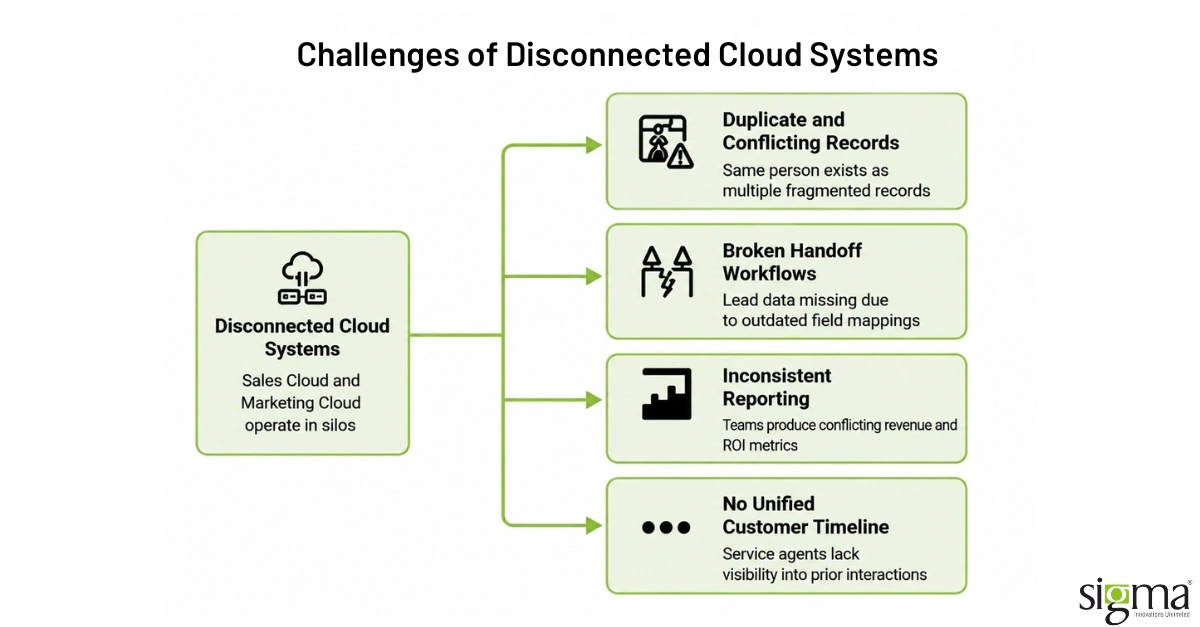
Duplicate and conflicting records. When Sales Cloud and Marketing Cloud maintain separate contact databases without shared deduplication, the same person exists as multiple records with fragmented data. No single record tells the full story.
Broken handoff workflows. A lead qualifies in a Marketing Cloud journey and should pass to Sales Cloud as a marketing-qualified lead. But field mappings configured during the original implementation were never updated. The lead arrives missing key data points. Sales ignores it. Marketing wonders why conversions are dropping.
Inconsistent reporting. Marketing reports campaign ROI from Marketing Cloud attribution. Sales reports pipeline from opportunity data. When the CEO asks how much revenue a campaign generated, three teams produce three different answers.
No unified customer timeline. Service agents handling a case cannot see the marketing interactions or sales conversations that preceded the issue. They ask the customer to repeat the context the company already has, just in a different cloud.
Seeing these symptoms across your Salesforce instance?
Read the Blog: Want higher CRM ROI from Salesforce? See how the right consulting approach makes it happen.
Why This Happens to Growth-Stage Companies
The root cause is sequencing, not incompetence. Sales Cloud comes first for pipeline tracking. Service Cloud follows when ticket volume grows. Marketing Cloud gets added when the team outgrows Mailchimp or HubSpot. Each implementation makes sense on its own. The problem is that nobody designed the cross-cloud data model or the Salesforce cross-cloud workflow logic that would keep all three synchronized.
The cost of living with misalignment compounds monthly. More duplicate records, more broken automations, more workarounds. RevOps teams build manual reconciliation spreadsheets. Service agents check two systems. Marketing creates its own tracking outside Salesforce because the data inside it cannot be trusted.
Read the blog: Salesforce Automation Strategies to Optimize Customer Experience and Operations in 2026
The Cross-Cloud Alignment Framework
Fixing Salesforce multi-cloud alignment is not a rip-and-replace project. It is a systematic realignment of data models, field mappings, automation logic, and governance across clouds. The work typically follows four priorities.
Priority 1: Unify the data model. Define what “Contact,” “Account,” “Lead,” and “Opportunity” mean across all three clouds. Establish which cloud is the system of record for each entity and how records synchronize between clouds. This single step eliminates most duplicate record issues.
Priority 2: Map and fix cross-cloud workflows. Audit every automation that passes data between clouds: lead assignment rules, case escalation flows, campaign member syncs, journey triggers. Identify where field mappings are stale, where data is lost in transit, and where workflows reference fields that no longer exist. Rebuild the broken ones using current Flow and platform event capabilities.
Priority 3: Standardize reporting definitions. Agree on shared metric definitions across teams. “Marketing-qualified lead,” “won opportunity,” and “active customer” must mean the same thing in every cloud and every report. Document these definitions and enforce them through validation rules and formula fields.
Priority 4: Implement ongoing governance. Cross-cloud alignment is not a one-time fix. Assign ownership for cross-cloud data quality. Establish a change management process so that a field change in Sales Cloud triggers a review of dependent Marketing Cloud journeys and Service Cloud case flows.
The following table maps each misalignment symptom to the alignment priority that resolves it:
| Misalignment Symptom | Root Cause | Alignment Priority |
| Duplicate contact records across clouds | No shared deduplication or system of record | Unified data model |
| Leads arriving in Sales Cloud with missing data | Stale field mappings between Marketing and Sales Cloud | Cross-cloud workflow audit |
| Conflicting revenue numbers across departments | Different metric definitions per cloud | Standardized reporting definitions |
| Service agents lacking marketing/sales context | No unified customer timeline across clouds | Unified data model + workflow mapping |
| Automations breaking after field changes | No cross-cloud change management process | Ongoing governance |
Building a Salesforce Strategy That Prevents Future Fragmentation
Preventing recurrence requires a Salesforce strategy that treats the instance as a single platform, not a collection of clouds. Every new cloud or feature should be scoped against the existing data model before implementation. Cross-cloud impact analysis should be part of every change request. And teams should evaluate whether Salesforce’s newer platform-native products (like Marketing Cloud Growth, built directly on the core platform) can replace legacy configurations that depend on external data syncs.
How Sigma Infosolutions Works on Multi-Cloud Salesforce Problems
Sigma has worked inside enough fragmented Salesforce instances to know that the problem is never just technical. It is also organizational. Sales, service, and marketing teams each have their own processes, their own reporting expectations, and their own definition of what the data should look like. Aligning the clouds means aligning the people who use them, and that requires a partner who can facilitate cross-team conversations as well as write the Flows.
For one B2B SaaS client running Sales Cloud and Service Cloud with Account Engagement (Pardot), Sigma found that 34% of contact records existed as duplicates across clouds because the original Account Engagement implementation created its own prospect records without matching to existing Sales Cloud contacts. The fix was not a mass merge. It was a reconciliation logic that matched on email address and company domain, preserved the richest data from each duplicate, and set up ongoing deduplication rules that prevented the problem from recurring.
For a FinTech platform that had added Marketing Cloud two years after Sales Cloud, the core issue was that campaign attribution data never made it back to the opportunity record. Marketing could report on email engagement, but could not connect it to closed revenue. Sigma built the Sales Service Marketing Cloud integration bridge: a campaign-to-opportunity attribution flow that tagged every opportunity with the marketing touches that influenced it, giving both teams a shared view of what was working.
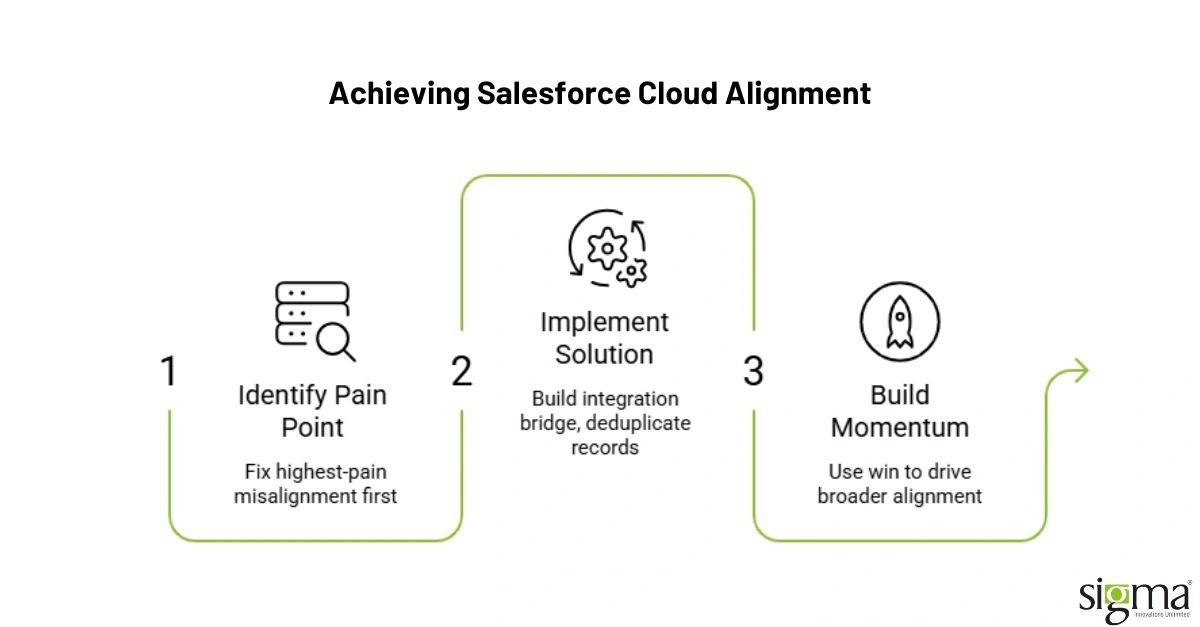
Sigma does not propose a six-month roadmap and start with a discovery phase. The team identifies the highest-pain misalignment first, fixes it within weeks, and uses that win to build momentum for the broader alignment work. That is how Salesforce consulting services should work for growth-stage companies that cannot afford to wait half a year for results.
Conclusion
Salesforce multi-cloud alignment is not a nice-to-have cleanup project. It is the prerequisite for every other Salesforce initiative that depends on trustworthy data: AI-powered automations, Agentforce deployments, cross-departmental reporting, and customer journey orchestration. Growth-stage companies that adopted Salesforce clouds incrementally now need to unify them architecturally, aligning data models, fixing Salesforce cross-cloud workflow handoffs, and establishing the governance that keeps the instance coherent as the business evolves. Sigma Infosolutions brings the Salesforce consulting services expertise to do that work quickly, starting with the highest-pain misalignment and building outward.
Is your Salesforce ecosystem holding back growth?
Frequently Asked Questions
What is Salesforce multi-cloud alignment and why does it matter?
Salesforce multi-cloud alignment is the process of unifying data models, workflows, and reporting across Sales Cloud, Service Cloud, and Marketing Cloud so they operate as a single coherent platform. Without alignment, teams work from conflicting data, automations break at cloud boundaries, and reporting produces inconsistent numbers that undermine CRM trust and adoption.
What causes Salesforce cross-cloud workflow issues?
Salesforce cross-cloud workflow issues typically result from stale field mappings created during initial implementations, clouds configured by different consultants with different data assumptions, and a lack of change management processes that account for cross-cloud dependencies when fields or automations are modified.
How do you achieve sales service marketing cloud integration?
Sales service marketing cloud integration requires a unified data model with a single system of record for each entity, field mappings that keep data synchronized across clouds, shared metric definitions, and workflow automation that passes leads, cases, and campaign data between clouds without data loss or duplication.
When should a company invest in a Salesforce strategy review?
Companies should review their Salesforce strategy when reports from different departments produce conflicting numbers, when service agents lack visibility into marketing and sales interactions, when automation failures increase after routine changes, or when the company plans to adopt Agentforce or Data Cloud features that require unified data.
How does Sigma approach Salesforce consulting services for multi-cloud issues?
Sigma audits cross-cloud data flows, identifies the highest-impact misalignment, and fixes it within weeks rather than months. The team builds reconciliation logic for duplicate records, repairs broken handoff workflows, standardizes reporting definitions, and establishes governance processes that prevent fragmentation from recurring as the instance grows.