Struggling to Convert Loan Applications During Seasonal Demand Spikes?

Key Highlights
- Rising application volumes strain lending infrastructure: January’s overlapping holiday-debt cycles create sustained application pressure, exposing capacity gaps across origination and loan processing.
- Underwriting bottlenecks reduce funded-loan conversions: Manual reviews, slow credit decisions, and fragmented document verification prevent lenders from converting application growth into funded loans.
- Connected, automated lending workflows improve conversion: Fast prequalification, automated underwriting, and scalable document intake enable lenders to process higher volumes without proportionally increasing manual effort.
- Sigma strengthens origination and underwriting capacity: Sigma scaled QuickBridge Funding’s monthly application processing from 350 to 2,300, achieving 45% faster underwriting and approval through engineered lending infrastructure.
Search interest in a debt consolidation loan application climbs every January, and the reason isn’t mysterious: holiday debt doesn’t resolve itself when the calendar turns over. LendingTree’s most recent holiday-debt survey, found more than a third of Americans took on new holiday debt averaging about $1,200, and 41% of respondents were still paying off debt from the previous holiday season. That overlap is what drives January’s application volume, not a single wave of new borrowers but a backlog of carried-over debt colliding with a fresh round of January credit card statements. For digital lenders, loan servicers, and alternative finance platforms, the open question isn’t whether interest rises in January, it reliably does, but whether origination, underwriting, and servicing capacity rises with it.
Why Do Debt Consolidation Loan Applications Rise in January?
Debt consolidation loan applications rise in January because two separate pressures land in the same few weeks: holiday purchases hit the first post-holiday statement, and a share of borrowers are still carrying balances from the holiday season before that. Both push the same consumer toward the same search and application behavior at once.
| Seasonal driver | Platform stress | Fix |
|---|---|---|
| New holiday-season debt hitting the January statement | Prequalification and intake volume spikes faster than underwriting throughput, creating a queue | Fast, automated prequalification that gives an applicant a real signal before committing to a full application |
| Carried-over debt from the prior holiday season | Document intake (income verification, bureau pulls) gets treated the same regardless of application complexity, slowing simple cases behind complex ones | Automated document intake and verification that routes simple applications through faster rather than one uniform manual queue |
| Comparison shopping across multiple lenders in the same week | Underwriting decisioning that relies on manual review loses applicants to a competitor who decisions faster | Automated underwriting and credit decisioning that returns a decision in minutes rather than days |
| Servicing and collections volume following the origination spike with a lag | Servicing systems built for steady-state volume strain once a surge of newly funded loans enters repayment at the same time | Scalable servicing and collections workflows provisioned ahead of the origination spike, not after it arrives |
The second row matters more than it looks. A platform can handle the top-of-funnel spike, enough web servers, enough intake forms, and still lose the surge at underwriting, because that’s where manual review and inconsistent decisioning actually live. That’s also where the data tells a more complicated story than “volume goes up every January.” dv01’s report on January 2026 consumer unsecured originations found funded volume actually fell 6.5% month over month, the weakest January in a decade, even though volume ran 32% higher than a year earlier. Application interest and funded-loan capacity are not the same number, and a platform that only plans for the first one is planning for the wrong bottleneck.
The timing of each stress point also differs, which matters for diagnosis. Prequalification volume moves first, within days of the January statement cycle, as borrowers start comparison-shopping before committing to a full application anywhere. Document intake and income verification load follows close behind, as applicants who clear prequalification move into the part of the funnel that actually requires bureau pulls and bank data. Underwriting backlog tends to build a little later, once enough applications have cleared intake to expose whatever manual-review capacity the platform has, and servicing and collections load arrives last, as a lag effect once the applications that did get approved actually fund. A lender tracking only a single aggregate “applications this week” number misses which of these four stages is actually the one running out of capacity, and the fix for a prequalification bottleneck looks nothing like the fix for an underwriting one.
How Can Lenders Handle Seasonal Application Surges?
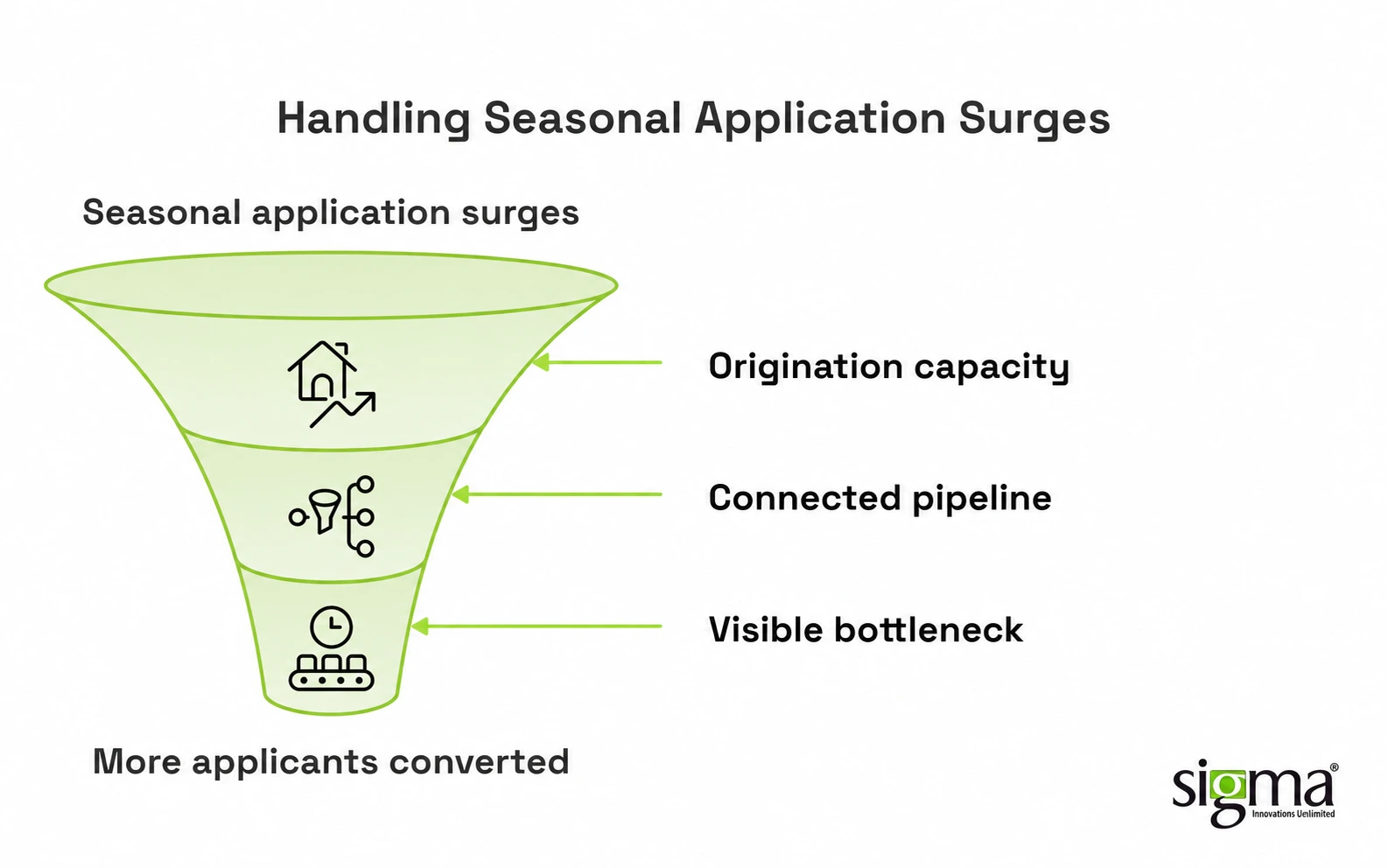
Lenders handle seasonal application surges by building origination capacity that holds through the full stretch of elevated demand, not just the first week, and by making sure the bottleneck isn’t quietly sitting at underwriting while intake looks fine.
That means treating prequalification speed, automated underwriting, and document intake as one connected pipeline rather than three separate vendor relationships. A fast prequalification step that hands off to a slow, manually reviewed underwriting queue doesn’t actually convert more applicants, it just moves the bottleneck one step further into the funnel where it’s harder to see on a dashboard that only tracks top-of-funnel volume.
What Does a Debt Consolidation Lending Platform Need?
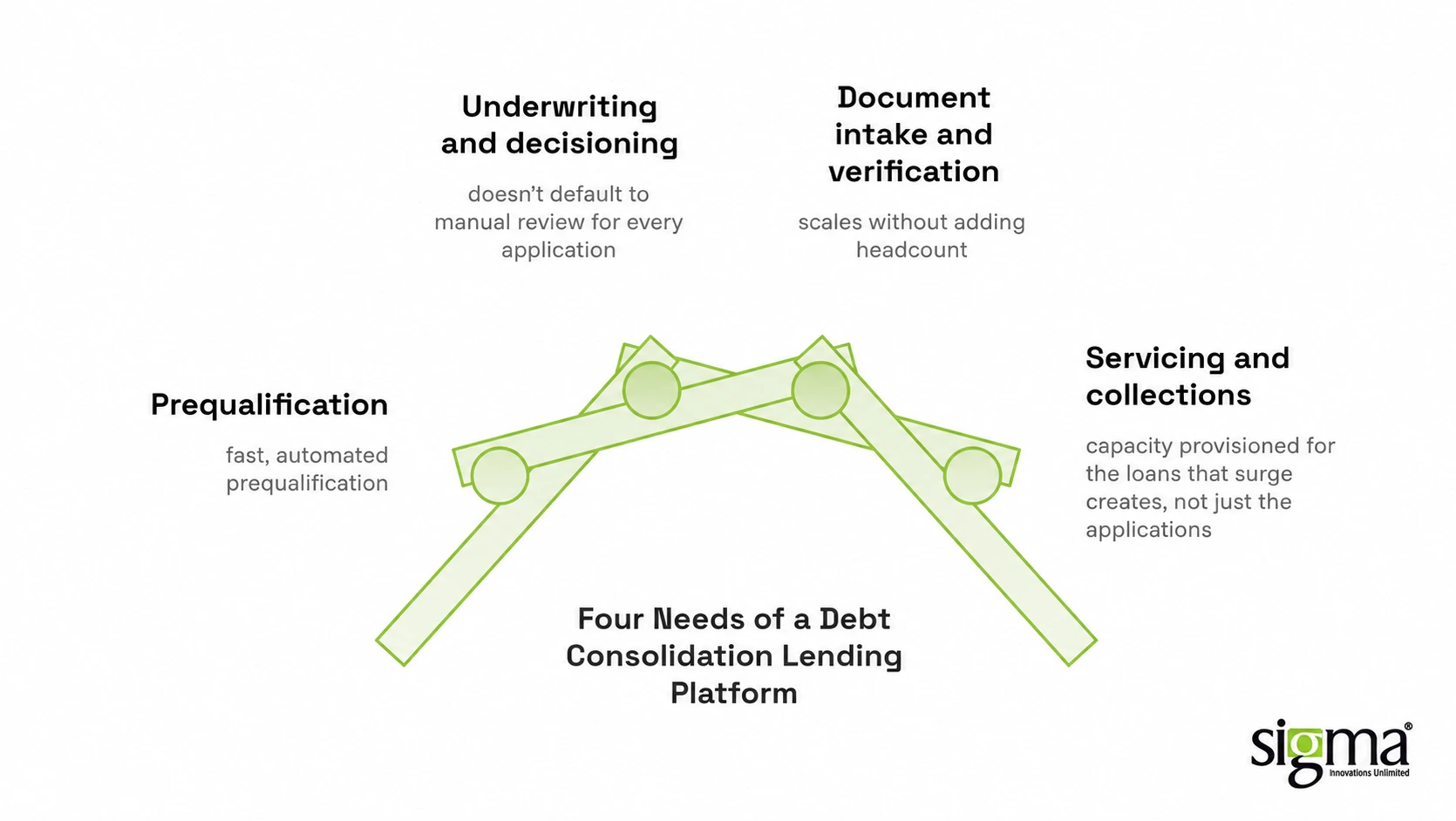
A debt consolidation lending platform needs four things working together during a seasonal surge: fast, automated prequalification; underwriting and credit decisioning that doesn’t default to manual review for every application; document intake and income verification that scales without adding headcount; and servicing and collections capacity provisioned for the loans that surge creates, not just the applications.
Compliance has to hold through all four under volume, not just at normal traffic. State licensing requirements, CFPB rules, FCRA and ECOA obligations around credit decisions don’t relax because application volume is elevated, and an automated underwriting system built without that discipline creates regulatory exposure precisely when it’s processing the most decisions. A credit decisioning model that can’t produce a clear adverse-action reason for every automated decline, for instance, is a compliance gap that a slow month never surfaces and a volume surge exposes immediately, simply because more declines are happening in the same week. Sigma’s AI-powered lending platform is built around underwriting intelligence with that compliance layer included, not bolted on after the fact.
The servicing and collections piece is the one most platforms underbuild for, because it’s the furthest from the visible application spike. A lender that successfully funds a surge of new debt-consolidation loans has, by definition, just added a wave of new accounts that all enter repayment on roughly the same cycle. If servicing capacity, payment processing, statement generation, and early-stage collections workflows were sized for steady-state volume, that wave arrives as its own smaller surge a month or two later, and it’s a worse time to discover a servicing gap than during the original application spike, because by then the loans are already funded and the platform has committed capital to them.
Why Application Volume and Funded-Loan Capacity Are Different Problems
Most conversations about a seasonal lending surge treat it as a single capacity question, can the platform handle more applications. That framing misses where the actual loss happens. A lender can absorb every January application that arrives and still fund fewer loans than it should, because the volume concentrated at underwriting, not at the website, is where manual review and inconsistent decisioning quietly turn a qualified applicant into an abandoned one.
Sigma has solved exactly this problem before. For QuickBridge Funding, a US B2C small-business lending platform, Sigma built the origination and underwriting infrastructure that scaled the platform from 350 to 2,300 loan applications processed a month, with the system built to handle up to 20,000 applications a month, 45% faster loan underwriting and approval, and a 23% increase in renewals from better client-engagement visibility.
That engagement also integrated multiple external data sources, credit bureaus and alternative data providers among them, directly into the underwriting decision, which is the same kind of connected-pipeline work a debt consolidation platform needs during a seasonal surge: prequalification, verification, and decisioning pulling from the same real-time data rather than each stage waiting on the one before it to finish separately.
For a lender or servicer heading into another January, the real decision isn’t whether to prepare for higher volume, that part is predictable. It’s whether prequalification, underwriting, document intake, and servicing are built as one connected pipeline that holds up when every stage gets tested at once, or whether the first real test happens live, with applicants abandoning at the one stage nobody was watching closely enough.
Conclusion
A debt consolidation loan application surge in January isn’t a single event, it’s two overlapping pressures, new holiday debt hitting the first post-holiday statement and carried-over debt from the season before, landing on the same borrowers in the same few weeks. LendingTree’s December 2025 survey found more than a third of Americans took on new holiday debt averaging about $1,200, with 41% still paying off the prior season’s balance, which is why the search and application behavior compounds rather than resetting each year. That volume doesn’t automatically become funded loans. dv01’s data on January 2026 originations showed funded volume falling 6.5% month over month even while running well above the prior year, evidence that application interest and underwriting throughput are two different numbers a lending platform has to manage separately. The platforms that lose the most during a surge aren’t the ones that can’t take in applications, they’re the ones where manual underwriting review quietly becomes the bottleneck nobody was tracking. Fast, automated prequalification gives applicants a real signal early, instead of pulling them through a full application only to stall later. Automated underwriting and credit decisioning that returns an answer in minutes, not days, is what keeps a comparison-shopping applicant from moving to a competitor mid-decision. Document intake and income verification that scales without proportional headcount growth is what keeps simple applications from queuing behind complex ones. None of this works without compliance holding through the volume, since state licensing, CFPB, FCRA, and ECOA obligations apply to every decision regardless of how many are being made that week. Servicing and collections capacity has to be provisioned ahead of the surge, not after, since a wave of newly funded loans enters repayment on a predictable lag behind origination. A lender that treats prequalification, underwriting, intake, and servicing as one connected pipeline converts a debt consolidation loan application surge into funded, performing loans instead of an abandoned queue. The alternative is discovering which stage was the real bottleneck only after this January’s applicants have already gone to a faster competitor.
Frequently Asked Questions
Why do debt consolidation loan applications rise in January?
Debt consolidation loan applications rise in January because new holiday debt hits the first post-holiday statement at the same time a share of borrowers are still carrying debt from the previous holiday season. Both pressures land on the same consumers in the same few weeks, compounding rather than resetting each year.
How can lenders handle seasonal application surges?
Lenders handle seasonal application surges by building prequalification, underwriting, document intake, and servicing as one connected pipeline rather than separate systems, so the bottleneck doesn’t quietly shift to underwriting while top-of-funnel volume looks fine on a dashboard. Capacity has to hold through the full elevated period, not just the first week.
What does a debt consolidation lending platform need?
A debt consolidation lending platform needs fast automated prequalification, underwriting and credit decisioning that doesn’t default to manual review, document intake that scales without added headcount, and servicing capacity provisioned ahead of the surge. Compliance with state licensing, CFPB, FCRA, and ECOA rules has to hold across all four under volume.
Why does application volume sometimes grow while funded loans don’t?
Application and inquiry volume can stay elevated while funded-loan volume lags because the two numbers measure different stages of the same pipeline. When underwriting relies on manual review, a surge in applications creates a queue rather than a corresponding surge in funded loans, so volume at the top of the funnel can look healthy while conversion quietly falls.
When should a lending platform prepare for a January application surge?
A lending platform should prepare before December ends, since prequalification, underwriting, intake, and servicing capacity all need validation against realistic surge-level volume ahead of time. Waiting until applications are already arriving leaves no room to fix whatever stage turns out to be the actual bottleneck.