Magento Replatform vs Optimize: A Decision Framework Before You Rebuild

Key Highlights:
- A proposal to replatform off Magento can be triggered by a performance problem that a full rebuild was never required to solve.
- Assessing infrastructure, caching, database health, extensions, customizations, and front-end architecture can reveal whether the constraint is configuration debt or a genuine platform limitation.
- Optimizing in place can preserve existing SEO equity, integrations, catalog data, and engineering investment while addressing the underlying performance problem.
- Replatforming becomes the stronger option when business requirements or architectural constraints have moved beyond what the existing Magento environment can reasonably support.
- Sigma approaches Magento engagements with an evaluation-first methodology, so the rebuild-or-optimize decision is based on evidence before significant budget and engineering capacity are committed.
Introduction
The Magento replatform vs optimize decision is rarely just a technology decision. It is a capital allocation decision with implications for revenue, SEO, engineering capacity, integrations, and growth.
A slow storefront, declining conversion rates, or worsening Core Web Vitals can make a replatform appear like the obvious answer. But before committing to a multi-month migration, leadership needs to establish whether Magento is actually the constraint.
In many stores, performance degradation is the result of accumulated configuration debt, aging extensions, database inefficiencies, infrastructure limitations, or front-end complexity rather than a fundamental platform limitation. Those problems can often be addressed without replacing the underlying commerce architecture. The opposite is also true. If the business has outgrown the platform’s architectural boundaries, continuing to optimize around those constraints only postpones the inevitable migration.
The right question is therefore not “Should we move off Magento?” It is “What evidence tells us whether optimization or replatforming is the better investment?”
This framework gives CTOs, CIOs, and VPs of Engineering a structured way to answer that question before committing budget, engineering capacity, and organizational attention to a rebuild.
Why “Slow” Gets Blamed on the Platform
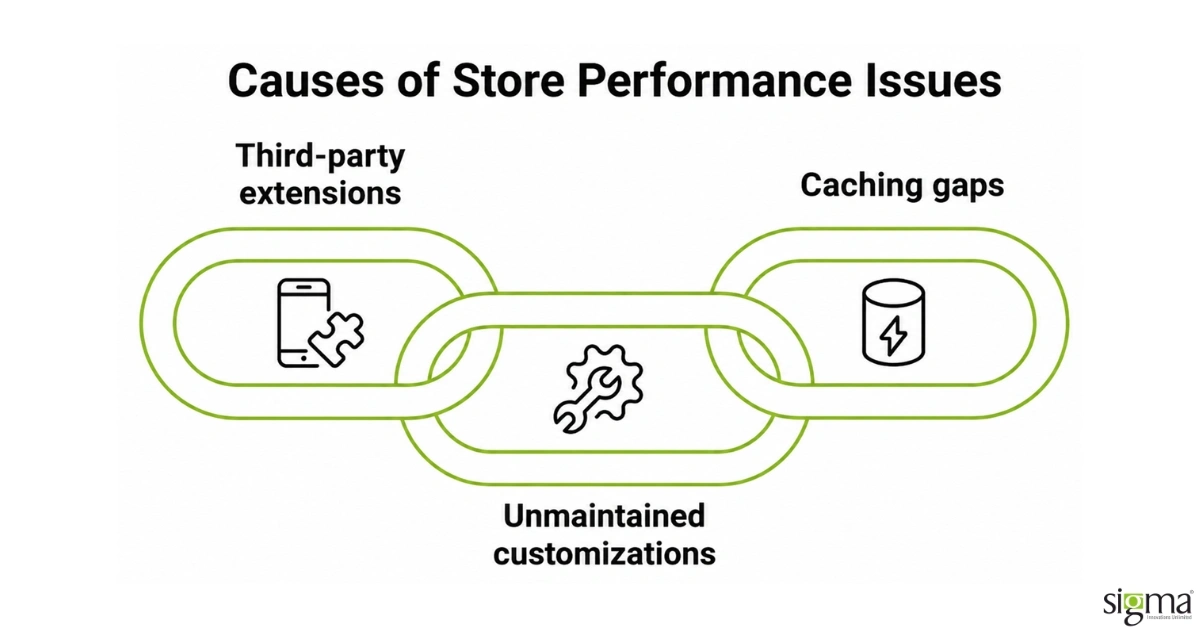
Performance problems get attributed to the platform more often than the evidence supports. Over time, Magento stores accumulate third-party extensions, customizations, integrations, caching gaps, database growth, and front-end changes. Individually, these may appear manageable. Collectively, they can create enough technical debt to affect storefront performance, checkout reliability, conversion rates, and the cost of ongoing engineering support.
That distinction matters when leadership is deciding whether to optimize or rebuild. If the underlying issue is configuration or accumulated technical debt, replacing the platform can introduce migration risk without addressing the root cause. If the constraint is architectural, continuing to optimize the existing environment can simply extend the life of a system that no longer fits the business.
The challenge is that both situations can look similar from the business side: the storefront is slow, customers are affected, and the existing technology is being blamed. That is why the rebuild decision should begin with an evidence-based assessment rather than a technology preference.
What Actually Justifies a Rebuild
A rebuild is justified when the constraint is structural rather than accumulated. Signals that point toward a genuine platform limitation can include a business model that Magento cannot represent without extensive customization, transaction or catalog requirements that remain constrained after appropriate infrastructure investment, or integration requirements that create persistent architectural friction.
These are fundamentally different from performance problems caused by configuration debt. Caching, database health, hosting capacity, extension quality, and front-end architecture should be assessed before concluding that the platform itself has reached its limit.
The important question is whether the limitation remains after the existing environment has been brought to a reasonable performance baseline. That baseline gives leadership something more valuable than a technical opinion: evidence. If the store remains constrained after meaningful optimization, the business has a stronger basis for approving a migration. If performance improves materially, the organization may be able to achieve its objectives without absorbing the cost and risk of a replatform.
The objective is not to defend Magento or advocate for migration. It is to identify which investment solves the actual constraint.
Is your Magento platform really the constraint?
What Often Turns Out to Be Configuration Debt
A significant share of Magento performance problems originate in the environment surrounding the platform rather than in Magento itself. Common contributors include ineffective caching, infrastructure that no longer matches traffic requirements, database growth, outdated extensions, unnecessary customizations, and front-end complexity. Individually, these issues may not justify architectural change. In combination, they can materially affect storefront performance and operational efficiency.
This is particularly common in stores that have evolved through multiple development cycles, vendors, integrations, and business requirements. The original implementation may have been appropriate at launch but become increasingly difficult to maintain as the business grew. What appears to be platform strain can therefore be the result of years of accumulated technical decisions.
That creates an important distinction for leadership: technical debt can make a capable platform appear inadequate. The appropriate response is not automatically another round of incremental fixes. It is to establish which layer is creating the constraint, quantify its business impact, and determine whether remediation can reasonably address it before considering a platform change.
Performance Problems Need Diagnosis Before Replatforming
If your Magento store is losing speed, search visibility, or conversions, the first step is identifying where performance is actually breaking down. Sigma’s Website Performance Optimization Services assess the technical factors affecting speed, SEO, and eCommerce performance so you can prioritize improvements before committing to a larger platform change.
Magento performance debt or platform limits?
The Real Cost Comparison
The financial case for optimization is not simply that it costs less than migration. The more important consideration is what each path requires from the broader business.
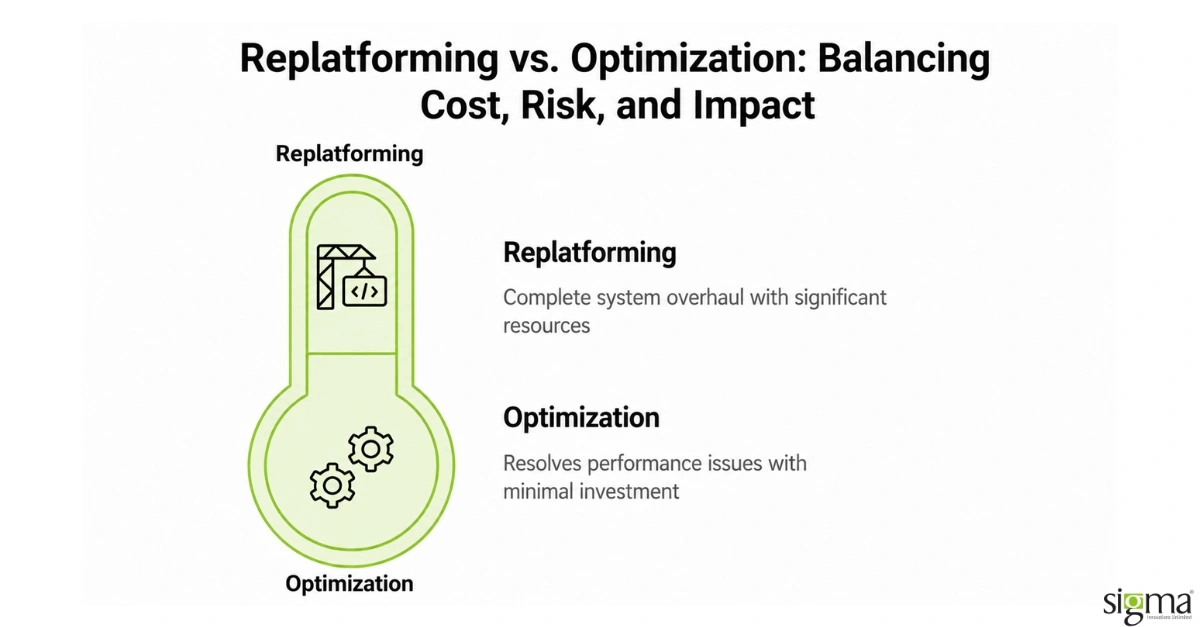
A replatform can involve engineering, QA, SEO, merchandising, analytics, integrations, and other teams for an extended period. It also introduces migration dependencies that can affect existing rankings, customer journeys, data flows, and third-party systems.
Optimization in place takes a different approach: preserve the existing commerce architecture and invest selectively in the areas that are actually constraining performance or scalability.
| Criteria | Full Replatform | Optimization In Place |
| Typical Timeline | Multiple quarters, multi-team commitment | Three to five weeks for caching, database, and image work; eight to sixteen weeks if a Hyva front-end rebuild is warranted |
| SEO and Integration Risk | Existing rankings and integrations exposed during migration | Existing catalog and search equity preserved throughout |
| Budget Commitment | Substantial, committed before any performance gain is realized | Scoped and measurable within a single fiscal quarter |
| Team Disruption | Pulls engineering, QA, and marketing off feature work for the duration | Minimal, since the store’s architecture is untouched |
Team disruption is the less visible part of this comparison. A rebuild pulls engineering and QA capacity into migration work and can require sustained involvement from SEO, merchandising, analytics, and marketing teams. That creates an opportunity cost even before direct implementation costs are considered.
An optimization engagement can be more targeted. Caching, database, infrastructure, and image-delivery improvements can often be addressed within several weeks, depending on the existing environment. Where the front end is itself a significant constraint, a Hyvä theme migration can provide a broader modernization path without replacing the underlying Magento commerce architecture.
The important point is that neither timeline nor investment should be treated as universal. The right scope depends on the condition of the existing store and the business outcomes being targeted.
What Leadership Should Require Before Approving a Replatform
Before approving a Magento replatform, leadership should expect an assessment that separates platform limitations from issues within the existing environment. The assessment should establish where the performance constraint actually sits, whether it is related to infrastructure, caching, database health, extensions, customizations, front-end architecture, or the underlying platform.
The assessment should also determine whether optimization can materially change the business outcome. Technical improvements only matter if they address the reason the investment is being considered. If the original concern is declining conversion, the evaluation should consider whether performance remediation can improve the customer journey. If scalability is the concern, it should determine whether the existing architecture can support the required growth after appropriate remediation.
A replatform should also have clearly defined outcomes. If the proposed migration does not address the underlying performance, scalability, integration, or business-model constraint, the organization may simply be moving the same problem into a new environment.
Finally, leadership should compare what each path costs the business. That means looking beyond engineering or vendor costs to consider implementation timeline, internal resource requirements, SEO and integration risk, expected performance or scalability gains, operational disruption, long-term maintainability, and the ability to support future business requirements.
The result should be documented before the investment decision is made. A concise comparison of the evidence, expected outcomes, risks, timeline, and investment required for each path gives leadership a much stronger basis for approving the right initiative.
How Sigma Approaches the Rebuild-or-Optimize Decision
Sigma treats the rebuild-or-optimize assessment as the starting point of a Magento engagement rather than assuming the requested solution is automatically the right one.
The evaluation considers the existing architecture, infrastructure, performance constraints, integrations, customizations, and front-end experience to determine where the business is actually constrained. From there, the recommended path can range from targeted performance optimization to front-end modernization or a broader platform migration.
That distinction matters because both decisions carry risk. An unnecessary replatform commits budget and internal capacity to migration work that may not resolve the original performance problem. Continuing to optimize a platform that has reached a genuine architectural limit creates a different cost: delayed growth and repeated investment in an environment that cannot support the business requirements.
Sigma’s role is to establish the evidence first, define the viable paths, and take ownership of the engineering work required by the selected approach. This keeps the technology decision connected to the business outcome rather than treating migration or optimization as an objective in itself.
When Migration Is the Right Answer
Hansen Wholesale provides a useful example of the other side of the decision. Its move from Magento 1 to Magento 2.4 addressed a genuine platform constraint rather than simply treating performance symptoms. The migration included rebuilt search and comparison capabilities and was followed by a 12% increase in average order value over the subsequent two years.
The lesson is not that Magento migration is always the better option. It is that migration can create value when the underlying platform constraint is real and the new architecture is designed around the business’s requirements. In that situation, continuing to optimize an outdated platform would have delayed the architectural change the business ultimately needed.
See how Sigma approaches Magento migration when platform limitations demand a different path.
When Optimization Is the Better Path
Sigma’s work with a leading US-based lender demonstrates the other side of the decision. An evaluation identified opportunities for targeted remediation rather than requiring a platform migration. Plugin cleanup, caching improvements, and a front-end rebuild contributed to a 40% increase in new-user traffic while the business retained its existing platform.
Although the engagement involved WordPress rather than Magento, the strategic principle is directly relevant: establish the constraint before deciding that the platform needs to change.
The example demonstrates why an evaluation-first approach can prevent an organization from undertaking a migration when targeted remediation can address the business problem. It also reinforces an important distinction for technology leaders: modernization does not always require replacing the underlying platform.
See how Sigma improved website performance without requiring a platform migration.
The Decision Framework in Practice
The rebuild-or-optimize decision becomes clearer when the evidence is viewed across four dimensions: performance, architecture, business requirements, and integrations and operations.
| Question | If the Evidence Points to Optimization | If the Evidence Points to Replatforming |
| Performance | Issues are concentrated in infrastructure, caching, database, extensions, or front-end complexity | Performance constraints persist after reasonable remediation |
| Architecture | Existing architecture can support projected business requirements | Core architecture creates persistent constraints |
| Business Requirements | Current Magento capabilities can support the operating model | Business model requires capabilities the existing architecture cannot reasonably support |
| Integrations & Operations | Existing integrations remain viable with targeted improvements | Integration complexity creates structural limitations or excessive ongoing maintenance |
| Investment | Targeted investment can address the identified constraints | Continued optimization creates diminishing returns against a known architectural limit |
This framework also prevents a common mistake: treating technical modernization and platform replacement as the same decision.
A store can need significant modernization without needing to leave Magento. Infrastructure optimization, database remediation, extension rationalization, front-end modernization, and architectural cleanup can materially change the performance and maintainability of an existing Magento environment.
Conversely, a well-optimized store can still reach a point where its architecture no longer aligns with the business. The decision should follow the evidence rather than the assumption that either optimization or migration is inherently the better strategy.
Conclusion
The Magento replatform vs optimize decision should start with evidence, not the assumption that a slow store needs a new platform.
Optimization is appropriate when the underlying architecture remains capable of supporting the business and the primary constraints are infrastructure, caching, database health, extensions, customizations, or front-end complexity. Replatforming becomes the stronger option when those constraints persist after reasonable remediation or when business requirements have moved beyond what the existing architecture can support.
For technology leaders, the most important comparison is therefore not simply migration cost versus optimization cost. It is the expected business outcome, risk, timeline, internal resource commitment, and long-term scalability of each path.
A disciplined evaluation makes that comparison possible before significant budget and engineering capacity are committed.
Magento performance debt or platform limits?
Frequently Asked Questions
How do I know if my Magento store actually needs a full rebuild?
Test the store against server, caching, database, and front-end criteria first. If most of these are already well configured and the store is still slow, or the business model genuinely does not fit Magento’s data structures, a rebuild is likely justified. If several checks fail, optimization is very likely sufficient.
What usually causes teams to assume they need a Magento rebuild?
Accumulated configuration debt, misconfigured caching, an outdated PHP version, database bloat, and an unaudited extension stack, gets mistaken for a platform limitation because it produces the same visible symptom, a consistently slow store, without an obvious single cause pointing back to any one of them.
How much does optimizing in place typically save compared to a rebuild?
A targeted optimization engagement addressing caching, database, and image delivery can complete within three to five weeks, and a front-end overhaul within eight to sixteen weeks, compared to a full replatform that typically requires multiple quarters of engineering time and carries added SEO and integration risk throughout the migration.
Does staying on Magento and optimizing preserve existing SEO rankings?
Yes, in most cases it does. Because the URL structure, content, and backlink profile remain unchanged during an optimization engagement, existing search rankings are generally preserved, whereas a replatform migration introduces real risk of ranking loss both during and immediately after the transition to a new platform.
What does Sigma evaluate before recommending a rebuild versus optimization?
Sigma audits server configuration, caching, database health, extension conflicts, and front-end architecture to determine whether the performance problem is configuration debt or a genuine structural limitation, and bases its recommendation on that documented evidence rather than a default toward either path or a preference for larger engagements.