Pre-Peak Conversion Rate Optimization for Growth-Stage eCommerce Companies: Fixes Worth Shipping Before Black Friday

Every funnel leak a growth-stage commerce company carries into peak season is multiplied by the traffic it paid to acquire. U.S. retail e-commerce reached $365.2 billion in the fourth quarter, underscoring how much revenue is concentrated in the period when conversion performance matters most. That arithmetic makes conversion rate optimization especially important before Black Friday, Cyber Monday, and other high-volume sales periods, but it also makes late production changes unusually risky.
For digital commerce brands, marketplace operators, omnichannel retailers, and subscription businesses, the question is not simply which conversion problems exist. The more important question is: which leaks are large enough to justify touching a revenue-critical platform before the deployment freeze?
This decision is particularly difficult for companies operating with existing commerce platforms, legacy integrations, payment providers, fulfillment systems, and customer-data infrastructure. A seemingly small checkout or payment change can affect multiple connected systems. The right pre-peak strategy therefore combines conversion analysis with platform readiness, engineering risk, observability, and rollback planning.
Key Highlights:
- Traffic will multiply and every existing leak multiplies with it, while the teams who could fix them are occupied with campaigns and merchandising.
- Size each leak by recoverable revenue, then weigh that against the deployment risk of shipping the fix inside the pre-peak window.
- The highest-value repairs land before the freeze, and the marginal ones wait until January rather than threatening the quarter that funds the year.
- Sigma fixes what measurably loses revenue and stops shipping before the freeze window, which occasionally means recommending against a change the client wants.
Conversion Rate Optimization Changes Character Once a Freeze Date Exists
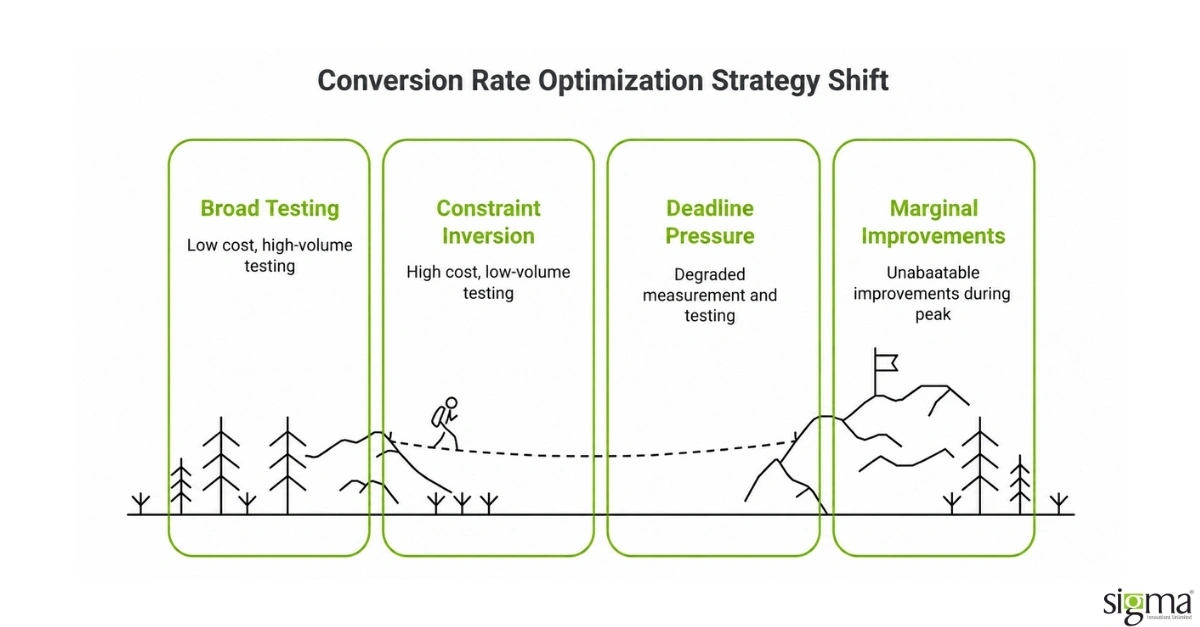
Conversion rate optimization is the practice of increasing the share of visitors who complete a desired action, ordinarily through measurement, hypothesis, and controlled change. In an ordinary quarter the constraint is learning speed, and the correct posture is to test broadly and accept that most tests will fail, since a failed test costs little.
Inside the pre-peak window the constraint inverts. A failed change no longer costs a little. It costs a share of the highest-revenue weeks of the year, at a moment when the engineering team is stretched, the on-call rotation is thin, and a rollback competes with live incidents for attention. The same change carries a different expected value in September than it does in June, and teams that do not adjust their threshold ship marginal improvements into a period that cannot absorb them.
Deadline pressure also degrades measurement. Tests started in October rarely reach significance before the traffic pattern shifts entirely, so results read during peak describe a population that will not exist again for a year. Most pre-peak work is therefore not testing at all. It is repair of things already known to be broken, which is a different discipline with a different evidence standard.
Sizing a Leak by Recoverable Revenue, Not by Severity
Prioritizing by severity produces the wrong order, because the most alarming problems are frequently not the most expensive. A leak is worth what it costs in recoverable revenue, and that figure is the product of how many sessions encounter it, how many of those would have converted, and how much they would have spent.
| Leak | Where it shows | What sizes it | Deploy risk this late |
| Mobile product page load time | High bounce before interaction | Sessions lost against desktop baseline | Low, mostly asset and caching work |
| Payment method failure | Drop at payment step by method | Failed authorizations by provider | Moderate, requires provider testing |
| Checkout form friction | Abandonment mid-form | Field-level drop-off against sessions | Moderate, touches the highest-value path |
| Out-of-stock handling | Exit from product page | Sessions hitting unavailable items | Low, mostly presentation logic |
| Search returning nothing | Exit from results page | Zero-result queries with commercial intent | Low, configuration rather than code |
| Guest checkout absent | Abandonment at account creation | New visitor share reaching that step | High, structural change to the flow |
Reading the last two columns together gives the pre-peak decision directly. Items that are low risk and well sized ship now. Items that are high risk ship in January regardless of how large the opportunity looks, because a structural change to checkout in October is a bet against the only weeks that matter.
Fix what measurably loses revenue before the window closes.
The Trade-off Nobody States: Every Fix Is Also a Risk
Pre-peak conversion work is usually discussed as though the only cost is engineering time, which makes every positive-expected-value fix look worth doing. The omitted cost is the probability that the change breaks something, multiplied by what breakage costs during the weeks in question.
That second term is unusually large near the peak and unusually poorly estimated. A defect introduced in June is found and corrected within days in ordinary traffic. The same defect introduced in mid-November is found by customers, at volume, while the team that would fix it is managing three other incidents. Deployment risk also rises precisely when the tolerance for it falls, because more changes are landing per week as everyone rushes their own pre-peak work into the same window.
Stating the trade-off explicitly changes which fixes get approved. A change that would recover a modest amount of revenue and carries a small chance of disrupting checkout is not obviously worth making, and teams that reason only about the upside will make it. Teams that reason about both sides ship less and end the quarter in a better position.
A technical view of what platform readiness requires ahead of a traffic peak. Read the blog : How to Prepare Your e-Commerce Store for the July 4th Sales Rush
What to Ship, What to Defer, and What to Ship Behind a Flag
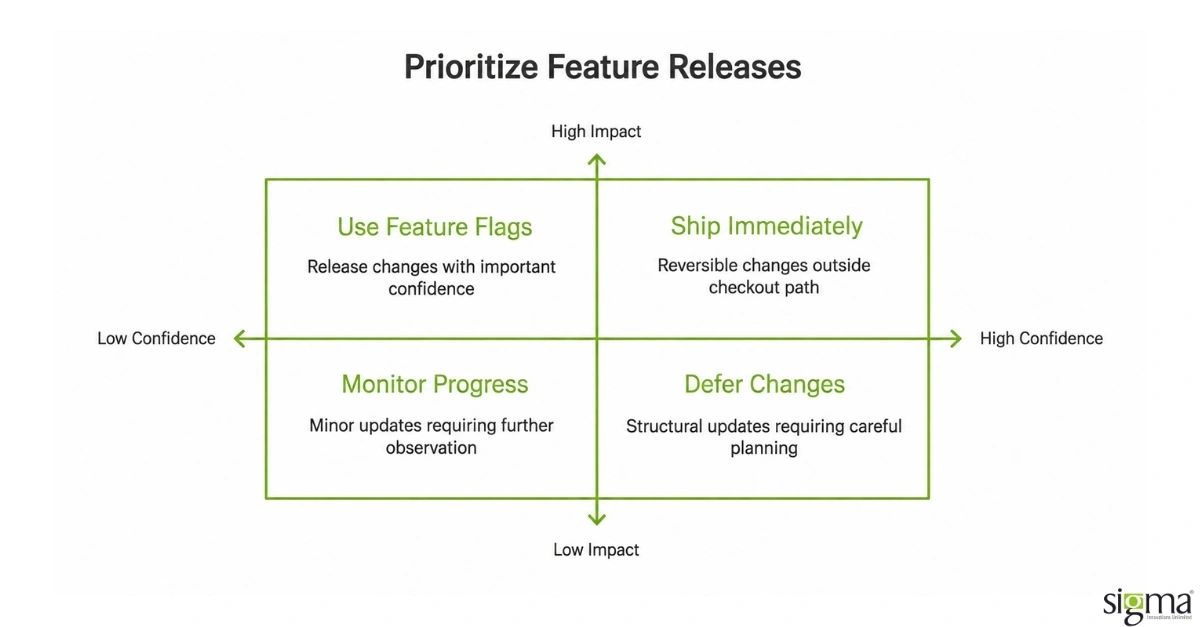
Three categories cover nearly every candidate fix, and sorting into them takes less time than arguing about any individual item.
Ship now covers changes that are reversible, well understood, and outside the checkout path. Performance work fits here almost entirely, since image handling, caching, and render-blocking resource removal improve Core Web Vitals without altering business logic, and a regression is visible immediately in monitoring rather than silently in the funnel.
Defer covers structural changes to checkout, payment provider migrations, and anything requiring a data model change. These have the largest upside and the least tolerance for being wrong, and January exists.
Ship behind a flag covers the middle, where the fix is valuable and the confidence is imperfect. A change deployed dark and enabled for a small traffic share can be evaluated with real behavior and disabled in seconds without a deployment, which converts a deployment risk into a configuration change. Establishing that capability is itself a pre-peak project, and it is the one with the highest return for teams that face a peak every year.
Read the blog: Holiday eCommerce sales trends that every business must know
The Decision Between a Better Funnel and a Stable One
Pre-peak optimization is not about maximizing the number of changes shipped before the freeze. It is about identifying which improvements are commercially meaningful, technically safe, and reversible within the remaining window. Sigma approaches that decision as a commerce engineering capability, balancing conversion opportunity against the operational risk of changing a revenue-critical system at the worst possible time.
Quantify the Upside Before Touching Production
Every proposed change should have a measurable reason to exist. Sigma evaluates funnel data to size the potential revenue recovery from checkout, navigation, search, product discovery, payment, and other conversion improvements. The result is a business case grounded in the client’s actual traffic and conversion behavior rather than a generic optimization target.
This approach draws on experience supporting commerce environments where sustained optimization matters across multiple peak cycles. The objective is not a one-time conversion lift, but a repeatable process for identifying, prioritizing, and safely implementing improvements.
Make Engineering Risk Explicit
A conversion improvement can be commercially attractive and still be the wrong change to make immediately before peak. Sigma assesses the systems affected, integration dependencies, observability coverage, rollback path, and operational ownership before recommending a production release.
That assessment becomes particularly important when checkout, payments, order management, or fulfillment systems are tightly connected. Experience modernizing Magento environments and introducing headless architecture also demonstrates how architectural decoupling can change the scope of what can be modified safely. When the presentation layer is separated from transaction-critical services, some experience improvements can move forward without exposing the entire order flow to unnecessary change risk.
Turn the Freeze Into an Operating Control
A deployment freeze works only when it is treated as a defined operating control rather than a general recommendation. Sigma establishes the freeze date early, separates planned improvements from genuine emergency fixes, and defines who can authorize an exception.
This gives engineering teams a clear boundary during peak traffic. Instead of continuing to absorb deployment risk, they can focus capacity on monitoring, incident response, performance stability, and the operational issues that high traffic inevitably surfaces.
Defer With a Plan, Not a Placeholder
When a change is too risky for the pre-peak window, deferral should not mean losing the improvement. Sigma converts deferred opportunities into an actionable post-peak roadmap, with the requirements, dependencies, architecture considerations, and measurement criteria already defined.
That creates a better outcome than rushing a questionable release or allowing a valuable optimization to disappear into the backlog. The business protects peak-season revenue while entering the next optimization cycle with a clearer path to measurable conversion gains.
Conclusion
Conversion rate optimization in the weeks before peak operates under a different expected value calculation than the same work in an ordinary quarter, because the cost of being wrong rises at exactly the moment the tolerance for it falls. Sizing each leak by recoverable revenue rather than by how alarming it looks produces a different priority order, and pairing that estimate with an honest deployment risk produces the decision itself. Performance and presentation repairs are generally worth shipping now, structural changes to checkout and payments are generally worth deferring, and the valuable middle belongs behind a feature flag that makes reversal a configuration change. A freeze that admits individually justified exceptions provides none of the protection it was created for. The organizations that come through peak well are usually the ones that shipped less than they wanted to and kept their engineering attention free for the problems traffic creates on its own.
FAQs
What is pre-peak conversion rate optimization, and how is it different from regular CRO?
Pre-peak CRO is the practice of fixing known, measurable conversion leaks before a major traffic event like Black Friday or Cyber Monday. Unlike ordinary CRO, which relies on continuous testing and accepts that most experiments will fail cheaply, pre-peak work is repair-focused: there isn’t time for tests to reach statistical significance before the traffic pattern shifts, so teams fix what’s already known to be broken rather than run new experiments.
Why does the same conversion fix carry more risk in October than in June?
Because the cost of a failed deployment rises sharply near peak season while the team’s capacity to absorb it shrinks. Engineering is stretched thin managing campaigns and incidents, on-call rotations are thinner, and a rollback has to compete with live production issues — so a defect that would be caught and fixed in days during an ordinary quarter can instead be found by customers, at volume, during the highest-revenue weeks of the year.
How should a company prioritize which conversion leaks to fix before the freeze?
By recoverable revenue, not by how alarming the problem looks. Recoverable revenue is a function of how many sessions hit the issue, how many of those sessions would have converted, and how much they’d have spent. That figure should then be weighed against deployment risk — low-risk, well-sized fixes (like performance and presentation issues) ship now, while high-risk structural changes (like checkout or payment provider migrations) get deferred regardless of how large the opportunity looks.
What kinds of fixes are generally safe to ship right before Black Friday?
Reversible, well-understood changes outside the checkout path — mainly performance and presentation work such as image optimization, caching, render-blocking resource removal, out-of-stock handling, and search configuration issues. These improve Core Web Vitals or user experience without touching core business logic, and a regression shows up immediately in monitoring rather than silently inside the funnel.
What should companies avoid changing right before peak season?
Structural changes to checkout, payment provider migrations, and anything requiring a data model change (like adding guest checkout). These carry the highest potential upside but the least tolerance for error, so they should be deferred to January rather than risked during peak weeks.
What does it mean to “ship a fix behind a flag,” and why does it matter for peak readiness?
It means deploying a change dark and enabling it for a small share of traffic, so it can be evaluated with real user behavior and instantly disabled — without a deployment — if something goes wrong. This converts a deployment risk into a configuration change. Building this capability ahead of peak season is itself a high-value pre-peak project, since it lets teams safely test the “valuable middle” of fixes that are neither obviously safe nor obviously too risky.
What is a deployment freeze, and how should it be enforced?
A deployment freeze is a defined operating control — not a general guideline — where the freeze date is set early, planned improvements are separated from genuine emergencies, and it’s clear who can authorize an exception. Without firm enforcement (i.e., if individually justified exceptions keep getting approved), the freeze provides none of the protection it’s meant to provide.
If a valuable fix has to be deferred, does it get lost?
It shouldn’t. Deferred fixes should become part of an actionable post-peak roadmap, with requirements, dependencies, architecture considerations, and measurement criteria already defined — so the improvement is ready to execute in January rather than sitting in an undefined backlog.
How does having a legacy platform or tightly connected systems (checkout, payments, fulfillment) affect this process?
It raises the stakes of any change, since a small checkout or payment adjustment can ripple across multiple connected systems. This is where assessing integration dependencies, observability coverage, rollback paths, and operational ownership becomes critical before approving any pre-peak release — and where architectural decoupling (e.g., headless approaches) can expand what’s safely changeable without exposing the full order flow to risk.
What’s the actual business outcome of doing this well?
Companies that manage this trade-off carefully typically ship fewer changes than they initially wanted to, but protect peak-season revenue and keep engineering capacity free to handle the operational issues that high traffic inevitably surfaces — rather than firefighting a self-inflicted regression during the weeks that fund the year.