A Magento Performance Monitoring Cadence Is What Keeps Your Fixed Store From Slowing Down Again

Key Highlights:
- A Magento store that has just been fixed is not permanently fixed, since new extensions, catalog growth, and content updates reintroduce the same performance problems within a few release cycles without ongoing oversight.
- A defined monitoring cadence, covering Core Web Vitals trends, server response behavior, and extension impact, catches regressions while they are small and cheap to fix rather than after they show up in conversion data.
- Deciding who owns this cadence internally, and how much of it to delegate to a specialist partner, is a resourcing decision that most teams make by default rather than on purpose.
- Sigma builds this monitoring cadence into every Magento performance engagement as a standing deliverable, not an optional add-on purchased after the fact.
Introduction
Your Magento Store Is Fast Again. How Do You Keep It That Way?
A Magento performance optimization project can solve the problems slowing your store today, but it cannot prevent those problems from returning as the storefront evolves. New extensions, larger catalogs, additional integrations, marketing scripts, traffic growth, and ongoing releases can gradually change the store’s performance profile. For an IT Director, Head of Engineering, CTO, or eCommerce technology leader, the question after a successful optimization project is therefore not simply whether Magento is fast today, but how to protect the investment as the platform changes. A Magento performance monitoring cadence provides that discipline by establishing a performance baseline, tracking meaningful signals, defining thresholds, and assigning clear ownership when performance begins to drift. The objective is not to monitor everything continuously; it is to identify regression while it remains a manageable engineering issue rather than allowing it to become a customer-experience, conversion, or infrastructure problem.
Magento performance slipping as your store evolves?
Why Magento Performance Regresses After a Successful Fix
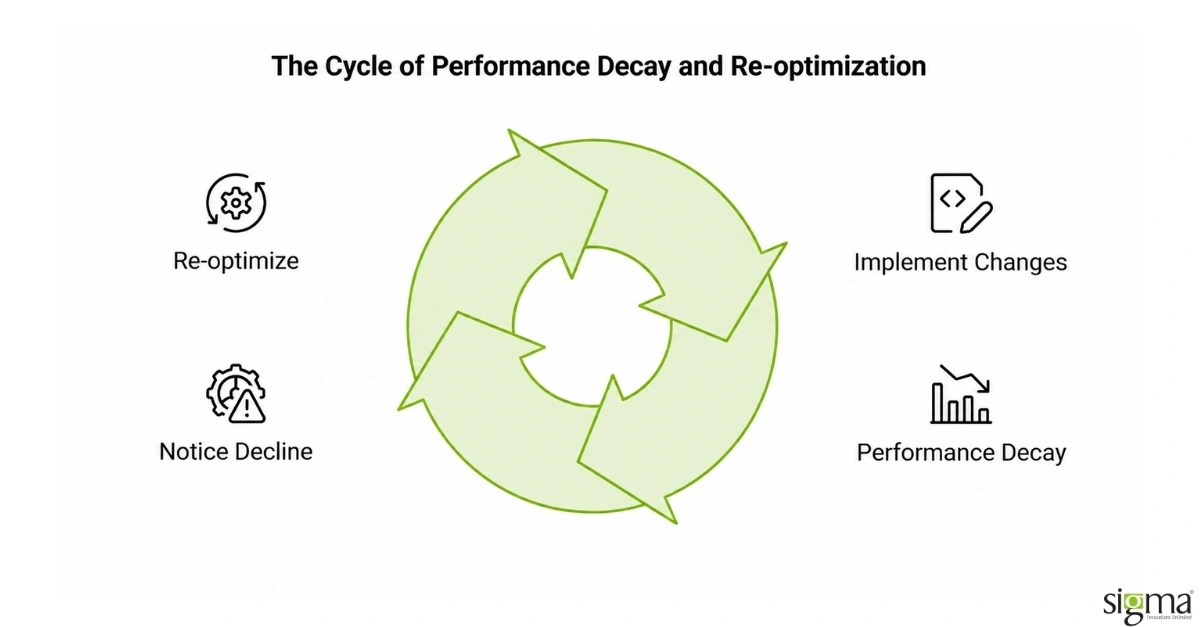
Performance regression does not necessarily mean the original optimization failed. Magento stores are active technology environments, and every new extension, integration, catalog expansion, content change, campaign script, or infrastructure adjustment can alter how the storefront performs. Individual changes may have little measurable impact, but their cumulative effect over several months can gradually move the store away from the baseline established after optimization. This creates a costly cycle in which a business invests in performance improvements, sees the store recover, allows performance to become someone else’s responsibility, and eventually funds another optimization project when customers or business metrics expose the decline. The underlying issue is often not poor technical decision-making but a lack of visibility between business changes and their performance consequences. Marketing may reasonably add personalization, product teams may introduce a new integration, and merchandising may expand the catalog, but without a defined performance review process, nobody is accountable for understanding how those decisions affect the storefront. A monitoring cadence closes that gap by making performance part of the ongoing operating model rather than something revisited only after the business notices a problem.
What a Working Magento Performance Monitoring Cadence Actually Tracks
A useful Magento performance monitoring cadence should focus on a limited set of signals that indicate whether the store is moving away from its expected operating baseline. Core Web Vitals can provide visibility into the customer-facing experience, while server response behavior, application errors, database performance, infrastructure capacity, and extension changes provide insight into what may be driving degradation. The objective is not to treat every fluctuation as an incident, but to identify sustained changes that warrant investigation. Thresholds are therefore as important as the metrics themselves. Rather than relying on a universal PageSpeed score or an arbitrary percentage change, engineering teams should establish thresholds based on the store’s existing baseline, traffic patterns, architecture, business requirements, and acceptable customer experience. This turns monitoring from passive reporting into an operating mechanism: a signal is detected, an owner evaluates it, and an agreed action follows.
Monitoring Cadence by Risk: Continuous, Weekly, and Periodic Checks
Different performance signals require different levels of attention. Critical availability, error-rate, and infrastructure issues should generally be monitored continuously through automated alerting because they can affect customers before a scheduled review takes place. Weekly reviews are better suited to identifying performance trends, including changes in Core Web Vitals, server response behavior, and anomalies following recent releases. Monthly or quarterly reviews can then examine slower-moving sources of degradation, such as extension dependencies, database growth, infrastructure capacity, third-party scripts, and architectural constraints. The right cadence depends on the complexity and business criticality of the storefront, but the principle remains consistent: monitor high-risk signals continuously, review performance trends regularly, and periodically reassess the underlying system as the business grows.
| Performance Area | What to Monitor | Business Implication | Recommended Cadence |
| Server & Application Health | Error rates, response times, uptime, infrastructure behavior | Slow or unstable systems can affect customer experience and transactions | Continuous monitoring + weekly review |
| Core Web Vitals | LCP, INP, CLS and broader storefront performance trends | Indicates whether customers are experiencing a degraded storefront experience | Weekly trend review |
| Extensions & Dependencies | New or updated extensions, third-party scripts, dependency changes | New functionality can introduce front-end or backend performance costs | Monthly + after major releases |
| Database Health | Slow queries, table growth, accumulated operational data | Database degradation can increase response times as the store grows | Monthly/quarterly |
Performance Should Become Part of the Release Decision
Monitoring is most valuable when it is connected to the changes that can cause regression. A new extension, third-party script, integration, catalog restructuring, or major campaign does not automatically require a full performance audit, but higher-impact changes should trigger consideration of their potential performance implications. A practical model is to assess the expected impact of significant changes, establish what should be measured after release, and compare the results against the existing baseline. This creates a feedback loop between business change and engineering oversight: change the storefront, assess the potential impact, release it, monitor the outcome, and investigate if performance moves outside the agreed range. For engineering leaders, this approach is more sustainable than treating performance as a separate technical activity that happens months after the change that caused the problem.
Deciding Who Owns the Magento Performance Cadence
Ownership is ultimately a resourcing and accountability decision rather than a tooling decision. Internal teams can often manage routine performance reviews, automated monitoring, and basic incident response when sufficient DevOps or eCommerce engineering capacity exists. Specialist support becomes more valuable when the issue requires deeper diagnosis, extension interaction analysis, architecture-level investigation, or remediation that falls outside the team’s day-to-day expertise. The most effective model does not necessarily require outsourcing the entire cadence. A deliberate split can allow the internal team to own routine monitoring while a specialist partner handles deeper assessments and complex regressions. What matters is that responsibility is explicit: someone must own the review, someone must determine whether a deviation matters, and someone must be accountable for investigating and resolving it when the threshold is breached.
| Responsibility | Internal Team | Specialist Partner |
| Routine performance review | ✓ | |
| Monitoring and alerting | ✓ | |
| Release and change awareness | ✓ | |
| Deep performance diagnosis | ✓ | |
| Extension interaction analysis | ✓ | |
| Architecture-level remediation | ✓ | |
| Periodic performance assessment | Shared | Shared |
The important question is therefore not who owns the monitoring tool. It is who owns the decision when Magento performance moves outside the agreed baseline. Making that responsibility explicit prevents performance issues from being pushed behind feature work until the resulting impact becomes visible to customers or business leadership.
The Costly Mistake: Monitoring Without Ownership
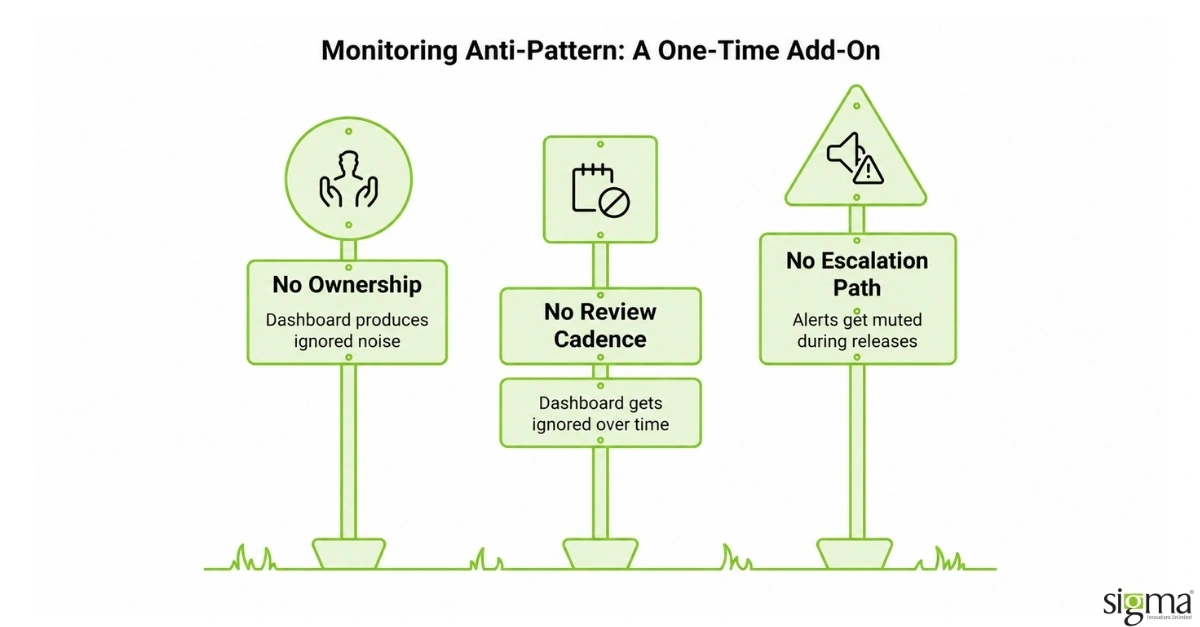
A monitoring dashboard does not create a performance management process by itself. Teams can configure alerts, establish dashboards, and technically have the right tools in place while still failing to detect meaningful regression because nobody is responsible for reviewing the signals or acting on them. Over time, alerts become noise, thresholds lose relevance, and performance monitoring becomes another operational task that gets deprioritized when feature work accelerates. A useful way to evaluate any monitoring program is therefore to ask whether every important signal has three things behind it: a defined threshold, a named owner, and a clear action. Without those three elements, the organization may believe Magento is being monitored while functionally operating without meaningful performance oversight.
From Performance Monitoring to Ongoing Performance Engineering
Monitoring should not exist simply to tell a team that Magento has become slower. Its greater value is creating an ongoing feedback loop between storefront changes, technical performance, and business priorities. When a performance deviation is detected, the next step should be to determine whether the issue is isolated or systemic, understand what changed, assess the business impact, and prioritize remediation accordingly. This prevents teams from responding to every performance fluctuation with a costly optimization exercise while also avoiding the opposite problem of allowing persistent degradation to accumulate. For a growing Magento business, ongoing performance engineering provides a more sustainable model because it connects measurement, diagnosis, prioritization, and remediation rather than treating each as a separate activity.
Sigma’s Approach to Sustaining Magento Performance
Performance optimization should not be treated as a point-in-time engineering exercise when the commerce environment continues to change. Sigma approaches Magento performance with that lifecycle in mind: establish the baseline, identify the factors affecting performance, prioritize improvements according to business impact, and define how performance will be evaluated as the storefront evolves. For organizations that require ongoing engineering support, this can extend into recurring performance reviews, regression analysis, extension and dependency assessments, and targeted remediation when the underlying system changes. For teams that prefer to manage routine monitoring internally, the same approach can be structured around documented baselines, monitoring criteria, and escalation considerations. The objective is not to add another dashboard to the technology stack; it is to make Magento performance an owned engineering outcome that remains visible as the catalog, integrations, traffic, and storefront continue to evolve.
Sigma’s broader Magento engineering approach is grounded in understanding the existing architecture before recommending where optimization effort should go. That means distinguishing between issues that can be addressed through infrastructure, caching, database, extension, or front-end improvements and situations where deeper architectural changes may be justified. The appropriate solution depends on the store’s current condition, business priorities, growth expectations, and technical constraints rather than on applying the same optimization checklist to every implementation.
Protect the Performance Investment, Not Just the Performance Score
Magento performance optimization creates a baseline; it does not freeze the storefront in place. As catalogs grow, extensions change, integrations evolve, campaigns launch, and traffic increases, the conditions affecting performance change with them. Without a defined way to detect and respond to that change, performance can gradually regress until the problem becomes visible through customer experience, conversion data, or infrastructure costs. The sustainable approach is to establish a practical operating model that combines continuous monitoring for critical issues, regular performance-trend reviews, periodic technical assessments, and clear ownership when performance moves outside the agreed baseline.
For IT Directors and Heads of Engineering, this turns Magento performance from a recurring optimization project into an ongoing engineering outcome. The goal is not simply to make the store faster once; it is to prevent the same performance problem from becoming the next project on the roadmap.
Conclusion
Magento performance is not something you fix once and forget. As your store evolves, changes in extensions, integrations, catalog size, traffic, and releases can gradually erode the gains made through optimization. A defined monitoring cadence gives your team the visibility to spot those changes early, understand what is driving them, and act before they become larger business or customer-experience issues.
The goal is simple: keep your Magento store performing as your business grows, not just immediately after an optimization project.
Ready to keep Magento performance strong as your store evolves?
Frequently Asked Questions
How often should a Magento store’s performance actually be reviewed?
Core Web Vitals and server response trends should be reviewed weekly at minimum, ideally through automated alerting rather than manual checks. A full extension and dependency audit should run quarterly, or immediately following any major catalog expansion, integration change, or marketing campaign that adds new front-end code.
Can an internal team handle Magento performance monitoring without outside help?
Often, yes, for routine weekly checks and basic alerting, provided the team has existing DevOps capacity and someone assigned to actually own the review. Quarterly deep audits and diagnosing subtle regressions, such as conflicts between extensions, typically benefit from more specialized experience than most internal eCommerce teams maintain day to day.
What is the biggest mistake teams make with Magento performance monitoring?
Treating it as a one-time setup task rather than an ongoing commitment with a named owner. A dashboard configured once and never reviewed on a defined cadence produces noise that gets ignored, which leaves the store functionally unmonitored despite having monitoring tools technically in place and configured correctly.
Why does a Magento store slow down again after it was already fixed?
Because the store keeps changing after the fix ships. New extensions, catalog growth, and content updates each introduce a small performance cost, and without a monitoring cadence to catch these changes early, they accumulate quietly back into the same problem the original fix was meant to resolve.
What does Sigma include in a Magento performance monitoring engagement?
Sigma defines a weekly Core Web Vitals and server response review cadence, sets documented alert thresholds, and runs quarterly extension and dependency audits, with ownership split clearly between the client’s internal team and Sigma’s engineers, documented as a named part of the original engagement scope.