Why eCommerce Search Fails Shoppers: Fixing Product Discovery With Generative AI

Key Takeaways:
- Ecommerce search is losing high-intent shoppers through zero-result and irrelevant searches.
- Generative AI understands shopper intent, improving product discovery through semantic search and automated attribute enrichment.
- AI merchandising scales beyond manual rules, optimizing product rankings using conversion, inventory, margin, and seasonal signals.
- Sigma starts with the data, combining search-log analysis, catalog enrichment, AI search, and merchandising within existing Magento, Shopify, or BigCommerce stacks.
Introduction
A shopper types “something warm for winter hiking” into your search box. The engine looks for products containing “something,” “warm,” “winter,” and “hiking.” It finds a beanie, a hiking sock, and nothing else. The insulated jacket that would have been perfect never appears, because its title says “Thermal Shell Parka” and its description never uses the word “warm.”
The shopper assumes you do not carry what they need and leaves. That shopper was among your highest-intent traffic. Site searchers convert at roughly 2.5 times the rate of browsers, and while they represent about a quarter of visitors, they drive close to half of all revenue. Generative AI ecommerce closes this gap by teaching search to understand intent rather than match strings, and extending that intelligence to merchandising decisions no team can hand-tune at catalog scale. Sigma’s eCommerce Development Services help mid-market retailers build that capability into the storefronts they already run.
Industry data puts the average ecommerce zero-results rate at 10% to 15% against a best-practice target below 5%, while roughly 81% of US shoppers abandon a site after an unsuccessful search and 82% avoid returning to a site where search failed them before.
The Search Box Is Where Revenue Leaks
Most mid-market retailers treat site search as infrastructure that either works or does not. In reality, it sits on a spectrum, and the difference between mediocre and excellent search is where a meaningful share of revenue lives.
The clearest symptom is the zero-results rate. One in seven searches on a typical store ends with an empty page, and those are shoppers who knew what they wanted and took the trouble to describe it.
The second symptom is subtler and more expensive: searches that return results, but the wrong ones. A shopper searching “wedding guest dress” gets every dress in the catalog sorted by popularity, including bridal gowns and sundresses. Technically the search worked. Practically it failed, because the shopper still has to wade through 200 products to find the ten that fit.
Both failures share a root cause. Keyword search matches literal strings against product text. It has no concept of what a product is for or what problem it solves.
Why Keyword Search Cannot Keep Up
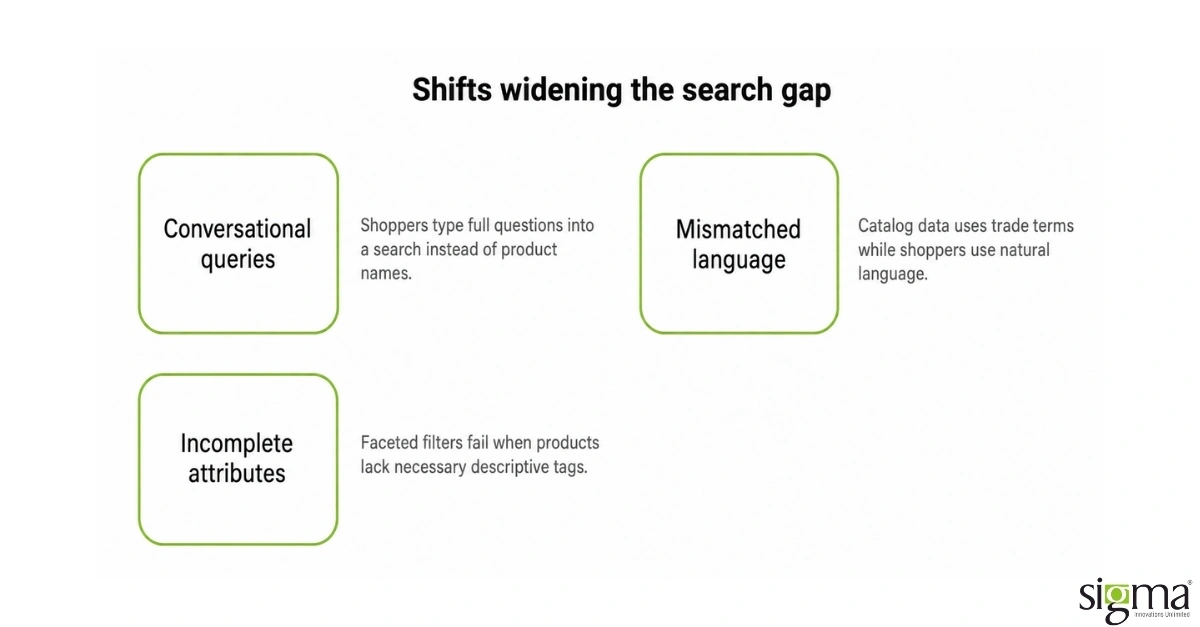
Shopper behavior has moved faster than search technology at most retailers. Three shifts have widened the gap.
Queries have become conversational. Shoppers who spend their day asking AI assistants full questions now type full questions into site search. “Gift for a dad who likes grilling” is a use-case query, not a product-name query. Keyword engines cannot answer it because no product contains those words.
Catalog language does not match shopper language. Product data written by vendors and manufacturers uses trade terms and specifications. Nobody searches for “polyurethane-coated ripstop nylon.” They search for “rain jacket that packs small.” Synonym dictionaries help at the margins but never cover the long tail of phrasings.
Attributes are incomplete. Faceted filters only work when products carry the attributes shoppers filter on. Coverage is strong for top sellers and patchy everywhere else. A product missing its occasion or fit tag is invisible to anyone filtering on those dimensions.
Zero-results rate drops when the catalog infrastructure is sound: Scaling Magento for high-SKU faceted search.
Why Merchandising Rules Hit the Same Ceiling
The merchandising layer has a parallel problem. AI merchandising matters because manual rules do not scale with catalog size or seasonality.
A team can realistically maintain curated ordering and boosting rules for the top 100 to 200 products. For a catalog of 10,000 SKUs, the rest runs on a default sort nobody has reviewed in months. High-margin products sit buried on page four. Seasonal relevance decays because updating rules across hundreds of category pages is a week of work nobody has time for.
| Capability | Keyword Search + Manual Rules | Generative AI Search + Merchandising |
| Query understanding | Literal string matching | Semantic meaning and intent |
| Use-case queries | Returns zero or irrelevant results | Maps intent to product attributes |
| Catalog coverage | Rules cover top 100–200 SKUs | Full catalog governed automatically |
| Attribute enrichment | Manual tagging, patchy coverage | Auto-generated attributes from images and copy |
| Seasonal adaptation | Manual rule updates per category | Adjusts to behavioral and inventory signals |
| Maintenance burden | Constant synonym and rule tuning | Model retraining on refreshed data |
What Generative AI eCommerce Actually Changes
AI product search replaces string matching with vector search. Queries and products are converted into embeddings, mathematical representations of meaning, and the engine returns the nearest matches. “Something warm for winter hiking” surfaces the Thermal Shell Parka because the model understands that thermal and warm occupy the same semantic space, despite zero shared keywords.
Generative models also close the attribute gap. Instead of hand-tagging 10,000 products with occasion, fit, and material attributes, a model reads product images and descriptions and generates structured attributes automatically. Faceted navigation improves across the entire catalog rather than just the curated slice.
On the merchandising side, generative AI retail systems set category-page ordering from live signals: conversion rate, margin, inventory depth, and seasonal behavior. The merchandising team shifts from writing rules to setting objectives.
Read the blog: Advancing Chatbot Capabilities with Full-Stack AI Development Services
The Gap Between Adoption and Results
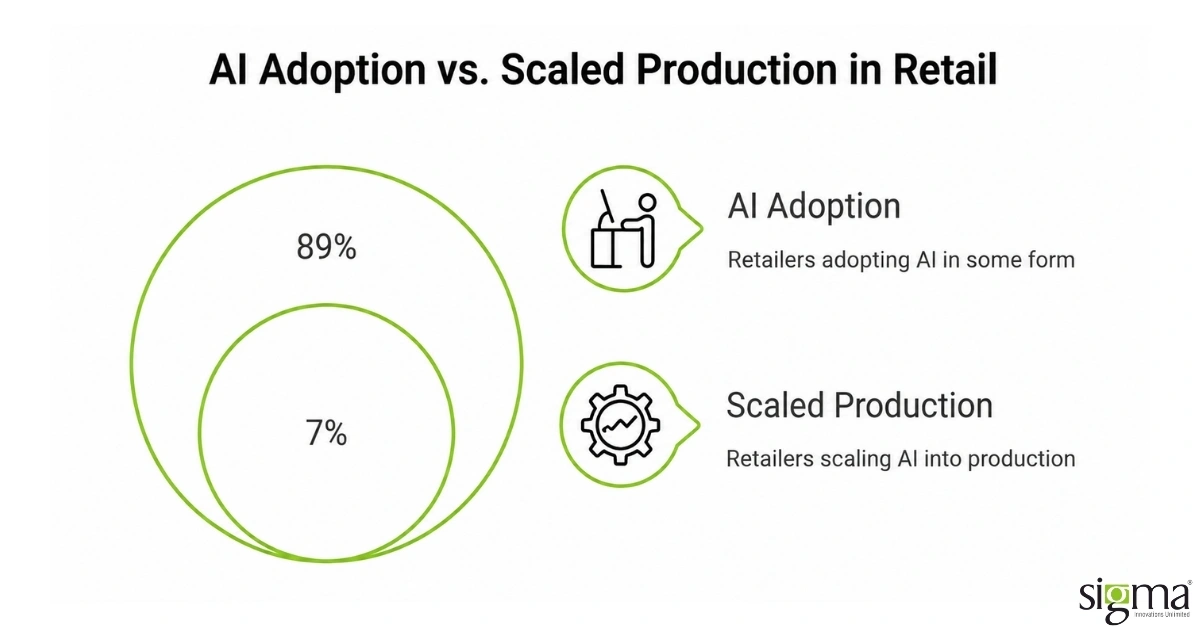
Roughly 89% of retailers report adopting AI in ecommerce in some form, but only about 7% have scaled it into production with measurable impact. That 82-point gap is the real story of AI in commerce right now.
The reason is rarely the model. It is the data underneath. Semantic search performs poorly on catalogs with thin descriptions and inconsistent taxonomies. AI merchandising cannot optimize toward margin if margin data never reaches the system. Ecommerce personalization AI cannot personalize without clean behavioral tracking. AI amplifies whatever data quality already exists, which is why retailers seeing returns treated catalog data as an engineering problem before treating AI as a purchase.
Reading the Search Logs Before Buying a Search Product
The most common sequence in mid-market retail search is also the most expensive one. A team buys a search product, connects the catalog feed, watches results improve for common queries and stay broken for everything else, and then arbitrates a dispute where the vendor blames the data, and the retailer has no way to verify or fix it.
Sigma does not start by evaluating search products, because the search product is rarely the variable. It starts with the logs, which nobody reads and which contain the answer.
At an apparel retailer with 9,000 SKUs and a zero-results rate of 14%, the logs showed that 60% of failed queries were use-case phrases the catalog carried no attributes to answer. Shoppers were describing occasions, fits, and seasons. The product data described materials and SKUs. No AI product search implementation resolves that mismatch, because the semantic layer has nothing on the product side to match against.
So the fix started with data. A generative pipeline read product images and vendor descriptions to produce occasion, fit, and season attributes for every SKU, and only then was the index rebuilt with vector matching layered over keyword fallback. Zero-results dropped to 4.2% within six weeks. The search technology was the last thing touched.
Enhanced search and product attribute management across a seven-year Magento partnership: continuous catalog optimization for a large-SKU retailer.
The AI merchandising side follows the same rule. A home goods retailer had functional search and category pages running on rules written eighteen months earlier. Sigma built a layer that reorders pages daily against conversion, stock depth, and margin, with guardrails so merchandisers can still pin campaign products regardless of model preference. The team stopped spending Mondays updating sort rules.
Behavior-driven recommendations, personalized email, and real-time inventory sync across 50+ locations: a Shopify build for a cosmetics brand.
Enriched attributes and merchandising logic live in the retailer’s own systems, not a vendor’s black box. This is Sigma’s eCommerce Development Services work on generative AI ecommerce.
Conclusion
Search and merchandising are where shopper intent meets your catalog, and at most mid-market retailers both run on technology that predates how people actually shop. Keyword matching cannot answer use-case queries. Manual rules cannot govern thousands of SKUs. Generative AI ecommerce addresses both by understanding what shoppers mean rather than what they typed, enriching product data automatically, and optimizing merchandising continuously. The retailers pulling ahead are not the ones with the most AI features. They are the ones who fixed catalog data first and then let the models work. Sigma Infosolutions helps mid-market retailers do exactly that, starting with search logs and product data rather than a vendor demo.
Frequently Asked Questions
What is generative AI ecommerce and how does it improve product discovery?
Generative AI ecommerce applies large language and embedding models to search, merchandising, and catalog enrichment. It converts shopper queries and products into semantic representations so search understands intent rather than matching keywords, and it generates missing product attributes automatically to improve filtering and discovery across the full catalog.
How does AI product search reduce zero-result searches?
AI product search uses vector matching, embedding both the query and the product catalog into a shared semantic space. A query like “something warm for winter hiking” returns insulated jackets that share no literal keywords, because the model matches meaning. This addresses the use-case queries behind a large share of zero-result searches.
What does AI merchandising do that manual rules cannot?
AI merchandising governs the entire catalog rather than the top 100 to 200 products a team can hand-tune. It reorders category pages continuously against conversion, margin, inventory depth, and seasonal signals, while allowing merchandisers to pin campaign products. Manual rules cover a small slice and decay between updates.
Why do most AI in ecommerce projects fail to scale?
Roughly 89% of retailers have adopted AI in ecommerce but only about 7% have scaled it with measurable impact. The common blocker is data rather than models. Thin product descriptions, inconsistent taxonomies, missing attributes, and incomplete event tracking limit what any AI system can do regardless of vendor.
How does Sigma implement generative AI retail capabilities on existing platforms?
Sigma starts with search log analysis and catalog data quality, then builds generative enrichment pipelines that produce missing product attributes, implements vector search with keyword fallback, and adds merchandising logic with merchandiser guardrails. The work is delivered inside the retailer’s existing Magento, Shopify, or BigCommerce stack.