Hyva Theme Migration ROI: Setting Realistic Expectations Before Budget Gets Committed

Key Highlights:
- Retailers evaluating a Hyva migration often anchor on marketing claims about speed rather than a grounded estimate of their own likely return.
- Hyva theme migration ROI depends on current Luma performance, catalog size, and how directly conversion rate responds to page speed for the specific store.
- Getting this estimate right before committing a budget avoids both an unjustified delay and an oversold business case that disappoints stakeholders later.
- Sigma scopes Hyva migrations for eCommerce clients with a realistic ROI model built from the store’s own baseline data, not industry averages.
Introduction
Retailers evaluating a migration from Magento’s legacy Luma theme to Hyva frequently encounter marketing material promising dramatic speed improvements without much grounding in how those improvements translate into an actual return for a specific store. Hyva theme migration ROI is genuinely substantial for many retailers, but the size of that return depends heavily on factors specific to the individual store, current Luma performance baseline, catalog size and complexity, and how directly the store’s conversion rate actually responds to page speed improvements, none of which a generic industry claim can account for. Building a grounded ROI estimate before committing a migration budget protects against both directions of error: delaying a migration that would clearly pay for itself, and overselling a migration’s expected return to stakeholders who then measure the investment against an inflated benchmark. For a Head of eCommerce or CTO evaluating whether migration budget is justified, the decision turns less on whether Hyva delivers speed gains and more on whether those gains translate to measurable conversion improvement for that specific store’s traffic profile and customer behavior. Getting this calibration right from the outset is what separates a business case that holds up under board scrutiny from one that quietly disappoints against its own projections after launch.
Assess your Magento store’s needs, migration scope, and performance goals before committing your budget.
Establishing an Accurate Performance Baseline Before Estimating Return
An accurate ROI estimate starts with measuring the current Luma theme’s actual performance, page load times, Core Web Vitals scores, and bounce rate correlation with page speed, rather than assuming a generic industry baseline applies to the specific store’s situation. A store already running a reasonably optimized Luma theme, cached and minified appropriately, will see a smaller absolute performance gain from migrating to Hyva than a store running an unoptimized, plugin-heavy Luma implementation, which directly affects how much of Hyva’s marketed performance advantage actually translates into measurable improvement for that specific store. This baseline measurement should be captured across a representative sample period, not a single snapshot, since traffic patterns, promotional spikes, and device mix all influence how the current theme actually performs for real customers on a typical day rather than an unusually quiet or unusually busy one.
Connecting Performance Gains to Actual Conversion Impact
The critical step most ROI estimates skip is connecting a projected performance improvement to actual conversion rate impact for the specific store, since the relationship between page speed and conversion varies by industry, catalog type, and existing traffic quality rather than following a single universal curve. A store with historical data showing a clear correlation between page speed and conversion, visible through funnel analysis when a specific slow release previously hurt conversion, can build a considerably more confident ROI projection than a store estimating this relationship from industry-wide averages that may not reflect its actual customer behavior.
Read our success story: Modernizing a Magento Storefront with Hyvä
How Store Profile Shapes Hyva Theme Migration ROI Across Different Implementations
| Store Profile | Expected Performance Gain | ROI Confidence |
|---|---|---|
| Unoptimized Luma, high traffic | Substantial | High, clear baseline to measure against |
| Already-optimized Luma, high traffic | Moderate | Moderate, smaller absolute gain |
| Unoptimized Luma, low traffic | Substantial | Lower, smaller total revenue impact |
| Already-optimized Luma, low traffic | Modest | Lower, migration may not justify cost yet |
Accounting for Migration Cost and Timeline Realistically
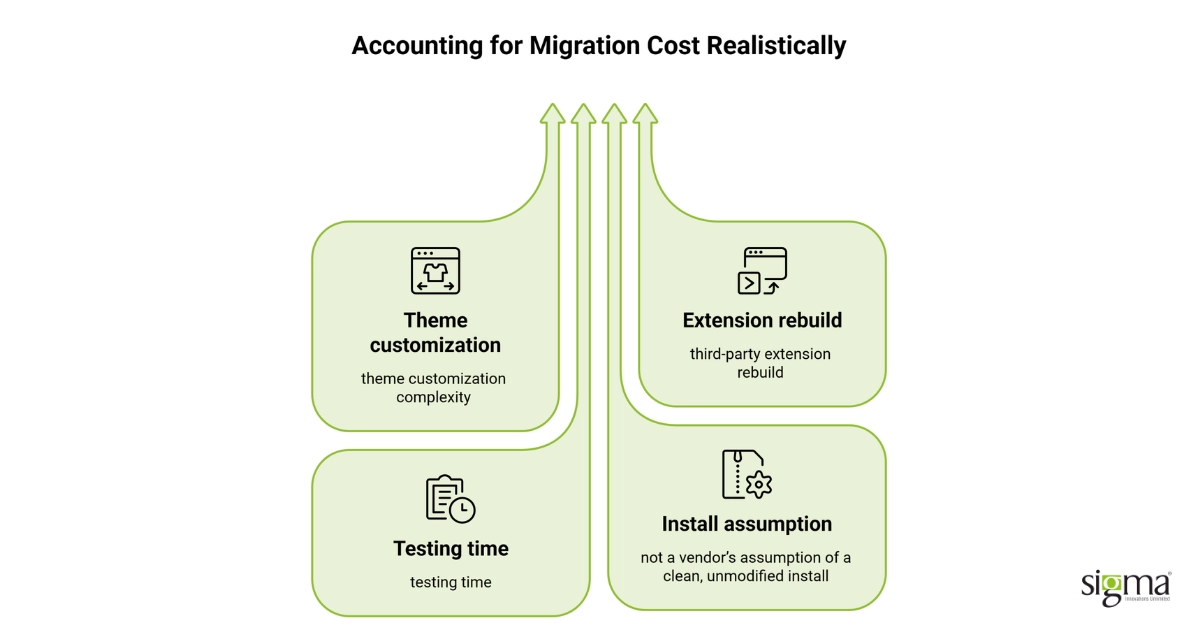
The cost side of the ROI equation requires an honest accounting of migration scope, theme customization complexity, third-party extension compatibility work, and testing time, rather than a vendor estimate that assumes a clean, unmodified Luma installation with no custom functionality to migrate. A store with significant Luma customization built up over years will face a considerably larger migration scope than a relatively vanilla implementation, which directly extends both the cost side of the calculation and the timeline before the performance gains actually start generating measurable return. Third-party extensions deserve particular scrutiny during this accounting, since Hyva’s frontend approach differs enough from Luma that extensions relying on Luma-specific templating often need a genuine Hyva-compatible rebuild rather than a straightforward reconfiguration, and that rebuild work is easy to underestimate when scoping the project from a vendor’s generic timeline rather than the store’s actual extension inventory.
That same grounding in measured baseline performance and actual outcomes, rather than marketing claims, is exactly what a credible Hyva migration ROI estimate depends on.
Building a Post-Migration Measurement Plan From the Start
A credible ROI estimate should include a defined measurement plan for after the migration goes live, tracking the same Core Web Vitals and conversion metrics used in the baseline against post-migration results over a defined period, since this is the only way to confirm whether the projected return actually materialized. Retailers that skip this measurement step lose the ability to validate their original business case, which also means they lose valuable data that would inform whether further Hyva investment, deeper customization or extending the migration to additional store views, is genuinely justified.
The ROI Model Sigma Builds Before Recommending Any Hyva Theme Migration
Sigma Infosolutions scopes Hyva migrations for eCommerce clients by first establishing a measured performance baseline and modeling expected ROI against that specific store’s catalog, traffic, and historical conversion sensitivity to page speed, rather than presenting a generic industry projection. That approach has produced migration business cases that held up under stakeholder scrutiny after launch, since the original estimate was grounded in the store’s own data rather than marketing claims that do not necessarily apply to every implementation.
Retailers that build their business case this way consistently secure stakeholder buy-in more easily and avoid the credibility cost of a migration that underdelivers against an inflated initial projection.
Deciding Whether to Migrate Now or Wait for a Stronger Case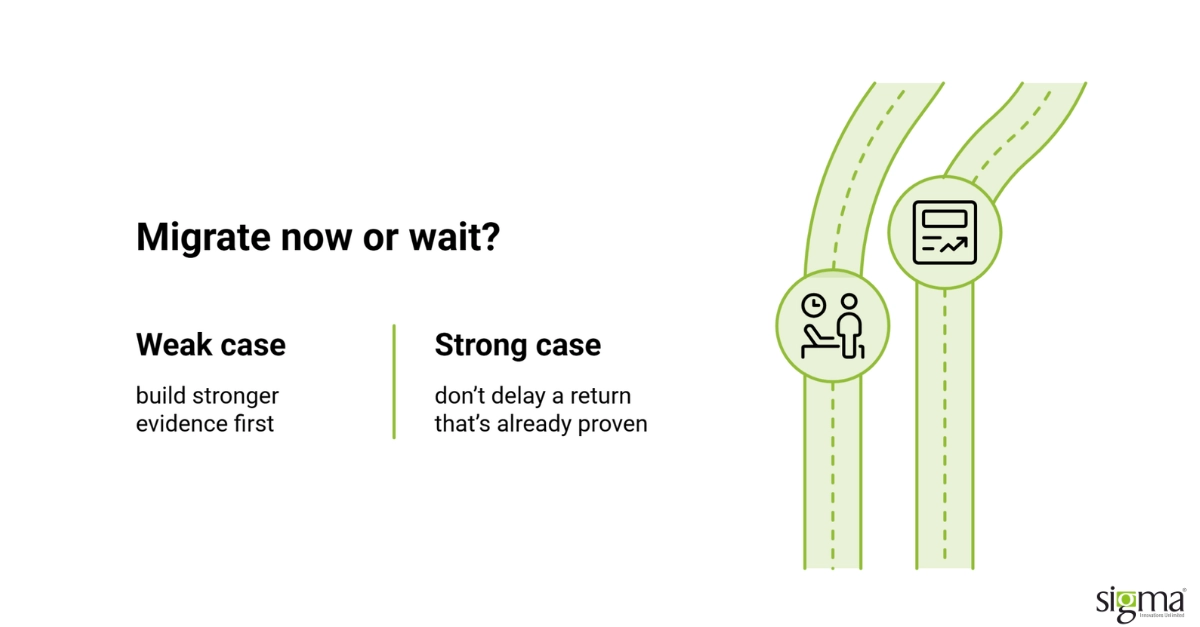
A store with a weak current ROI case, already reasonably optimized Luma, lower traffic, no clear historical conversion sensitivity to speed, does not necessarily need to migrate immediately, since waiting and continuing to build the case with better data can produce a stronger, more defensible business case later. This is distinct from indefinitely postponing a migration that a rigorous baseline already shows would deliver strong returns; the discipline is matching the timing decision to what the store’s actual data supports rather than either a fear of missing out on a trending theme or an assumption that migration can always wait.
Once a migration is approved and underway on the strength of a grounded ROI case, the decisions made during implementation directly determine whether that projected return actually materializes or quietly erodes.
Wrapping up:
Hyva theme migration ROI is genuinely substantial for many retailers, but the size of that return depends on store-specific factors, current Luma baseline, catalog complexity, and actual conversion sensitivity to speed, that a generic marketing claim cannot account for. An accurate estimate starts with measuring the current theme’s actual performance rather than assuming an industry-average baseline applies to every implementation. Connecting projected performance gains to actual conversion impact for the specific store is the critical step most ROI estimates skip entirely, relying instead on averages that may not reflect real customer behavior. Migration cost and timeline should be estimated honestly against the store’s actual customization complexity, not a vendor’s assumption of a clean, unmodified installation with no custom functionality involved. A credible ROI estimate includes a defined post-migration measurement plan, tracking the same metrics used in the baseline to confirm whether the projected return actually materialized after launch. Retailers that skip this measurement step lose both the ability to validate their original business case and the data that would inform further Hyva investment decisions down the road. A store with a weak current ROI case does not necessarily need to migrate immediately, since waiting to build stronger evidence can produce a more defensible business case later on. Getting this estimate right before committing a budget avoids both an unjustified delay and an oversold business case that disappoints stakeholders once the migration is complete and measured against reality. Retailers that build their business case on grounded, store-specific data consistently secure stakeholder buy-in more easily than those relying on generic marketing claims about Hyva’s performance potential. Sigma’s approach to scoping these migrations reflects the same discipline throughout, treating the store’s own baseline as the foundation for every projection rather than a generic industry figure. Once a migration is complete and its ROI confirmed, the natural next question becomes how to protect that return through the customizations and additions that follow in the months ahead, since a poorly scoped post-migration addition can quietly erode the very performance gain the original business case was built around.
Build a Faster, Scalable eCommerce Store with Sigma
Frequently Asked Questions
1. How long does it typically take to see a return on a Hyva migration investment?
This varies considerably by store, but a store with a strong pre-migration ROI case, unoptimized Luma theme, high traffic, and clear conversion sensitivity to speed, can often see meaningful conversion improvement within a few months of a well-executed migration and rollout, provided the post-migration measurement plan is actually tracking the right metrics from launch.
2. Does every Magento store see a strong ROI from migrating to Hyva?
No, and this is the key misconception marketing claims tend to obscure. A store already running a reasonably optimized Luma theme with lower traffic may see a smaller absolute gain that takes considerably longer to justify the migration’s cost and disruption relative to a store starting from an unoptimized baseline.
3. What is the biggest factor most ROI estimates fail to account for?
Connecting projected performance improvement to actual conversion impact for the specific store is the step most estimates skip, relying instead on industry-wide averages that may not reflect how that particular store’s customers actually respond to page speed changes over time, especially on mobile devices during peak shopping periods.
4. Should a retailer wait for a stronger business case before migrating to Hyva?
It depends on what the current data shows. A store with a weak initial case can reasonably wait and build stronger evidence, while a store whose baseline data already shows a strong likely return gains little from delaying an investment that would clearly pay off.
5. How should a retailer measure whether a Hyva migration actually delivered its projected ROI?
By tracking the same Core Web Vitals and conversion metrics used in the pre-migration baseline against post-migration results over a defined period, comparing actual outcomes against the original projection rather than assuming success based on qualitative impressions or anecdotal feedback from the wider internal team.