Why Black Friday Cart Abandonment Spikes on Mobile (and the UX Fixes That Recover Lost Carts)
Key Highlights:
- Mobile shoppers abandon Black Friday checkout at a higher rate than any other channel when pages load slowly, forms run long, payment choices are limited, or recovery messages feel generic.
- A focused set of mobile checkout fixes, guest checkout, one-tap wallets, autofill, shorter forms, speed, trust cues, and AI-led recovery, applied before peak traffic arrives rather than after a bad BFCM weekend.
- Brands that fix mobile checkout friction recover revenue from traffic they already paid to acquire, instead of losing it at the final step.
- Sigma audits the mobile funnel across UX and performance, redesigns checkout, integrates wallets and alternative payments, and adds AI-driven personalization and cart recovery once the structural fixes are in place.
Black Friday cart abandonment spikes hardest on mobile, where slow pages, long forms, limited payment options, and weak trust signals turn expensive paid traffic into an empty cart. Among shoppers who abandon checkout for a reason other than browsing, Research insights suggest that 40% cite extra costs revealed too late, 18% cite being forced to create an account, and 17% cite a checkout process that felt too long or complicated, with the average US checkout showing 23.48 form fields against an ideal of 12 to 14.
Mobile devices already carry the majority of peak-season online spend, so every one of these friction points is magnified exactly when traffic and ad spend are highest. This article walks through the mobile checkout fixes, guest checkout, one-tap wallets, autofill, shorter forms, faster load times, trust cues, and AI-led recovery messaging that recover the most revenue during BFCM week.
Why Black Friday Cart Abandonment Spikes on Mobile
For a growth-stage DTC brand or omnichannel retailer, Black Friday week concentrates the year’s most expensive paid traffic into a channel, mobile, where checkout friction is least tolerated. A shopper on a laptop can absorb an extra form field or a slow-loading page with some patience; the same friction on a five-inch screen, often on a slower connection in a crowded moment, is a reason to leave.
The specific, named causes behind this are already documented. Baymard’s research across dozens of studies finds extra costs (40%), forced account creation (18%), and a checkout that feels too long or complicated (17%) among the leading reasons shoppers abandon checkout, alongside payment distrust (19%) and site errors (17%). None of these are vague “shoppers changed their mind” explanations. Each is a specific, fixable point in the flow.
Why Do Mobile Shoppers Abandon Checkout?
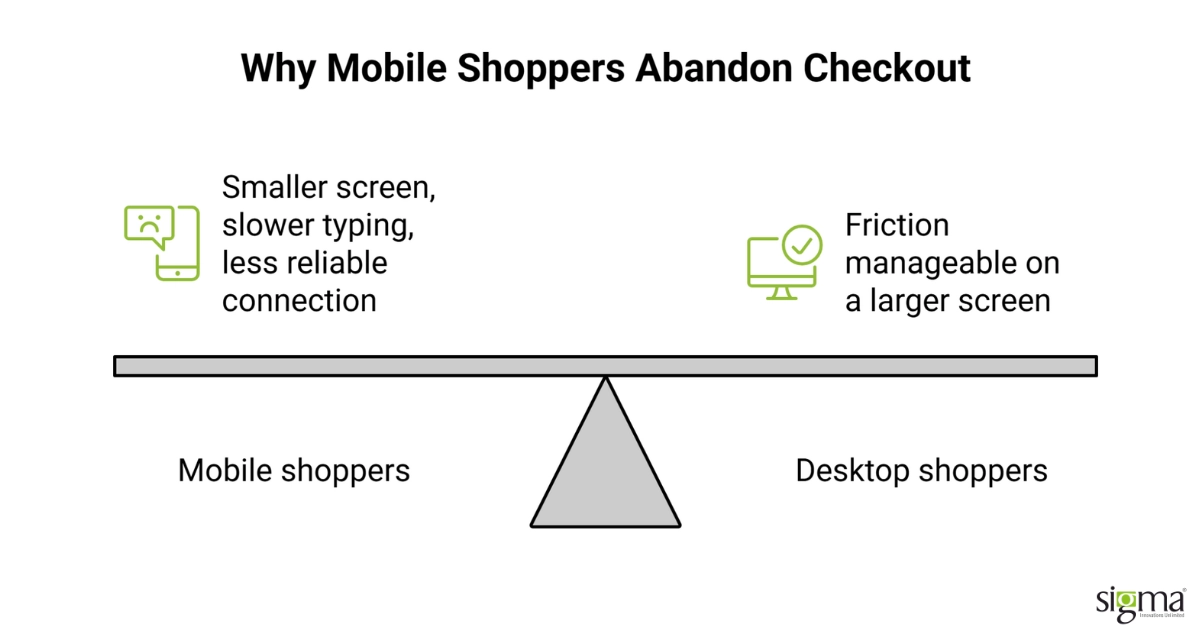
Mobile shoppers abandon checkout more often than desktop shoppers because friction that is manageable on a larger screen becomes a bigger barrier on a phone. The same underlying causes, extra costs, forced accounts, long forms, slow pages, exist on both channels, but mobile’s smaller screen, slower typical typing speed, and often less reliable connection make each one feel worse at the exact moment a shopper is deciding whether to finish.
This matters specifically for Black Friday because paid traffic skews even more heavily toward mobile during peak shopping events than it does on an average day, so whatever abandonment rate a store carries on mobile the rest of the year gets applied to its single highest-spend week.
What Is a Good Mobile Checkout Flow?
A good mobile checkout flow shows the full order cost, including shipping and any fees, before the final step, offers guest checkout as the default path rather than an easy-to-miss option, keeps form fields close to the 12 to 14 field range with autofill support doing the rest, and gives shoppers a one-tap wallet option alongside standard card entry.
Each of these traits maps directly to one of the documented abandonment causes above. A flow that gets all of them right is not following a generic best-practices checklist; it is closing the specific gaps shoppers themselves report.
How Do You Reduce Cart Abandonment on Mobile?
Reducing mobile cart abandonment starts with identifying which documented cause is actually driving the most drop-off for a given store, then fixing that cause directly.
| Drop-off cause | Share citing it | UX fix | Expected impact |
|---|---|---|---|
| Extra costs revealed late | 40% | Show the full cost, including shipping, before the final step | Addresses the single largest reason shoppers report leaving checkout |
| Forced account creation | 18% | Offer guest checkout as the default path | Removes a barrier for first-time Black Friday shoppers not ready to commit to an account |
| Long or complicated checkout | 17% | Cut form fields toward the 12 to 14 range; add autofill and one-tap wallets | Fewer fields and faster entry reduce the physical effort of checking out on a small screen |
| Payment distrust | 19% | Add visible trust cues (security badges, clear return policy) near the payment step. | Reduces hesitation at the exact point shoppers are entering card details |
| Site errors or slow pages | 17% | Confirm mobile page speed and checkout stability under peak traffic ahead of BFCM. | Addresses a technical reliability problem rather than a design one, so it needs its own validation |
Should You Add AI-Led Cart Recovery, or Fix the Flow First?
AI-led cart recovery, personalized reminder messages, predictive discount timing, and retargeting that adapts to browsing behavior, can recover some revenue from carts that are already lost. It cannot substitute for fixing the friction that caused the abandonment in the first place.
Fixing the checkout flow itself is the higher-leverage move when the abandonment causes are structural: long forms, missing guest checkout, limited payment options, or slow mobile pages. These are one-time fixes that reduce abandonment at the source for every future peak season, not only this one.
AI-led recovery becomes a useful addition once the structural fixes are in place, catching the smaller share of abandonment that genuine indecision or comparison shopping causes, rather than friction the brand controls directly. Treating AI recovery as the first move, before the flow itself is fixed, recovers only a fraction of the carts that fixing the underlying friction would have kept in the first place.
Recover checkout revenue lost to mobile friction with a UX audit built around how Black Friday shoppers actually behave on a phone.
Why Redesigning Checkout Before Measuring the Drop-Off Point Backfires
A common response to high Black Friday cart abandonment is to redesign the checkout page before measuring exactly where mobile shoppers actually drop off. Teams add trust badges, shorten a form, or integrate a new wallet, then wait for results without first confirming the step at which shoppers were leaving. When the real cause sits somewhere else entirely, a slow product image on the page before checkout, a payment method shoppers expected but could not find, the redesign changes the wrong page and the abandonment rate holds.
Sigma Infosolutions audits the full mobile funnel, not just the checkout page, before recommending a fix, tracking where shoppers actually exit relative to where the brand assumes they exit. The UX and integration work Sigma delivered for iReliev, an electrotherapy device brand selling on WooCommerce, rebuilt the customer experience around improved product search and new user-experience design, validated with split testing to confirm which changes actually moved the needle, contributing to a 62% increase in gross sales.
See how UX-led checkout and product experience changes helped lift gross sales 62% for an eCommerce brand.
That same audit-before-redesign discipline applies even when a UX-focused agency itself needs an engineering partner to scale what it recommends to its own clients. Sigma extended a Boston-based ecommerce agency’s own UI/UX offering into end-to-end, technology-backed implementation, helping that agency grow new revenue by 100%.
Explore how Sigma helped a Boston-based ecommerce agency grow new revenue by 100 percent.
For a growth-stage DTC brand heading into BFCM 2026, the sequence matters: measure where mobile shoppers actually abandon checkout, fix the highest-impact cause first, and add AI-led recovery messaging once the structural friction is gone. Sigma can run that funnel audit as a defined engagement or continue as the team that owns mobile conversion year-round.
Wrapping up:
Black Friday cart abandonment spikes hardest on mobile, where friction that is easy to tolerate on a desktop browser becomes a reason to leave on a small screen. Extra costs revealed late, forced account creation, long forms, and slow pages are the specific, named causes behind most of that abandonment, not vague shopper indecision. Each of those causes has a direct fix: showing full cost earlier, offering guest checkout, shortening forms with autofill and one-tap wallets, and confirming mobile speed ahead of peak traffic.
Trust cues placed near the payment step address a different cause: hesitation about handing over card details and the need for their own fix rather than being folded into a general redesign. Measuring exactly where mobile shoppers drop off, before changing anything, prevents a redesign that fixes the wrong page while the real cause goes untouched.
AI-led cart recovery messaging can win back some revenue after abandonment happens, but it does not address the structural friction that caused the abandonment in the first place. Structural fixes to the checkout flow itself carry forward into every future peak season, while recovery messaging only works on carts already lost. The right sequence treats recovery as an addition once the flow itself is fixed, not a substitute for fixing it.
A comparison of the specific drop-off causes against their fixes gives a brand leader a concrete starting point rather than a general best-practices list. Brands that treat Black Friday cart abandonment as a mobile-specific, diagnosable problem recover revenue from traffic they already paid to acquire. The alternative, applying generic checkout tweaks without knowing where mobile shoppers actually leave, risks spending limited pre-BFCM time without moving the abandonment rate at all.
Optimize Mobile Checkout with eCommerce Development Services
Reduce checkout friction and recover lost sales with faster, smoother mobile shopping experiences.
Frequently Asked Questions
Why do mobile shoppers abandon checkout more than desktop shoppers?
Mobile shoppers abandon checkout more often because friction that is manageable on a larger screen, a long form, a slow page, a missing payment option, becomes a bigger barrier on a phone. The same causes exist on desktop, extra costs, forced accounts, long checkout, but mobile’s smaller screen and typically slower connection make each one feel worse.
What does a good mobile checkout flow actually look like?
A good mobile checkout flow shows the full order cost, including shipping, before the final step, offers guest checkout by default, keeps form fields close to the 12 to 14 field range with autofill support, and gives shoppers a one-tap wallet option alongside card entry. Each trait directly addresses a documented reason shoppers abandon checkout.
How do you reduce cart abandonment on mobile during Black Friday specifically?
Reducing mobile cart abandonment during Black Friday starts with identifying which documented cause, extra costs, long forms, forced accounts, or slow pages, is driving the most drop-off for a given store, then fixing that cause directly rather than applying every tactic at once. Confirming mobile page speed and checkout stability should happen before the event, not during it.
Does AI-led cart recovery actually bring back lost Black Friday revenue?
AI-led cart recovery, personalized reminders and retargeting based on browsing behavior, can recover some revenue from carts already abandoned, but it works best after the structural causes of abandonment are fixed. Using it as a first response, before shortening forms or adding guest checkout, recovers only a fraction of what fixing the underlying friction would.
Should a growth-stage DTC brand redesign checkout before Black Friday or measure first?
Measuring where mobile shoppers actually drop off should come before any redesign. A checkout change made without that data risks fixing a page that was not the actual problem, while the real cause, often earlier in the funnel or in a specific form field, goes untouched and the abandonment rate holds.