AI Recommendation Engine for eCommerce: Why Generic Product Suggestions Leak Revenue

Key Highlights:
- eCommerce stores running static or rules-based recommendations show every visitor the same “bestsellers” and “trending now” modules, ignoring individual browsing behavior and leaving measurable revenue on product pages, cart pages, and post-purchase flows.
- An AI recommendation engine powered by collaborative filtering and content-based models surfaces the right product to the right shopper at the right moment, lifting average order value, conversion rate, and repeat purchase frequency.
- Stores that stick with generic recommendations will lose ground to competitors whose product discovery feels personalized, and they will continue paying the same acquisition costs while extracting less revenue per session.
- Personalized product discovery has an outsized impact on revenue relative to the small share of sessions that engage with it, making recommendations one of the highest-ROI investments a mid-market storefront can make.
Introduction
Your traffic is growing. Your catalog has never been deeper. And yet, revenue per session is flat. Shoppers browse two or three pages and leave. The ones who buy add a single item and check out below your category AOV benchmarks. The problem is not traffic. It is what happens between landing and checkout.
Most mid-market Magento, Shopify, and BigCommerce stores show every visitor the same modules: “Bestsellers,” “New Arrivals,” “Trending Now.” These are editorial lists disguised as recommendations. A shopper who browsed running shoes sees the same carousel as one who browsed kitchen appliances. An AI recommendation engine closes that gap by replacing static modules with models that learn from each shopper’s behavior. Sigma’s eCommerce Development Services help mid-market brands build that personalization layer into the storefronts they already run.
McKinsey estimates that effective personalization can lift eCommerce revenue by up to 40%. This reflects a broader industry trend where shoppers who engage with personalized product recommendations are significantly more likely to complete purchases and generate higher revenue per session.
Ready to replace generic merchandising with AI-driven shopping experiences that increase revenue?
What Is an AI Recommendation Engine?
An AI recommendation engine is a machine learning system that analyzes shopper behavior, purchase history, and product attributes to deliver personalized product recommendations in real time. Unlike rules-based recommendations, it continuously learns from customer interactions and adapts as buying patterns, catalogs, and customer preferences change.
Where the Revenue Leaks Are
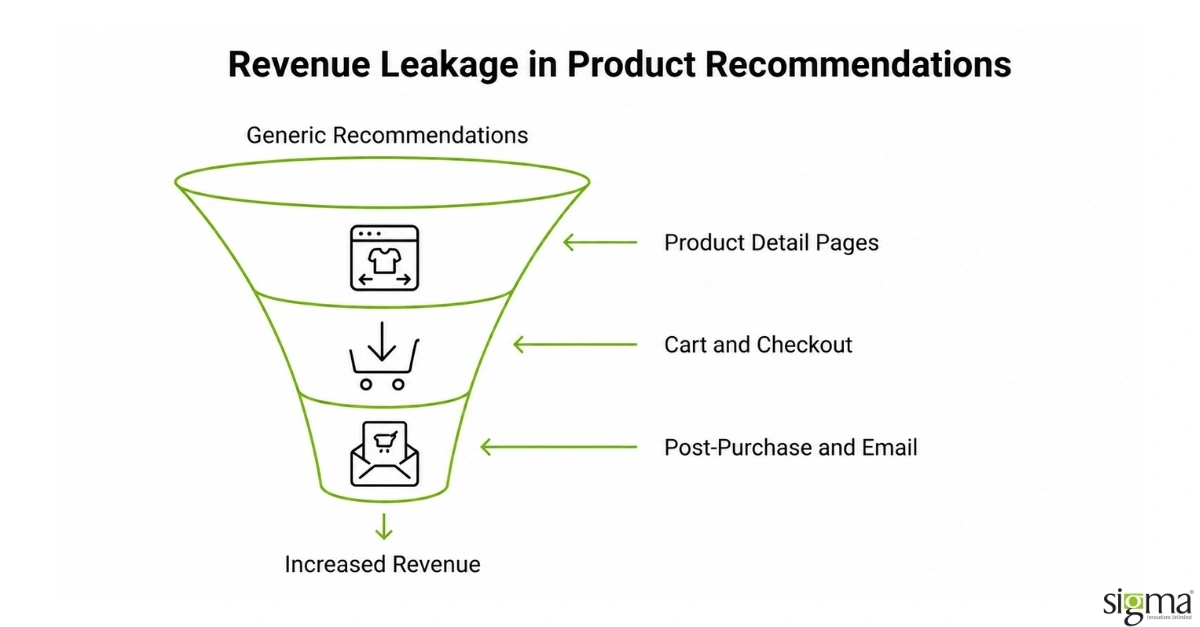
The revenue impact of generic recommendations is not evenly distributed across the storefront. It concentrates in three specific places where product discovery either works or fails.
Product Detail Pages
The “You May Also Like” section is the highest-leverage recommendation placement on the site. A relevant recommendation here extends the session and introduces products the shopper would not have found through navigation. A generic module showing bestsellers from an unrelated category does nothing.
Cart and Checkout
“Frequently Bought Together” modules have a direct effect on AOV. When the recommendation is genuinely complementary, it feels helpful. When it is a random top seller, it gets ignored. Conservative implementations of AI-powered product recommendations at cart produce 15% to 22% AOV increases on average.
Post-Purchase and Email
Personalized post-purchase emails recommending products based on what the customer just bought drive repeat purchases at a fraction of acquisition cost. Stores without a personalized product recommendation engine in their email flows send the same blast to every customer. Repeat purchase rate stays flat.
Read to know more: Headless vs Monolithic Commerce: MACH Architecture Explained
Why Rules-Based Recommendations Stop Working
Most mid-market stores are not running zero recommendations. They are running rules-based ones. “If customer views product in Category A, show top sellers from Category A.” “If cart contains product X, show product Y.” These rules work when the catalog is small and the customer base is homogeneous. They break as both grow.
The first problem is that rules do not learn. A rule written six months ago reflects the merchandiser’s best guess at the time, not what the data shows today. Product affinities shift with seasons, trends, and inventory. Rules do not adapt unless a human rewrites them.
The second problem is coverage. A merchandiser can write rules for the top 50 to 100 products. For a catalog with 5,000 to 50,000 SKUs, the long tail gets no recommendation logic at all.
The third problem is personalization depth. “Customers who bought X also bought Y” does not account for individual browsing history, price sensitivity, or brand preference. It is a population average that consistently underperforms individual-level models.
| Capability | Rules-Based Recommendations | AI Recommendation Engine |
| Learning from new data | Manual rule updates by merchandiser | Continuous model retraining on behavior data |
| Catalog coverage | Top 50–100 products covered | Full catalog including long-tail SKUs |
| Personalization depth | Segment-level (all shoppers in a group see the same thing) | Individual-level (each shopper sees unique recommendations) |
| Cross-category discovery | Limited to manually defined associations | Surfaces unexpected affinities from behavioral patterns |
| Adaptation to trends | Lags behind until rules are rewritten | Adjusts as purchase and browsing patterns shift |
Read more: The architecture that makes this work in production, from embedding layers to contextual bandits and real-time feature pipelines: Building a recommendation engine that does not feel generic.
How Collaborative Filtering and Content-Based Models Work Together
An effective machine learning recommendation system typically combines two approaches.
Collaborative filtering recommendation identifies patterns across shoppers. If Shopper A and Shopper B have similar browsing and purchase histories, products that Shopper A bought but Shopper B has not seen yet become recommendations for Shopper B. This is powerful for surfacing products a shopper would not have found through search or navigation, but it struggles with new products (no purchase history yet) and new visitors (no behavior data yet).
Content-based filtering machine learning solves the cold-start problem by analyzing product attributes: category, brand, color, material, price range, description text. It recommends products that are similar to what the shopper has already viewed or purchased, based on product characteristics rather than other shoppers’ behavior. This works immediately for new products and new visitors but tends to produce less surprising, less discovery-oriented recommendations.
The combination, often called a hybrid model, covers the full range: collaborative filtering recommendation drives cross-category discovery for returning shoppers, while content-based filtering machine learning handles new visitors and new products. This is the architecture behind every serious product recommendation engine in production today.
What Matters for eCommerce Implementation
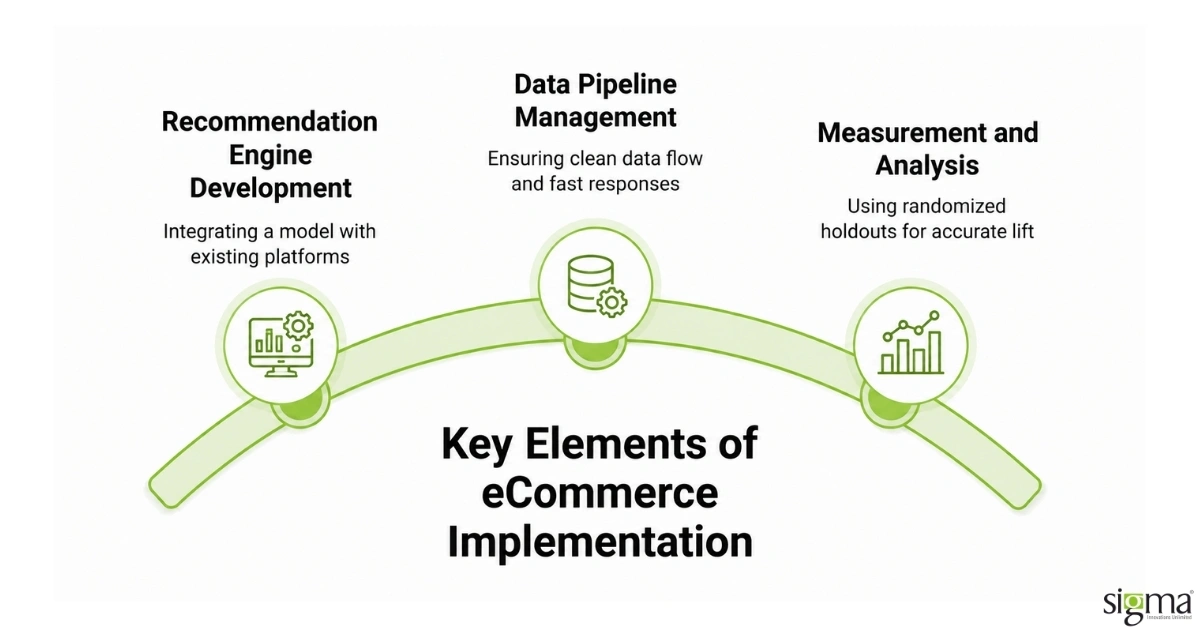
Recommendation engine development for a mid-market storefront is an integration project, not a research project. The model needs to connect to the product catalog, ingest real-time browsing events, pull purchase history, and serve recommendations through existing templates (Magento blocks, Shopify sections, BigCommerce widgets).
The data pipeline matters more than model sophistication. A perfectly tuned collaborative filtering model is useless if event tracking is incomplete or recommendation response time exceeds 200ms. For growth-stage retailers, the practical challenge is getting clean behavioral data flowing into the model and recommendations back onto the page without visible delay.
Measurement needs to be honest. The only reliable way to measure true incremental lift is a randomized holdout: show recommendations to 90% of traffic and withhold from 10%, then compare conversion, AOV, and revenue per session.
When Is an AI Recommendation Engine Worth Implementing?
An AI recommendation engine delivers the greatest impact for retailers with thousands of SKUs, repeat customer traffic, diverse product catalogs, and enough behavioral data to train recommendation models. Businesses running Magento, Shopify, Adobe Commerce, or BigCommerce stores typically see the highest returns when they want to improve product discovery, increase average order value, and surface long-tail inventory. Smaller catalogs with only a few dozen products may benefit more from merchandising improvements before investing in advanced AI personalization.
Beyond Recommendations: Building AI-Native eCommerce Experiences
An AI recommendation engine is often the first AI capability retailers deploy because its revenue impact is easy to measure. But the same behavioral data, product catalog, and event pipelines can support a much broader set of intelligent shopping experiences.
Sigma’s AI and eCommerce engineering teams build AI capabilities directly into existing Magento, Shopify, Adobe Commerce, BigCommerce, and headless storefronts rather than treating AI as a standalone application. That means retailers can introduce intelligence incrementally without rebuilding their commerce platform.
Depending on the business need, the same AI foundation can power:
- Conversational shopping assistants that answer product questions, guide discovery, and reduce purchase hesitation.
- Visual product discovery that lets shoppers search using images instead of keywords.
- Predictive merchandising that surfaces products based on browsing intent, inventory levels, and purchase likelihood.
- AI-powered search that understands shopper intent instead of relying on exact keyword matches.
- Customer behavior analytics that identify abandonment patterns, cross-sell opportunities, and high-value customer segments.
- Demand forecasting and inventory intelligence that improve merchandising decisions using historical and real-time data.
The common thread across these capabilities is not the AI model itself but the commerce architecture behind it. Clean behavioral data, scalable integrations, low-latency APIs, and production-ready deployment determine whether AI becomes a measurable revenue driver or another disconnected experiment. That is why Sigma approaches AI as part of the eCommerce platform, ensuring every capability integrates with the storefront, catalog, customer data, and operational workflows already in place.
Ready to move beyond product recommendations?
Giving 11,800 Ignored SKUs a Reason to Surface
An apparel and accessories retailer came to Sigma with 12,000 SKUs and a merchandising team of four. They had done the obvious thing: hand-curated “Related Products” for their top 200 items. Those 200 performed well. The other 11,800 had no recommendations, no cross-sells, and no discovery path at all, which meant they were reachable only by shoppers who already knew how to search for them.
The instinct in that situation is to hire merchandisers or buy a rules engine. Neither scales. A rules engine still requires someone to write rules, and 11,800 rules is not a project anyone finishes.
Sigma trained a hybrid machine learning recommendation system on 14 months of browsing and purchase data, combining collaborative filtering recommendation for returning shoppers with content-based filtering machine learning to handle new products and first-time visitors. The recommendation engine development work deployed through native Magento blocks on PDP, cart, and category pages, so nothing about the storefront template changed. Every SKU in the catalog got a recommendation for the first time.
Within the first quarter, previously uncovered long-tail products accounted for 9% of all recommendation-driven revenue. The merchandising team did not write a single rule.
The storefront architecture matters as much as the model. A large catalog with slow faceted navigation will bury recommendations regardless of how well the AI recommendation engine ranks them, which is why Sigma’s Magento work often starts at the platform layer.
Read more: Headless Magento 2.x for a diversified catalog across consumer, business, and government segments: An electronics store implementation.
The same hybrid approach solves a different problem on multi-store setups. A Shopify Plus retailer running three regional storefronts had siloed behavioral data, so every new regional launch started with zero personalization for its first six months. Sigma built a cross-store model that borrows signals from established stores while respecting regional pricing and catalog differences, which is the same pattern behind the behavior-driven AI-powered product recommendations and real-time inventory sync Sigma delivered for a cosmetics brand operating across 50+ locations, built inside the storefront the client already ran through Sigma’s eCommerce Development Services.
Conclusion
Generic recommendations are not neutral. They are a revenue leak. Every product page showing irrelevant bestsellers, every cart page missing a complementary suggestion, and every post-purchase email blasting the same promotion to every customer represents revenue that a smarter system would have captured. An AI recommendation engine built on collaborative filtering recommendation and content-based filtering machine learning replaces those static modules with individual-level personalization that lifts AOV, conversion, and repeat purchase rate. Sigma Infosolutions helps mid-market eCommerce brands build that capability into their existing Magento, Shopify, or BigCommerce storefronts, turning browsing data into revenue.
Frequently Asked Questions
What is an AI recommendation engine and how does it differ from rules-based recommendations?
An AI recommendation engine uses machine learning models trained on browsing and purchase data to surface personalized product suggestions for each individual shopper. Rules-based systems rely on manually written conditions that treat all shoppers in a segment identically and do not adapt as customer behavior or catalog composition changes.
How does a product recommendation engine increase average order value?
A product recommendation engine increases AOV by surfacing complementary and cross-category products at high-intent moments like PDP and cart. When recommendations are genuinely relevant to the individual shopper’s browsing context, they add items the shopper would not have discovered through navigation, increasing basket size per session.
What is collaborative filtering recommendation and when does it work best?
Collaborative filtering recommendation identifies purchase and browsing patterns shared across shoppers and recommends products based on behavioral similarity. It works best with returning visitors who have enough interaction history, and for catalogs with high purchase volume where the model has sufficient data to detect meaningful product affinities.
What is content-based filtering machine learning and how does it solve the cold-start problem?
Content-based filtering machine learning recommends products based on attribute similarity (category, brand, price, description) to items a shopper has already viewed. It does not require other shoppers’ data, making it effective for new visitors with no browsing history and newly launched products with no purchase data yet.
How does Sigma build recommendation engines for eCommerce storefronts?
Sigma integrates hybrid ML models into the retailer’s existing platform (Magento, Shopify, BigCommerce), connecting to the product catalog and behavioral event stream. The team handles recommendation engine development, deploys recommendations through native storefront templates, sets up holdout testing for measuring incremental lift, and provides ongoing model tuning through a retainer engagement.