Universal Commerce Protocol: How AI-Powered Commerce Is Redefining Digital Retail

Key Highlights:
- Most commerce platforms today operate in isolated silos, making it difficult for AI agents and intelligent shopping systems to interact seamlessly across channels and services.
- Universal Commerce Protocol (UCP) provides a standardized communication layer that allows AI-driven systems, merchants, and commerce platforms to exchange data and transact with minimal friction.
- Sigma Infosolutions helps businesses modernize their commerce infrastructure with API-first architectures, headless commerce implementations, and AI integrations that position them for the era of intelligent digital commerce.
Introduction
Digital commerce is entering a period of transformation that few organizations are fully prepared for. As AI-powered shopping agents, autonomous purchasing systems, and personalized commerce experiences become mainstream, the underlying infrastructure of most businesses simply cannot keep up. The result is fragmented customer journeys, missed revenue opportunities, and a growing technology debt that widens with every passing quarter.
Universal Commerce Protocol (UCP) is emerging as a critical concept in addressing this gap. By creating a common language through which AI agents and commerce systems can interact, UCP lays the foundation for a more intelligent, automated, and connected retail ecosystem. Businesses that invest in AI-powered commerce readiness now will be far better positioned to capitalize on the opportunities this shift brings.
Understanding what UCP is, why it matters, and how to prepare for it is no longer a question for tomorrow’s technology roadmap. It is a strategic priority for today.
What Is the Universal Commerce Protocol?
Universal Commerce Protocol is a proposed open standard designed to define how AI agents, digital commerce platforms, and third-party services communicate with one another in a structured and interoperable way.
Think of it as a common API specification for the commerce layer of the internet. Just as HTTP standardized how browsers and servers exchange information, UCP aims to standardize how AI-driven systems discover products, negotiate transactions, check availability, and complete purchases across any platform or marketplace.
The Core Purpose of UCP
At its core, UCP is built to solve a fragmentation problem. Today, an AI shopping agent attempting to purchase a product on behalf of a user must navigate dozens of incompatible data formats, authentication methods, and fulfillment APIs. This complexity limits what AI agents can realistically accomplish and slows down the adoption of autonomous commerce.
UCP defines a shared vocabulary and interaction model for:
- Product discovery and catalog access
- Real-time inventory and pricing retrieval
- Checkout, payment, and order management
- Post-purchase tracking and returns processing
How It Enables AI Agents to Participate in Commerce
One of the most significant implications of UCP is its ability to make commerce machine-readable at scale. AI assistants like those embedded in voice devices, mobile apps, and enterprise procurement tools can follow the protocol to transact on behalf of users without requiring custom integrations with every retailer.
This opens up new possibilities for autonomous purchasing, B2B procurement automation, and deeply personalized shopping experiences driven by real-time context and user preferences.
Why Universal Commerce Protocol Matters for Businesses
The rise of AI shopping assistants is accelerating faster than most commerce teams anticipated. Retailers and enterprise buyers are already exploring tools that allow intelligent agents to handle product research, comparison, and purchasing. UCP gives these agents a consistent framework to work within.
Enabling AI Shopping Assistants
AI shopping assistants depend on structured, machine-readable commerce data. Without a standard like UCP, every AI integration requires significant custom engineering. With it, businesses can expose their catalog, pricing, and fulfillment capabilities to any compliant AI agent with minimal overhead.
This dramatically reduces the cost of participating in an AI-driven commerce economy and opens new sales channels that do not require a human to initiate every transaction.
Creating Personalized Purchasing Experiences
Personalization at scale requires real-time data sharing between AI systems and commerce backends. UCP provides the communication layer that makes this possible, enabling systems to deliver the right product to the right buyer at the right moment, without relying on manual curation or static recommendation engines.
A leading retailer that tested AI-driven personalization tools saw measurable improvements in cart conversion and repeat purchase rates simply by making their product data more accessible to intelligent recommendation systems.
Supporting Omnichannel Commerce
Modern buyers interact with brands across web, mobile, social, voice, and physical touchpoints. UCP creates a unified data layer that allows AI agents to work across all of these channels without losing context between sessions or platforms.
For omnichannel businesses, this means smoother handoffs between touchpoints, fewer abandoned carts, and more consistent customer experiences regardless of where a transaction begins.
The Future of Digital Retail
As AI becomes the primary interface between consumers and commerce, the businesses that win will be those that have built their systems to be inherently AI-accessible. UCP is not a distant future concept. It is the next logical step in the evolution of API-driven commerce, and early movers will have a significant advantage in capturing the intelligent commerce market.
Industries That Could Benefit from Universal Commerce Protocol
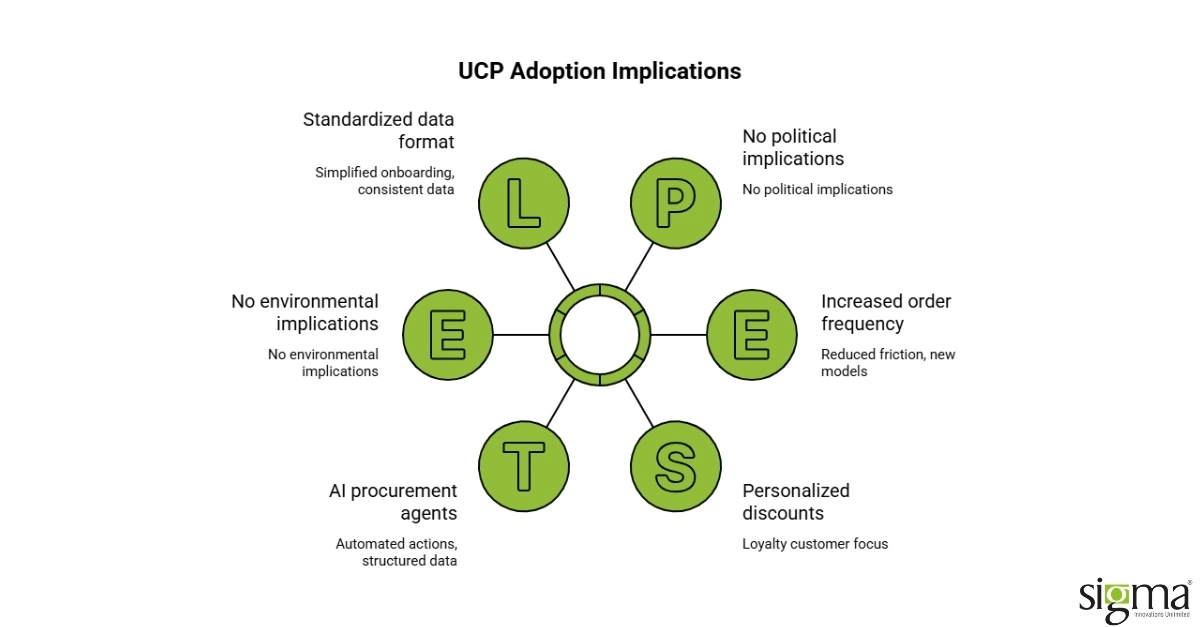
The implications of UCP extend well beyond direct-to-consumer retail. Several sectors stand to gain significantly from adopting AI-ready commerce standards.
Retail and Direct-to-Consumer Brands
Retailers can use UCP to allow AI agents to browse catalogs, apply personalized discounts, and complete purchases on behalf of loyalty customers. This reduces friction, increases order frequency, and enables entirely new purchasing models.
B2B Commerce and Procurement
Enterprise procurement is one of the most complex and manual processes in business operations. UCP can enable AI procurement agents to search supplier catalogs, request quotes, apply approval workflows, and place orders, all without human intervention at each step.
Many B2B organizations are already using AI to pre-qualify vendors and surface reorder recommendations. UCP provides the transactional layer that turns those recommendations into automated actions.
Marketplaces and Aggregators
For marketplace operators, UCP simplifies the onboarding of new sellers by standardizing the data format required for product listings, pricing, and fulfillment capabilities. AI agents navigating marketplaces can access consistent, structured data regardless of which seller has listed a product.
Subscription and Recurring Revenue Businesses
Subscription commerce depends on automated billing, plan management, and renewal logic. UCP creates a pathway for AI agents to manage subscriptions on behalf of users, including upgrades, pauses, and cancellations, using a standardized set of instructions that any compliant platform can interpret.
Preparing Your Commerce Ecosystem for the AI Era
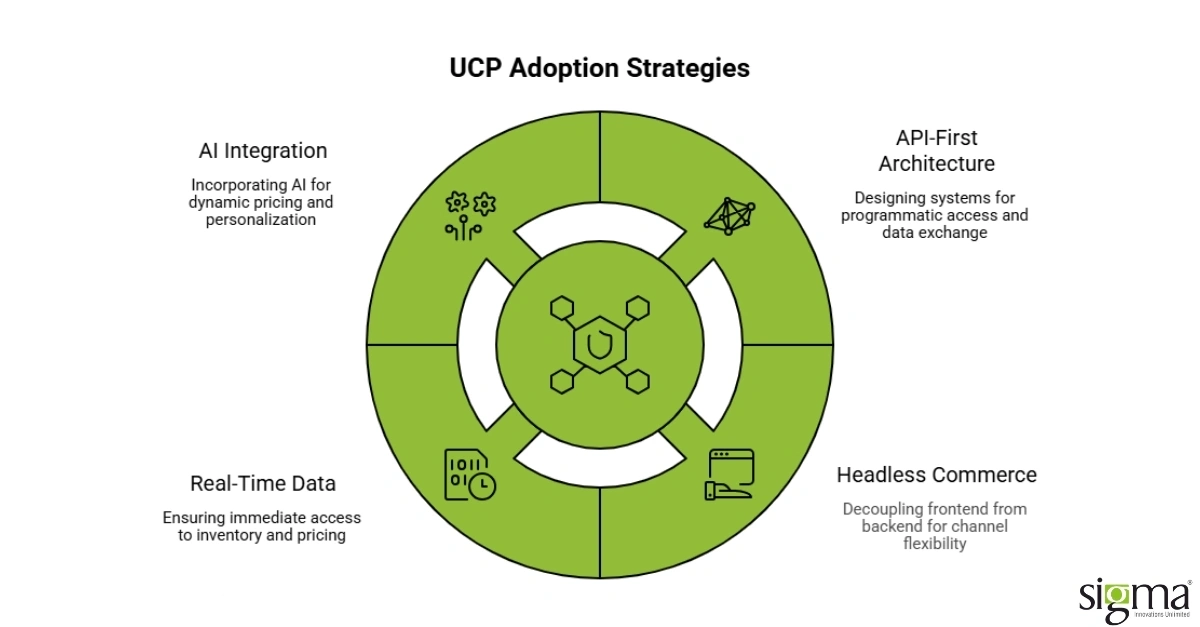
While the Universal Commerce Protocol is still taking shape as an industry standard, the steps businesses take today to modernize their commerce infrastructure will determine how well they can adopt it when it matures.
The organizations that will benefit most from UCP are those that have already built API-first, composable commerce architectures. These businesses have a significant head start because their platforms are already designed to expose structured data and accept programmatic instructions from external systems.
Why API-First Architecture Is the Foundation
An API-first approach means designing your commerce systems so that every function- catalog browsing, checkout, inventory management, and order tracking is accessible through a well-documented, versioned API. This is the foundational requirement for any AI agent to interact with your commerce environment.
Businesses still operating on monolithic, tightly coupled platforms will face significant engineering challenges when AI-driven commerce standards arrive. The migration cost grows with every year of delay.
Headless Commerce as a Strategic Enabler
Headless commerce decouples the frontend presentation layer from the backend commerce engine. This separation allows businesses to serve content and commerce experiences to any channel, including AI agents, without rebuilding their core platform.
Organizations using headless architectures on platforms like Shopify or Adobe Commerce are already positioned to extend their commerce capabilities to new interfaces, including those driven by AI.
The Role of Real-Time Data and AI Integration
AI agents require access to real-time inventory, pricing, and availability data to make accurate purchasing decisions. Businesses that have invested in event-driven architectures and real-time data pipelines will be far better equipped to participate in UCP-compliant commerce networks.
Integrating AI and machine learning capabilities into the commerce stack, whether for dynamic pricing, fraud detection, or personalized recommendations, also creates the internal competency needed to build and maintain AI-agent-compatible commerce systems.
How Sigma Infosolutions Helps Businesses Build AI-Ready Commerce Ecosystems
As Universal Commerce Protocol gains traction, businesses need a technology partner that understands both the commerce layer and the AI integration layer. Sigma Infosolutions brings deep expertise in both areas, helping organizations modernize their platforms and prepare for the next wave of intelligent commerce.
Discovery and Strategy
Sigma begins every engagement with a thorough assessment of the existing commerce infrastructure. The team identifies gaps in API coverage, evaluates platform flexibility, and maps out a modernization roadmap aligned with the client’s growth objectives and AI readiness goals.
Solution Architecture
Sigma’s architects design composable, API-first commerce environments using platforms such as Shopify Plus, Adobe Commerce, and BigCommerce. The focus is on creating modular systems where each component- catalog, cart, checkout, and fulfillment can be replaced or extended independently without disrupting the whole platform.
Headless Commerce Implementation
Sigma has extensive experience delivering headless commerce solutions that separate the presentation layer from the commerce engine. This architectural pattern is essential for businesses that want to serve AI agents, voice interfaces, and other non-traditional commerce touchpoints alongside their existing web and mobile channels.
Explore Sigma’s eCommerce development services to understand the full scope of their platform expertise.
AI and Data Engineering
Beyond platform implementation, Sigma integrates AI capabilities directly into the commerce stack. From conversational BI tools powered by large language models to predictive analytics that surface high-value purchasing signals, Sigma’s engineering teams help businesses extract intelligence from their commerce data and act on it in real time.
Quality Assurance and Deployment
Every Sigma engagement includes rigorous quality assurance processes designed to validate performance, security, and integration reliability before go-live. Sigma’s DevOps practices ensure that production environments remain stable and consistent across deployment cycles.
Ongoing Support and Optimization
Commerce platforms require continuous optimization as traffic patterns, catalog complexity, and customer expectations evolve. Sigma provides ongoing support that includes performance monitoring, feature development, and strategic guidance as new AI commerce standards emerge.
Conclusion
Universal Commerce Protocol represents a fundamental shift in how AI agents and commerce systems will interact over the next decade. Businesses that recognize this shift early and take deliberate steps to modernize their commerce infrastructure will hold a meaningful competitive advantage as the standard matures.
The path forward begins with API-first thinking, headless commerce architectures, and a commitment to making your commerce ecosystem machine-readable. These are not abstract future investments. They are practical decisions that improve platform flexibility, integration capability, and customer experience today, while positioning your organization to adopt AI-powered commerce standards tomorrow.
Sigma Infosolutions is the technology partner that helps businesses take these steps with confidence. With deep expertise in Shopify, Adobe Commerce, headless implementations, and AI integration, Sigma builds the commerce infrastructure that makes intelligent retail possible.
Frequently Asked Questions
What is Universal Commerce Protocol (UCP)?
Universal Commerce Protocol (UCP) is a standardized framework that enables AI agents and commerce platforms to exchange data and complete transactions seamlessly.
Why is Universal Commerce Protocol important for AI-powered commerce?
UCP eliminates integration barriers, allowing AI shopping assistants to interact efficiently with multiple commerce systems.
How does UCP support AI shopping assistants?
UCP gives AI assistants structured access to product data, pricing, inventory, and checkout workflows for automated purchasing.
What are the benefits of adopting an API-first commerce architecture?
API-first architecture improves scalability, flexibility, and integration readiness for AI-driven commerce experiences.
How does headless commerce help businesses prepare for AI-driven retail?
Headless commerce enables brands to deliver commerce experiences across websites, apps, voice interfaces, and AI agents.
Which industries can benefit most from Universal Commerce Protocol?
Retail, B2B commerce, marketplaces, procurement, and subscription businesses can leverage UCP to automate transactions and improve efficiency.
How does UCP improve omnichannel customer experiences?
UCP connects multiple sales channels through a unified framework, ensuring consistent and personalized customer interactions.
What role does real-time data play in AI-powered commerce?
Real-time data enables AI systems to provide accurate recommendations, inventory updates, and personalized shopping experiences.
How can businesses prepare for the future of intelligent commerce?
Businesses should invest in API-first platforms, headless commerce solutions, and AI integrations to become commerce-ready.
How does Sigma Infosolutions help businesses build AI-ready commerce ecosystems?
Sigma Infosolutions develops API-first, headless, and AI-enabled commerce solutions that support the future of intelligent digital retail.