Magento Extension Sprawl Is Slowing Your Store: How to Reduce Performance and Maintenance Debt

Key Highlights:
- Teams that add Magento extensions for eCommerce stores one request at a time end up with a stack nobody on the current team fully understands or can safely modify.
- A documented evaluation framework, covering vendor maintenance history, code quality, and overlap with functionality the store already has, turns extension decisions into a repeatable process instead of a one-off judgment call.
- Deciding deliberately between custom development, a vetted commercial extension, or extending an existing module cuts both integration risk and the maintenance burden new code creates over time.
- Sigma pairs every extension or custom-development recommendation with an architecture review against the store’s actual codebase, rather than a generic marketplace comparison, so the decision holds up after launch.
Introduction
Most Magento stores do not arrive at a bloated, conflict-prone extension stack through one bad decision. They arrive there through a dozen reasonable ones, each extension solving a real problem at the time it was installed, with no one stepping back to ask whether the store needed a new dependency or whether the capability already existed somewhere in the codebase. Magento extensions for eCommerce businesses are not inherently risky; the absence of a decision process around them is. This post sets out the framework a technical decision-maker should use before adding functionality to a Magento store, covering when to buy a commercial extension, when to build custom, when to extend what already exists, and how to vet a vendor’s code before it goes anywhere near production. None of this requires naming specific products, because the criteria that make an extension a good or bad fit are durable across vendors and change far more slowly than any individual product’s feature list or maintenance status.
Is extension debt slowing your Magento store?
Why “Which Extension Should We Install” Is the Wrong First Question
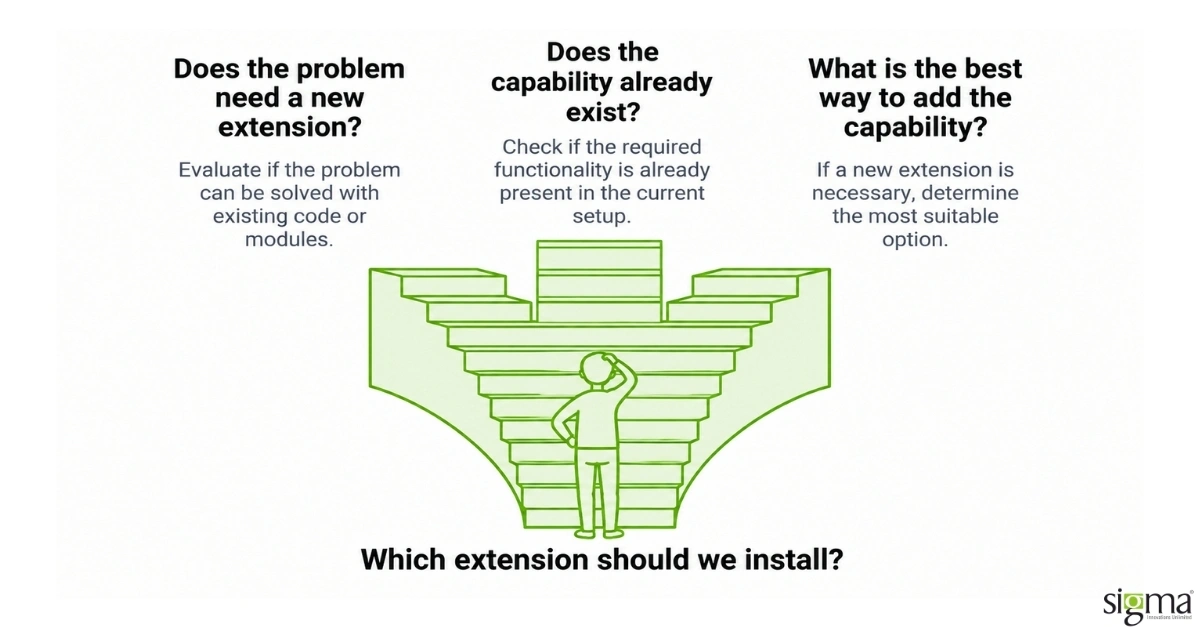
The question that actually protects a Magento store is not which extension solves this problem, but whether this problem needs a new extension at all. Every third-party module added to a Magento instance introduces a dependency the internal team did not write and may not fully understand, a maintenance obligation that persists as long as the module stays installed, and a compatibility surface that has to be re-validated on every platform upgrade. None of that is a reason to avoid extensions altogether; commercial and open-source modules exist because rebuilding common eCommerce functionality from scratch is rarely the best use of engineering time. It is a reason to ask the question in the right order: what capability do we actually need, does it already exist in some form in our current codebase or a module we already run, and only then, what is the best way to add it if it genuinely does not exist yet. Teams that skip straight to the second question, evaluating candidate extensions before confirming the gap is real, end up comparing products against each other instead of against the store’s actual requirements, which is how a store ends up with two different extensions quietly solving the same problem in slightly incompatible ways.
Build, Buy, or Vet: A Framework for Magento Extension Decisions
Once a genuine gap is confirmed, the decision is not binary. There are three realistic paths, and the right one depends on how core the capability is to the business and how much long-term control the team needs over it.
| Approach | Time to Value | Long-Term Control | Best Fit |
| Buy a vetted commercial extension | Fast, days to a few weeks | Lower, vendor controls the roadmap | Common, well-standardized functionality (shipping rules, tax calculation, basic SEO tooling) |
| Custom development against the platform | Slower, weeks to months | Highest, internal team owns the code | Functionality tied directly to competitive differentiation or a unique business process |
| Extend an existing module already in use | Fastest when feasible | Moderate, depends on the base module’s quality | Incremental features that overlap with capability already installed |
Buying makes sense when the functionality is genuinely standardized and commodity, the kind of feature dozens of other Magento stores need in a nearly identical form. Custom development earns its higher cost when the feature is close to what makes the business distinct, since a generic extension will either force the business to change its process to fit the tool or require so much customization that the “buy” advantage disappears. Extending something already installed is the most overlooked option and often the cheapest, since it avoids adding a new dependency entirely, but it only works when the existing module’s code quality can support the extension without becoming fragile.
What a Proper Magento Extension Audit Actually Checks
Whichever path the framework points to, buying or extending still requires vetting the code before it reaches production. A proper audit looks at five things: how recently the vendor last shipped an update, since a module that has not been touched in over a year is a maintenance liability regardless of how well it currently works; whether the vendor publishes a changelog and responds to support tickets in a reasonable window; how the module modifies core Magento behavior, since extensions that override core classes rather than using standard plugins and observers are far more likely to conflict with future platform upgrades; what the module’s actual database and front-end footprint looks like under load, not just its feature list; and whether the licensing and support terms match how long the business expects to run the store on its current platform version. Skipping this step is how a store ends up with an extension that worked perfectly during the sales demo and then breaks the checkout the first time it interacts with a different module installed six months later. None of these five checks require deep platform expertise to run consistently, but they do require someone to own the process end to end, since a checklist that only gets applied when someone remembers to use it is not meaningfully different from having no process at all.
The Hidden Cost of Skipping Vendor Due Diligence
The cost of an unvetted extension rarely shows up on installation day. It shows up during the next platform upgrade, when a module that overrides core checkout logic conflicts with a security patch and forces the team to choose between staying on an outdated, unsupported Magento version or spending weeks untangling a conflict that proper vetting would have flagged before go-live. It shows up when a vendor stops maintaining a module the store depends on, leaving the internal team to either fork and maintain code they did not write or migrate off functionality customers rely on. Extension accumulation without a governance process is also a documented driver of storefront performance decline, since every module adds JavaScript, database queries, or both. In every one of these scenarios, the cost was avoidable at the point of installation and became expensive only because it stayed hidden until something else forced it into view.
Choosing Extensions Against Load Time and Long-Term Maintenance Cost
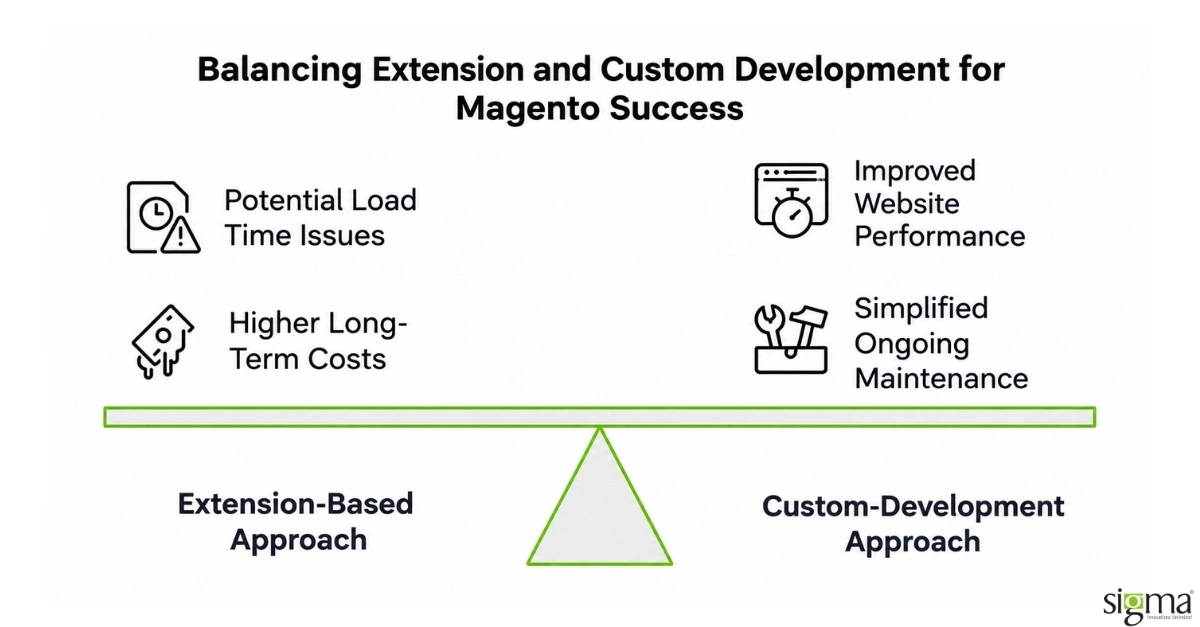
Most Magento engagements that go wrong on the extension question do not fail because the team chose badly once. They fail because there was never a process, so every request got a fresh, disconnected answer from whoever happened to own it that quarter. Sigma treats extension and custom-development decisions as an architecture question first and a procurement question second: every recommendation is checked against the store’s current codebase, existing modules, and upgrade roadmap before a build-or-buy call gets made, which is why the same request from two different clients can reasonably lead to different answers. On a Middle East-based electronics retailer’s Magento 2 platform, Sigma ran a full technical audit ahead of a version upgrade, then handled the SAP ERP and payment gateway integrations as scoped custom work rather than stitched-together extensions, producing a 60 percent improvement in website performance alongside the new functionality. For an Oceania-based retailer running duplicate Magento storefronts, Sigma consolidated the two into a single headless architecture and eliminated extensions that had accumulated across both instances rather than migrating every one of them forward, simplifying ongoing maintenance for the internal team.
That engagement addressed a single storefront’s extension footprint; a similar governance gap shows up at a larger scale when a business runs more than one Magento instance.
Both results came from the same underlying discipline: mapping what a storefront’s extensions and modules actually do before deciding what to rebuild or retire. The electronics retailer’s rebuild proved that discipline holds up under a full architecture change; the Oceania retailer’s consolidation proved it also works in reverse, removing modules a dual-storefront setup no longer needed. Extension decisions made without that mapping step tend to add complexity in one direction only.
How Sigma Infosolutions Manages Magento Extension Governance
Sigma Infosolutions approaches Magento extension management as part of ongoing platform governance rather than a one-time selection exercise. Sigma’s Magento team audits existing extension stacks, identifies performance-impacting or redundant extensions, and evaluates new extension additions against performance and compatibility criteria before installation. This approach prevents extension debt from accumulating between major platform reviews.
If your Magento extension stack has grown without a formal governance process and you are concerned about its impact on store performance or upgrade compatibility, speak with Sigma Infosolutions. Sigma’s Magento engineers can audit your current stack and recommend a structured extension management approach.
Conclusion
Magento extensions for eCommerce stores are not a risk in themselves; the absence of a decision process around them is. A store accumulates a fragile, unauditable stack one reasonable-seeming request at a time when there is no framework guiding whether to buy, build, or extend. The right first question is never which extension to install; it is whether the capability already exists somewhere in the current codebase. Buying suits standardized, common functionality where a vendor’s roadmap is an acceptable tradeoff for speed. Custom development earns its higher cost when the feature is close to the business’s competitive differentiation. Extending an existing, well-maintained module is often the cheapest path and the most overlooked. Any extension or custom code that does get added still needs a vendor and code audit before it reaches production, covering maintenance history, core-override behavior, and real performance impact. Skipping that audit rarely costs anything on installation day; the cost surfaces during the next platform upgrade or the next vendor who stops maintaining their module. Sigma applies this framework as part of its Magento development and architecture work, checking every recommendation against the store’s actual codebase rather than a generic comparison chart. The same discipline applies whether a team is adding its first handful of extensions to a new store or auditing a decade of accumulated ones on a mature platform. A retailer that governs extension decisions this way keeps its stack smaller, safer, and easier to hand off between engineering teams as the business grows.
Ready to simplify your Magento store?
Frequently Asked Questions
What is the difference between a Magento extension audit and a general code review?
A code review checks whether code meets internal quality standards. An extension audit specifically evaluates a third-party module’s maintenance history, vendor responsiveness, core-override behavior, and performance footprint before installation, since those factors determine long-term risk in ways a one-time code review of the finished store would not catch.
How do we decide whether to build a feature custom or buy an extension?
Buy when the functionality is standardized and common across many Magento stores. Build custom when the feature is close to what differentiates the business competitively, since a generic extension will either force a process change or need so much customization that its cost advantage disappears. Extend existing modules when the overlap allows it.
What should we check before installing a third-party Magento extension?
Check the vendor’s update history, changelog transparency, and support responsiveness; how the module modifies core Magento code, its actual database and front-end performance impact under realistic load, and whether its licensing terms match how long the store will run on its current platform version. Document the findings so the next team inherits the reasoning, not just the extension.
How many extensions is too many for a Magento store?
There is no fixed number; the real question is whether each installed extension is still needed, still maintained by its vendor, and documented so the current team understands why it exists. A smaller number of vetted, actively maintained extensions is safer than a larger number nobody has reviewed recently.
Does Sigma build custom Magento functionality or only implement extensions?
Both, depending on the audit outcome. Sigma evaluates each functionality request against the store’s existing codebase and roadmap, then recommends a vetted commercial extension, custom development, or extending an existing module, whichever produces the best long-term fit rather than defaulting to one approach as a matter of habit.