Why Returns and Exchange Pages Break Under Boxing Day Volume

Key Highlights:
- Post-sale return and exchange requests spike sharply in the days after Boxing Day, causing portal timeouts, incorrect refund states, support overload, and repeat-purchase loss.
- A broken returns experience does not just cost the price of handling one return; it costs the customer relationship, since a frustrating returns process is one of the fastest ways to lose a repeat buyer.
- A scalable self-service returns portal, AI-assisted classification, carrier integration with proactive tracking, automated refund orchestration, and real-time inventory sync that restores sellable stock quickly.
- Sigma builds or modernizes returns portals, integrates order management, ERP, and payment refund flows, and adds AI automation for classification and support.
Searches for boxing day deals reflect shoppers hunting discounts, but for the retailer who processed those sales, the real test arrives about a week later. UK post-Christmas returns reached an estimated £1.51 billion in value in early January 2025, up 6.8% year over year, with Royal Mail reporting returns volume up 52% on a typical day and a 554.7% jump on January 2 compared with Boxing Day itself.
Every one of those returns has to pass through the same sequence, request, classification, carrier pickup, refund or exchange, and inventory update, and a returns process built for an ordinary week finds out fast whether it can absorb that spike. This article maps where returns and exchange pages actually break under post-Boxing Day volume and the fixes that turn returns from a cost center into a retention advantage.
Why Do Returns Portals Fail During Sales?
Returns portals fail during high-volume periods for the same reasons any transactional system fails under load it was not built for: request volume exceeds the portal’s capacity, classification rules that worked fine for a trickle of returns create a bottleneck at scale, and refund or exchange processing that depends on manual review cannot keep pace once hundreds of requests arrive in the same week instead of spread across a month.
Also, read the blog : Preparing Your Ecommerce Site for the Boxing Day Traffic Surge: A Retailer’s Infrastructure Checklist
How Do You Scale an Ecommerce Returns Process?
Scaling an ecommerce returns process means treating each step of the flow, request, classification, carrier and tracking, refund or exchange, and inventory update, as its own capacity problem, rather than assuming that a portal which works at normal volume will simply absorb a spike.
| Returns step | Common failure point | Business fix |
|---|---|---|
| Return request | Portal timeouts and unclear eligibility | Scalable self-service portal with clear rules |
| Return classification | Manual triage and inconsistent decisions | AI-assisted classification and exception workflows |
| Carrier and tracking | Limited visibility and repeated support contacts | Carrier integration and proactive status updates |
| Refund or exchange | Incorrect refund state and delayed settlement | Automated refund orchestration and payment integration |
| Inventory update | Sellable stock not restored quickly | Real-time OMS, WMS, and marketplace synchronization |
How Can AI Automate Returns?
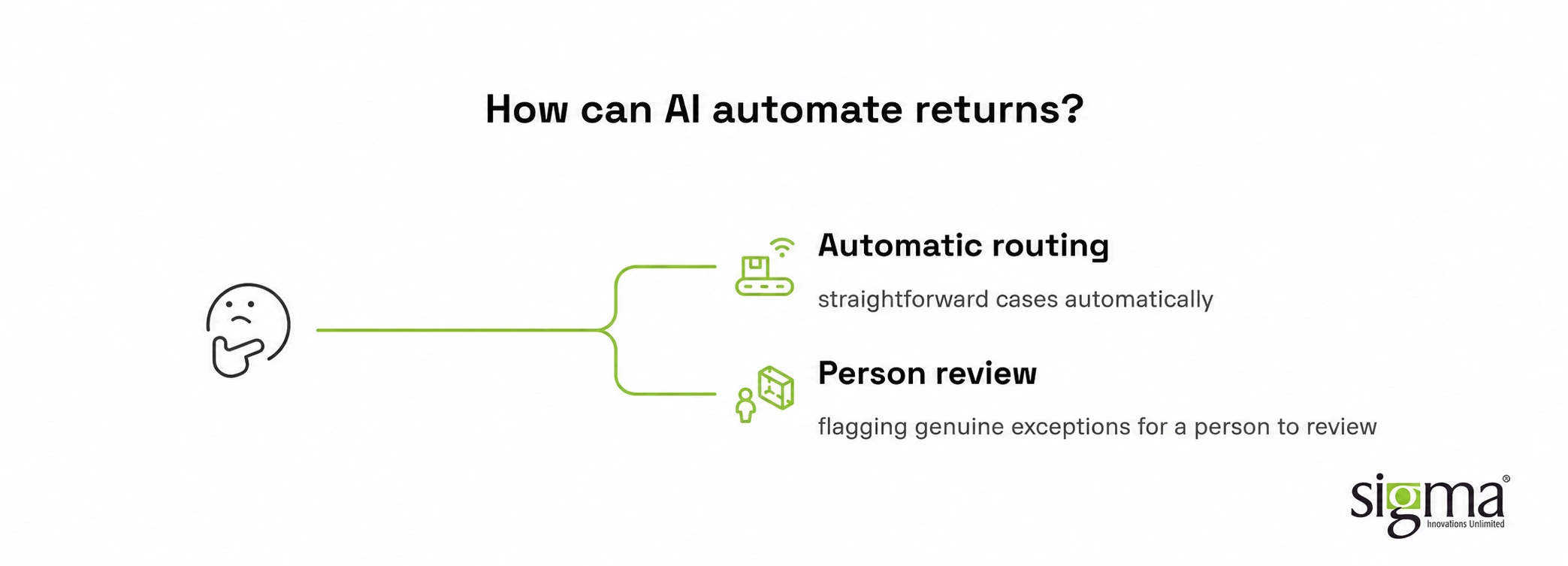
AI can automate the classification step that most often becomes a manual bottleneck, reviewing a return request against stated reason, product condition, and policy rules to route straightforward cases automatically while flagging genuine exceptions for a person to review. This does not remove human judgment from the process; it reserves that judgment for the cases that actually need it, instead of spending it on requests a rule could resolve instantly.
The same logic applies to the customer-facing side of returns, not just the back-office triage. A chatbot or self-service flow that can answer “where is my refund” or “is this item eligible for exchange” from live return-status data removes a large share of the support contacts that would otherwise queue up behind every other post-holiday request, freeing the support team to handle the exceptions that actually need a person.
Treating Returns as a Retention Lever, Not a Cost Center
A returns process measured only by cost per return optimizes for the wrong outcome. The customer standing at the return request step is deciding, in that moment, whether to buy from this retailer again, and a slow, confusing, or inaccurate returns experience answers that question before a support agent ever gets involved. A fast, accurate returns process, by contrast, is one of the more reliable ways to protect the lifetime value of a holiday-season customer who has already spent money once.
Why Fixing the Returns Page Without Fixing the Systems Behind It Backfires
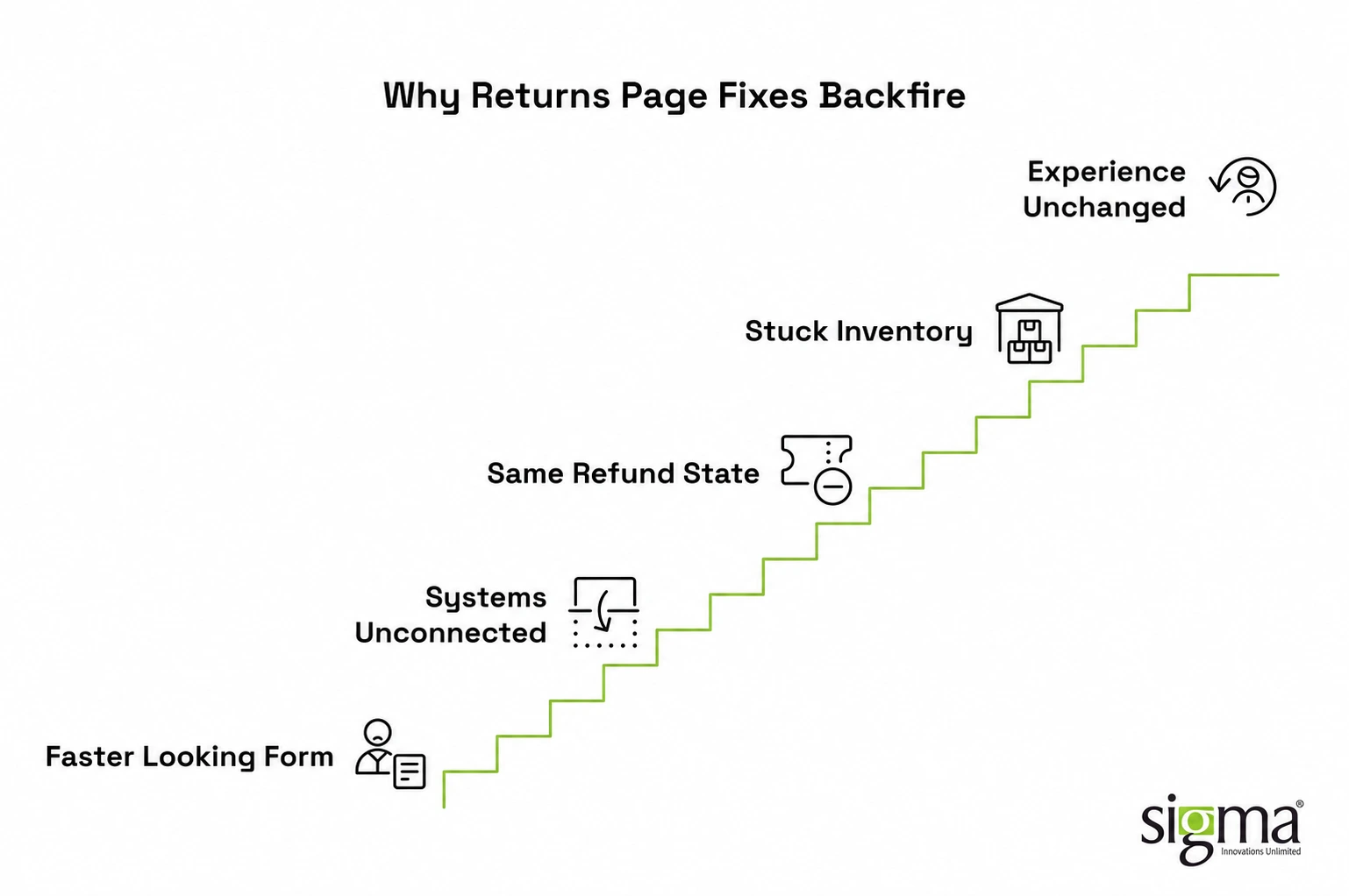
The most common mistake in returns-process improvement is redesigning the customer-facing return request page without fixing the order management, inventory, and refund systems behind it. A faster-looking request form still produces the same incorrect refund state and the same stuck inventory if the systems underneath were never connected to update together. The visible page gets better; the actual customer experience, “where is my refund,” “why does this still show as unavailable,” does not.
Sigma Infosolutions helped ExcelHealth, maker of the iReliev line of FDA-cleared electrotherapy devices, build an integrated ecommerce ecosystem on WooCommerce with NetSuite ERP integration, giving the retailer the kind of connected inventory and order data that keeps stock counts accurate as transactions move through the system rather than drifting out of sync. Gross sales increased 62% following the build, a result that reflects what a properly connected platform does for the whole customer journey, not just the storefront.
For a retailer or marketplace heading into the post-Boxing Day returns wave, the question is whether the returns portal, order management, and inventory systems are connected well enough to keep pace once request volume multiplies in a matter of days. Sigma can run a returns-flow audit as a defined engagement or stay engaged as the team behind the platform through peak season and beyond.
Conclusion
Boxing day deals search reflects shopper demand, but the retailer’s harder test arrives about a week later, when a share of those purchases come back as returns and exchanges all at once. Post-sale return requests spike sharply in the days after Boxing Day, and the failures that follow, portal timeouts, incorrect refund states, support overload, and repeat-purchase loss, trace back to specific, fixable points in the returns flow. A returns portal that cannot handle request volume creates the first bottleneck, and manual classification that works fine at low volume creates the second. Carrier and tracking visibility gaps generate repeated support contacts that a proactive status update would have prevented.
Refund or exchange processing that depends on manual review falls behind once volume multiplies, leaving customers with an incorrect refund state and no clear answer about when it will resolve. Inventory that does not update in real time keeps sellable stock locked up longer than it needs to be. None of these fixes matter much if a retailer treats the returns page as a cosmetic problem instead of a systems problem, since a faster-looking form built on the same disconnected backend produces the same frustrating experience underneath.
Redesigning the customer-facing return request page without fixing the order management and inventory systems behind it only moves the frustration from one screen to the next, since the refund state and stock count underneath never actually catch up. Retailers who treat returns as a retention lever, not a cost center, protect the repeat-purchase revenue that a bad returns experience would otherwise cost them. The returns wave into early January is predictable every year, concentrated into roughly a week rather than spread evenly across a month. The only real question is whether the systems behind that wave were ready before it arrived.
Frequently Asked Questions
Why do returns portals fail during sales?
Returns portals fail during high-volume periods because request volume exceeds portal capacity, classification rules built for a trickle of returns create a bottleneck at scale, and manual refund review cannot keep pace once hundreds of requests arrive in the same week instead of spread across a month.
How do you scale an ecommerce returns process?
Scaling an ecommerce returns process means treating each step, request, classification, carrier tracking, refund or exchange, and inventory update, as its own capacity problem. A portal that works at normal volume will not automatically absorb a post-holiday spike without each step being tested for it specifically.
How can AI automate returns?
AI can automate the classification step by reviewing a return request against stated reason, product condition, and policy rules, routing straightforward cases automatically while flagging genuine exceptions for a person to review. This reserves human judgment for the cases that actually need it instead of every request.
Why does the post-Boxing Day returns wave matter more than other return periods?
Post-Christmas returns concentrate into a short window right after the holiday, when UK data showed returns volume up sharply in a matter of days after Boxing Day, compressing a normal month’s worth of returns into roughly a week and leaving little time for a strained system to catch up gradually.
How do returns affect repeat-purchase behavior?
A customer’s returns experience shapes whether they buy from a retailer again, since a slow or confusing returns process signals how the retailer will treat them after the sale. A fast, accurate returns process protects the lifetime value of a holiday-season customer who already made at least one purchase.