AI eCommerce Search Is Replacing the Navigation Menu: What Retail Teams Need to Rethink

Key Highlights:
- Navigation menus built for smaller catalogs push high-intent shoppers into dead-end category paths as SKU counts grow.
- Treat AI-driven search as core storefront architecture, supported by structured product data and a decoupled serving layer.
- Shoppers reach relevant products through intent while category pages keep their crawlability and organic rankings.
- Sigma sequences the rebuild across catalog data, headless delivery, and SEO safeguards inside existing Magento and Shopify Plus stacks.
For a mid-market retailer with a few thousand SKUs, the main navigation menu has quietly stopped doing the job it was built for. AI eCommerce search now absorbs a growing share of product-finding behavior, yet most Magento and Shopify Plus storefronts still treat search as a box in the header and the category tree as the real architecture.
That inversion creates a structural problem rather than a relevance problem, because product data, page templates, URL strategy, and merchandising controls were all designed around browsing. Adding an AI search vendor on top of that foundation improves some queries and leaves the underlying architecture unchanged.
Make Your Storefront AI-Ready
Modernize your eCommerce architecture for smarter product discovery. Explore eCommerce Development Services
Why Is AI eCommerce Search Now a Structural Decision Rather Than a Feature Upgrade?
AI eCommerce search is a retrieval layer that interprets what a shopper means, maps that intent to structured product attributes, and ranks results using behavioral and commercial signals rather than literal keyword matches. Once search works at that level, it stops being a utility and becomes a primary entry point into the catalog, competing directly with the menu. Much of the early investment in AI in ecommerce went into recommendations and chatbots, while search was left on legacy keyword engines.
Shopper behavior already reflects the split. Baymard Institute‘s research insights suggest that roughly half of test participants prefer search as their product-finding strategy while the other half rely on the main navigation, and that 56% of benchmarked sites deliver mediocre or worse search experiences. For a store where half the sessions start in the search bar, an architecture optimized only for the other half leaves a large revenue channel underbuilt.
The implication for decision-makers is architectural. Search-led sessions depend on attribute coverage, index freshness, latency, and ranking logic. Navigation-led sessions depend on taxonomy, category templates, and crawlable URLs. When both share one product data model and one set of page templates designed for browsing, improvements to one layer frequently degrade the other.
Turn your search layer into the primary route to revenue with AI development services for eCommerce.
The Category Tree Was Designed for a Catalog You No Longer Have
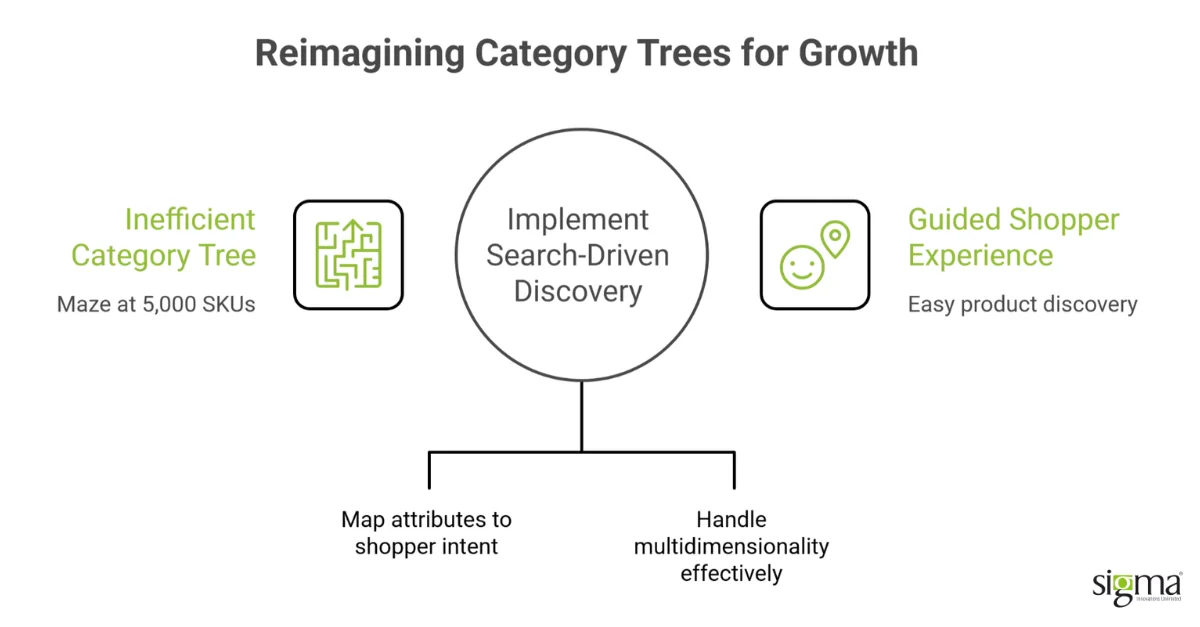
Most category trees at growth-stage retailers were designed when the catalog was a fraction of its current size. A structure that made sense at 300 SKUs, with six top-level categories and a dozen subcategories each, becomes a maze at 5,000 SKUs, where products legitimately belong in several places and shoppers think in use cases the tree was not designed to anticipate.
Merchandising teams usually respond by adding more menu depth, more mega-menu columns, and more manually maintained landing pages. Each addition increases maintenance cost and splits the same products across overlapping paths. A shopper looking for a waterproof trail shoe in a wide fit has to guess whether the answer sits under footwear, hiking, or a seasonal collection and then apply filters that may not exist for that branch of the tree.
The underlying constraint is that a tree forces every product into a single hierarchy, while shopper intent is multidimensional. Attributes such as use case, fit, compatibility, and occasion rarely map cleanly to one branch. Search-driven discovery handles that multidimensionality far better, which is why growth-stage teams on Magento and Shopify Plus increasingly find that the tree limits shoppers more than it guides them.
Read the blog: Recover high-intent shoppers lost to zero-result queries: Why eCommerce Search Fails Shoppers.
Where Search-First Architecture Breaks: Product Data, Crawlability, and Control
Moving discovery toward search exposes three dependencies that navigation-first stores can hide for years. Each one needs a design decision before a search vendor is selected, not after.
Product Data Becomes the Architecture
In a navigation-led store, category assignment carries much of the meaning. In a search-led store, attributes carry it. Product discovery AI can only rank what the catalog describes, so thin descriptions, inconsistent units, and missing use-case attributes surface directly as poor results. Retailers often discover that product data spread across an ERP, a PIM, and several storefront admins has to be consolidated into one governed model before any search investment pays back.
Crawlability Cannot Depend on the Search Box
Search engine crawlers do not type queries into a site search box. Category and listing pages remain the main route by which organic traffic reaches most catalogs, and Google’s documentation on faceted navigation recommends keeping crawlable listing pages and individual product pages while restricting low-value filter combinations.
A storefront that replaces category pages with JavaScript-rendered search results risks losing rankings that took years to build. The practical answer is a curated set of indexable, server-rendered collection pages, often powered by the same search engine, while long-tail filter states stay out of the index. For large Magento catalogs, index configuration matters.
Read the blog: How to Scale Magento for Back to School Traffic and High SKU Catalogs
Merchandisers Still Need Control
Ranking models in AI-powered search ecommerce deployments optimize toward signals such as conversion and relevance, but margin, stock depth, and campaign commitments require human override. Teams that hand ranking entirely to a model often find campaign products buried and brand agreements unmet. A workable design gives merchandisers pinning, boosting, and exclusion controls inside the same system, with visibility into why the model placed a result where it did.
Navigation-Led, Hybrid, or Search-Led: Choosing the Right Architecture
No single architecture suits every retailer. The right model depends on catalog size, query patterns, dependence on organic traffic, and the team’s capacity to govern product data over time.
| Criteria | Navigation-Led | Hybrid (Search-Augmented) | Search-Led |
| Typical fit | Small or browse-heavy catalogs | Mid-market catalogs with 500+ SKUs and meaningful organic traffic | Deep technical catalogs and repeat buyers with specific intent |
| Primary entry point | Menu and category tree | Menu for orientation, search for specific intent | Search bar and search-powered collections |
| Product data requirement | Accurate category assignment | Consistent core attributes across the catalog | Complete, governed attributes for every SKU |
| SEO exposure | Low, if category URLs are stable | Moderate, managed through indexable collection pages | High, unless crawlable pages are deliberately preserved |
| Merchandising model | Manual sorting and landing pages | Rules plus model ranking with overrides | Objective setting with guardrails on model ranking |
| Engineering effort | Low | Moderate, phased | High, usually requires a decoupled front end |
| Main risk | Shoppers fail to find products as the catalog grows | Two discovery paths drift out of sync | Organic rankings and merchandiser trust erode |
For most mid-market retailers in the US, Canada, and ANZ running Magento or Shopify Plus, the hybrid model is typically the appropriate starting point. It reserves the navigation menu for top-level orientation and seasonal campaigns, turns high-value category pages into search-powered collections that remain indexable, and lets ecommerce site search optimization handle long-tail and use-case queries. On Adobe Commerce, Magento AI search can sit alongside the native OpenSearch index rather than replacing it outright, which preserves a keyword fallback for exact and SKU queries.
A fully search-led storefront can make sense for catalogs with deep technical attributes or heavy repeat-purchase traffic, but it demands mature data governance and a deliberate SEO plan. Browse-heavy categories such as fashion, where shoppers seek inspiration more than specific items, often keep more navigation weight even after search matures.
Sequencing a Search-First Storefront So Rankings Survive the Transition
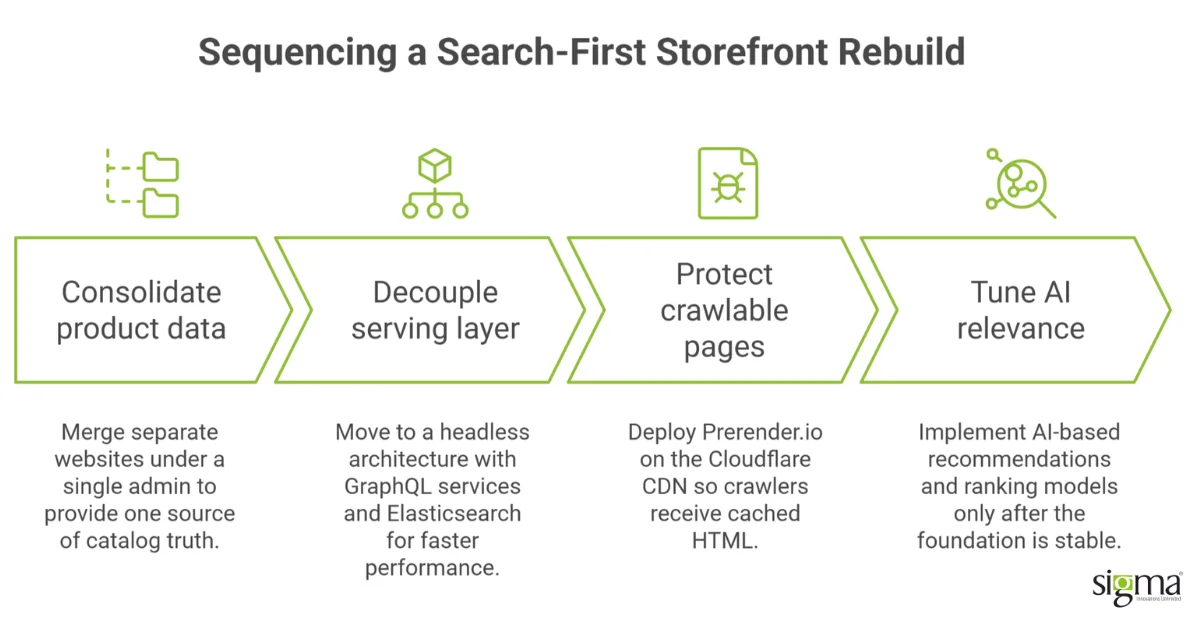
Whether a search-first rebuild succeeds depends less on which search engine a retailer selects and more on the order of operations. Sigma works through the rebuild in four stages: consolidate product data, decouple the serving layer, protect crawlable pages, and only then tune AI relevance and ranking. Reversing that order is a common reason search projects stall after the vendor demo.
Consolidation comes first because discovery cannot be better than its source data. An Oceania-based specialty retailer operating more than 120 stores ran two separate Magento websites, each with its own admin, so product and content data had to be entered twice. Sigma upgraded the platform from Magento 2.3.2 to 2.4.4 and merged both sites under a single admin before any front-end work began, giving discovery features one source of catalog truth.
The same engagement then moved the storefront to a headless Magento PWA with Strapi managing content, added Algolia-based AI recommendations, and deployed Prerender.io on the Cloudflare CDN so crawlers received cached HTML from the JavaScript front end. The retailer gained faster page loads, content updates without code changes, and a decoupled front end that did not sacrifice search engine visibility.
The serving layer becomes the next constraint when the catalog itself changes daily. A storefront that reindexes slowly or redeploys with downtime undermines search relevance regardless of how capable the ranking model is, because shoppers see stale or missing products.
For a Germany-based multi-seller marketplace where new products and categories are added every day, Sigma rebuilt the storefront as a Magento PWA backed by GraphQL services and an Elasticsearch index, with Kubernetes-based CI/CD for zero-downtime deployments and rollback. The storefront reached Google PageSpeed scores above 90, giving the discovery layer the speed and release stability that a constantly growing catalog requires.
With data consolidated, the serving layer decoupled, and indexable collection pages protected, AI relevance work such as intent-aware query handling and merchandiser-governed ranking can be introduced incrementally and measured against search conversion. Sigma typically delivers this through a dedicated engineering team or a long-term partnership, so the search layer keeps improving after launch instead of stalling at go-live.
Modernize Magento Without Losing Search Visibility
Upgrade, decouple, and scale Magento storefronts while keeping performance and crawlability intact.
Explore Magento Development Services
Conclusion
The navigation menu remains useful, but it no longer carries product discovery on its own for mid-market retailers with growing catalogs. AI eCommerce search has become an equal entry point, which turns it from a feature decision into an architectural one. Category trees designed for smaller catalogs struggle with multidimensional shopper intent and add maintenance cost with every new branch.
Moving discovery toward search exposes three dependencies: governed product data, crawlable listing pages, and merchandiser control over ranking. Product data effectively becomes the architecture, because AI can only rank what the catalog describes. Organic visibility depends on keeping indexable collection pages rather than replacing them with search-only experiences.
Merchandising teams still need the ability to pin, boost, and exclude products when commercial priorities differ from model preferences. For most Magento and Shopify Plus retailers with 500 or more SKUs, a hybrid architecture is the practical starting point. Fully search-led storefronts suit specific catalog profiles and require mature data governance. The order of operations matters more than the choice of search vendor, starting with data consolidation and a decoupled serving layer. Retailers that sequence the rebuild deliberately can let search lead discovery without giving up rankings, speed, or commercial control.
Build AI-Powered Discovery Into Your Commerce Stack
Turn product data, shopper intent, and ranking signals into practical AI capabilities built around your existing commerce architecture.
Explore Artificial Intelligence Development Services
Frequently Asked Questions
What is AI eCommerce search, and how does it differ from keyword site search?
AI eCommerce search interprets the intent behind a shopper’s query, maps it to structured product attributes, and ranks results using behavioral and commercial signals. Keyword site search matches literal text in product titles and descriptions. The difference matters most for use-case and descriptive queries, where shoppers describe a need rather than naming a specific product or brand.
What happens to category pages when a storefront becomes search-first?
High-value category pages usually stay, but their role changes. They become curated, indexable collection pages, often powered by the same search engine, that serve organic traffic and campaign landing needs. Long-tail filter combinations can remain out of the index. Removing category pages entirely risks losing organic rankings, since crawlers cannot reach products through a site search box.
How much product data work is needed before implementing AI search on Magento or Shopify Plus?
The effort depends on attribute coverage and how many systems hold product data. Retailers with catalogs spread across an ERP, a PIM, and multiple storefront admins typically need consolidation first. Use case, fit, compatibility, and material attributes matter most, because AI search can only rank products on attributes the catalog actually contains and keeps current.
When does a hybrid navigation and search architecture make more sense than a search-led one?
A hybrid model suits most mid-market retailers with meaningful organic traffic, browse-heavy categories, or limited data governance capacity. It keeps navigation for orientation and campaigns while search handles long-tail intent. A search-led design fits catalogs with deep technical attributes or repeat buyers who know what they want, provided data quality and SEO planning are mature.
How do merchandisers keep control when AI ranks search results?
Effective implementations give merchandisers pinning, boosting, and exclusion rules that override model ranking for campaign products, margin priorities, or brand commitments. Ranking dashboards should show why a product appears where it does. Without these controls, models optimize toward conversion alone, which can bury strategic products and create friction between merchandising teams and the engineering roadmap.