Top 4 Magento Extensions to Boost Sales

Key Highlights:
- Adding Magento extensions to boost sales without a plan for measuring the result leaves leadership unable to tell which investments actually paid off and which just added complexity.
- Isolating a single extension’s conversion effect through a controlled before-and-after comparison against a stable baseline turns a feature launch into an evidence-backed business decision.
- Focusing evaluation on the functional categories most consistently tied to conversion, checkout friction, search relevance, and personalization concentrates effort where the return is most likely to show up.
- Sigma builds measurement into the same engagement as the functionality itself, so a conversion claim is backed by data from the store’s own traffic rather than a vendor’s marketing page.
Introduction:
The question “which extensions boost sales” gets asked constantly and answered badly just as often, usually with a list of products rather than a way to know whether any of them worked. Magento extensions to boost sales are only worth adding when their conversion effect can actually be measured against a baseline, isolated from seasonal noise, traffic shifts, and everything else changing in the store at the same time. This post sets out which functional categories most consistently move conversion metrics on a Magento store, and the measurement discipline needed to know, after installation, whether a given investment actually earned its keep. That discipline matters as much as the functionality itself, since a business that cannot say which past investments worked has no reliable way to prioritize the next one either.
Turn Magento Extensions Into Measurable Growth
Get expert Magento development services to optimize extensions, performance, and conversions.
Which Functional Categories Actually Move Conversion
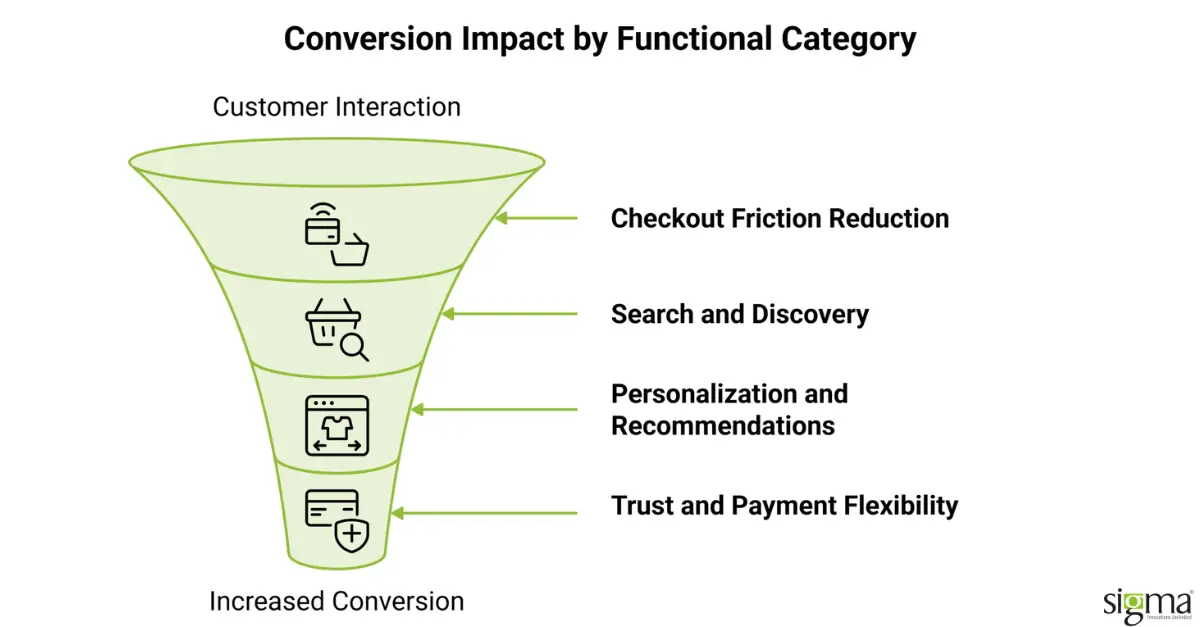
Not every category of functionality has an equal claim on conversion impact, and treating them as interchangeable is how measurement budgets get spread too thin to prove anything. A team that tries to measure everything at once usually ends up measuring nothing well, since each additional variable under observation makes it harder to attribute any single conversion change to a specific cause. Checkout friction reduction, fewer steps, saved payment methods, and clearer shipping cost visibility earlier in the flow have one of the most direct and well-documented paths to conversion, because it acts at the exact moment a customer is deciding whether to complete a purchase. Search and product discovery improvements matter most for stores with large or complex catalogs, where a customer who cannot find a relevant product within the first few results is far more likely to leave than to keep browsing. Personalization and recommendation functionality, cross-sell and related-product surfacing at the right point in the journey, can move average order value meaningfully, but only when it is genuinely relevant to what the customer is already looking at, since irrelevant recommendations tend to be ignored rather than actively harmful. Trust and payment-flexibility functionality, visible security signals, multiple payment options, and transparent return policies tend to matter most for first-time visitors deciding whether to trust an unfamiliar store at all.
Magento Extension Categories, Their Typical Conversion Lever, and How to Measure Them
| Functional Category | Typical Conversion Lever | How to Measure the Effect |
|---|---|---|
| Checkout friction reduction | Fewer abandoned carts at the payment step | Cart-to-purchase conversion rate, before and after, on comparable traffic |
| Search and product discovery | Fewer zero-result and abandoned searches | Search-to-product-view rate and search abandonment rate |
| Personalization and recommendations | Higher average order value through relevant cross-sell | Attach rate and average order value on sessions that engage with recommendations |
| Trust and payment flexibility | Higher first-time visitor conversion | New-visitor conversion rate segmented from returning-visitor conversion rate |
The categories with the clearest measurement path, checkout and search, are usually the ones worth prioritizing first, precisely because their effect is easiest to isolate. Personalization and trust functionality still matter, but their conversion signal is noisier and takes longer to separate from other variables, which is a reason to sequence them carefully rather than to skip them. Sequencing checkout and search first also builds internal confidence in the measurement process itself, which makes it easier to defend a more patient, longer measurement window for personalization once the team gets to it.
How to Measure Conversion Impact After Installation, Not Just Assume It
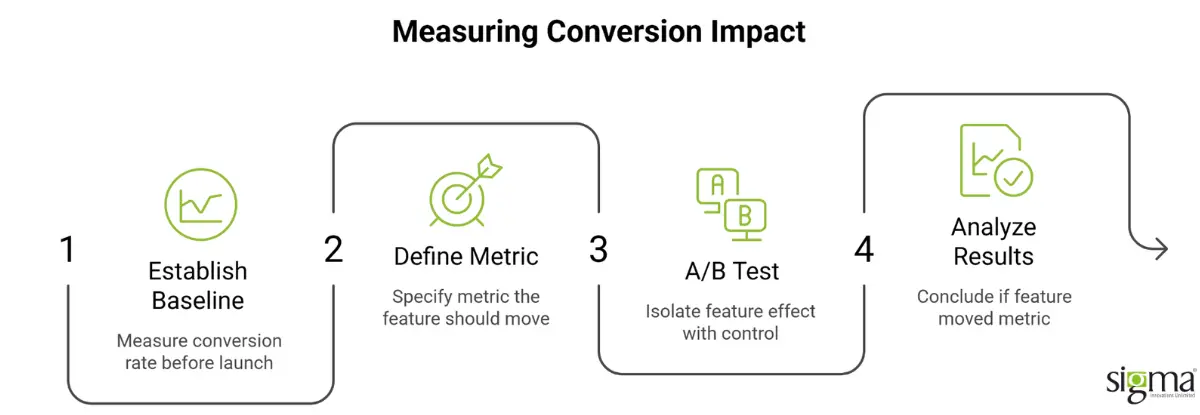
A defensible measurement approach starts before the new functionality goes live, not after. That means establishing a stable baseline conversion rate over a representative period, ideally excluding major promotions or seasonal spikes that would distort the comparison, and defining in advance which specific metric the new functionality is expected to move- cart-to-purchase rate for a checkout change, search-to-product-view rate for a discovery improvement- rather than watching overall revenue and attributing any change to the new feature. Where traffic volume supports it, an A/B test against a held-back control group isolates the effect far more reliably than a simple before-and-after comparison, since it controls for the seasonal and traffic-mix changes that a before-and-after comparison cannot separate. Even a modest test, run on a subset of traffic large enough to reach statistical significance within a few weeks, produces a far more defensible answer than a company-wide rollout followed by a hopeful glance at the monthly revenue dashboard. Where volume does not support a clean A/B split, a longer observation window with clear documentation of what else changed on the store during that period is the more honest alternative to a false-precision claim.
The discipline that matters most is being willing to conclude that a given piece of functionality did not move the metric it was meant to move. Extensions and custom features that do not clear this bar are candidates for removal, both because unused functionality accumulates as maintenance overhead and because a store’s extension stack should reflect what is actually contributing to the business. That same build-buy-vet framework is worth applying retroactively too, since a feature that once justified its cost through strong conversion performance can stop earning that place on the platform once traffic patterns, competitors, or the product catalog shift underneath it.
Sigma Measures Conversion Impact as Part of the Engagement, Not After the Fact
Most functionality projects treat measurement as an afterthought, something to check on later if anyone remembers, which is exactly why so many teams cannot say with confidence which past investments actually worked. By the time anyone gets around to asking, the baseline data needed to answer the question honestly is usually long gone, replaced by memory and whichever anecdote happens to be most convenient. Sigma builds the measurement plan into the same engagement as the functionality itself, defining the target metric and baseline before development starts so the result is never in question after launch. On a Magento 2.3.5 Commerce Cloud engagement for ChessBazaar, Sigma implemented custom cross-sell functionality, an Algolia-powered image search for product discovery, and a product recommendation engine, changes concentrated in exactly the checkout, search, and personalization categories with the clearest measurement path, producing an 82 percent increase in sales and a 61 percent increase in orders.
Read our success story: Cross-sell, search, and recommendation improvements produced measurable conversion gains for a specialty retailer after a structured extension audit.
That engagement targeted personalization and discovery specifically; the trust and checkout-friction categories show up just as clearly in a separate retail engagement.
Both results came from treating extension selection as a conversion decision, not a feature checklist. The specialty retailer’s cross-sell and search improvements moved measurable conversion metrics after a structured audit; the Dubai retailer’s custom search and checkout functionality met regional requirements no off-the-shelf extension could satisfy. The common thread is fit to the specific storefront, not the length of the extension list.
Read our success story: Custom search and checkout functionality built for a Dubai-based retailer met strict regional requirements without template-based shortcuts.
How Sigma Infosolutions Evaluates Magento Sales Extensions
Sigma Infosolutions evaluates Magento extension investments by tying the selection criteria to measurable conversion outcomes rather than feature lists. Sigma’s Magento team assesses whether a proposed extension addresses the specific drop-off point in the buyer journey that is suppressing conversion, and whether the performance cost of adding the extension is justified by the expected lift.
Not every conversion-focused extension delivers a measurable lift, and some introduce performance overhead that offsets any gains. The decision to add an extension should be preceded by identifying the specific drop-off point it is meant to address, rather than treating a feature list as a proxy for conversion impact.
If you are evaluating Magento extensions to improve conversion and want a framework for identifying which ones are likely to produce measurable results for your store, speak with Sigma Infosolutions. Sigma’s Magento engineers can assess your current conversion funnel and recommend extensions matched to your actual bottlenecks.
For eCommerce directors, VPs of digital, and heads of growth evaluating Magento extensions to boost sales, the key trade-off is between conversion gain and implementation complexity. An extension that adds meaningful checkout friction reduction or search improvement typically requires real engineering time to configure correctly for a specific catalog and traffic profile, it is not a one-click install with guaranteed results. The limitation of treating extension selection as a feature checklist exercise is that it ignores this configuration cost entirely. Extensions chosen on the basis of a feature list but installed without proper baseline measurement and testing infrastructure create technical debt without a measurable return.
Sigma Infosolutions works with Magento merchants as a long-term partner on extension strategy, building measurement frameworks alongside the functionality so that every investment is evaluated against real conversion data rather than assumed to work. If your team is evaluating Magento extensions to boost sales and wants a partner who will own both the implementation and the measurement, speak with Sigma’s Magento commerce team.
Conclusion:
Magento extensions to boost sales are only a meaningful investment when their conversion effect can actually be measured, not assumed from a feature list or a vendor’s claims. Checkout friction reduction and search or product discovery improvements carry the clearest, most reliably measurable conversion path of the functional categories available. Personalization and trust-building functionality matter too, but their signal takes longer to isolate from other variables on the store. A defensible measurement approach establishes a stable baseline before launch and defines the target metric in advance, rather than watching overall revenue and guessing at the cause. An A/B test against a held-back control group isolates a functionality’s effect more reliably than a simple before-and-after comparison whenever traffic volume supports it. Where traffic does not support a clean split, a longer observation window with documented concurrent changes is the more honest alternative. Extensions and features that consistently fail to move their intended metric are legitimate candidates for removal, since unused functionality is still a maintenance cost. Average order value, not overall conversion rate, is usually the more direct metric for personalization functionality specifically. This measurement discipline connects directly to how a store should evaluate and vet new functionality before it is added, not only after. Sigma builds this measurement plan into the same engagement as the functionality itself, so results are never in question after launch. A retailer that treats conversion measurement as part of the build, not an afterthought, can defend every functionality investment with its own data rather than a generic industry claim.
Make Every Store Investment Count
Frequently Asked Questions
Which Magento extension categories have the most reliable conversion impact?
Checkout friction reduction and search or product discovery improvements tend to have the clearest, most measurable conversion path, since they act at moments customers are actively deciding to buy or find a product. Personalization and trust functionality also matter, but their effect is harder to isolate cleanly.
How do we measure whether a new extension actually increased conversion?
Establish a stable baseline conversion rate over a representative period before launch, define the specific metric the functionality should move, and compare before-and-after or, ideally, run an A/B test against a held-back control group to isolate the effect from seasonal and traffic changes. Document anything else that changed on the store during the same window.
Should we remove extensions that don’t clearly move a conversion metric?
Extensions that consistently fail to move their intended metric are strong candidates for removal, since unused functionality adds maintenance overhead without a measurable return. Confirm the measurement window was long and clean enough to trust before removing anything based on early results, and rule out concurrent changes that could have masked the actual effect.
Is average order value or conversion rate the better metric for personalization features?
Average order value, specifically attach rate on sessions that engage with recommendations, is usually the more direct metric for personalization functionality, since its primary effect is on what customers add to an existing purchase rather than whether they purchase at all. Overall conversion rate can still move, but treat it as a secondary signal.
How long should we measure before concluding an extension worked or didn’t?
Long enough to cover a full representative traffic cycle and avoid drawing conclusions from a single promotional spike or slow week, typically several weeks at minimum. Document any other changes made to the store during that window so the result can be attributed with confidence.